
Sign up to save your podcasts
Or



On this live, I spoke with cult and mind-control expert Dr. Stephen Hassan about how coercive influence works, why intelligence does not make people immune, and how to engage loved ones with empathy rather than ridicule. Dr. Hassan also discusses the BITE Model, digital manipulation and surveillance, practical reality-testing, and the role of trust networks in resisting misinformation.
Friends, if you appreciate my voice and the conversations you hear on Freedom Over Fascism, I hope you’ll pitch in to help me continue this work. Please consider becoming a paid subscriber now. You can also leave a one-time donation in any amount. Thank you.
Key Topics
Dr. Hassan explains how vulnerability, social influence and information silos can draw people into high-control groups, regardless of intelligence or education.
He recommends respectful curiosity, active listening and reconnecting people with their pre-radicalization identity instead of insulting or confronting them with facts alone.
Dr. Hassan describes the BITE Model: behavior, information, thought and emotional control, and its use in assessing authoritarian influence across political, religious, commercial and personal settings.
The conversation links attention-capturing digital media and doomscrolling with trance-like states that can reduce critical scrutiny.
Dr. Hassan urges people to interrupt constant media reinforcement, spend time offline and use independent sources to reality-test claims.
Dr. Hassan suggests forming a trust pod - a group of people with different expertise who check one another’s claims - can help assess health, news and online content before sharing or acting on it.
Dr. Hassan advocates a scientist mindset: separate beliefs from ego, test hypotheses and revise conclusions when better evidence appears.
We discuss privacy and secure communication, including Dr. Hassan’s use of Signal and Proton Mail for sensitive matters.
Dr. Hassan argues for public education about coercive influence, training for professionals and supportive exit ramps for people leaving high-control groups.
The closing message centers on empathy, community and hope: Hassan’s mantra is that love is stronger than mind control.
Chapters
00:00 Meet cult and mind-control expert Dr. Stephen Hassan
02:59 Why facts alone can deepen commitment
06:34 Hassan’s recruitment into the Moonies and his exit
10:04 How predators target universal human needs
11:14 Lifton’s criteria and the political use of influence
18:36 The BITE Model: behavior, information, thought and emotion
21:12 Trance states, doomscrolling and digital manipulation
24:28 Social platforms, radicalization and reaching audiences
30:48 How to have a truth-seeking conversation with family
33:17 Privacy tools, surveillance and protecting sensitive messages
38:26 Build a trust pod and verify before sharing
42:23 Think Again: separating beliefs from ego
48:10 Seven generations, planetary survival and big ideas
51:13 Education, professional training and exit ramps
54:06 Hassan’s books and resources for understanding cults
56:17 How to reconnect with someone who has been radicalized
59:01 Hope, empathy and why love is stronger than mind control
resources
**While my articles come straight out of my brain onto the page, show notes are generated with the help of AI.
Thank you NeuroDivergent Hodgepodge, Soso’s World, Deborah J., roberta, Teralex 🌊🌊, and many others for tuning into my live video with Dr. Steven Hassan! Join me for my next live video in the app.
Thanks for reading Freedom Over Fascism! This post is public so feel free to share it.
On this live, I spoke with cult and mind-control expert Dr. Stephen Hassan about how coercive influence works, why intelligence does not make people immune, and how to engage loved ones with empathy rather than ridicule. Dr. Hassan also discusses the BITE Model, digital manipulation and surveillance, practical reality-testing, and the role of trust networks in resisting misinformation.
My purpose is to help people understand how power works in the world, how we can make radical change, and how we need to come together to build the society we want to see. If you like hearing from me and my guests, please subscribe. And if you can afford it, a paid subscription will help me support my family.
Key Topics
Dr. Hassan explains how vulnerability, social influence and information silos can draw people into high-control groups, regardless of intelligence or education.
He recommends respectful curiosity, active listening and reconnecting people with their pre-radicalization identity instead of insulting or confronting them with facts alone.
Dr. Hassan describes the BITE Model: behavior, information, thought and emotional control, and its use in assessing authoritarian influence across political, religious, commercial and personal settings.
The conversation links attention-capturing digital media and doomscrolling with trance-like states that can reduce critical scrutiny.
Dr. Hassan urges people to interrupt constant media reinforcement, spend time offline and use independent sources to reality-test claims.
Dr. Hassan suggests forming a trust pod - a group of people with different expertise who check one another’s claims - can help assess health, news and online content before sharing or acting on it.
Dr. Hassan advocates a scientist mindset: separate beliefs from ego, test hypotheses and revise conclusions when better evidence appears.
We discuss privacy and secure communication, including Dr. Hassan’s use of Signal and Proton Mail for sensitive matters.
Dr. Hassan argues for public education about coercive influence, training for professionals and supportive exit ramps for people leaving high-control groups.
The closing message centers on empathy, community and hope: Hassan’s mantra is that love is stronger than mind control.
Chapters
00:00 Meet cult and mind-control expert Dr. Stephen Hassan
02:59 Why facts alone can deepen commitment
06:34 Hassan’s recruitment into the Moonies and his exit
10:04 How predators target universal human needs
11:14 Lifton’s criteria and the political use of influence
18:36 The BITE Model: behavior, information, thought and emotion
21:12 Trance states, doomscrolling and digital manipulation
24:28 Social platforms, radicalization and reaching audiences
30:48 How to have a truth-seeking conversation with family
33:17 Privacy tools, surveillance and protecting sensitive messages
38:26 Build a trust pod and verify before sharing
42:23 Think Again: separating beliefs from ego
48:10 Seven generations, planetary survival and big ideas
51:13 Education, professional training and exit ramps
54:06 Hassan’s books and resources for understanding cults
56:17 How to reconnect with someone who has been radicalized
59:01 Hope, empathy and why love is stronger than mind control
resources
**While my articles come straight out of my brain onto the page, show notes are generated with the help of AI.
Thank you NeuroDivergent Hodgepodge, Soso's World, Deborah J., roberta, Teralex 🌊🌊, and many others for tuning into my live video with Dr. Steven Hassan! Join me for my next live video in the app.
Thanks for reading Freedom Over Fascism! This post is public so feel free to share it.
Be sure to download this to your favorite podcast app to listen to this episode later.
Feelings Over Facts: Why an emotions-first narrative strategy matters
I sat down with Dr. Jiggy Geronimo and Kate Catherall to unpack their report, Feelings Over Facts, and why political communication can fall short when it assumes people are persuaded by logic alone. They argue that effective messaging starts with values, emotion, and social proof—not fact dumps and poll-tested boilerplate.In this conversation, they break down how the right frames stories through fear, identity, and vivid villains, while the left often responds with explanations, statistics, and “well actually” corrections. They also discuss why culture is upstream of politics, why storytelling needs to be concrete and vivid, and why people change their minds more readily when it feels psychologically safe to do so. Feelings Over Facts is in partnership with Innovating for the Public Good.
Freedom Over Fascism is a labor of love. There are no paywalls, but I need to keep a roof over my head. Please subscribe either free or paid, since even free subs help the algorithm.
In this episode:
Dr. Jiggy Geronimo explains how emotional responses influence decision-making.
Kate Catherall shares:
Message testing can reward the least-offensive message, which may not be the one that mobilizes people.
They discuss:
The “well actually” trap—responding to emotional narratives with facts and corrections instead of offering a compelling alternative story.
They explain:
How political narratives use villains, values, and emotion to galvanize people.
They explore:
How to make broad issues tangible through cost of living, data centers, surveillance, and corruption.
They emphasize:
Images, messengers, audio, and other signals matter alongside the words in a story.
They argue:
Culture is upstream of politics, and creative voices need room to bring strategic ideas to life.
They highlight:
Social proof can help people feel that taking action—or changing their minds—is safe and shared.
They discuss:
Why shaming people or purity-testing newcomers can make persuasion and coalition-building harder.
They conclude:
Authenticity and shared values can matter more than agreeing on every single issue.
Timestamps
00:00 — Welcome and an introduction to Feelings Over Facts02:24 — Jiggy’s neuroscience background and how emotions shape decisions04:50 — Kate’s path from organizing to research and message testing08:42 — Why emotional resonance can beat policy language09:12 — The “well actually” trap and the critical race theory example12:45 — Why counter-messaging needs a new story, not just a debate14:42 — How political narratives shape events around a villain17:06 — Building a narrative with a hero, problem, villain, and solution18:55 — Why cost of living can be more relatable than abstract economic language21:56 — Making economic inequality feel concrete24:44 — Data centers, surveillance, and corruption as tangible entry points28:20 — Journalism’s role in surfacing stories and building narratives30:33 — Why images, messengers, and other signals matter34:13 — How culture shapes politics—and why creatives need room to work36:01 — Polling, consulting incentives, and resistance to change39:16 — Motivated reasoning and why people resist conflicting information42:03 — Long-term planning and the pressure for immediate results45:24 — Values-driven action and the creation of social proof47:50 — What social proof is and why people look to their communities50:29 — Showing that people from many backgrounds are taking action51:23 — How trusted messengers can make change feel possible52:54 — Why shaming people can make persuasion harder55:39 — Humanizing people and living your values57:29 — Purity testing and disagreement within movements58:28 — Why authenticity and shared values matter59:07 — The closing takeaway: feelings and authenticity move people60:01 — Where to find the guests and read the report
Show notes created with the assistance of Riverside.
Thank you Nick Paro, Amy Gabrielle, Noble Blend, Jai Porter 🇨🇦, julie elder, and many others for tuning into my live video with Kate Catherall and Jiggy Geronimo! Join me for my next live video in the app.
I sat down with Dr. Jiggy Geronimo and Kate Catherall to unpack their report, Feelings Over Facts, and why political communication can fall short when it assumes people are persuaded by logic alone. They argue that effective messaging starts with values, emotion, and social proof—not fact dumps and poll-tested boilerplate.In this conversation, they break down how the right frames stories through fear, identity, and vivid villains, while the left often responds with explanations, statistics, and “well actually” corrections. They also discuss why culture is upstream of politics, why storytelling needs to be concrete and vivid, and why people change their minds more readily when it feels psychologically safe to do so. Feelings Over Facts is in partnership with Innovating for the Public Good.
Feelings Over Facts: Why an emotions-first narrative strategy matters
I sat down with Dr. Jiggy Geronimo and Kate Catherall to unpack their report, Feelings Over Facts, and why political communication can fall short when it assumes people are persuaded by logic alone. They argue that effective messaging starts with values, emotion, and social proof—not fact dumps and poll-tested boilerplate.In this conversation, they break down how the right frames stories through fear, identity, and vivid villains, while the left often responds with explanations, statistics, and “well actually” corrections. They also discuss why culture is upstream of politics, why storytelling needs to be concrete and vivid, and why people change their minds more readily when it feels psychologically safe to do so. Feelings Over Facts is in partnership with Innovating for the Public Good.
Freedom Over Fascism is a labor of love. There are no paywalls, but I need to keep a roof over my head. Please subscribe either free or paid, since even free subs help the algorithm.
In this episode:
Dr. Jiggy Geronimo explains how emotional responses influence decision-making.
Kate Catherall shares:
Message testing can reward the least-offensive message, which may not be the one that mobilizes people.
They discuss:
The “well actually” trap—responding to emotional narratives with facts and corrections instead of offering a compelling alternative story.
They explain:
How political narratives use villains, values, and emotion to galvanize people.
They explore:
How to make broad issues tangible through cost of living, data centers, surveillance, and corruption.
They emphasize:
Images, messengers, audio, and other signals matter alongside the words in a story.
They argue:
Culture is upstream of politics, and creative voices need room to bring strategic ideas to life.
They highlight:
Social proof can help people feel that taking action—or changing their minds—is safe and shared.
They discuss:
Why shaming people or purity-testing newcomers can make persuasion and coalition-building harder.
They conclude:
Authenticity and shared values can matter more than agreeing on every single issue.
Timestamps
00:00 — Welcome and an introduction to Feelings Over Facts02:24 — Jiggy’s neuroscience background and how emotions shape decisions04:50 — Kate’s path from organizing to research and message testing08:42 — Why emotional resonance can beat policy language09:12 — The “well actually” trap and the critical race theory example12:45 — Why counter-messaging needs a new story, not just a debate14:42 — How political narratives shape events around a villain17:06 — Building a narrative with a hero, problem, villain, and solution18:55 — Why cost of living can be more relatable than abstract economic language21:56 — Making economic inequality feel concrete24:44 — Data centers, surveillance, and corruption as tangible entry points28:20 — Journalism’s role in surfacing stories and building narratives30:33 — Why images, messengers, and other signals matter34:13 — How culture shapes politics—and why creatives need room to work36:01 — Polling, consulting incentives, and resistance to change39:16 — Motivated reasoning and why people resist conflicting information42:03 — Long-term planning and the pressure for immediate results45:24 — Values-driven action and the creation of social proof47:50 — What social proof is and why people look to their communities50:29 — Showing that people from many backgrounds are taking action51:23 — How trusted messengers can make change feel possible52:54 — Why shaming people can make persuasion harder55:39 — Humanizing people and living your values57:29 — Purity testing and disagreement within movements58:28 — Why authenticity and shared values matter59:07 — The closing takeaway: feelings and authenticity move people60:01 — Where to find the guests and read the report
Show notes created with the assistance of Riverside.
Thank you Nick Paro, Amy Gabrielle, Noble Blend, Jai Porter 🇨🇦, julie elder, and many others for tuning into my live video with Kate Catherall and Jiggy Geronimo! Join me for my next live video in the app.
In this Freedom Over Fascism Fireside Chat, I talk with Michele Hornish, co-founder and executive director of Every State Blue, about why it matters to run candidates in every district—including the reddest and most overlooked ones. Michele explains how Every State Blue supports state legislative candidates, why down-ballot races can help build broader political power, and how small actions can make a difference over time.
Key conceptsHi Friends,
Before I give you the show notes, a word about AI. I use AI to create show notes, but everything else comes straight from my head to the page.
I’m happy to be back with weekly (and more) conversations. If you find these valuable, please subscribe…either paid or free. I’d love to be able to do this full time, but I completely understand how thin everyone is stretched with subscriptions. I don’t use paywalls.
Why Every State Strategy Matters for Democrats in Red Districts
In this Freedom Over Fascism Fireside Chat, I talk with Michele Hornish, co-founder and executive director of Every State Blue, about why it matters to run candidates in every district—including the reddest and most overlooked ones. Michele explains how Every State Blue supports state legislative candidates, why down-ballot races can help build broader political power, and how small actions can make a difference over time.
Key concepts
* Every State Blue funds Democratic candidates in under-resourced state legislative districts through state projects and the national First In Line effort.
* Running candidates everywhere can help build local political infrastructure, even when a district is not immediately competitive.
* Candidates in uncontested districts can hold elected officials accountable, connect with neighbors, recruit volunteers, register voters, and learn what matters in their communities.
* Michele describes research indicating that running a candidate in a previously uncontested district can increase vote share for the top of the ticket by 1.5 percent.
* Funding candidates for practical needs—such as gas, yard signs, websites, and campaign materials—can help them organize and present themselves professionally.
* Every State Blue prioritizes candidates who have raised the least, directing support to those with the fewest resources.
* The discussion revisits Howard Dean’s 50-state strategy and the importance of building political infrastructure beyond competitive races.
* Uncontested and underfunded races exist in blue states as well as red states.
* Long-term political power is built through consistent organizing across election cycles, not only through short-term campaigns.
* People can help by sharing candidates’ posts, voting early, talking with friends and neighbors about voting, and supporting local races with small donations.
* Michele shares examples from Missouri, Iowa, Ohio, Texas, and other states to illustrate how local candidates can contribute to broader turnout and organizing efforts.
* The conversation closes with a reminder: people may not be able to do everything, but everyone can do something.
Timestamps
(00:00) Welcome to Freedom Over Fascism and the focus on political and cultural power(01:23) Michele’s background and the work of Every State Blue(03:14) Why an every-state strategy matters(03:41) How Every State Blue supports candidates in overlooked districts(04:40) How running candidates can benefit the rest of the ticket(07:08) Why candidates run in districts where winning may be difficult(10:00) Why supporting a candidate is not wasted effort just because they may not win(11:23) Howard Dean’s 50-state strategy and what changed after it ended(15:08) How sustained local support works in Missouri(16:56) Candidates as local organizers with a title(19:18) The reported 1.5 percent vote-share increase for the top of the ticket(20:46) Missouri’s change in the share of uncontested races(23:15) Why political power needs to be built over time(24:39) Why districts in blue states can also need support(26:03) The scale of uncontested and underfunded races nationwide(31:21) Practical ways people can help, including sharing posts and voting early(34:10) Iowa as an example of down-ballot investment(36:24) Beto O’Rourke and the long-term impact of organizing(41:06) Texas and the effort to contest every state legislative district(43:48) How small donations can encourage candidates who feel overlooked(46:37) Why funding can make it easier for people to run(52:30) Michele describes the candidate mastermind groups(54:52) What candidates hear when they talk with voters at the door(56:19) Candidate stories from Every State Blue’s Substack(57:14) Michele’s closing message about taking action
Hi Friends,
Before I give you the show notes, a word about AI. I use AI to create show notes, but everything else comes straight from my head to the page.
I’m happy to be back with weekly (and more) conversations. If you find these valuable, please subscribe…either paid or free. I’d love to be able to do this full time, but I completely understand how thin everyone is stretched with subscriptions. I don’t use paywalls.
Why Every State Strategy Matters for Democrats in Red Districts
In this Freedom Over Fascism Fireside Chat, I talk with Michele Hornish, co-founder and executive director of Every State Blue, about why it matters to run candidates in every district—including the reddest and most overlooked ones. Michele explains how Every State Blue supports state legislative candidates, why down-ballot races can help build broader political power, and how small actions can make a difference over time.
Key concepts
* Every State Blue funds Democratic candidates in under-resourced state legislative districts through state projects and the national First In Line effort.
* Running candidates everywhere can help build local political infrastructure, even when a district is not immediately competitive.
* Candidates in uncontested districts can hold elected officials accountable, connect with neighbors, recruit volunteers, register voters, and learn what matters in their communities.
* Michele describes research indicating that running a candidate in a previously uncontested district can increase vote share for the top of the ticket by 1.5 percent.
* Funding candidates for practical needs—such as gas, yard signs, websites, and campaign materials—can help them organize and present themselves professionally.
* Every State Blue prioritizes candidates who have raised the least, directing support to those with the fewest resources.
* The discussion revisits Howard Dean’s 50-state strategy and the importance of building political infrastructure beyond competitive races.
* Uncontested and underfunded races exist in blue states as well as red states.
* Long-term political power is built through consistent organizing across election cycles, not only through short-term campaigns.
* People can help by sharing candidates’ posts, voting early, talking with friends and neighbors about voting, and supporting local races with small donations.
* Michele shares examples from Missouri, Iowa, Ohio, Texas, and other states to illustrate how local candidates can contribute to broader turnout and organizing efforts.
* The conversation closes with a reminder: people may not be able to do everything, but everyone can do something.
Timestamps
(00:00) Welcome to Freedom Over Fascism and the focus on political and cultural power(01:23) Michele’s background and the work of Every State Blue(03:14) Why an every-state strategy matters(03:41) How Every State Blue supports candidates in overlooked districts(04:40) How running candidates can benefit the rest of the ticket(07:08) Why candidates run in districts where winning may be difficult(10:00) Why supporting a candidate is not wasted effort just because they may not win(11:23) Howard Dean’s 50-state strategy and what changed after it ended(15:08) How sustained local support works in Missouri(16:56) Candidates as local organizers with a title(19:18) The reported 1.5 percent vote-share increase for the top of the ticket(20:46) Missouri’s change in the share of uncontested races(23:15) Why political power needs to be built over time(24:39) Why districts in blue states can also need support(26:03) The scale of uncontested and underfunded races nationwide(31:21) Practical ways people can help, including sharing posts and voting early(34:10) Iowa as an example of down-ballot investment(36:24) Beto O’Rourke and the long-term impact of organizing(41:06) Texas and the effort to contest every state legislative district(43:48) How small donations can encourage candidates who feel overlooked(46:37) Why funding can make it easier for people to run(52:30) Michele describes the candidate mastermind groups(54:52) What candidates hear when they talk with voters at the door(56:19) Candidate stories from Every State Blue’s Substack(57:14) Michele’s closing message about taking action
Thank you Mack Devlin, Amy Gabrielle, Amelia Hall, MSW, CPACC, The Rebel Crone (Shālah), Laura Tompkins, and many others for tuning into my live video with Beth Cruz and Nick Paro! Join me for my next live video in the app.
Welcome to Season 8 of Freedom Over Fascism Fireside Chats!
Our American story is complicated and nuanced. How have we come to this moment where our children's future is in question? Where freedom and equality take a backseat to cruelty and lies, and where history itself is being rewritten.
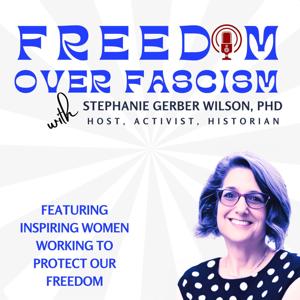
I'm Dr. Stephanie Wilson, and I host Freedom Over Fascism Fireside Chats, which feature no BS conversations about power and how to engage with it, solutions to this moment's problems, and strategies for engaging with each other in order to create a society where liberty and justice are for all of us.
Join me at freedomoverfascism.us or wherever you get your podcasts.
From the publisher's feed

36,380 Listeners

87,607 Listeners
7,626 Listeners

6,892 Listeners

12,519 Listeners
4,589 Listeners

50,469 Listeners

7,513 Listeners

10,401 Listeners
2,233 Listeners

6,916 Listeners
1,166 Listeners
1,159 Listeners
3,441 Listeners

6,168 Listeners