Every insurer receives risk submissions the same way: an email arrives, packed with documents in whatever format the broker chose to send them, and someone on the operations team has to figure out what is in there. The problem is not that carriers lack data. The problem is that nobody has built a scalable way to operationalize it. Richard Hartley spent a decade building that infrastructure at Cytora — and then sold it to the company that reaches seventy percent of US agents.
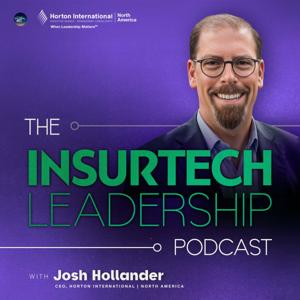
Hartley is the co-founder and CEO of Cytora, an AI-powered risk processing platform acquired by Applied Systems and now powering EPIC Autofill and EPIC Submissions Manager. The conversation was recorded live at AppliedNet, where Cytora's integration into the Applied ecosystem was being unveiled. In this conversation, Josh Hollander and Hartley dig into how Cytora's seven-agent architecture produces confident extraction from any document format, why automation is a dial not a switch, and what it took to rebuild the company from ninety people to thirty at the start of COVID before finding the right product.
Richard Hartley is the co-founder and CEO of Cytora, an AI-powered risk processing platform now operating as a division of Applied Systems. Cytora digitizes and processes risk submissions across any format — emails, PDFs, spreadsheets, images — and routes structured data into downstream systems including policy admin, underwriting platforms, and agency management systems. Before founding Cytora, Hartley studied history and political science, worked in Shanghai for a tech company building core insurance systems across Asia Pacific, and trained as a classical ballet dancer. Cytora's technology is now embedded in EPIC, Applied's core agency management system used by seventy percent of US agents.
The problem was never too little data
Cytora's original thesis was that underwriters needed more data to make better risk selection decisions. That turned out to be wrong. The real problem was that carriers could not operationalize the data they already had into a workflow that functioned at scale. Recognizing that distinction forced a full company pivot — and ultimately led to the product that Applied acquired.
Be agnostic to the input, define the output
Most earlier attempts to digitize submissions trained models on labeled examples of prior submissions — a rigid approach that broke every time document formats changed. Cytora took the opposite position: be entirely agnostic to what comes in, whether it is a bare email, a long Excel spreadsheet, a set of images, or a stack of PDFs, and instead let the insurer define their view of risk as the output. That design principle became the foundation of a platform that works across every line of business without retraining.
Seven agents at different temperatures
Cytora's extraction engine runs seven AI agents simultaneously on the same field, each using a slightly different strategy. When all seven return the same value, confidence is high and the field is accepted automatically. When agents disagree, confidence drops and a human review task is triggered. It is the same logic as solving a math problem seven different ways — agreement across methods is the confidence signal.
Automation is a dial, not a switch
Carriers and insurers sit at different points on the automation spectrum. Some will route lower-complexity, homogeneous risks straight through without human review. Others will use Cytora to present every risk decision-ready but keep a human in the final approval seat. Hartley is deliberately non-prescriptive about which is right — the platform accommodates both, and the correct setting depends on risk complexity, organizational strategy, and appetite for accountability.
The Applied acquisition: emotionally as much as analytically
Cytora was raising its Series C when it met Applied at a conference. Both organizations had been solving the same problem from different ends of the value chain — Cytora from the insurer side, Applied from the broker and agent side. Hartley describes the acquisition decision as emotional as much as analytical: seventy percent of US agents use Applied, which made joining forces the only path to the scale of industry impact Cytora was built to achieve.
EPIC Autofill and what comes next
Post-acquisition, Cytora integrated into EPIC via API in a matter of weeks. Documents that agents previously had to read, review, and rekey manually are now digitized automatically and pre-populated in EPIC. Coming next is a feature called Transactions — a capability that unifies the multiple follow-up communications that typically accompany a single submission into one coherent, complete risk view for the insurer.
Founder lesson: be obsessed by the problem, not the solution
Cytora's hardest moment came at the start of COVID, when the team pivoted from ninety people to thirty with no certainty about what the new product would be. Hartley's advice to founders in that position: stay obsessed with the problem. The solution will come if the problem is real and you care enough about solving it. Hire people who show commitment under pressure rather than people who describe what they would do in theory.
"The reason we exist is really to enable risk to flow in a much more frictionless way through the value chain, from the retail broker through to the insurer."
"Be agnostic to the input because you can't control it. But define the output you want. Define your view of risk."
"I view automation as a dial. You should dial it up, dial it down, really depending on what your strategy is and what you're trying to do."
"We went from eighty, ninety people to around thirty people. We had no idea what the product would be that we would build."
"Be obsessed by the problem. Don't worry about not knowing the solution, because it will take some time."
"Seventy percent of agents in the US use Applied. Being intellectually honest, that was the path."
Cytora: https://www.cytora.com
Applied Systems: https://www.appliedsystems.com
Richard Hartley on LinkedIn: https://www.linkedin.com/in/richard-hartley-7744b851/
Joshua R. Hollander on LinkedIn: https://www.linkedin.com/in/joshuarhollander/
Horton International (USA): https://www.horton-usa.com/
Insurtech Leadership Podcast: https://www.linkedin.com/showcase/insurtech-leadership-show
If you enjoyed this episode, subscribe on your favorite platform and leave a review. The Insurtech Leadership Podcast is available on YouTube, Apple Podcasts, and Spotify.