
Sign up to save your podcasts
Or

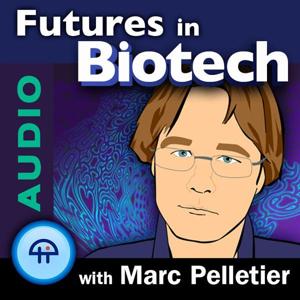


An interview with Dr. Terrence Sejnowski about theoretical and computational biology and neurobiology.
Audible pick: This Is Your Brain on Music: The Science of a Human Obsession, Abridged, By Daniel J. Levitin, Narrated by Edward Herrman. For a free audiobook, visit Audible.com/biotech.
Hosts: Marc Pelletier and Dave Brodbeck, Ph.D
Guest: Terrence Sejnowski
Thanks to Phil Pelletier and Will Hall for the great themes.
Thanks to CacheFly for providing the bandwidth for this netcast.
Marc talks with Dr. Oliver Smithies, Professor, Department of Pathology and Lab Medicine University of North Carolina at Chapel Hill, 2007 Nobel Laureate, and father of mammalian genetic engineering.
Host: Marc Pelletier
Guest: Dr. Oliver Smithies
Thanks to Phil Pelletier and Will Hall for the great themes.
Thanks to CacheFly for providing the bandwidth for this netcast.
Our guest is John Gabrieli; Grover Herman Professor of Health Sciences and Technology and Professor of Brain and Cognitive Sciences, Massachusetts Institute of Technology (MIT)
Looking directly into the human mind with fMRI technology.
Audible pick: Meditations on First Philosophy: With Selections from the Objections and Repiles, Unabridged, By Rene Descartes, Narrated by Paul Hecht. For a free audiobook, visit Audible.com/biotech.
Host: Marc Pelletier
Guests: Dave Brodbeck, Ph.D and John Gabrieli
Thanks to Phil Pelletier and Will Hall for the great themes.
Thanks to CacheFly for providing the bandwidth for this netcast.
From wooly mammoths, to cybernetics, and controlling your computer with your brain, a panel discusses the recent big stories in bioscience.
Host: Marc Pelletier
Guests: Vincent Racaniello, Ph.D, Andre Nantel, Ph.D, Justin Sanchez, Ph.D, and Dave Brodbeck, Ph.D
Thanks to Phil Pelletier and Will Hall for the great themes.
Thanks to CacheFly for providing the bandwidth for this netcast.
Our guest is Dr. Vincent Racaniello, Ph.D., is a professor of Microbiology at Columbia University Medical Center and the host of This Week in Virology.
Host: Marc Pelletier
Guest: Vincent Racaniello, Ph.D
Thanks to Phil Pelletier and Will Hall for the great themes.
Thanks to CacheFly for providing the bandwidth for this netcast.
A follow-up look at Folding@Home, the world's most powerful distributed computing cluster, designed to perform computationally intensive protein folding simulations.
Our guest is Dr. Vijay S. Pande, Director of Folding@Home and Associate Professor of Chemistry and of Structural Biology, Stanford University
Audible pick: Always Looking Up: The Adventures of an Incurable Optimist, Abridged, By Michael J. Fox, Narrated by Michael J. Fox. For a free audiobook, visit Audible.com/biotech.
Hosts: Marc Pelletier and Randal Schwartz
Guest: Vijay S. Pande
Thanks to Phil Pelletier and Will Hall for the great themes.
Thanks to CacheFly for providing the bandwidth for this netcast.
Leading virologist Peter Palese explains why he revived a virus that killed 50 million people.
Our guest is Peter Palese, professor and chair of microbiology at the Mount Sinai School of Medicine in New York.
In the winter of 1918-19, fifty million people died horrible deaths from the Spanish flu. The threat of this happening again today is ever so present. And while we have drugs that are fairly effective against influenza, they are not foolproof.
The possible devastation to humanity from this threat is extremely significant. The world will look to the best and brightest scientists and clinicians in hopes that they know and understand the virus well enough to fight it.
Dr. Palese has made great contributions to our understanding of influenza, and his scientific endeavors have given us the knowledge and tools to prevent this potential devastation.
Hosts: Marc Pelletier and Vincent Racaniello, Ph.D
Guest: Peter Palese
Thanks to Phil Pelletier and Will Hall for the great themes.
Thanks to CacheFly for providing the bandwidth for this netcast.
Dr. Lisa Weasel discusses the controversies surrounding genetically-modified foods.
Our guest is Dr. Lisa Weasel, associate professor of biology at Portland State University in Oregon, a member of Governor Ted Kulongoski's task force on developing public policy for bio-pharmaceutical crops in Oregon, and author of Food Fray: Inside the Controversy over Genetically Modified Foods.
Why isn't there a wide consumer acceptance of genetically modified (GM) foods? If we can design crops that reduce pesticides, grow more effectively in poor soil, bring nutrients such as vitamins A to populations with high incidences of blindness, or even just taste better, why are we hesitating?
Audible pick: On the Origin of Species, Abridged, By Charles Darwin, Narrated by Richard Dawkins. To sign up for a free audiobook, visit Audible.com/biotech.
Host: Marc Pelletier
Guest: Dr. Lisa Weasel
Thanks to Phil Pelletier and Will Hall for the great themes.
Thanks to CacheFly for providing the bandwidth for this netcast.
How Dr. Martin Chalfie transformed a green fluorescent jellyfish protein into the most important biological marker used today.
Our guest is Dr. Martin Chalfie; Professor and Chair of the Department of Biological Sciences, Colombia University, New York, NY.
This is Part II of our conversation with Dr. Martin Chalfie. In this episode Dr. Chalfie shares the historical account of his contribution to the 2008 Nobel Prize in Chemistry: How he transformed a green fluorescent jellyfish protein into the most important biological marker used today, one that allows us to track the life of recombinant protein in a living cell.
Audible pick: The Ten Most Beautiful Experiments, by George Johnson, Narrated by dion Graham. To sign up for a free audiobook, visit Audible.com/biotech.
Hosts: Marc Pelletier and Dr. Glen Ernstrom
Guest: Martin Chalfie
Thanks to Phil Pelletier and Will Hall for the great themes.
Thanks to CacheFly for providing the bandwidth for this netcast.
Our guest is Marty Chalfie, 2008 Nobel Laureate in Chemistry
This episode covers how Marty Chalfie discovered the molecular machinery that senses touch. In Part II, Chalfie describes how he developed one of the most important tools of modern molecular biology, one that allows us to see inside a living cells, down to the protein level. With green fluorescent protein, or GFP, we can now track the life of a protein, from when the gene that makes the protein is turned on, to where it goes, to where it dies.
Audible Pick: The Snows of Kilimanjaro and Other Stories, Abridged, By Ernest Hemingway, Narrated by Stacy Keach.
Hosts: Marc Pelletier and Dr. Glen Ernstrom
Guest: Martin Chalfie
Thanks to Phil Pelletier and Will Hall for the great themes.
Thanks to CacheFly for providing the bandwidth for this netcast.
From the publisher's feed
Explore the world of cloning, protein folding, genome mapping, and more with the most important researchers in the field.
Although the show is no longer in production at TWiT, you can enjoy episodes from the TWiT Archives.
9 Listeners
34 Listeners
109 Listeners
6 Listeners
139 Listeners
29 Listeners
96 Listeners
35 Listeners
72 Listeners
116 Listeners
94 Listeners
24 Listeners
50 Listeners
15 Listeners
10 Listeners
9 Listeners
0 Listeners
28 Listeners
32 Listeners
0 Listeners