
Sign up to save your podcasts
Or

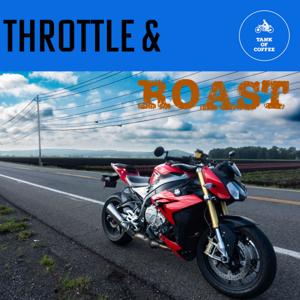

Many riders insist that tanks are too small on modern motorcycles, but the real story is far more nuanced than a simple glance at fuel capacity suggests. In this episode of Throttle and Roast, host Niels Meersschaert digs into the full picture of motorcycle range, examining why manufacturers build smaller tanks, how fuel economy changes everything, and whether the complaints flooding social media actually hold up in the real world.
Niels begins by establishing the extremes of tank capacity currently available on the market. The smallest street motorcycle tank belongs to the Honda Grom at just 1.6 gallons, while the largest is found on the BMW R1300 GS Adventure at 7.9 gallons. Most of the bikes people complain about fall somewhere in between those two extremes. Manufacturers choose smaller tanks for two primary reasons: aesthetics and weight. A larger tank dramatically changes the visual profile of a motorcycle, and with fuel weighing roughly six pounds per gallon, a fully loaded large tank can add nearly 50 pounds of weight concentrated high on the bike, affecting low-speed handling and overall feel. As modern bikes have also added electronics, ABS, TFT displays, and other features that riders demand, manufacturers have had to find weight savings somewhere, and the fuel tank is often the easiest place to trim.
But tank size alone does not tell the full story. When you factor in fuel economy, the range equation shifts considerably. The Honda Grom, despite its tiny 1.6-gallon tank, achieves around 125 miles per gallon in real-world use according to the fuel tracking tool Fuelly, giving it a range of roughly 200 to 250 miles. Meanwhile, the BMW R1300 GSA, with its nearly 8-gallon tank, returns around 40 to 44 miles per gallon in practice, translating to 315 to 395 miles of range. That is a meaningful difference, but far less dramatic than the raw tank size comparison would suggest.
Niels backs this up with over 15 years of personal fuel data tracked through Fuelly. His Vespa GTS 300, with a 2.2-gallon tank, averages 67.6 miles per gallon and delivers close to 150 miles of range, more than enough for his typical short errands. His BMW F900GS, despite having less than half the tank capacity of his old R1200 GSA, achieves nearly the same practical range thanks to better fuel economy on the newer, smaller engine. Even his BMW R18 Classic, a cruiser that many riders criticized for having a tank that is too small, delivers around 190 miles of range at 45 miles per gallon, virtually identical to what he gets from the F900GS.
Niels also addresses the argument that riders need more range for long trips. Using a 250-mile travel day as a benchmark, he points out that comfort, fatigue, and safety already push most riders to stop every 100 miles or so. His personal rule of thumb is to stop every two hours or every 100 miles, whichever comes first. If you are stopping for a break anyway, refueling takes only a moment and removes any range anxiety entirely. For the rare stretches where gas stations are genuinely far apart, such as the 169-mile gap between Tonopah and Ely in Nevada, a compact auxiliary fuel bag ca
Send us Fan Mail
Support the show
Thanks for listening!
Click the "Send us a Text Message" link above to send us your questions, comments, and feedback on the show! Please make sure you leave the podcast title. Or if you prefer to leave an audio message, leave us a voicemail on our website!
Subscribe to our newsletter to keep up to date on the latest from the show.
Check out our favorite products to use on and off your motorcycle.
 View all episodes
 By Tank of Coffee
5
66 ratings
Many riders insist that tanks are too small on modern motorcycles, but the real story is far more nuanced than a simple glance at fuel capacity suggests. In this episode of Throttle and Roast, host Niels Meersschaert digs into the full picture of motorcycle range, examining why manufacturers build smaller tanks, how fuel economy changes everything, and whether the complaints flooding social media actually hold up in the real world.
Niels begins by establishing the extremes of tank capacity currently available on the market. The smallest street motorcycle tank belongs to the Honda Grom at just 1.6 gallons, while the largest is found on the BMW R1300 GS Adventure at 7.9 gallons. Most of the bikes people complain about fall somewhere in between those two extremes. Manufacturers choose smaller tanks for two primary reasons: aesthetics and weight. A larger tank dramatically changes the visual profile of a motorcycle, and with fuel weighing roughly six pounds per gallon, a fully loaded large tank can add nearly 50 pounds of weight concentrated high on the bike, affecting low-speed handling and overall feel. As modern bikes have also added electronics, ABS, TFT displays, and other features that riders demand, manufacturers have had to find weight savings somewhere, and the fuel tank is often the easiest place to trim.
But tank size alone does not tell the full story. When you factor in fuel economy, the range equation shifts considerably. The Honda Grom, despite its tiny 1.6-gallon tank, achieves around 125 miles per gallon in real-world use according to the fuel tracking tool Fuelly, giving it a range of roughly 200 to 250 miles. Meanwhile, the BMW R1300 GSA, with its nearly 8-gallon tank, returns around 40 to 44 miles per gallon in practice, translating to 315 to 395 miles of range. That is a meaningful difference, but far less dramatic than the raw tank size comparison would suggest.
Niels backs this up with over 15 years of personal fuel data tracked through Fuelly. His Vespa GTS 300, with a 2.2-gallon tank, averages 67.6 miles per gallon and delivers close to 150 miles of range, more than enough for his typical short errands. His BMW F900GS, despite having less than half the tank capacity of his old R1200 GSA, achieves nearly the same practical range thanks to better fuel economy on the newer, smaller engine. Even his BMW R18 Classic, a cruiser that many riders criticized for having a tank that is too small, delivers around 190 miles of range at 45 miles per gallon, virtually identical to what he gets from the F900GS.
Niels also addresses the argument that riders need more range for long trips. Using a 250-mile travel day as a benchmark, he points out that comfort, fatigue, and safety already push most riders to stop every 100 miles or so. His personal rule of thumb is to stop every two hours or every 100 miles, whichever comes first. If you are stopping for a break anyway, refueling takes only a moment and removes any range anxiety entirely. For the rare stretches where gas stations are genuinely far apart, such as the 169-mile gap between Tonopah and Ely in Nevada, a compact auxiliary fuel bag ca
Send us Fan Mail
Support the show
Thanks for listening!
Click the "Send us a Text Message" link above to send us your questions, comments, and feedback on the show! Please make sure you leave the podcast title. Or if you prefer to leave an audio message, leave us a voicemail on our website!
Subscribe to our newsletter to keep up to date on the latest from the show.
Check out our favorite products to use on and off your motorcycle.
843 Listeners
43 Listeners

252 Listeners
338 Listeners
431 Listeners

89 Listeners

80 Listeners
191 Listeners
27 Listeners

3,858 Listeners

1,314 Listeners
32 Listeners
105 Listeners

22 Listeners

2,536 Listeners