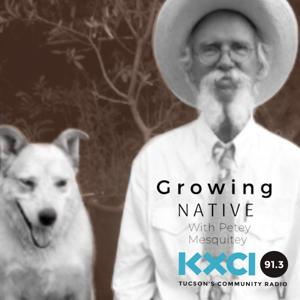
Growing Native with Petey Mesquitey

Growing Native with Petey Mesquitey

By Petey MesquiteySociety & CultureEducation
Download on the App Store

Growing Native with Petey Mesquitey episodes

  • Dung on a Twig
    The etymology of the word mistletoe is all over the place and has been traced to Old English, Middle English, Anglo Saxon and old German…a mix of all of the above. I do like the meaning “dung on a twig.” And listen, mistletoe is really an excellent plant for birds, so why don’t native plant nurseries offer Phoradendron californicum for your ironwood or mesquite or catclaw? Ask your favorite nursery person for dung on a twig!
    5 min
  • Your Yowser Yucca
    When I would give talks I would always show photos and talk about our regional yucca species; Yucca elata, Yucca baccata and Yucca madrensis… Yucca madrensis, by the way, is the former Yucca schottii, but here’s what’s cool about this resident of the Madrean Evergreen Woodlands; it’s pollinated by a different moth species than Y. baccata or Y. elata. They each have their own yucca moth species doing the pollinating. Cool? Very! The photos are mine.
    5 min
  • The Apache Fox Squirrel
    The Apache fox squirrel – one of a few common names, but always Sciurus nayaritensis…is found in the Sierra Madre Occidental from Nayarit and north all the way to the Chiricahua Mountains where Ms. Mesquitey and I can be found poking around looking at local flora and fauna. The photos are mine.
    5 min
  • Heart Heard Beating
    This is an episode about hearing my heart beat. I initially was going to talk about the noise made by ORVs, ATVs, SUVs and pickup trucks out in the deserts and hills. I fall in the “pickup truck” category. Don’t want you thinking I’m a holier than thou sorta guy…ha! Anyway, guess I’ll pontificate about all that another time. You’re welcome. So, this is an episode about hearing my heart beat while hanging out on a rocky slope in the Galiuro Mountains. The photos are mine.
    4 min
  • Monarda Curative for the New Year
    Monarda species are endemic to North America. As near as I can figure there are fifteen or sixteen species and four of those are found in Arizona. Yay! Monarda fistulosa spp. menthifolia would be a wonderful addition to a high desert landscape…did you hear me say in it grew in pine forests? We’re talking shade, so under a tree or shrub that will get an extra drink. Oh yeah!  And, it’s pretty special to see it in the wild blooming in those shady pine forests from June to September. The photos are mine.
    5 min
  • Christmas Tree Tradition
    Douglas fir (Pseudotsuga menziesii) is found from central California, up through the Pacific Northwest, throughout the Rockies (variety glauca) and southward down into our sky islands. We are so lucky to have it as a part of the mixed coniferous forests in the mountains of the borderlands. What a magnificent tree! I highly recommend reading about its ecology and history..a small assignment. The photos are mine and taken the day of our tree hunt. That’s Marian…Ms. Mesquitey… looking over the other side of that deadfall and finding a Douglas fir.
    5 min
  • Sycamores on a Gravelly Plain
    I’ve written a lot of episodes about sycamore trees over the years. Below are some of the things I wrote for  those episodes. “I could look at sycamores all day. They remind me of when I was a kid in Kentucky and the huge sycamores we climbed along the creeks back there. Some big ones were hollow and you could go in them! It was a different species…Platanus occidentalis…this one is P. wrightii.” “Sycamores are the genus Platanus, which was the old Greek name for the tree that is the species Platanus orientalis. There are five or six species found…
    5 min
  • Autumnal Wild Cotton
    I use the common name wild cotton, but here are some other common names: Thurber’s cotton, desert cotton, and algodoncillo. Your choice, but if in doubt try Gossypium thurberi. I think it’s interesting that in the Southwestern US Gossypium thurberi occurs only in Arizona, but then, southward across the border into the Mexican states of Sonora, Chihuahua and Jalisco. The photos are mine and of an illustration by Lucretia Breazeale Hamilton taken from Benson and Darrow’s Plants of the Southwest Deserts. Her beautiful illustrations are found in so many of my favorite plant books. And yes, that’s my shadow in…

    5 min
  • Layer Up!
    It was Carl Linnaeus, the king of binomial nomenclature, who decided to use the classical Latin name fraxinus as the genus for ash trees. One hundred years later the American botanist John Torrey gave the species name velutina to the tree I’m talking about in this episode; Fraxinus velutina or velvet ash. There are sixty-five to seventy species of Fraxinus found around the world. Seven of those species are found in Arizona, so hey, collect them all! The photos are mine of velvet ash along our driveway and in fall color.
    4 min
  • My Girlfriend Hanna
    Talking about desert broom (Baccharis sarothroides) is a November tradition and so is singing an old hymn that I like to play with. The melody of the song has had quite a journey from a Dutch folk song of the early 1600s to the early 1800s when Eduard Kremser wrote the hymn using the melody. The Kremser starts with the line “We gather together.” I love the line in the song, “the wicked oppressing now cease from distressing.” I hope it’s a great season of friends and family for all of us. Celebrations full of laughter, maybe tears, but all…
    4 min

About Growing Native with Petey Mesquitey

From the publisher's feed

Petey Mesquitey is KXCI’s resident storyteller. Every week since the spring of 1992 Petey has delighted KXCI listeners with slide shows and poems, stories and songs about flora, fauna, and family and…

More shows like Growing Native with Petey Mesquitey

Hidden Brain by Hidden Brain, Shankar Vedantam

Hidden Brain

43,356 Listeners

The Moth by The Moth

The Moth

26,807 Listeners

Reveal by The Center for Investigative Reporting and PRX

Reveal

8,421 Listeners

The Great Simplification with Nate Hagens by Nate Hagens

The Great Simplification with Nate Hagens

434 Listeners