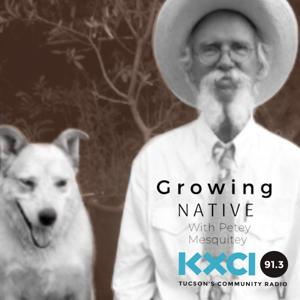
Growing Native with Petey Mesquitey

Growing Native with Petey Mesquitey

By Petey MesquiteySociety & CultureEducation
Download on the App Store

Growing Native with Petey Mesquitey episodes

  • Our Nodding Onion
    The genus Allium has had quite a taxonomic journey and is at this time (stay tuned!) in the amaryllis family, Amaryllidaceae, where it had once been, so welcome back Allium. There are over 400 species of Allium native to the Northern Hemisphere. Arizona has 13 of those and nodding onion, Allium cernuum is one of those. Yay! Oh, I know, I know, it’s unlikely that an onion will usurp the rose as the national plant of the United States. Allow me to dream. The photos are mine.

    5 min
  • Fall Festival of Blooming Asteraceae
    How fortuitous to come across Gregg’s mistflower out in the desert scrub during the Fall Festival of Blooming Asteraceae! What a beautiful plant. Oh, and by the way, this mist flower’s botanical name used to be Eupatorium greggii. That was fun, because I could jabber about Mithradates VI Eupator, the king of Pontus in northern Anatolia, not to mention the botanist, explorer and plant collector Josiah Gregg. Luckily for you I ran out of time. The photos are mine.
    5 min
  • A Strong Gift in Bisbee
    I had a chance to use the word didymus when describing the seed pods of Menodora, but forgot, so here: the common name twinberry for Menodora scabra refers to the didymus seed capules, side by side small globes…twins. The short trail that I walked is actually a city park. If you walked nonstop from end to end it would take maybe ten minutes. Several years ago I walked that little city park trail with some friends and fellow flora/fauna geeks. I think it took us over two hours while we identified and jabbered about the plants and pollinators we saw.…
    5 min
  • Busy Bees in the Borderlands
    Squash bees are out so early in the morning that they’re moving pollen around well before honey bees even arrive. Research done by the Department of Agriculture found that squash bees “are largely responsible for the production of cultivated squash across North America” and “much of the Americas.” That is very cool. I like buffalo gourd (Cucurbita foetidissima) and I haven’t talked about it in many years. If you were to look it up you’d find that there has been a lot of research on seed of the gourd, but also of the large tuberous root. And, this is cool;…
    5 min
  • Collector of Clutter
    Arizona white oak is Quercus arizonica. I’ve come across some magnificent ones over the years of living near them in southeastern Arizona. We also have some home grown white oaks planted around our home and they have some stories too. The photos are mine. I figured you like to see a little bit of my clutter, so there you go. That’s Ms. Mesquitey’s hand on the bark of the huge white oak and some leaves and developing acorns on an Arizona white oak.
    5 min
  • Asclepias involucrata
    A sentimental episode written and recorded amidst the cluttered space that I call books and bones. Thank goodness for a milkweed plant to help me snap out of it! Asclepias involucrata has a wide range in the southwestern US and into Mexico. I don’t remember ever seeing it offered in a nursery , but then I don’t remember a lot of stuff. But hey, it is a perennial with a woody tap root, so I’m thinking It would be a fun addition to a wildflower pollinator garden. Queen butterflies and their following caterpillars certainly thought it was a nice addition…
    5 min
  • Mexican Hog-nosed Snake
    I first learned this snake as the western hog-nosed snake (Heterodon nasicus). It’s now called the Mexican hog-nosed snake (H. kennerlyi). And, this is neat, at least for me; a snake of my Kentucky youth was the eastern hog-nosed snake (Heterodon platirhinos). It has all the same crazy wonderful behavior as our borderlands species. Back in those olden days I remember folks called it puff adder or puffing adder, among other colloquial names based on its defensive behavior. Now you know. The photos are mine. Those are Marian’s hands and our dog Badger’s nose.
    5 min
  • Rain Deprived Dude in the Mules
    I’m pretty sure I first encountered the plant called mala mujer in the Santa Rita Mountains south of Tucson around 30 years ago. I had 10 years of commercial horticulture under my belt and I had become a native plant geek. “To heck with all these exotics,” I’d shout to people, “Grow native!” Yes, an obnoxious native plant geek. Anyway, I’m also pretty sure I turned that encounter into a Growing Native episode and I mispronounced the genus Cnidoscolus. “The C is silent,” my botanist/horticulturist friend Gene Joeseph gently told me. Where would I be without friends like that? There…
    5 min
  • Reptiles and Amphibians, Oh My!
    Hmmm, a rambling reminiscence about amphibians and reptiles and of course to be continued, ‘cause here comes monsoon! The Sonoran Desert Toad, formerly the Colorado River Toad, is Incillius alvarius….formerly Bufo alvarius. As near as anyone can figure Incillius means ditch or trench and alvarius may refer to its large abdomen. A fun common name could be the Tubby Tummied Ditch Toad, but yeah, the Sonoran Desert Toad is an excellent name. And, a duded up Sonoran Desert Toad was the logo for the Tucson band The Dusty Chaps. The photos are mine.
    5 min

About Growing Native with Petey Mesquitey

From the publisher's feed

Petey Mesquitey is KXCI’s resident storyteller. Every week since the spring of 1992 Petey has delighted KXCI listeners with slide shows and poems, stories and songs about flora, fauna, and family and…

More shows like Growing Native with Petey Mesquitey

Hidden Brain by Hidden Brain, Shankar Vedantam

Hidden Brain

43,356 Listeners

The Moth by The Moth

The Moth

26,807 Listeners

Reveal by The Center for Investigative Reporting and PRX

Reveal

8,421 Listeners

The Great Simplification with Nate Hagens by Nate Hagens

The Great Simplification with Nate Hagens

434 Listeners