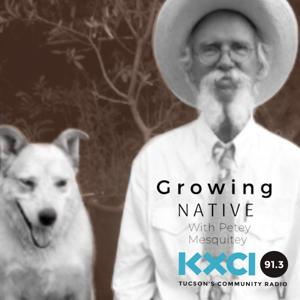
Growing Native with Petey Mesquitey

Growing Native with Petey Mesquitey

By Petey MesquiteySociety & CultureEducation
Download on the App Store

Growing Native with Petey Mesquitey episodes

  • She Calls Me Peter
    I was looking through photos that I’ve taken of this plant over the years and realized I even have 35 mm slides of Jatropha macrorhiza. Slide show! So yeah, this is a favorite plant. And, I love this description from the web site SEINet: Jatropha macrorhiza “is a charismatic plant you won’t forget once you recognize it. The large, palmately lobed, bristle-toothed leaves coming out of an erect stem with pink flowers really stands out.” Yup! The photos are mine of the newly emerging plants on the rocky hillside described in this episode.
    5 min
  • The Story of the Yucca Moth
    I’ve told the story of the yucca moths and the soaptree yuccas many times. I love to tell it when I give talks and I’m not making this up; years ago on a special International Women’s Day at KXCI, my wife, yes, Ms. Mesquitey, told the yucca moth story on Growing Native. We both think it is one of the most amazing things that happen around us and part of an extremely long and always lengthening list of crazy wonderful happenings in the natural world. The photos are mine and taken here at home. I was pulling back the petals…
    5 min
  • Petey Does Mimosas
    It was Linnaeus that created the name Mimosa from the Greek: mimos for mime and the suffix osa for resembling. And as to the plant jabbered about, it was Asa Gray that named the species grahamii to honor James Graham probably at William Emory’s suggestion…fellow soldier surveyors in the field. The photos are mine.
    5 min
  • Mexican Stoneroller
    The streams and pools of the Swisshelm, Chiricahua, Mule, Pedregosa, Perilla and Peloncillo mountains are part of the Rio Yaqui Drainage. Those water courses drain toward Sonora and the Rio Yaqui and they have or used to have the same eight species of fish that are found in that river. The Mexican stoneroller is one of those eight species and I owe that fish big time for helping cure the blues. So yay, for cool native fish found in the borderlands of southeastern Arizona! The photos are mine.

    5 min
  • Desert Ironwood Festival
    I love desert ironwood trees….love peering under them to see the plants they’re nursing …love the purple and white flowers and seed pods that follow… never minded the spiny branches tugging at my clothing and sometimes drawing blood… and, love the desert litter beneath them. The desert ironwood is a beautiful tree…yeah, it is! The photos are mine
    5 min
  • Crimson Sage
    The first time I identified crimson sage (Salvia henryi) was years ago just outside Paradise in the Chiricahua Mountains. Marian and I were checking out a native mulberry when we saw the bright red flowers on the same hillside. That’s pretty cool, because I learned later that John and Sara Lemmon collected it in the Chiricahuas in 1882. The Lemmons sent their plant collections back east to Asa Gray for identification and naming. It was Gray who named the species henryi after the botanist Augustine Henry who collected and botanized in China. Jeez, talk about an argument for species names…
    5 min
  • HIgh in the Mountains
    False Solomon’s seal was formerly in the family Liliaceae, but is now in Asparagaceae. There are 2 subspecies of Maianthemum racemosum. The subspecies out here in the mountainous forests of the western U.S. is amplexicaule, so it reads like this: Maianthemum racemosum subsp. amplexicaule. Between the 2 subspecies false Soloman’s seal can be found all over North America…all over…and into a bit of northern Mexico. So wherever you are, search the rich damp soil of the mountain forest under story. Doesn’t “rich damp soil” sound glorious? It almost makes me want to create a forest garden with that kind of…
    5 min
  • Spring in the Borderlands
    Asclepias asperula is found beyond the borderlands around the Southwestern United States and into Northern Mexico. My explanation of the common name antelope horns being the result of drug use wasn’t fair. At one point the species name for this milkweed was capricornu from Latin meaning goat horn. And here is a good quote from I forget who (drug use), “the common name Antelope Horns is reflective of the maturing seed pods which begin to curve as they grow and soon resemble antelope horns.” Sooo, antelope horns or inmortál, your choice, but always Asclepias asperula. Whenever we see this milkweed…
    5 min
  • Ubiquiticola
    I love following the drainages out of the mountains and across the deserts, observing all the plants and animals that follow them as well. Do I always tell you that? Having wild turkeys come out of the nearby mountains and wander by our little homestead reminded me to talk about the magic of canyons and arroyos that cross our deserts. The reintroduction of the Gould’s turkey into the mountain ranges of southeastern Arizona began in the early 1980s and continued through the 1990s. There were blunders and successes. Now a days we can’t go into the mountains without seeing turkeys.…
    5 min

About Growing Native with Petey Mesquitey

From the publisher's feed

Petey Mesquitey is KXCI’s resident storyteller. Every week since the spring of 1992 Petey has delighted KXCI listeners with slide shows and poems, stories and songs about flora, fauna, and family and…

More shows like Growing Native with Petey Mesquitey

Hidden Brain by Hidden Brain, Shankar Vedantam

Hidden Brain

43,356 Listeners

The Moth by The Moth

The Moth

26,807 Listeners

Reveal by The Center for Investigative Reporting and PRX

Reveal

8,421 Listeners

The Great Simplification with Nate Hagens by Nate Hagens

The Great Simplification with Nate Hagens

434 Listeners