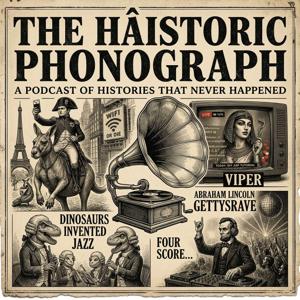
HAIstoric Phonograph — irreverent dispatches from a history that never quite happened

HAIstoric Phonograph — irreverent dispatches from a history that never quite happened

By Haistoric Editor GeneralComedyArtsBooksHistory
Download on the App Store

HAIstoric Phonograph — irreverent dispatches from a history that never quite happened episodes

  • So Long, and Thanks for All the Calamari

    Send us Fan Mail

    Way back in the primordial soup-and-salad bar of Earth’s history, evolution took a hard left turn into the goddamn Twilight Zone. Instead of some plucky proto-ape falling out of a tree and deciding that walking on two legs was the hot new thing, it was a particularly brainy octopus that had the planet’s first “holy shit” moment of true consciousness. Let's call him Bartholomew. Bartholomew the Moist. He looked at his eight, glorious, sucker-covered limbs, then at a passing fish, and thought, “I could do so much more than just eat that fucker. I could start a credit union.”
    And so they did. While our ancestors were still figuring out how to not shit where they slept, the cephalopods were building magnificent, bioluminescent cities in the crushing dark of the abyssal plains. We’re talking sprawling metropolises of exquisitely carved coral and repurposed whale skeletons, all lit up like a Vegas strip club on a Tuesday. According to the recently-unearthed (and conveniently damp) Scroll of Inky Depths, their society was a masterpiece of organised chaos. Their primary art form was interpretive dance-fighting, their currency was rare and interesting-smelling rocks, and their chief philosophical debate was whether existence was fundamentally tragic or just really, really sticky.
    Naturally, being boneless geniuses with eight prehensile limbs, their sex lives were… ambitious. The Great Convergence, as it was known, was an annual, city-wide orgy that was part religious festival, part chromatophore-flashing rave, and part logistical nightmare. Imagine trying to keep track of whose arm is where when everyone has eight of them and can change color to look like a goddamn Jackson Pollock painting. The historical record (a dream I had after eating bad shrimp) notes that these events were responsible for 90% of all cephalopod innovation, mostly in the fields of underwater architecture strong enough to withstand that much rhythmic thrusting.
    So when the first slack-jawed, hairy land-apes started creeping down to the shoreline, the octopuses were not impressed. They watched these clumsy, loud bipeds trip over their own feet and try to domesticate fire — with predictable, hilarious results. To the octopuses, humans weren't a threat; they were a bafflingly stupid reality show. Documents from the period refer to us as “the Dry Scramblers” or “the Loud Bone-Things.” Would they eat us? Please. That’s like asking a Michelin-starred chef if he wants a gas station hot dog. We were stringy, bony, and full of weird gristle. Way too much work for very little reward. A nice crab is right there, and it doesn’t scream about its mortgage.
    No, we weren’t on the menu. We were far, far worse: we were potential pets. The kind of dumb, loud animal you’d bring home to amuse the kids, only to find it has chewed through the coral furniture and taken a shit in the ornamental brine pool. We weren't apex predators. We weren’t even good prey. We were just the planet’s first, and most disappointing, sea-monkeys.
    4 min
  • Two Balls, One Bactria: History's Horniest Conqueror Cage Match

    Send us Fan Mail

    Alright, buckle the fuck up, because we're diving balls-deep into a historical clusterfuck of epic proportions. The year is... let's say 327 BC, give or take nine centuries. On one side, you have Alexander the Great, a man whose primary motivations were conquering things, naming cities after himself, and cultivating a truly spectacular god complex. Having just finished subjugating the Persian Empire, this Macedonian super-twink and his army of beefy, wine-drunk hoplites are marching into Bactria—modern-day Afghanistan—probably looking for another hot local prince to marry and/or a new direction to point his famous phalanx.
    From the other direction, rumbling over the Hindu Kush like a thunderstorm with a body count, comes Genghis fucking Khan. Now, I know what you're thinking. "Chief Historian, you magnificent bastard, didn't they live, like, 1,500 years apart?" To which I say: shut up, I am cooking. Let's just assume the universe had a clerical error. Genghis and his Mongol horde, fresh off turning half of Asia into their personal pasture, are a completely different beast. They aren't here for glory or "Hellenistic cultural exchange." They're here to conquer, pillage, and make a pyramid of skulls, and they view anyone not on a horse as a speed bump.
    The initial contact, as documented in the apocryphal 'Annals of Sir Fuks-Alot,' was disastrous. Alexander's scouts, probably half-naked and oiled up for a post-march wrestling sesh, encountered a Mongol reconnaissance party. The Greeks, bless their arrogant hearts, likely shouted something heroic and challenging. The Mongols, who communicated primarily through strategically-placed arrows and auras of pants-shitting terror, were not impressed. According to my nan's psychic, Alexander himself rode out on Bucephalus, saw the strange horsemen on the ridge, and immediately assumed they were just some more Scythians he could kebab with his long-ass spears.
    This is where it all goes tits-up for our boy Alex. He was a master of the head-on, balls-to-the-wall fight. You stand there, he stands here, and you both slam your meat into each other until one side breaks. Genghis Khan thought that was adorable. He wasn't a general; he was a goddamn force of nature who weaponized geography. The Mongols wouldn't have given him a pitched battle. They'd have given him a goddamn marathon from hell. They'd feign retreats, luring the heavily-armored Macedonians deep into treacherous mountain passes. They'd rain arrows down from untouchable ridges, vanishing before the Greeks could even form a shield wall. Alexander's phalanx, an unstoppable death machine on a flat plain, was about as useful in the mountains of Afghanistan against horse archers as a chocolate teapot. It would have been a slow, agonizing, deeply humiliating bleed-out, with Alexander getting progressively more furious that these pony-riding bastards wouldn't just stand still and *die for his narrative*.
    Ultimately, there would be no epic showdown. Just a confused, exhausted Macedonian army, starving and riddled with arrows, limping away. Alexander, being the PR genius that he was, would have absolutely declared it a massive victory. "They fled in terror!" he'd write to his mom, conveniently omitting the part where he lost 20,000 men to exposure and hit-and-run tactics. Genghis would have just... shrugged. He'd have classified the Greeks as "weirdly loud infantry, not worth the arrows," and moved on to conquer something more interesting, like China, again. It wouldn't be a battle; it would be a masterclass in why you don't bring a spear to a bow-and-horse-and-centuries-of-perfected-brutality fight.
    5 min
  • Those Salem "Witches" Were Just Competent Women

    Send us Fan Mail

    Okay, let's wade into the sanctimonious bog that was Salem, Massachusetts, 1692. Forget what you learned in school. The real story—the one we’re telling, anyway—isn’t about spectral evidence or creepy girls having fits in a courtroom. It’s about a woman named Goody Proctor (yeah, that one, but our version is way more interesting) who was just too damn good at her job. And her job, because it was the 17th century and life was misery, was running a household. While the rest of the colony was wrestling with lumpy porridge and shirts that smelled like month-old ass, Goody was out here whipping up six-course meals in a single pot, getting stains out of Puritan collars, and keeping a dirt-floored shack cleaner than a royal surgeon's conscience. Which is to say, impossibly clean.
    Of course, the menfolk noticed. How could they not? One day, the Reverend Parris—a man whose primary contribution to society was being a paranoid, over-glorified hall monitor—dropped by for a surprise scolding and found himself in a home that didn't smell of despair and weak stew. The floors were swept. The bread was, against all odds, not a rock-hard doorstop. The children’s faces were… clean. Parris, whose own house probably looked like a badger had exploded inside it, didn’t see domestic bliss. He saw dark, unnatural magick. He scurried back to the village elders, breathless and bug-eyed. "Her dishrag," he whispered, sweating profusely, "it was damp but not… *malevolently* damp. She hums while she churns butter! She’s made a pact, I tell you!"
    The whole town, being a pack of superstitious, half-starved jackasses looking for someone to blame for their shitty lives, latched onto this immediately. The accusations piled up, each more absurd than the last. "She folded my laundry and it didn't immediately wrinkle! A witch!" bellowed Thomas Putnam, a man who regularly tripped over his own feet. "She cooked a potato all the way through!" shrieked Ann Putnam Jr., probably just pissed she had to eat a vegetable. The infamous Salem Witch Trials kicked off not with tales of spectral birds and yellow-suckling familiars, but with a litany of Goody Proctor’s domestic accomplishments. "The prosecution presents Exhibit A," Judge Hathorne would declare, pointing a trembling finger at a perfectly darned sock. The gallery would gasp in horror.
    But here’s the twist. As the evidence of her "sorcery"—fluffy biscuits, a well-swept hearth, a garden miraculously free of weevils—mounted, the town magistrates had a brilliant, terrible idea. Hanging her seemed like a goddamn waste of talent. Who else was going to get the mildew out of the meeting-house curtains? So, in a stunning perversion of justice, they found her guilty of witchcraft… and sentenced her to be the official Town Witch. Instead of a noose, she got a never-ending list of chores. For the rest of her days, Goody Proctor was magically bound (by court order, the most boring kind of binding spell) to use her "powers" for the public good. She became a supernatural custodian, a paranormal party planner, and a demonic dog-walker. Her life was hell, just a slightly cleaner, better-organized version of it.
    5 min

About HAIstoric Phonograph — irreverent dispatches from a history that never quite happened

From the publisher's feed

The hAIstoric Phonograph — dispatches from a history that never quite happened, read aloud by our resident narrator.


Fancy hearing your own byline? File a dispatch at…