
Sign up to save your podcasts
Or



Transcription from historical marker:
This is the first Carnegie Library in Oklahoma. Frank Frantz, last Territorial Governor and Charles Haskell, First State Governor, were inaugurated on the steps here. The mock wedding of Miss Indian Territory and Mr. Oklahoma Territory was here. The first state flag was made here by 90 Oklahoma women on June 16, 1908.
Erected by the Fogarty Jr High Oklahoma History Classes of 1954-1955.
Transcription from the historical marker:
With the opening of the approximately two million acres of "Oklahoma Country" for homestead settlement at 12 noon, Monday, April 22, 1889, thousands of settlers rushed to claim free land. Those making claims were required by law to register at one of two U.S. Government Offices, one located at Kingfisher and one at Guthrie.
The modest 18x30 feet false-fronted frame building of the U.S. Land office stood alone that day, capping the hill east of the railroad station. Almost immediately, it was surrounded by hundreds of eager settlers, seeking to register claims. By nightfall, it stood in a sea of tents that collectively made up Guthrie.
The Kansas City Gazette on April 23 reported: "The crowd around the land office is too great to be numbered. Those who did not get in to file their claims last night slept where they were in the line to be on hand this morning."
The Land Office continued its "land office business" rush for weeks, as the thousands of homesteaders filed claims and counterclaims for free land. Lines of claimants crowded "Hell's Half Acre" outside the Office.
Land Office Register John Dillie of Huntington, Ind., and Receiver Cassius Barnes of Fayetteville, Ark., who became the 5th territorial governor in 1897, worked all day and late into the night on many occasions. In many cases more than one individual claimed a single piece of land leading to bitter arguments and court disputes that lasted for years afterwards.
After a brick U.S. Post Office was built in 1903 on "Hell's Half Acre", the old frame land office was removed.
Transcription from the historical marker:
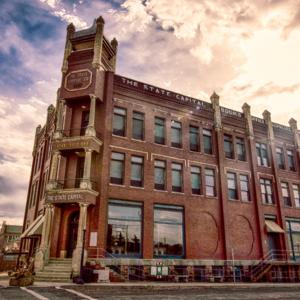
Built in 1890 by Irwin S. DeFord, self-described “money-lender” and capitalist, the DeFord Building is perhaps the gem of Joseph Foucart’s architecture in downtown Guthrie.
The sidewall, facing “Government Acre” surrounding the Land Office, is even more distinguished than its front, featuring contrasting-colored arched windows with worked wooden fans above corbelled brick, with a small turret marking the south end. Detailed acanthus leaves decorate capitals of defining pillars.
DeFord lived upstairs in the building when completed, and the New York Clothiers (Cohen and Strauss) were on the first floor. By 1892, however, the U.S. Post Office temporarily replaced the clothing store. Offices for lawyers were located on the 2nd floor. The U.S. Courtroom was located in the basement until the Federal Building (Post Office and Courtroom) was completed in 1903.
Flora M. Willis purchased the building in 1904. She and her first husband, Joseph Willis ,operated their general store there. Later, the store was used exclusively for furniture, and they added the Willis Building immediately south in 1914.
After Willis died, his widow operated the store alone until she married E. W. Knightlinger in 1923, and he joined her in the business. She died in 1955, and Mr. Knightlinger continued operation of the store through 1981. Both the DeFord and the Willis Buildings have been scrupulously maintained by the owners.
Mr. Knightlinger (whose picture is shown) deeded the DeFord building as a gift to the Logan County Historical Society on Dec. 7, 1981.
Transcription from historical marker:
One of the most popular of the numerous saloons in Guthrie during Territorial times, the Blue Bell was an 1889 enterprise of John Selstrom and Jack Tearney. It boasted Tom Mix as a bartender before he departed for stardom in silent films, and Temple Houston, famed attorney, as a favorite customer.
The original frame structure was replaced in 1903 by the present brick edifice, probably Guthrie’s only commercial building with two beveled entryways, front and back. The “C-11” crest over the front doorway is the insignia of Ned Cheadle, local agent and bottler for the Ferd Helm Brewing Co., whose brother company, Freemont Land and Improvement Co., built the structure.
Besides the saloon, the building in 1903 housed a restaurant on the Harrison Ave side and a music store on the Sound Second St. side. Its upper floor, officially called a “hall,” consisted of 17 small rooms surrounding a lobby and was probably a bordello. It was connected in early days by an iron sky-walk to the Elks Hotel across the alleyway.
After prohibition (concurrent with statehood, 1907) various businesses occupied the lower floor. A bar was re-established when prohibition was repealed in 1959, and it was re-named “Blue Bell” in 1977. Much of the original interior is still in place.
Transcription from the historical marker:
Erected in 1890, the International “Block” was named for its builders, the International Loan and Investment Company. H.J. Whitley and George D. Orput, prime movers of the Guthrie Club booster organization, were heads of the company, financed by New York and Pennsylvania investors. The Guthrie Club later became the Chamber of Commerce.
Lillie’s Drug Store occupied the first floor of the building when completed, and offices for Oklahoma Territory were on the upper floor. A basement barber shop was opperated by F.E. Knowlton, who developed his famed Danderien Hair Tonic there.
Stables for horses of the occupants were an adjunct to the basement. These stables extended out under the sidewalk adjoining the structure, and included stalls with harness racks and other refinements.
The building was one of several built in similar pattern throughout the Territory by the company. It gradually lost its glory and was condemned as unsafe in 1963. It was then razed.
Transcription from the historical marker:
During the 17 Territorial years, open saloons thrived in Guthrie. One of the most popular was the “Same Old Moses” operated by Moses Weinberger, a settler from Wichita, Kansas.
Weinberger made the Run selling bananas April 22, 1889, and soon established a fruit stand at 218 West Oklahoma. Thinking liquor more profitable than perishable fruit, he obtained a goverm,ent liquor license and opened one o the first legal saloons and wholesale liquor businesses in the area. Although he moved his saloon several times, he was a popular “mein host,” and his business at 211 West Harrison flourished.
Carry Nation, well known prohibitionist leader, was living in the capital city, and repeatedly threatened the local saloon keepers. She reportedly wielded her bar-breaking hatchet against the “Same Old Moses,” and Weinberger, seeing the publicity good for business, responded with a sign: “All nations welcome except carry.”
Strict prohibition came with statehood in 1907 and Weinberger, by then located in the basement of the Lyon Building, 102 West Harrison, sold his stock and swung the saloon doors closed for the last time.
Transcription from the historical marker:
Triumph of its time, the “Victor Block” was built in 1893 as the finest commercial building in Guthrie by Winfield S. Smith, who constructed many of the downtown business structures. Besides Lillie’s Drug Store, the building also held a number of Territorial offices, several saloons, a wholesale liquor business, and a ballroom on its third floor. Its basement connected with other downtown buildings via tunnels. Associated Order of United Workmen Insurance Offices were later in the building, as well as state headquarters of that mutual organization. The basement became a bowling alley in the late 1960s.
Restoration began in 1981 as part of the Historic District Preservation Movement. It is considered one of Joseph Foucart’s best designs.
Transcription from the historical marker:
Restored in 1980 to its original look, the Foucart Building was built in 1891 by Edward T. Patten to house the Boston Store (dry goods) managed by J.M. Brooks, later builder of Brooks Opera House. George King’s New York Racket Store (notions, general) succeeded the Boston by 1899. (Racket was “society” slang for a fashionable crowded fete.)
National Biscuit Co. leased the space for offices in 1911. Later occupants were a repair shop and, in 1920, E. A. Neher’s Paige Automobile Agency.
The building was returned to retail merchandising in 1928 when John E. Gaffney moved his furniture store there. Successive owners continued furniture sales until 1974, after which the building became vacant.
The building was designed by Joseph Foucart, who had his office in the 3rd floor tower from 1893 to 1897. These were among Foucart’s most productive years as an architect in the growing Territorial capital’s business district. As his office site, and because the native sandstone edifice emphasizes his distinctive style, the structure became known by his name rather than that of the builder.
The 1980 façade restoration was he first completed in the Guthrie Historic District Restoration Program, sponsored by the Logan County Historical Society.
Transcription from the historical marker:
Home of the Guthrie Daily Leader since 1894, the “Waite Block” was built in 1891 by A.H. Waite, manager of the Kansas City Mercantile Co. to house two separate retail establishments.
The Leader was founded in 1892 as the Territory’s Democratic newspaper. Brought to prominence by editor Leslie Niblack, it moved by 1894 into the east half of the building with presses on the ground floor and editorial offices above.
By 1903, the Leader expanded to use both bays, with a book binding operation on the second floor above the presses and office.
After purchasing the assets of the State Capital in 1911, the Leader expanded its circulation. The editorial offices were again on the second floor during the 1920s, moving back to the first floor during the 1930s. In 1933, the interior separating wall was removed in extensive remodeling which included an exterior coat over the original brick and stone construction. Several changes in editors and ownership occurred during this period. Offset printing presses were installed in 1967.
In 1976, the structure was completely remodeled inside and out by the present owner, Donald W. Reynolds of Donrey Media Inc. The façade does not follow the original design, but is derivative of Victorian architecture of the period when the Leader’s establishment saw Harrison Avenue bloom as the center of commercial Guthrie.
The Leader, with its annual ‘89er Special Editions, has long been in the forefront of Guthrie’s Historic Preservation Movement.
Transcription from the historical marker:
Two weeks after was declared on Spain, 85 volunteers, mostly members of the Territorial National Guard, on May 5, 1898 filled the Territory’s quota as Troop A of First United States Volunteer Cavalry, the famed “Rough Riders.”
Examined and issued orders from “Camp George W. Steele” in the McKay Building, 103 East Harrison, they were sworn into federal service on the vacant lots across the street. There was much fanfare; the City of Guthrie also presented a horse to Capt. Robert B. Huston, troop commander. They were joined at San Antonio, Texas by units from Arizona and New Mexico Territories for brief training before fighting as dismounted Troop D at the July 1 and 2, 1898 Battle of San Juan Hill under Lt. Col. Theodore Roosevelt, who later visited veterans of the troop in Guthrie.
In response to the clamor to serve, formation of the First Territorial Volunteer Infantry allowed more Guardsmen to enlist for the Territorial quota. Guthrie’s group was joined by men from Pawnee to make Company 1. After mustering ceremonies on the vacant lots, the company marched under command of Capt. Harry C. Barnes to the depot to entrain for Fort Reno. They were joined by four other companies from Oklahoma and Indian Territories. Later, units from Arizona and New Mexico joined them for training in Kentucky and Georgia before they were mustered out of service in February 1899.
From the publisher's feed