
Sign up to save your podcasts
Or



Transcription from the historical marker:
The 1890 City Directory lists 107 S. 2nd as F. C. Bonfils Real Estate with residence on 2nd floor. Son of a Missouri Judge and descendant of Napoleon, he was 28 when he joined the Land Run of 1889. A colorful con man and lottery promoter, he had but one intention -- to make money for Bonfils. His confidence games forced him to leave town after constructing this first native stone business building in Guthrie. Among his schemes was selling town lots in Oklahoma City at bargain prices -- but they were in Oklahoma City, Texas, not Oklahoma, as most supposed. Bonfils was also involved in a "money-making machine" which duped early settlers into believing the machine actually made large bills from small ones.
He later went to Denver and was co-founder of the Denver Post newspaper. He died 1932, a wealthy and nationally influential figure.
Transcription from the historical marker:
117 S. 2nd
"Oklahoma -- an all black state with a black governor -- was the dream of E. P. McCabe, lawyer, farmer, and Republican activist. McCabe vigorously promoted black settlement and assumed role as spokesman for black people in Washington with President Benjamin Harrison.
As a candidate for Territorial Governor, he was quoted in the St. Louis Globe-Democrat: "Should I become governor, I promise to rule fairly and fearlessly." McCabe became Logan County treasurer by appointment of Gov. Steel in 1890. He served as secretary of the Territorial Legislature in 1890, and was deputy auditor of the Territory from 1897 to 1907.
He was chiefly responsible for the founding of Langston and helped in the location and establishment of Langston University."
Transcription from the historical marker:
"One of the most notorious gambling houses of the Southwest opened in a tent on April 23, 1889. Soon a frame building went up, later replaced by brick. The owners claimed their doors never closed, day or night, for 15 years. When closed by prohibition in 1907, a key could not be found. Inside, a sign proclaimed:
'We the citizens of Guthrie are law-abiding people. But to any one coming here looking for trouble, we always keep it in stock with a written guarantee that we will give you a decent burial. We will wash your face, comb your hair, and polish your boots. Place your sombrero on your grave, and erect a memento as a warning to others saying … ‘he tried and failed.’''
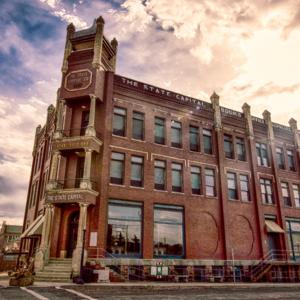
Transcription of the historical marker:
"Built in 1902 by Frank Hilton Greer, this building housed the first newspaper in Oklahoma Territory and the largest printing plant west of the Mississippi.
The paper actually began in Kansas before the Run and came to Guthrie with the opening. It soon outgrew its tent. A wooden structure, soon replaced by brick, was erected on this lot. After a fire Easter Sunday, 1902, this building was erected with help of popular subscriptions in the amount of $50,000.
Greer developed a politically powerful newspaper with the largest circulation in the Territory aided by installation of the first Linotype in Oklahoma. He embarked upon a campaign of scathing criticism of Gov. Haskell, first state Governor. Haskell, enraged, threatened to “see grass grown in the streets of Guthrie” if Greer were not silenced. Greer would not be budged and, largely through Haskell’s efforts, the 1910 referendum moved the capital to Oklahoma City.
As a Bicentennial Project, the building was given in 1975 to the Oklahoma Historical Society for a printing museum. The building is a Joseph Foucart design and is a National Register Site. On February 17, 1972, the Oklahoma Press Association officially endorsed the Printing Museum as a project."
From the publisher's feed