
Sign up to save your podcasts
Or



Transcription from historical marker:
Built in 1899 as an adjunct to the Royal Hotel, the Brooks was praised in its day as the finest theater in the Southwest. It presented popular entertainments and was also the setting for many dazzling “first nights” for territorial society.
Some historic events of its golden years: the opening session of the Oklahoma Constitutional Convention, and an address by William Jennings Bryan, the Great Populist, in a campaign tour. Lon Chaney, famed motion picture actor, began his career here as a stagehand. Later years saw the Brooks become the Avon motion picture theater before it was razed in 1967.
(Editor's note: this historical marker is ... well ... let's just say it's based a little more on myth than fact :)
Transcription from historical marker:
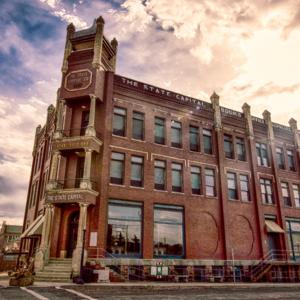
This building was the state capitol when the state seal was stolen from here and taken to Oklahoma City on the night of June 11, 1910, thus moving the site of the state capitol. The first University of Oklahoma was located here in 1892. It operated as such for two years.
Erected by Fogarty Jr. High Oklahoma History Classes 1954-55
Transcription from historical marker:
Birthplace of the Scottish Rite of Freemasonry in Oklahoma
On October 4, 1899, William L. Eagleton, Grand Master of Masons for Oklahoma Territory, laid a cornerstone at this site for the construction of the first Scottish Rite Masonic Temple in Oklahoma.
The Temple occupied the south half of this block and boasted a larger auditorium, stage and proscenium than the Brooks Opera House, also located in downtown Guthrie. It was fitted with all the modern improvements, including electric lights. The architect for the building was D.W.F. Turbyfill, Oklahoma City.
The Dedication Reunion of the Guthrie Scottish Rite Bodies was held on May 29-31, 1900. A class of 47 candidates emerged as 32 degree Masons, thus launching what would become one of the largest Scottish Rite Masonic organizations in the United States.
In 1920, a new edifice was constructed by the Scottish Rite at 900 East Oklahoma Avenue. The first Scottish Rite Temple in Oklahoma was finally razed in 1956.
Transcribed from the historical marker:
Two buildings designed to look as one, the De Steiguer building was an ornament of East Guthrie. Built in 1890 by the banking pioneer De Steiguer brothers, Rodolph and Louis. It housed their Bank of Guthrie in the west section, and a tobacco company operated by E.G. and A.J. Millikan (brothers) in the east part. The De Steiguers and later the Millikans lived in apartments above.
One of the few historic downtown structures with a façade of Oklahoma’s native red sandstone, the building was a grace note for the street with its double oriels, each flanked by arched windows outlined with two shades of coursed stone.
The De Steiguers and their troubled bank soon passed from the scene. The building saw many changes in occupants and numerous tax-title changes in ownership before reaching the tranquility of its present ownership and occupancies.
Transcript from the historical marker:
After successful settlement of rival claim to the lots by one Xenophon Fitzgerald, the Logan County Investment Co. built this imposing structure in 1901, financed by St. Louis, Missouri investors who foresaw a solid future for the town and territory.
Immediately upon completion, its ground floor was occupied by the Logan County Bank. Its upper floor was leased to the Territory for offices of the last Territorial Governors: Jenkins, Grimes, Ferguson, and Frantz. A basement stable for horses and carriages of tenants was provided, forerunner of today’s parking garages.
Transcript from the historical marker:
Wm. H. "Harry" Gray, a naturalized Canadian, homesteaded the lot bearing the west half of this building. He staked it April 22, 1889 and immediately relocated his grocery and wholesale business from Udall, Kan. His brother, George, joined him in buying the corner lot, where they built in 1890 the elaborate brick and sandstone structure that commands the intersection.
Gray Bros. continued the grocery business, adding queensware and feed in a frame building, razing it, and adding the west half of the present structure in 1903. It can be distinguished by slightly different spacing of the cornice "torches" and facade treatment.
The west half housed Gray Bros. store, followed by F.E. and J.F. Houghton's Bank Grocery and subsequent varied retail establishments. W.H. Gray kept an office on the 2nd floor, managing his extensive holdings.
The east half of the building originally housed the Bank of Indian Territory and later the Oklahoma State Bank. Guthrie's superintendent of schools had offices on the 2nd floor in 1892 and by 1893 the town's first telephone exchange was also there.
The property was leased in 1926 Jelsma Abstract Co. A barber shop was located in the basement until the mid-1970's. The building's Russian-capped oriel, beveled corner, elaborate metal cornices, arched windows, and combined use of native sandstone and dark red brick suggest it was a Joseph Foucart design.
Transcript from historical marker:
Winfield S. Smith, Guthrie City Councilman and builder of many early commercial buildings, granted by deed on July 28, 1899 to Nathanial McKay the right to build a two-story, 8 x 10 feet brick privy on his property (Lot 23) with right of access to occupants of that lot as well as those of lots 24 and 25. McKay, a transplanted easterner who became a Guthrie developer, was charged with keeping the privy maintained and in good repair when he purchased the lot and its "Triumph Building. Tenants of the building were assured of two seats on each floor of the privy.
While no photograph of the privy exists, the artist's sketch indicates the type of structure and the covered walk assuring access from the second floor of the building.
GUTHRIE NATIONAL BANK
202 W. Oklahoma Ave.
Rushed to completion in the summer of 1889, the Guthrie National Bank building was the first brick structure built in what became Oklahoma Territory. It also proudly claimed many other firsts. It was located where J.W. McNeal of Medicine Lodge, Kansas, opened the McNeal-Little bank with his partner, A.W. Little, the afternoon of April 22, 1889. It became, as the Guthrie National Bank, June 14, 1890 the first national bank chartered in either of the twin territories.
As the premier structure in the infant city, the building housed the "grand reception" for the visiting delegation of Congressmen in September, 1889.
Once finished, the building was crowded with tenants. Besides the bank, it housed Beadle's shoe store on the west side, "Oklahoma Farmer" newspaper and the Guthrie Club, a booster organization, shared the basement. Territorial Governor Steele in 1890 had an office on the 2nd floor for a few months, until larger quarters were available.
After consolidating and acquiring various other Guthrie banks, the parent company crowded out its tenants. It became known as the First National Bank of Guthrie in 1912. The present building replaced the first structure in 1923.
Transcript from historical marker:
NOBLE AVENUE VIADUCT BRIDGE TIMELINE
Early 1889 - The first crossing of the creek was with a single foot log and an enterprising young man charging a dime to walk across or fall in.
Late 1889 - A timber truss bridge was constructed. Following many flood events, the bridge washed out.
1905 - A Steel truss bridge was constructed. This bridge was closed to traffic by 1920.
1935 - Preparation for the double-decker bridge begins. The bridge was completed in late 1936.
THE NOBLE AVENUE VIADUCT est. 1936, Guthrie, Oklahoma
Unique In Design
Homer X. White a bridge engineer with the Oklahoma State Highway Commission, developed the design to address the specific needs of this crossing.
Design Purpose: 1. Carry Noble Avenue traffic and pedestrians safely over Cottonwood Creek and the railroad tracks. 2. Maintain vehicle access to the large ice plant and railroad tracks located on the east side of the creek.
Bridge Features: Features are typical of other bridges from that time period and were based on the standardized plans from the Oklahoma Highway Commission.
The double deck design and steep vertical geometry is considered entirely unique to this bridge. There are no other known bridges within Oklahoma to have a similar design.
OPENING DAY
The bridge was dedicated with a parade and ceremony on March 17, 1937, with a reported 1,500 spectators crossing the bridge. Invited dignitaries from the state and national level included the Chairman of the State Highway Commission, State Senators and Representatives, he Guthrie Mayor, and the State WPA Director.
"an important milestone in the civic development of the city." - The Guthrie News Leader on the Bridge Dedication Day.
The First Bridge
The first bridge constructed over the creek was a timber Pratt through truss bridge completed late in 1889. This bridge was washed away within a few years and it is possible that several other iterations were also constructed and lost over the next 5 -10 years.
Cottonwood Creek
The creek was an important body of water for the establishment of Guthrie. The location was prime because of its proximity to rail lines and a water source.
The creek provided advantages to the city, however it was also a major source of trouble for the community.
Flooding events were common, and continue to present day. The flooding events not only wreaked havoc and inconvenience upon the townspeople, but they occasionally resulted in loss of life.
THE NOBLE AVENUE VIADUCT BRIDGE
The concrete double deck bridge was built in 1936. The initial plan was to use labor and funding from the Public Works Administration, but it was completed with the Works Progress Administration labor and funding. At the time of its demolition, it was the only known double deck bridge in Oklahoma.
The city of Guthrie and Logan County worked with the Oklahoma State Highway Commission, federal engineers, and the railway engineers to secure funding through the Public Works Administration's Grade Crossing Relief Program to construct a viaduct carrying Noble Avenue over Cottonwood Creek and the Santa Fe Railroad tracks.
The via duct was a primary travel route over Cottonwood creek; however flooding events at the creek continued to wreak havoc on the bridge and the route, with road closures occurring several times annually due to water overtopping the bridge.
Ultimately, there was no way to save the historically significant bridge while still maintaining a safe passage for travelers over Cottonwood Creek.
Transcript from historical marker:
Guthrie's building spree peaked April 9, 1902, with laying the cornerstone for its commodious City Hall, designed by Joseph Foucart, in his best belfry and turret style. The building's second floor assembly room was used for the Constitutional Convention, beginning November 1906, as elected delegates hammered out Oklahoma's State Constitution.
Almost as soon as the villages of Guthrie united into a city, a fitting municipal building for the Territorial Capital was envisioned, and lots were purchased in 1891. When built, the $25,000 City Hall held all city offices and a jail, as well as the assembly room.
The assembly room was freely used for civic purposes: Inaugural balls for Territorial Governor Frank Frantz and first State Governor Charles N. Haskell: early county fairs; and many public events through the years, including basketball games during the 1920's. Use was denied Carry A. Nation in 1906, however, on one of her prohibition speaking tours, to her bitter and vocal fury.
Somehow, the City Hall lots were not removed from the county's tax rolls, and in November 1912, F. L. Williams paid the $7.45 taxes due and received title to the lots. He sold them back to the City for $8.00 in December 1915.
By a slender margin, bonds were voted to a new City Hall and the old building was razed in July 1955. Bricks from the old building were used for the entryway paving of the present structure.
From the publisher's feed