
Sign up to save your podcasts
Or



Based on Podcast App listening data
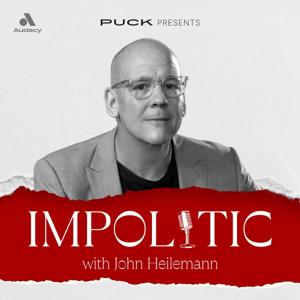
John welcomes back Skybridge Capital founder and Trump Wall Street apostate Anthony Scaramucci to discuss the president’s mindset and machinations as he barrels towards a brutish repudiation in the midterm elections. Scaramucci—who served an inglorious, 11-day stint as White House communications director in 2017—explains how Trump’s view of his power to save his party sits alongside his barely concealed desire to see its members crash and burn; how his attacks on the Pope earlier this year were a roundabout effort to mess with JD Vance; and why Natalie Harp is more likely to be Trump’s nursemaid than concubine. The Mooch also expounds on his new book, “All the Wrong Moves: How Three Catastrophic Decisions Led to the Rise of Trump.”
John welcomes former UCLA and Milwaukee Bucks star Marques Johnson to discuss his new book, “The Crenshaw Chronicles,” and all things NBA. Johnson explains why the infamy of his high school alma mater as an epicenter of South Central LA's gang culture, though not unearned, is only part of the story; what it was like to be a five-time All Star in the 1980s still overshadowed by Bird, Magic, and the other MJ; his repeated snubs by the Basketball Hall of Fame; and how he wound up playing a blade-wielding playground baller in “White Men Can’t Jump.” He also weighs in, from his perch as a Bucks TV analyst, on Giannis’s Milwaukee exit, Lebron’s Philly relocation, and Wemby's paradigm-shifting potential.
John welcomes Washington Post tech culture reporter Nitasha Tiku to discuss this mind-blowing, deeply unnerving moment in the evolution of AI. Tiku explains the genesis of the fears that the systems being developed by the AI frontier labs could ultimately end the human race; how AI extinction scenarios migrated from fringe Bay Area subcultures into the labs themselves, then into elite institutions, and now to the center of the mainstream political and cultural discourse; how the labs are confronting the ethical and moral implications of what they’re building; and why, when it comes to the debate over AI regulation, we should focus less on what industry leaders are saying and more on what they’re doing.
John welcomes retired three-star general and former U.S. Army Europe commander Mark Hertling to discuss Donald Trump’s turns on the world stage at the United Nations General Assembly and China summit with Xi Jinping. Hertling argues that, contrary to Trump’s claim that the Iran war will end after the midterm elections, it's more likely to go on for years; that his U.N. speech was “anti-American” and his handling of the Xi meeting, deeply unserious; and that America's military leaders saw his performances in both venues as “beyond embarrassing.” Hertling also explains why it will take “generations to rebuild” the armed forces after the damage being done to them by Pete Hegseth.
John welcomes Naomi Klein, arguably the left’s most prominent and influential public intellectual, to discuss her new best-selling book, “End Times Fascism,” co-authored with Astra Taylor. Klein—whose 2000 book, “No Logo,” became a manifesto for the turn-of-the-millennium anti-globalization movement, and whose 2008 tome, "The Shock Doctrine," introduced the concept of “disaster capitalism”—explains that “End Times Fascism” is the apotheosis of all her work to date; how an unlikely coalition of religious fundamentalists, Silicon Valley tech barons, and far right ethno-nationalists has embraced varying forms of apocalypticism and taken center stage in our politics; and how that alliance can be defeated.
From world events to everyday decisions, economics explains it all. Platypus Economics makes it clear, useful, and actually fun. Available now: link.pscrb.fm/f0281/PE_IMPOL
John welcomes back Alex Wagner, host of Runaway Country for Crooked Media and senior political analyst at MS Now, to discuss her new book, “The Steal: Four Right-Wing Hard-Liners, One Republican Presidency, and the Raid on America's Courts.” Alex examines the half-century genesis of the conservative takeover of the federal judiciary, its resemblance to a heist movie, and the quartet of thieves—Paul Weyrich, the mastermind; Ed Meese, the inside man; Robert Bork, the public face; and Joe Coors, the money—central to the caper. She also assesses a raft of recent developments: James Talarico’s trolling of Ken Paxton in Texas, Hasan Piker’s ongoing bedevilment of Abdul El-Sayed in Michigan, and Donald Trump’s blithe reaction to the rampant fears in the AI industry that its products may kill us all.
John welcomes Jacob Weisberg, co-founder of Pushkin Industries and former editor of Slate, to discuss his new book, “Profiles in Cowardice: A Study of Collaboration in the Trump Era.” Weisberg explains how he took the format and framing of “Profiles in Courage,” John F. Kennedy’s classic examination of moral leadership in politics, and turned it inside out, focusing not on the admirable but the culpable; and why some of America’s best-known and most powerful public figures—from Jeff Bezos and Stephen Schwarzman to John Roberts, Megyn Kelly, and Mitch McConnell—became complicit in a signal feature of Donald Trump’s second term: the remarkable degree of capitulation to a president few of them like or respect and many once resisted.
John welcomes back Searchlight Institute president Adam Jentleson to discuss the post-Labor Day Senate battleground map and his new book, “Supermajority: How Democrats Can Build Lasting Power.” Jentleson explains why cautious optimism is in order about his party’s prospects of retaking the upper chamber; how the strength of James Talarico and Rob Sand (in the Texas Senate and Iowa governor’s races, respectively) are rooted in the sort of ideological heterodoxy Jentleson champions in his book; why the razor-thin margins and slim majorities of our time are historical anomalies; and the degree of compromise Democrats will need to accommodate to build governing coalitions broad enough to last.
John is joined by Lawrence Wright, Pulitzer Prize-winning author of “The Looming Tower: Al-Qaeda and the Road to 9/11,” to commemorate the 25th anniversary of the 2001 attacks on the World Trade Center and the Pentagon. Wright explains what we understand today about 9/11 that we didn't understand at the time, and what we still don’t know; how the war on terror waged in its aftermath changed America, the world, and us; and the terrible possibility that, in the end, Osama bin Laden achieved more of his goals than we care to admit.
From the publisher's feed
Ranked by our users in the last 21 days

4,452 Listeners

301 Listeners

6,600 Listeners
3,356 Listeners
12,515 Listeners
4,603 Listeners
8,030 Listeners
8,090 Listeners

269 Listeners

85,617 Listeners

108 Listeners
3,981 Listeners

693 Listeners
559 Listeners
10,411 Listeners
9,190 Listeners

373 Listeners
2,631 Listeners

1,171 Listeners
1,885 Listeners
12,716 Listeners
2,034 Listeners

204 Listeners
2,240 Listeners
3,186 Listeners

86 Listeners
6,927 Listeners

116 Listeners
3,455 Listeners

241 Listeners
804 Listeners
1,092 Listeners
769 Listeners

172 Listeners