Intentional Growth

Intentional Growth

By Arkona - Intentional GrowthBusinessEntrepreneurshipInvestingManagement
Download on the App Store

Intentional Growth episodes

  • #383 - The Billionaire Mindset: Why Average Equals Death with Richard Wilson the Founder of the Family Office Club
    In this episode I talk with Richard Wilson, who's had the unique opportunity to interview numerous billionaires, sheds light on what really sets these individuals apart. It's not just about having groundbreaking ideas or exceptional skills; it's about their mindset and approach to life and business.
     
    THREE BIG IDEAS FROM THE INTERVIEW:
    The Significance of Family Offices in Wealth Management: Richard discusses how family offices have evolved and become crucial in managing the wealth of the ultra-rich. He emphasizes the importance of understanding what a family office is and how it operates to effectively manage significant wealth.
    The Power of Networking and Learning: Richard highlights the value of consistently learning from high achievers like billionaires. His journey of interviewing and learning from billionaires offers unique insights into their thought processes and success strategies.
    Balancing Wealth and Health: An intriguing part of the conversation revolves around the idea of not just being wealthy but also being healthy. Richard stresses the importance of maintaining a balance between accumulating wealth and taking care of one's health and well-being. 
     
     
    RESOURCES:
    Family Offices
    Investor Club
    Text Richard at 305-333-1155
    Billionaires.com
     
    PODCAST INTERVIEW QUOTES:
    06:40  - “So it seems like every time I've had success, I've taken the same approach of really de -risking the situation by taking tons of actions and trying different combinations of approaches.” - Richard C. Wilson
    11:34  - “I have this theory that if you have the most fun year of your life… you know yourself well enough to know what you enjoy and what you're great at. If you focus on having the most fun year of your life, you're a better example to those around you… So the combination of those two things is very important.” - Richard C. Wilson
    18:53  - “If you have a strong consistent work ethic combined with focus, like you will run circles around other people.” - Richard C. Wilson
    30:40  - “If you can't say it in a simple way over email then you really don't know what you're doing.” - Richard C. Wilson
    34:08  - “Likely you're doing five to 12 different things in your business and you should only be doing maybe it. 20 % of what you're doing now.” - Richard C. Wilson
    47:22  - “Do some real work on how you get into an ideal peak state of mind, correct yourself when you go off the rails and something gets you off your ideal state of mind.” - Richard C. Wilson
     
    INTENTIONAL GROWTH™ RESOURCES:
    Intentional Growth™ Podcast Archives: Archive of 356+ episodes and counting. Get access to the entire library HERE. We'll be adding a searchable tagging feature later on this year.
    IG Financial Scorecard: Get your Intentional Growth™ Score that grades you on how well you are viewing - and running your business like a financial asset. Get your results and 5 case study videos
    58 min
  • #382: Q4 2023 Economic and M&A Update with Brian Beaulieu and Jeff Buettner
    In this insightful episode of the podcast, we delve into the complexities of the current economic landscape with a focus on the forecast for 2024, the implications of a mild recession, and strategies for businesses to navigate these challenging times. The discussion also covers the evolving dynamics of wholesale trade, financial market volatility, and the impact of geopolitical events on global economies.
     
    THREE BIG IDEAS FROM THE INTERVIEW:
    Mild Recession in 2024 and Opportunities It Presents: The episode discusses the anticipated mild downturn in 2024. Despite this, there are opportunities for entrepreneurs to capitalize on, particularly as the U.S. economy is expected to rise in the second half of 2025 and beyond.
    Economic Volatility and Its Implications: The podcast highlights the elevated volatility in financial markets and other sectors like oil, emphasizing the need for businesses to be prepared for rapid changes and unexpected developments.
    Impact of Geopolitical Events and Changing Global Dynamics: The conversation sheds light on how geopolitical events, such as the evolving relationship between China and the United States, are influencing global economic trends and supply chains.
     
    ABOUT BRIAN BEAULIEU:
    Brian Beaulieu has served as CEO and Chief Economist of ITR Economics since 1987, where he researches the use of business cycle analysis and economic forecasting as tools for improving profitability. Brian has shared his highly valued research results via presentations, workshops, and seminars in numerous countries to hundreds of thousands of business owners and executives for the last 40 years. He is coauthor of Prosperity in the Age of Decline, a powerful look at how to make the most of the US and global trends over the next 20 years, as well as Make Your Move, a practical and insightful guide to increasing profits through inevitable business cycle changes. Brian also coauthored But I Want It!, ITR Economics’ first children’s book. Brian serves on the board of directors for the Ariens Company, a leading global manufacturer of outdoor power equipment, as an advisor to Ackerberg Investors Fund III, as well as the board for Bellwether Wealth, an investment management and strategic wealth planning firm based in Lincoln, NE. 
    Brian has shared his expertise through various media outlets, including: USA Today, Knight Ridder, The Atlanta Journal-Constitution, The Wall Street Journal, Barron’s, The Washington Post, Kudlow and Friends, First on Fox, and numerous other outlets.
     
    Resources:
    ITR Economics
    Sign Up for the 2030s Great Depression Update (Webinar)
    Facebook
    Twitter/X
    1 hr 7 min
  • #381: The Growth Dilemma: How To Fund Your Target Equity Valuation So It Aligns with Your Goals with Ami Kassar
    In an era where entrepreneurship is booming, financial literacy becomes a cornerstone for success. This podcast, I talk to Ami Kassar, an expert in business financing, who shares invaluable insights into the world of debt markets, particularly focusing on SBA (Small Business Administration) loans, and the crucial role of financial literacy in entrepreneurial ventures.
     
    THREE BIG IDEAS FROM THE INTERVIEW:
    Understanding Different Debt Options: It's crucial for business owners to understand their financial stories and needs. Ami emphasizes the importance of knowing the debt markets and selecting appropriate financing options, such as SBA loans, to retain control and avoid equity dilution.
    Financial Literacy and Forecasting: The podcast highlights the lack of financial literacy among many entrepreneurs. A key takeaway is the need for a well-thought-out financial forecast and projection, allowing business owners to make informed decisions about their cash needs and financing options.
    The Right Use of Debt and Equity: The discussion sheds light on the appropriate use of lines of credit (for emergencies and operational needs) versus term debt (for investments in growth). Additionally, the conversation stresses the importance of understanding the differences between equity and debt, especially in terms of control and decision-making in the business.
     
    PODCAST INTERVIEW QUOTES:
    04:14  - “We work with business owners and entrepreneurs to try and understand their stories, to try and frame and get a clearer concept of what's going on and what their needs are to achieve their goals.” - Ami Kassar
    07:17  - “SBA lending as a whole has a branding problem..” - Ami Kassar
    14:28  - “Our whole mantra or culture or values here, or treat an entrepreneur like we want to be treated. I had my lights turned off a couple of times building my company. I don't want that to happen to anybody else if they can possibly help it.” - Ami Kassar
    18:54  - “What I always say to people is slow that down. Slow down. Take a breath. What are we trying to fulfill here? What are we trying to accomplish?” - Ami Kassar
    37:37  - “My credit in my opinion is like an insurance policy. I don't care if you never touch it. It's fine with me if you never touch it but it should be there.” - Ami Kassar
    38:33  - “You never will be in a situation, if you can possibly help it, where a lender smells blood and desperation.” - Ami Kassar
     
    INTENTIONAL GROWTH™ RESOURCES:
    Intentional Growth™ Podcast Archives: Archive of 356+ episodes and counting. Get access to the entire library HERE. We'll be adding a searchable tagging feature later on this year.
    IG Financial Scorecard: Get your Intentional Growth™ Score that grades you on how well you are viewing - and running your business like a financial asset. Get your results and 5 case study videos HERE.
    Intentional Growth™ Academy: 71 Videos, 9.5 hours of content, 20+ exercises. $995 for subscribers [normally $1,495]
    57 min
  • #380: 2024 Planning: Leveraging EOS, Strategic Planning, Budgeting & Forecasting to Hit Your Target Equity Valuation [Part 2]
    Today I break down the intricacies of annual planning, focusing on how to effectively use an operating systems like EOS© (Entrepreneurial Operating System) by integrating budgeting, forecasting, and projecting company value. I emphasize the importance of tying your short and long-term goals (e.g., your V/TO) to a target equity valuation, understanding financial constraints, and making informed decisions for investment and growth. I also cover the budgeting processes and how to align financial strategies with overall business objectives, offering valuable tips for business owners aiming for stress-free planning and clear future visibility.
     
    3 Key Takeaways:
     
    1. Target Equity Valuation as a Central Goal: One of the key points highlighted is the significance of setting a target equity valuation for the company. By reverse-engineering this goal using the three financial statements (income statement, balance sheet, cash flow statement), business owners can better understand the trade-offs and decisions required for growth while creating  sustainable, predictable, and transferable cash flow..
    2. Strategic Use of Budgeting and Forecasting: The podcast dives into the strategic use of budgeting and forecasting, emphasizing the need for a realistic and achievable plan that aligns with the owner’s  financial goals and targets. I highlight the importance of understanding the future cash position and the impact of various financial decisions on the company's trajectory.
    3. Integrating Financial Statements into Planning: I stress the importance of integrating all three financial statements into the planning and forecasting process. This integration allows for a comprehensive view of the company's financial health, aiding in making more informed decisions regarding investments, distributions, and growth strategies.  
     
    INTENTIONAL GROWTH™ RESOURCES:
    Intentional Growth™ Podcast Archives: Archive of 356+ episodes and counting. Get access to the entire library HERE. We'll be adding a searchable tagging feature later on this year.
    IG Financial Scorecard: Get your Intentional Growth™ Score that grades you on how well you are viewing - and running your business like a financial asset. Get your results and 5 case study videos HERE.
    Intentional Growth™ Academy: 71 Videos, 9.5 hours of content, 20+ exercises. $995 for subscribers [normally $1,495] HERE
    45 min
  • #379: 2024 Planning: Leveraging EOS, Strategic Planning, Budgeting & Forecasting to Hit Your Target Equity Valuation [Part 1]
    Today we start the two part series with a conversation around effective annual planning strategies with CEO Nexus owner (a CEO Peer Group), Steve Quello. Our discussion highlights the importance of integrating the financials - and a target equity valuation - into structured frameworks like EOS©, which aids in scaling and managing businesses through vision, data, process, and traction. We break down the role of financial literacy, and the power budgeting and forecasting bring to decision-making, particularly aiming for normalized EBITDA over arbitrary revenue targets. Additionally, we discuss the value of peer groups and people who can hold you accountable, while also enhancing the planning and budgeting process.
     
    THREE BIG IDEAS FROM THE INTERVIEW:
    1.The Importance of Structured Frameworks in Business Growth: These frameworks (e.g. EOXS©) provide a disciplined approach to managing and scaling businesses, focusing on vision, data, process, and traction.
    2. Integrate the Financials into EOS© and/or Your Long-Term Plan: By understanding and aligning the income statement, balance sheet, and cash flow statement, you can integrate your budgeting process right into your annual planning. This will allow you to make more informed decisions that are aligned with your long-term financial goals, particularly focusing on normalized EBITDA, future cash flow, and a target equity valuation, rather than arbitrary revenue targets.
    3. Utilizing Peer Groups and Regular Review for Effective Planning: Steve highlights the value of peer groups, such as CEO Nexus, in providing support and external insights for better decision-making and accountability.
     
    ABOUT STEVE QUELLO:
    A career, like any journey, is subject to chance encounters and events that influence the choices and ultimate course of that journey. It was such an encounter that changed the career path for Steve Quello when he met Edward Lowe, an entrepreneur’s entrepreneur — the inventor of Kitty Litter, Tidy Cat and a host of other successful business ventures. The introduction to Lowe and subsequent working relationship gave Quello a deep understanding of exactly what it takes for entrepreneurs to start, grow and scale a business. This understanding is what ultimately led Quello to his current position as president of CEO Nexus, a consulting business dedicated to providing the resources and networks leaders of second-stage businesses need to sustain and scale a company.
     
    INTENTIONAL GROWTH™ RESOURCES:
    Intentional Growth™ Podcast Archives: Archive of 356+ episodes and counting. Get access to the entire library HERE. We'll be adding a searchable tagging feature later on this year.
    IG Financial Scorecard: Get your Intentional Growth™ Score that grades you on how well you are viewing - and running your business like a financial asset. Get your results and 5 case study videos HERE.
    Intentional Growth™ Academy: 71 Videos, 9.5 hours of content, 20+ exercises. $995 for subscribers [normally $1,495] HERE
    1 hr 17 min
  • #378: Becoming an Empire Builder: The Road to a Billion with Adam Coffey
    Adam Coffey is on the show to talk about his new book, "Empire Builder," which serves as a guide for businesses aiming to scale from zero to a billion dollars in revenue. The book emphasizes the importance of understanding and mastering unit-level economics, achieving specific financial metrics (as outlined in the "30-20-10 rule"), and transitioning from a hands-on role to a more strategic, overseeing role as the business grows. 
    It also highlights the significance of thinking like an investor, prioritizing cash flow growth, and understanding the role of private equity in business scaling. Throughout, the book stresses the importance of a comprehensive understanding of business growth, strategic planning, people management, and financial literacy for entrepreneurs aiming for significant business success.
     
    THREE BIG IDEAS FROM THE INTERVIEW:
     
    1. The 30-20-10 Rule for Business Growth: Adam introduces a key concept for scaling businesses, the "30-20-10 rule." This emphasizes that businesses should aim for a 30% gross margin, keep SG&A expenses below 20%, and have a minimum net profit of 10%.
    2. The Importance of Financial Literacy and Role Evolution: As businesses scale, there's a prevalent gap in financial understanding among entrepreneurs. They need to grasp unit-level economics, understand business valuations based on earnings (not just revenue), and manage finances for long-term value. Additionally, as businesses grow, entrepreneurs need to transition from hands-on roles to overseeing broader operations, akin to moving from playing every instrument to conducting the orchestra.
    3. Adopting an Investor Mindset and Understanding Private Equity: Entrepreneurs should think like investors, focusing on cash flow growth and understanding their equity positions and growth strategies. The article also highlights the significance of private equity in scaling businesses, introducing the concept of the "P.E. pyramid," which shows that as companies grow in size, they become more valuable, allowing them to sell at higher multiples and create wealth.
     
    ABOUT ADAM COFFEY:
    Empire builder, CEO coach, in-demand speaker, and three-time #1 bestselling author Adam Coffey builds high-performance cultures that drive transformative exponential growth. A CEO for more than two decades, he led three national private equity-backed service companies for nine PE sponsors, completing 58 acquisitions and realizing billions of dollars in successful exits. Coffey is a founding partner of CEO Advisory Guru, serving as management consultant and independent director to PE portfolio companies, family offices, and elite executives. His specialties include growth strategy, mergers and acquisitions, new business development, and exits. A proud US Army veteran, Coffey lives in Texas with his family.


    PODCAST INTERVIEW QUOTES:
    07:35 - “There's 33 million small businesses in America today. And of those 33 million, only 7% ever get to a million dollars of revenue.” - Adam Coffey
    13:00 - “Invest in what you know.” - Adam Coffey
    13:46 - “Invest in what people need or build a company around needs. - Adam Coffey
    45:33 - “First I'll tell you they have almost no understanding of their own finances.” - Adam Coffey
    45:42 - “I consider the income statement. It's a set of stairs and I'm walking down the stairs.” - Adam Coffey
     
    INTENTIONAL GROWTH™ RESOURCES:
    Intentional Growth™ Podcast Archives: Archive of 356+ episodes an

    1 hr 22 min
  • #377: Why, How, & When to Consider Podcasting to Fuel Your B2B Growth After 1000+ Interviews & 12+ Years with John Corcoran
    In this episode with John Corcoran, we dove deep into the power of podcasting for B2B growth. John shares his journey from blogging to podcasting and how it's reshaped networking and business relationships. Together, we explore podcasting's multifaceted benefits for businesses beyond just audience engagement and content production. We discussed how podcasting can serve as a means to boost internal training, enhance client interaction, and even facilitate market research. A critical takeaway from our conversation was the need to ensure that podcasting initiatives are in sync with a business's overarching goals. John also highlighted how his services are particularly geared towards B2B enterprises with substantial client lifetime values, emphasizing that a clear understanding of the target audience and product line is essential to make a podcast truly successful.
     
    THREE BIG IDEAS FROM THE INTERVIEW:
    1. The Evolution and Value of Podcasting for Networking and Business Growth: John emphasizes podcasting as a unique medium for deep conversations and networking. Through genuine interactions, businesses can access hard to reach contacts, foster stronger relationships, making podcasting a powerful tool for connection before in-person meetings. Especially for businesses with high client lifetime values, podcasting offers multifaceted benefits ranging from professional development to strategic partnerships.
     
    2. The Future of Podcasting and Overcoming Perceived Barriers: John envisions the integration of AI in podcasting, enhancing content accessibility and interactivity. While potential podcasters often face perceived barriers such as equipment or content concerns, these challenges are surmountable. Emphasizing the possibility for every unique person and company to have a voice, John encourages diving into podcasting despite the crowded landscape, likening its growth potential to the early days of web development.
     
    3. Podcasting as a Strategic Business Tool and Content Marketing Strategy: Podcasting serves dual roles in personal development and as a potent content marketing strategy for the business. John's journey illustrates how converting passion into content creation can lead to robust brand building and audience engagement. It's crucial for both B2B and B2C businesses to align podcasting endeavors with their client acquisition cost and strategy. .
      
    PODCAST INTERVIEW QUOTES:
    11:14 - “A podcast is like an online tool that helps you strengthen offline relationships.” - John Corcoran
    11:43 - “I wouldn't have been doing this every single week for almost eight years if I didn't think it was worth it.” - Ryan Tansom
    17:05 - “Again used the podcast each time in order to build more relationships.” - John Corcoran
    33:03 - “That was why I did it [podcasting], I needed leverage.” - Ryan Tansom
    42:30 - “Who cares if you get 100 downloads or 100,000 downloads?” - John Corcoran
     
    INTENTIONAL GROWTH™ RESOURCES:
    Intentional Growth™ Podcast Archives: Archive of 356+ episodes and counting. Get access to the entire library HERE. We'll be adding a searchable tagging feature later on this year.
    IG Financial Scorecard: Get your Intentional Growth™ Score that g
    59 min
  • #376: The Dropout Multi-Millionaire: Brian Will Shares Lessons on How to Succeed in Business With No Money, No Education and No Clue
    Brian Will's decision-making framework revolves around personal experiences, lessons from failures, and an emphasis on preserving lifestyle over chasing momentary gains. He underlines the significance of not risking assets when investing, relying instead on stable income for significant ventures.
    Drawing from past setbacks, he adopts a protective approach, ensuring his investments don't jeopardize his overall lifestyle. Influenced by insights from Terry Pendleton about athletes' financial misjudgments, Brian adopts a conservative stance, valuing secure investments like T-bills. Introducing the "McDonald's safety net" principle, he highlights that security lies in maintaining one's lifestyle, even if everything else falls apart.
     
    THREE BIG IDEAS FROM THE INTERVIEW:
    The Importance of Self-awareness and Personal Motivation in Business: Understanding and continually reevaluating one's motivations is vital in both business and personal life.
    Challenges, Risks, and Adaptability in Entrepreneurship: His principle of not risking assets while being willing to invest income and the "McDonald's safety net" concept stress the need for financial prudence and the importance of maintaining a security baseline.
    Understand Your Role in Business: It's crucial for business owners to understand their strengths, delegate where needed, and structure their business in a way that promotes growth without being consumed by day-to-day operations.
     
    PODCAST INTERVIEW QUOTES:
    13:50 - “We start businesses and entrepreneurs and we build them because we think we're going to create a lifestyle.” - Brian Will
    14:00 - “The problem is entrepreneurs start doing this and they sacrifice the very thing that they were building the business for in the first place.” - Brian Will
    23:24 - “Human beings can think either emotionally or intellectually, but they can never think both of those at the same time.” - Brian Will
    42:38 - “Venture capital is a game and it is not a game of making profit. It is a game of flipping companies and dumping them, dumping them off on the next highest bidder.” - Brian Will
    56:56 - “I had no financial assets to back me up when my business took a hit.” - Brian Will
     
    INTENTIONAL GROWTH™ RESOURCES:
    Intentional Growth™ Podcast Archives: Archive of 356+ episodes and counting. Get access to the entire library HERE. We'll be adding a searchable tagging feature later on this year.
    IG Financial Scorecard: Get your Intentional Growth™ Score that grades you on how well you are viewing - and running your business like a financial asset. Get your results and 5 case study videos HERE.
    Intentional Growth™ Academy: 71 Videos, 9.5 hours of content, 20+ exercises. $995 for subscribers [normally $1,495] HERE
    Q4 Nov. 2024 Intentional Growth™ Boot Camp: Two-day workshop with 25 other owners on November 8th and 9th in Minnesota at Bethel University. Learn more HERE.
    Minnesota CEO Exchange: Content + Panel
    1 hr 13 min
  • #375: From $1,000 to $30M: The Power of Leveraged Buyouts (LBOs) for Acquisition Entrepreneurs with Bakari Akil
    In this episode featuring Bakari Akil, we explore the remarkable journey of an entrepreneur who discovered the transformative power of Entrepreneurship Through Acquisition (EtA) using Leveraged Buyouts (LBOs) through a YouTube video, leading him to acquire a handbag company doing $30M in revenue, even though he started with only $1,000 in his bank account.
     
    Bakari's story, from humble beginnings to successful acquisitions, highlights the importance of maintaining a consistent deal flow, building trust, and the convergence of wealth and societal impact. His journey serves as an inspirational roadmap for aspiring entrepreneurs, demonstrating how strategic knowledge and unwavering determination can pave the way for success in the world of business acquisitions.
     
    THREE BIG IDEAS FROM THE INTERVIEW:
    1. The Power of Leveraged Buyouts (LBOs) for Acquisition Entrepreneurs: Bakari Akil's journey into the world of acquisitions showcases the potential of LBOs as a path to entrepreneurship. He discovered the concept of LBOs through a YouTube video and pursued it through education and networking. This approach allows individuals like Bakari to acquire existing, well-run businesses without immediately making drastic changes (like the $30M handbag company he bought), offering a clear and concise path to business ownership and success.
     
    2. Accessing Capital and Building Trust: Bakari's story highlights the importance of trust and transparency in the world of business acquisitions. Despite having only $1,000 in his checking account, Bakari recognized the potential for acquiring profitable businesses and attracting investors who trust his leadership. He established a significant network, the "Alternative Investments Club of New York," to connect with potential investors. This demonstrates the significance of trust in securing capital for acquisitions and growing one's venture.
    3. Changing Perceptions of Wealth and Impact: Bakari's evolving perception of wealth and its role in making a positive impact on society is another key takeaway. He initially viewed wealth differently but realized the power of capital in effecting change. The interview underscores the idea that individuals can generate wealth while simultaneously making a positive impact, challenging the notion that one must choose between being a capitalist or an activist.
     
    ABOUT BAKARI AKIL:
    As Director of Corporate Development for TriMech Solutions, Bakari Akil buys companies- sourcing and executing lower middle-market engineering software acquisitions. Bakari is backed by Sentinel Capital Partners & The Halifax Group. He acquires companies for hispersonal family office. In 2023, hisportfolio grew to include a $30M burlap bag manufacturing company he acquired where he sits on the board of directors.
     
    RESOURCES:
    Graveshallcap.com
    Nomad Noir (YouTube)
     
    PODCAST INTERVIEW QUOTES:
    08:57 - “I was aware that there were big pools of capital but I didn’t know how to get access to that.” - Bakari Akil
    15:27 - “If you're a smart person, you come in, you take over a business like that and you don
    1 hr 5 min
  • #374: The Power of Intentionality in Entrepreneurial Decision Making & Leadership with Eric Rieger
    If you’ve ever sat in your leadership seat and struggled with the question, “What is this all for?”, then you’ll relate to this episode. I met Eric Reiger, the Founder and CEO of WEBIT, in the 10 Disciplines Coaching program led by Gino Wickman and Rob Dube. I was immediately drawn to his depth of reflection and the thoughtfulness behind his decisions. Eric truly elevated our conversation today.
    Eric Rieger's interview underscores the profound role of a genuine "why" in guiding our decisions as leaders and entrepreneurs. This "why" is different from the one Simon Sinek became famous for. It's deeper. It's the original source behind the motivation and decision-making of the founder, leader, or owner.
    Key Takeaways:
     
    The Power of "Why" in Business Decisions: Eric's journey highlights the pivotal role of a genuine "why" in guiding entrepreneurial choices. Ensuring decisions are rooted in authentic motivations ensures a meaningful and purposeful business path.
    The Transformative Potential of Employee Ownership (ESOPs): Eric's move to introduce an ESOP underscores the value of placing employees at a business's core. Such structures can counteract rising private equity influences, emphasizing the balance between profit and people.
    Personal Growth and Vulnerability in Authentic Leadership: Eric's openness about personal challenges and beliefs showcases the human element in leadership. Embracing vulnerability and introspection fosters authenticity and deeper connections in the entrepreneurial journey.
     
    RESOURCES:
    WEBIT Services
    Reach out to Eric on Linkedin!
    Eric’s phone: 630-870-1088
     
    PODCAST INTERVIEW QUOTES:
    15:31 - “Open book management led me to ESOP.” - Eric Rieger
    17:57 - “Well, as a child, I was one of those annoying, why, why?” - Eric Rieger
    25:08 - “We could go three months with income being completely shut off and still be able to pay our bills. Most companies are three weeks or less.” - Eric Rieger
    33:27 - “Being inquisitive has been the catalyst that's brought me to the right people.” - Eric Rieger
    43:00 - “If you start poking at their why, they're chasing somebody else's dream.” - Eric Rieger
    45:39 - “If you're doing the right things for the right reasons for the right people, the cash will come, right?” - Eric Rieger
     
    INTENTIONAL GROWTH™ RESOURCES:
    Intentional Growth™ Podcast Archives: Archive of 356+ episodes and counting. Get access to the entire library HERE. We'll be adding a searchable tagging feature later on this year.
    IG Financial Scorecard: Get your Intentional Growth™ Score that grades you on how well you are viewing - and running your business like a financial asset. Get your results and 5 case study videos HERE.
    Intentional Growth™ Academy: 71 Videos, 9.5 hours of content, 20+ exercises. $995 for subscribers [normally $1,495]
    1 hr 26 min

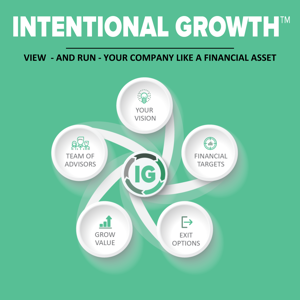
About Intentional Growth

From the publisher's feed

Intentional Growth™ is a podcast is a podcast for entrepreneurs and business owners wanting to view - and run - their company like a financial asset so they can have fun, create wealth, and make an impact. Truly make the entire journey of owning and running a company "worth it".