Intentional Growth

Intentional Growth

By Arkona - Intentional GrowthBusinessEntrepreneurshipInvestingManagement
Download on the App Store

Intentional Growth episodes

  • #177: How to Increase the Value of Your Business with Ken Sanginario (Ep.1 of Value Growth Series)
    Podcast #177: Ken SanginarioHosted by Ryan Tansom
    Learn how you could double the value of your business by de-risking your company specific risk and focusing on the 8 functional areas of a business
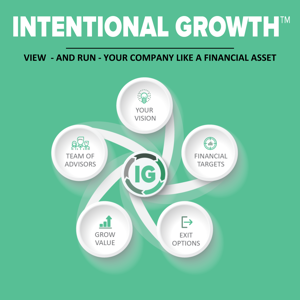
    We are kicking off a mini-series on How to Increase the Value of Your Business. The 4th principle in the 5 Growth & Exit Principles is, INCREASE Value. Once you know what Your Drivers (Principle #1) and have your 3 Financial Targets identified and on track (Principle #2) and a rough idea what your ideal exit and timeline is (Principle #3) then you are ready to grow the value of your business with the end in mind.
    Regardless of whether you want to exit your business next year or 20 years from now, if you focus on creating value but reinvesting in your business, making your cash flow more sustainable, predictable and transferable, you will create many more exit options and have a much more valuable business... it's the only way to run a business!
    Ken Sanginario is the founder of Corporate Value Metrics and creator of the Value Opportunity Profile. He is also an educator who teaches business owners about the importance of intrinsic value. He has a myriad of certifications and credentials that make him the ideal guest for this subject. 
    If you are a business owner or looking purchase a business today’s episode is chalked full of information about the Value Opportunity Profile and Company Specific Risk. This standard system will help business owners create a business that stands up to due diligence and draws in the ideal buyer. 
    We also discuss the disturbing trend that is surfacing in the market. Many baby boomers are getting ready to go to market, and there aren’t enough buyers to help them all. Because of this issue, only 6-7% of baby boomer sellers get a favorable outcome from their sell.
    Ken is quick to explain how his assessment system is important to the baby boomer issue. He also explains how the assessing process came about and how it has reached an international audience.
    What you will learn:
    Ken’s time as a business consultant.
    His experience as a CPA, CFO, and his multiple credentials.
    How Ken designed the Value Opportunity Profile.
    Why Ken felt the need to create a standardized process.
    The Company Specific Risk metric and what it means.
    The 3 traditional approaches of value assessment.
    Why the market approach is a shaky approach and multiples are meaningless.
    Why the income approach is considered the one true method.
    The pros and cons of value assessment approaches.
    The 3 parts of the discounted cash flow method.
    The 8 primary categories to create maximum value.
    The 50 subcategories that are based off the prime 8.
    How Ken’s system is connected to due diligence.
    The 2 components of cost of capital.
    What is intrinsic value?
    The difference between a financial and a strategic buyer.
    The baby boomer issue and how younger business owners can help.
    Run your company at the highest quality at all times.
    Takeaways:
    If you are a business owner, Ken’s program is essential to maximizing your business’s value. You need to focus on intrinsic value and create a business that is ready to sell. The more work you put into your value building, the more confident you’ll be at the negotiation table.
     Links and Resources:
    Corporate Value MetricsKen’s email address508-870-5805 
    About Ken:
    Ken Sanginario is the Founder of Corp

    1 hr 21 min
  • #177: How to Increase the Value of Your Business with Ken Sanginario (Ep.1 of Value Growth Series)
    Podcast #177: Ken SanginarioHosted by Ryan Tansom
    Learn how you could double the value of your business by de-risking your company specific risk and focusing on the 8 functional areas of a business
    We are kicking off a mini-series on How to Increase the Value of Your Business. The 4th principle in the 5 Growth & Exit Principles is, INCREASE Value. Once you know what Your Drivers (Principle #1) and have your 3 Financial Targets identified and on track (Principle #2) and a rough idea what your ideal exit and timeline is (Principle #3) then you are ready to grow the value of your business with the end in mind.
    Regardless of whether you want to exit your business next year or 20 years from now, if you focus on creating value but reinvesting in your business, making your cash flow more sustainable, predictable and transferable, you will create many more exit options and have a much more valuable business... it's the only way to run a business!
    Ken Sanginario is the founder of Corporate Value Metrics and creator of the Value Opportunity Profile. He is also an educator who teaches business owners about the importance of intrinsic value. He has a myriad of certifications and credentials that make him the ideal guest for this subject. 
    If you are a business owner or looking purchase a business today’s episode is chalked full of information about the Value Opportunity Profile and Company Specific Risk. This standard system will help business owners create a business that stands up to due diligence and draws in the ideal buyer. 
    We also discuss the disturbing trend that is surfacing in the market. Many baby boomers are getting ready to go to market, and there aren’t enough buyers to help them all. Because of this issue, only 6-7% of baby boomer sellers get a favorable outcome from their sell.
    Ken is quick to explain how his assessment system is important to the baby boomer issue. He also explains how the assessing process came about and how it has reached an international audience.
    What you will learn:
    Ken’s time as a business consultant.
    His experience as a CPA, CFO, and his multiple credentials.
    How Ken designed the Value Opportunity Profile.
    Why Ken felt the need to create a standardized process.
    The Company Specific Risk metric and what it means.
    The 3 traditional approaches of value assessment.
    Why the market approach is a shaky approach and multiples are meaningless.
    Why the income approach is considered the one true method.
    The pros and cons of value assessment approaches.
    The 3 parts of the discounted cash flow method.
    The 8 primary categories to create maximum value.
    The 50 subcategories that are based off the prime 8.
    How Ken’s system is connected to due diligence.
    The 2 components of cost of capital.
    What is intrinsic value?
    The difference between a financial and a strategic buyer.
    The baby boomer issue and how younger business owners can help.
    Run your company at the highest quality at all times.
    Takeaways:
    If you are a business owner, Ken’s program is essential to maximizing your business’s value. You need to focus on intrinsic value and create a business that is ready to sell. The more work you put into your value building, the more confident you’ll be at the negotiation table.
     Links and Resources:
    Corporate Value MetricsKen’s email address508-870-5805 
    About Ken:
    Ken Sanginario is the Founder of Corp
    1 hr 20 min
  • #176 The 5 Growth & Exit Principles and Recap of 2019's Top Interviews
    Host: Ryan Tansom
    Happy Holidays, everybody! Today’s episode centers on reflection. We’re going to take a stroll through the most popular podcasts of 2019 and recap their best tips for entrepreneurs. Some of the topics I’ll cover include: Growth planning; social capitalism; serial entrepreneurship; financing options; and exit planning. (To name a few.) What better time than now to take a close look at your operations and efficiencies and see what improvements you can make next year?
    So if you’re ready to learn how to operate an even better business or get a pinch more out of a deal, this podcast recap is for you.  I even break down what the real Growth & Exit Planning principles are that Arkona and I work with every day as well to give you the best start to the New Year possible.
    What you’ll learn:
    The top Life After Business interviews from 2019
    The top stories of owners who started, grew and sold in a variety of ways
    An explanation of the 5 Growth & Exit Principles
    How each of the top interviews relate to one of the 5 Growth & Exit Principles
    How to focus on long term value creation with the end in mind using the 5 principles
    Stories of entrepreneurs who figured out what they wanted from their business and why
    Ways to increase the value of your business
    The 3 financial targets you should identify and monitor
    The 5 main categories of exit options
    How to work with your team of advisors to optimize your growth and exit
     
    Principles #1 – YOUR DRIVERS
    What drives you to work in your business?
    You’re choosing to work in your business (otherwise you’d be doing any of a hundred other things), so why are you doing it? The answer to this question will tell you so much about what you should be focusing your energy on. If you’re no longer passionate about the business you have, perhaps it’s time to shift gears. You might balk at the idea of exit planning, but that’s exactly what you need. Whether an exit means turning into a passive owner or out-right retiring, you need to start planning what your business looks like without you at the helm. You’ll be pleasantly surprised about how many opportunities this opens up for you to rediscover your passion in life and make sure you’re on the right track for it.
    Here are the top episodes on Principle #1 from 2019:
    #174: The Entrepreneurial Leap With Gino Wickman​
    #172: How To Create A Vision To Align Your Business & Your Life With Chris Yonker​
    #170: How One Week Killed The Perfect Billion Dollar Deal With Sunny Vanderbeck​
    #164: What Should I Do With The Company That I've Built? - With Hannah Paramore​
    #157: Chasing Perfection: Shatter The Illusion; Minimize Self - Doubt & Maximize
    45 min
  • #176 The 5 Growth & Exit Principles and Recap of 2019's Top Interviews
    Host: Ryan Tansom
    Happy Holidays, everybody! Today’s episode centers on reflection. We’re going to take a stroll through the most popular podcasts of 2019 and recap their best tips for entrepreneurs. Some of the topics I’ll cover include: Growth planning; social capitalism; serial entrepreneurship; financing options; and exit planning. (To name a few.) What better time than now to take a close look at your operations and efficiencies and see what improvements you can make next year?
    So if you’re ready to learn how to operate an even better business or get a pinch more out of a deal, this podcast recap is for you.  I even break down what the real Growth & Exit Planning principles are that Arkona and I work with every day as well to give you the best start to the New Year possible.
    What you’ll learn:
    The top Life After Business interviews from 2019
    The top stories of owners who started, grew and sold in a variety of ways
    An explanation of the 5 Growth & Exit Principles
    How each of the top interviews relate to one of the 5 Growth & Exit Principles
    How to focus on long term value creation with the end in mind using the 5 principles
    Stories of entrepreneurs who figured out what they wanted from their business and why
    Ways to increase the value of your business
    The 3 financial targets you should identify and monitor
    The 5 main categories of exit options
    How to work with your team of advisors to optimize your growth and exit
     
    Principles #1 – YOUR DRIVERS
    What drives you to work in your business?
    You’re choosing to work in your business (otherwise you’d be doing any of a hundred other things), so why are you doing it? The answer to this question will tell you so much about what you should be focusing your energy on. If you’re no longer passionate about the business you have, perhaps it’s time to shift gears. You might balk at the idea of exit planning, but that’s exactly what you need. Whether an exit means turning into a passive owner or out-right retiring, you need to start planning what your business looks like without you at the helm. You’ll be pleasantly surprised about how many opportunities this opens up for you to rediscover your passion in life and make sure you’re on the right track for it.
    Here are the top episodes on Principle #1 from 2019:
    #174: The Entrepreneurial Leap With Gino Wickman​
    #172: How To Create A Vision To Align Your Business & Your Life With Chris Yonker​
    #170: How One Week Killed The Perfect Billion Dollar Deal With Sunny Vanderbeck​
    #164: What Should I Do With The Company That I've Built? - With Hannah Paramore​
    #157: Chasing Perfection: Shatter The Illusion; Minimize Self - Doubt & Maximize
    44 min
  • #175: How to Save Yourself Millions in Your Exit by Hiring the Right Team of Advisors
    Today we are talking to tax strategy and asset protection specialist Todd Ganos. We’re talking about tax law and how to be both compliant but also save the most on taxes. Todd and I talk about how to facilitate and optimize a plan in order for you to get exactly what you want each year. We also talk about some of the stories Todd has run across, where clients and business owners have lost out on millions of dollars when they don’t think far enough ahead. 
    What you will learn:
    Who is Todd and what experience does he have?
    Stories and situations where people lose millions of dollars when they don’t think ahead
    Different ways to get your advisors to collaborate
    How to facilitate and optimize your plan
    How to get the best outcome and save the most on taxes
    How to build the plan that gets you what you want
    What is an advanced ruling? What are the treasury regulations?
    The difference between tax attorneys versus advisors versus accountants
    Quotes
    ”If you understand what good looks like, you can hire the right people because you know what you’re trying to get to.” - Ryan
    “If someone responds in a defensive way, you know they’re probably wrong or they don’t know how to be wrong--which is a problem regardless.” - Ryan
    “The goal is now--before you pull the ripcord (years before!)--start building your team around you so you can optimize your plan.” - Ryan
    Takeaway:
    If you understand what you want and what you’re trying to sell for, you can watch out and look for the right tax attorney for you. You don’t have to be an expert in all the different strategies (from legal to taxes). Your main goal, as an owner, is to hire the right people and get people next to you, who are the smartest in their field, who don’t have big egos, and that know how to collaborate. And if they don’t know an answer to a question, they’re going to collaborate with all of the other designations and they’re going to go find the different ways that they can go optimize your plan for you.
    Links and Resources:
    Todd Ganos, Forbes column
    Integrated Wealth, website
    Todd Ganos, email: [email protected]
    ARKONA Boot Camp
    Reach out to me if you have questions about the boot camp! 
    You can also reach out to me via email at [email protected]
    1 hr 25 min
  • #175: How to Save Yourself Millions in Your Exit by Hiring the Right Team of Advisors
    Today we are talking to tax strategy and asset protection specialist Todd Ganos. We’re talking about tax law and how to be both compliant but also save the most on taxes. Todd and I talk about how to facilitate and optimize a plan in order for you to get exactly what you want each year. We also talk about some of the stories Todd has run across, where clients and business owners have lost out on millions of dollars when they don’t think far enough ahead. 
    What you will learn:
    Who is Todd and what experience does he have?
    Stories and situations where people lose millions of dollars when they don’t think ahead
    Different ways to get your advisors to collaborate
    How to facilitate and optimize your plan
    How to get the best outcome and save the most on taxes
    How to build the plan that gets you what you want
    What is an advanced ruling? What are the treasury regulations?
    The difference between tax attorneys versus advisors versus accountants
    Quotes
    ”If you understand what good looks like, you can hire the right people because you know what you’re trying to get to.” - Ryan
    “If someone responds in a defensive way, you know they’re probably wrong or they don’t know how to be wrong--which is a problem regardless.” - Ryan
    “The goal is now--before you pull the ripcord (years before!)--start building your team around you so you can optimize your plan.” - Ryan
    Takeaway:
    If you understand what you want and what you’re trying to sell for, you can watch out and look for the right tax attorney for you. You don’t have to be an expert in all the different strategies (from legal to taxes). Your main goal, as an owner, is to hire the right people and get people next to you, who are the smartest in their field, who don’t have big egos, and that know how to collaborate. And if they don’t know an answer to a question, they’re going to collaborate with all of the other designations and they’re going to go find the different ways that they can go optimize your plan for you.
    Links and Resources:
    Todd Ganos, Forbes column
    Integrated Wealth, website
    Todd Ganos, email: [email protected]
    ARKONA Boot Camp
    Reach out to me if you have questions about the boot camp! 
    You can also reach out to me via email at [email protected]
    1 hr 24 min
  • #174: The Entrepreneurial Leap with Gino Wickman
    On today’s episode, I’m talking with world-renowned entrepreneur, EOS founder, and author Gino Wickman about what it takes to make an entrepreneur. I was honored to be able to talk with Gino about his process, what makes an entrepreneur, what tools he has to offer for new entrepreneurs, and how he builds a business. In this episode, you should be able to find pertinent information whether you’re brand new to business, have been in business for a while, or if you’re looking to sell your business and start something new.
     
    What you will learn:
    What is an entrepreneur? What is not an entrepreneur?
    The 6 essential entrepreneurial traits you need to have to be a great entrepreneur
    How do you identify what type of company you should buy?
    How to find out if you’re truly having fun and avoiding burnout.
    The assessment to determine if this is really for you
    How do you go forward in the next stage of the business?
    The 8 disciplines for increasing your odds of success
    The 9 stages of building a business
    Takeaway:
    If you own a business, read Entrepreneurial Leap and reflect on: “Did you do the right things? Are you sitting where you are cause you might have missed a couple of steps? Is there a gap analysis you can do in order to figure out how you could have gone about this and why you are dealing with some of the challenges you are dealing with? Entrepreneurial Leap is the manual to help you start if you haven’t started or bought a business just yet.
    Links and Resources:
    Entrepreneurial Leap by Gino Wickman, Amazon
    E-Leap.com, website for free tools, assessments, and chapter of Gino’s new book
    EOS Worldwide, website
    Rocket Fuel: The One Essential Combination That Will Get You More of What You Want from Your Business by Gino Wickman, Amazon
     
    ARKONA Boot Camp
    Reach out to me if you have questions about the boot camp! 
    You can also reach out to me via email at [email protected] or on my
    1 hr 7 min
  • #174: The Entrepreneurial Leap with Gino Wickman
    On today’s episode, I’m talking with world-renowned entrepreneur, EOS founder, and author Gino Wickman about what it takes to make an entrepreneur. I was honored to be able to talk with Gino about his process, what makes an entrepreneur, what tools he has to offer for new entrepreneurs, and how he builds a business. In this episode, you should be able to find pertinent information whether you’re brand new to business, have been in business for a while, or if you’re looking to sell your business and start something new.
     
    What you will learn:
    What is an entrepreneur? What is not an entrepreneur?
    The 6 essential entrepreneurial traits you need to have to be a great entrepreneur
    How do you identify what type of company you should buy?
    How to find out if you’re truly having fun and avoiding burnout.
    The assessment to determine if this is really for you
    How do you go forward in the next stage of the business?
    The 8 disciplines for increasing your odds of success
    The 9 stages of building a business
    Takeaway:
    If you own a business, read Entrepreneurial Leap and reflect on: “Did you do the right things? Are you sitting where you are cause you might have missed a couple of steps? Is there a gap analysis you can do in order to figure out how you could have gone about this and why you are dealing with some of the challenges you are dealing with? Entrepreneurial Leap is the manual to help you start if you haven’t started or bought a business just yet.
    Links and Resources:
    Entrepreneurial Leap by Gino Wickman, Amazon
    E-Leap.com, website for free tools, assessments, and chapter of Gino’s new book
    EOS Worldwide, website
    Rocket Fuel: The One Essential Combination That Will Get You More of What You Want from Your Business by Gino Wickman, Amazon
     
    ARKONA Boot Camp
    Reach out to me if you have questions about the boot camp! 
    You can also reach out to me via email at [email protected] or on my
    1 hr 6 min
  • #173: Growing and Selling a Company from the Integrator (2nd in Command)'s Perspective
    If you’re listening and you own a company, and you’re trying to figure out how to handle conversations with your second-in-command, align your objectives with your eventual growth and exit plan, or if you’re trying to figure out how to hire a second in command, this is the show for you. 
    Today I’m talking with John “JT” Thelan, who used to work in Corporate America as the second-in-command for a company that (under his wing) grew from 4 mils to 10 mils in revenue, then helped sell the company for 11 times EBITA. JT explains what the process was like, what it’s like being in the head of a second-in-command, and how to make sure that everyone is on the same page.
    What you will learn:
    Who is JT and what is his background in business?
    The key metrics that JT processed which helped him grow companies
    JT’s journey from sales and publishing to his most recent position
    How to find a good second-in-command
    JT’s preferred onboarding procedures (onboarding is like dating)
    JT’s experience with bonus structure and normalized EBITA
    What it is like to be a second-in-command
    How to make sure everyone is on the same page
    Takeaway:
    The benefits of having a great second-in-command and the process of finding one. There are huge returns (as seen with Steve and JT) to finding a great second-in-command, getting on the same page, and compensating them correctly. It is worth so much money if you focus on value creation as it relates to the value of your company, instead of focusing on annual income.
    Links and Resources:
    Jonathan Thielen, LinkedIn
    JT’s cell: 612-720-2594
    Rocket Fuel: The One Essential Combination That Will Get You More of What You Want from Your Business by Gino Wickman, Amazon
    ARKONA Boot Camp
    Reach out to me if you have questions about the boot camp! 
    You can also reach out to me via email at [email protected] or on my LinkedIn
    About JT:
    JT is a growth leader who has leveraged the principles of leadership to create accountable teams, operational discipline, and strategic growth strategies. As President, he sold shareholders company for 11x in 2019. JT builds scalable SaaS B2B and B2C sales growth strategies driving revenues, profits and engaging customer experiences. He has h
    1 hr 12 min
  • #173: Growing and Selling a Company from the Integrator (2nd in Command)'s Perspective
    If you’re listening and you own a company, and you’re trying to figure out how to handle conversations with your second-in-command, align your objectives with your eventual growth and exit plan, or if you’re trying to figure out how to hire a second in command, this is the show for you. 
    Today I’m talking with John “JT” Thelan, who used to work in Corporate America as the second-in-command for a company that (under his wing) grew from 4 mils to 10 mils in revenue, then helped sell the company for 11 times EBITA. JT explains what the process was like, what it’s like being in the head of a second-in-command, and how to make sure that everyone is on the same page.
    What you will learn:
    Who is JT and what is his background in business?
    The key metrics that JT processed which helped him grow companies
    JT’s journey from sales and publishing to his most recent position
    How to find a good second-in-command
    JT’s preferred onboarding procedures (onboarding is like dating)
    JT’s experience with bonus structure and normalized EBITA
    What it is like to be a second-in-command
    How to make sure everyone is on the same page
    Takeaway:
    The benefits of having a great second-in-command and the process of finding one. There are huge returns (as seen with Steve and JT) to finding a great second-in-command, getting on the same page, and compensating them correctly. It is worth so much money if you focus on value creation as it relates to the value of your company, instead of focusing on annual income.
    Links and Resources:
    Jonathan Thielen, LinkedIn
    JT’s cell: 612-720-2594
    Rocket Fuel: The One Essential Combination That Will Get You More of What You Want from Your Business by Gino Wickman, Amazon
    ARKONA Boot Camp
    Reach out to me if you have questions about the boot camp! 
    You can also reach out to me via email at [email protected] or on my LinkedIn
    About JT:
    JT is a growth leader who has leveraged the principles of leadership to create accountable teams, operational discipline, and strategic growth strategies. As President, he sold shareholders company for 11x in 2019. JT builds scalable SaaS B2B and B2C sales growth strategies driving revenues, profits and engaging customer experiences. He has h
    1 hr 11 min

About Intentional Growth

From the publisher's feed

Intentional Growth™ is a podcast is a podcast for entrepreneurs and business owners wanting to view - and run - their company like a financial asset so they can have fun, create wealth, and make an impact. Truly make the entire journey of owning and running a company "worth it".