Intentional Growth

Intentional Growth

By Arkona - Intentional GrowthBusinessEntrepreneurshipInvestingManagement
Download on the App Store

Intentional Growth episodes

  • 7 Exits in the Pursuit of Passion

    Today we’re talking to Travis Steffen. Travis has exited seven companies so far, and he’s going to share what he’s learned along the way, including lessons learned from a botched exit. He will help us understand what builds a successful business. We will also touch upon following our passions and how to find happiness as an entrepreneur when you’re always chasing the next best thing. He’s got some great tips, so you won’t want to miss it!

    In This Episode You’ll Learn:
    • The first time Travis decided to become an entrepreneur and how he funded his first company.
    • The types of businesses that Travis has run and how he got into them.
    • Travis’s mindset as he gets into his businesses: What is he trying to accomplish? Does he keep the end in mind? Travis discusses how he used opportunities as stepping stones.
    • One particular example of the sale of a company that Travis wishes he’d handled differently, including what he’d do now that would significantly increase the value of the business when it came time to sell.
    • Travis’s thoughts on how people can switch industries based on his experience.
    • How people can free themselves from what they’ve built: Travis recommends steps to follow.
    • How Travis’s different exits have changed his mindset on what constitutes a successful finish.
    • Travis’s definition of meaningful work and happiness as well as where he finds his fulfillment.
    • Travis’s best advice for the exit journey, before and after.
    • Takeaways:
      1. It’s important to systematize internal processes. If you’re doing things more than once, figure out a way to never have to do it again.
      2. It’s important to find your passion. We are always chasing the numbers and the competition, but it’s more important to figure out the “why.”
      3. Buyers just want an investment. They want cashflow with a good ROI. Know that your baby will eventually be someone else’s investment.
      4. Links and Resources:

        The Value Advantage

        Viral Hero

        Bax.co

        About Travis Steffen:

        Travis Steffen, author of Viral Hero, is a serial entrepreneur with 7 successful exits (and a few crash-and-burn failures) to his name. As a growth engineer, he specializes in building products that grow themselves.

        After nearly a decade of running startups, Travis began to adopt a different way of building products by building the viral loops first, then finding product details that fit inside those structures. After seeing this strategy work, he set a goal to gain a deeper understanding of viral marketing mechan

        0 min
      5. 7 Exits in the Pursuit of Passion
        Today we’re talking to Travis Steffen. Travis has exited seven companies so far, and he’s going to share what he’s learned along the way, including lessons learned from a botched exit. He will help us understand what builds a successful business. We will also touch upon following our passions and how to find happiness as an entrepreneur when you’re always chasing the next best thing. He’s got some great tips, so you won’t want to miss it!
        In This Episode You’ll Learn:
        The first time Travis decided to become an entrepreneur and how he funded his first company.
        The types of businesses that Travis has run and how he got into them.
        Travis’s mindset as he gets into his businesses: What is he trying to accomplish? Does he keep the end in mind? Travis discusses how he used opportunities as stepping stones.
        One particular example of the sale of a company that Travis wishes he’d handled differently, including what he’d do now that would significantly increase the value of the business when it came time to sell.
        Travis’s thoughts on how people can switch industries based on his experience.
        How people can free themselves from what they’ve built: Travis recommends steps to follow.
        How Travis’s different exits have changed his mindset on what constitutes a successful finish.
        Travis’s definition of meaningful work and happiness as well as where he finds his fulfillment.
        Travis’s best advice for the exit journey, before and after.
        Takeaways:
        It’s important to systematize internal processes. If you’re doing things more than once, figure out a way to never have to do it again.
        It’s important to find your passion. We are always chasing the numbers and the competition, but it’s more important to figure out the “why.”
        Buyers just want an investment. They want cashflow with a good ROI. Know that your baby will eventually be someone else’s investment.
        Links and Resources:
        The Value Advantage
        Viral Hero
        Bax.co
        About Travis Steffen:
        Travis Steffen, author of Viral Hero, is a serial entrepreneur with 7 successful exits (and a few crash-and-burn failures) to his name. As a growth engineer, he specializes in building products that grow themselves.
        After nearly a decade of running startups, Travis began to adopt a different way of building products by building the viral loops first, then finding product details that fit inside those structures. After seeing this strategy work, he set a goal to gain a deeper understanding of viral marketing mechan
        30 min
      6. Scalable, Repeatable and Profitable Growth

        Today we are going to be talking to Erik Huberman. Erik found that discovering a company’s unfair advantage and exploiting it through digital marketing and sustainable business processes can take a company and its profits to new heights.

        Erik is the current owner of Hawke Media, has sold multiple companies and is on the Forbes 30 Under 30. He started Hawke Media three years ago with just seven employees and he has scaled it to 150 employees today. He’s also a cofounder of Arrowroot Capital. Today, we’re going to talk about how to build a sustainable business that is profitable and that gives you the option to sell whenever you want. Erik will explain the three pillars of marketing and how to make good decisions.

        In This Episode You’ll Learn:
        • How Erik grew up with the entrepreneurial mindset, as well as how he went from small opportunities to a full-fledged business.
        • Some of the things Erik has done to accelerate the growth of Hawke Media.
        • Some of the things Erik did that ended up paying off when it came time to exit despite not building with the intent of selling.
        • How he ended up selling his first business.
        • How Erik’s mindset has changed when it comes to valuing companies.
        • The dynamics Erik uses when setting up deal structures for either investing or selling.
        • The types of industries and unfair advantages that Erik looks for when determining whether or not to take a risk.
        • Some things that Erik has seen work and not work when it comes to raising funds.
        • The three marketing pillars that Erik focuses on: Nurturing, awareness, and trust. He also talks about what most people are missing the most when it comes to these pillars.
        • Erik’s top tip on hiring people.
        • Erik’s definition of a sustainable business
        • Takeaways:
          1. The importance of knowing what your unfair advantages are and leveraging them.
          2. The importance of knowing how you can let the world know about your unfair advantage and what unique value you can bring to others.
          3. The importance of knowing how you can build a sustainable and profitable business that will give you exit options later.
          4. Links and Resources:

            Hawke Media

            Erik on Facebook

            Erik on Twitter

            About Erik Huberman:

            Erik Huberman is the Founder & CEO of Hawke Media, a full-service Outsourced CMO based in Santa Monica, CA that launch

            0 min
          5. Scalable, Repeatable and Profitable Growth
            Today we are going to be talking to Erik Huberman. Erik found that discovering a company’s unfair advantage and exploiting it through digital marketing and sustainable business processes can take a company and its profits to new heights.
            Erik is the current owner of Hawke Media, has sold multiple companies and is on the Forbes 30 Under 30. He started Hawke Media three years ago with just seven employees and he has scaled it to 150 employees today. He’s also a cofounder of Arrowroot Capital. Today, we’re going to talk about how to build a sustainable business that is profitable and that gives you the option to sell whenever you want. Erik will explain the three pillars of marketing and how to make good decisions.
            In This Episode You’ll Learn:
            How Erik grew up with the entrepreneurial mindset, as well as how he went from small opportunities to a full-fledged business.
            Some of the things Erik has done to accelerate the growth of Hawke Media.
            Some of the things Erik did that ended up paying off when it came time to exit despite not building with the intent of selling.
            How he ended up selling his first business.
            How Erik’s mindset has changed when it comes to valuing companies.
            The dynamics Erik uses when setting up deal structures for either investing or selling.
            The types of industries and unfair advantages that Erik looks for when determining whether or not to take a risk.
            Some things that Erik has seen work and not work when it comes to raising funds.
            The three marketing pillars that Erik focuses on: Nurturing, awareness, and trust. He also talks about what most people are missing the most when it comes to these pillars.
            Erik’s top tip on hiring people.
            Erik’s definition of a sustainable business
            Takeaways:
            The importance of knowing what your unfair advantages are and leveraging them.
            The importance of knowing how you can let the world know about your unfair advantage and what unique value you can bring to others.
            The importance of knowing how you can build a sustainable and profitable business that will give you exit options later.
            Links and Resources:
            Hawke Media
            Erik on Facebook
            Erik on Twitter
            About Erik Huberman:
            Erik Huberman is the Founder & CEO of Hawke Media, a full-service Outsourced CMO based in Santa Monica, CA that launch
            44 min
          6. How to Build a Board of Directors

            Today we are talking to Jim Zuehlke, who will be speaking about a board of directors: why they’re important, how to build one, how to compensate them, and how to upgrade the talent of your current board of directors. Jim has tons of experience as a builder of a boards of directors. Although many perceive a board of directors or board of advisors to be solely for extremely profitable companies, the truth is that any company can benefit. Today’s episode is a must-listen for anyone who wants to take their company to the next level.

            In This Episode You’ll Learn:
            • Jim’s background and how he got into his business, as well as how he got into building and developing boards of directors.
            • What Jim asked candidates for boards of directors and what many of them have in common.
            • The difference between a board of directors and a board of advisors and why the former is important.
            • Where to start in forming a board. Jim lays out the steps to follow as well as some of the common mistakes companies make.
            • Your obligation in compensating your board of directors.
            • The factors that make a successful operating board and why it’s helpful to compare it to marriage, as well as balancing out the skillsets of the people involved.
            • How to know that you’re not where you should be with your board of directors as well as tips on how to make changes.
            • Jim’s recruitment process for someone who doesn’t have a board already.
            • The typical set of subject pillars that Jim uses as he blends groups of people together, as well as Jim’s thoughts on diversity on boards and how that will change in the next decade or so
            • How to Build a Board of Directors Takeaways:
              1. Jim gave a very clear definition of a board of directors as well as how their role differs from those of a board of advisors and from a CEO’s peer advisory group.
              2. If you have a family business or a business with a crucial CEO, having a board of directors to be the voice of reason can eliminate some of the politics that goes along with having multiple invested interests.
              3. It’s important to know the qualities of a great board member and Jim gave us some excellent qualities to look for when searching for the expertise a company needs.
              4.  

                Links and Resources:

                Cardinal Board Services

                Principles

                About Jim Zuehlke:

                Jim’s company, Cardinal Board Services, is passionate about maximizing the effectiveness our clients boards. Whether it be a Board of Directors or the Board of Advisors, they help organizations with board formation, bylaw creation, recruitment & hiring of directors as well as facilitating the initial board meetings.

                His clients range in size from $30M to over $1B companies from a variety of industries including manufacturing, construction, technology, CPG, wholesale apparel and medical. Our clients are mostly private companies seeking to grow their business, transition to a new generation or bring in outside management.

                Full Transcription:

                Ryan:               Welcome back to the Life After Business podcast. Today’s guest name is Jim Zuehlke. Jim is on the show today to talk about how to build a board of directors, why a board of directors is important, the functions that the board of directors plas, actually how to strategically build them with the different roles and experiences, and then what happens if you need to upgrade your talent of your board if you already have a board of directors set up. Jim has a ton of experience to be able to speak to this because he started his company, Cardinal Ma

                0 min
              5. How to Build a Board of Directors
                Today we are talking to Jim Zuehlke, who will be speaking about a board of directors: why they’re important, how to build one, how to compensate them, and how to upgrade the talent of your current board of directors. Jim has tons of experience as a builder of a boards of directors. Although many perceive a board of directors or board of advisors to be solely for extremely profitable companies, the truth is that any company can benefit. Today’s episode is a must-listen for anyone who wants to take their company to the next level.
                In This Episode You’ll Learn:
                Jim’s background and how he got into his business, as well as how he got into building and developing boards of directors.
                What Jim asked candidates for boards of directors and what many of them have in common.
                The difference between a board of directors and a board of advisors and why the former is important.
                Where to start in forming a board. Jim lays out the steps to follow as well as some of the common mistakes companies make.
                Your obligation in compensating your board of directors.
                The factors that make a successful operating board and why it’s helpful to compare it to marriage, as well as balancing out the skillsets of the people involved.
                How to know that you’re not where you should be with your board of directors as well as tips on how to make changes.
                Jim’s recruitment process for someone who doesn’t have a board already.
                The typical set of subject pillars that Jim uses as he blends groups of people together, as well as Jim’s thoughts on diversity on boards and how that will change in the next decade or so
                How to Build a Board of Directors Takeaways:
                Jim gave a very clear definition of a board of directors as well as how their role differs from those of a board of advisors and from a CEO’s peer advisory group.
                If you have a family business or a business with a crucial CEO, having a board of directors to be the voice of reason can eliminate some of the politics that goes along with having multiple invested interests.
                It’s important to know the qualities of a great board member and Jim gave us some excellent qualities to look for when searching for the expertise a company needs.
                 
                Links and Resources:
                Cardinal Board Services
                Principles
                About Jim Zuehlke:
                Jim’s company, Cardinal Board Services, is passionate about maximizing the effectiveness our clients boards. Whether it be a Board of Directors or the Board of Advisors, they help organizations with board formation, bylaw creation, recruitment & hiring of directors as well as facilitating the initial board meetings.
                His clients range in size from $30M to over $1B companies from a variety of industries including manufacturing, construction, technology, CPG, wholesale apparel and medical. Our clients are mostly private companies seeking to grow their business, transition to a new generation or bring in outside management.
                Full Transcription:
                Ryan:               Welcome back to the Life After Business podcast. Today’s guest name is Jim Zuehlke. Jim is on the show today to talk about how to build a board of directors, why a board of directors is important, the functions that the board of directors plas, actually how to strategically build them with the different roles and experiences, and then what happens if you need to upgrade your talent of your board if you already have a board of directors set up. Jim has a ton of experience to be able to speak to this because he started his company, Cardinal Ma
                58 min
              6. How to Increase the Value of Your Company

                Today on the Life After Business podcast, we’re going to be talking to Ken Sanginario. Ken is the founder of the Corporate Value Metrics and the creator of the Value Opportunity Profile and the Certified Value Growth Advisor. He’s got a lot of experience and he has developed a system that shows business-owners how to develop and implement a strategic plan. He’s going to give us some background on the work he’s done and some tips on how to fund your growth through your process. Sit back and relax; you won’t want to miss this episode!

                In This Episode You’ll Learn:
                • Some of the milestones that got Ken to where he is today.
                • The first thing Ken would do when getting into a turnaround in order to keep the company running.
                • The importance of having a cash flow statement.
                • The main things Ken looks at to determine the value of a particular company, as well as how its value would relate to transferability.
                • How Ken would advise a business-owner who is in the middle of a crisis.
                • Some of the categories that Ken keeps in mind when figuring out a business’s valuation.
                • Some specific challenges that Ken has helped companies overcome.
                • Why it’s so hard for consultants to get business-owners to change.
                • Why having a process you can measure is essential.
                • Today’s podcast centers on the concept of value: value today, and value enduring. We have no greater asset than ourselves when we start a business, this is true. But we need to grow our businesses into stand-alone, fully functioning organizations that do not require our constant input and upkeep.

                  The issue is: how do we get from here to there?

                  Categorize Your Business Value Prioritize

                  Ken Sanginario has identified 8 key points that all business owners need to consider. These are as follows: planning, leadership, sales, marketing, people, operations, finance and legal—and these breakdown further into 47 subcategories. Ken developed his role as a turnaround consultant with these points in mind and has successfully saved business and business owners alike from bankruptcy time and time again.

                  These categories are not, of course, the alpha and omega of successful businesses—but they are pretty darn close. Ken has implemented his working business valuation model into a software program, as well, to aid struggling business owners on a wider plain.

                  Every company is underperforming to some degree, even ones which are strong and profitable. This makes a turnaround consultant a vital part of your advisory team. Where a consultant adds value is by providing measurable ideas. If you’ve had a consultant approach your business in the past with lots of big ideas, but zero ways to measure these ideas, then you have not experienced a real consultant. True advisors are able to provide points (or, in this case, categories) to you which you can measure and evaluate over time so there are real progress points to show your increased business value.

                  What Business Value is Valuable?

                  Your best and truest valuation—the value of future cash flows—depends on sustainability, transferability and predictability.

                  If your co

                  0 min
                • How to Increase the Value of Your Company
                  Today on the Life After Business podcast, we’re going to be talking to Ken Sanginario. Ken is the founder of the Corporate Value Metrics and the creator of the Value Opportunity Profile and the Certified Value Growth Advisor. He’s got a lot of experience and he has developed a system that shows business-owners how to develop and implement a strategic plan. He’s going to give us some background on the work he’s done and some tips on how to fund your growth through your process. Sit back and relax; you won’t want to miss this episode!
                  In This Episode You’ll Learn:
                  Some of the milestones that got Ken to where he is today.
                  The first thing Ken would do when getting into a turnaround in order to keep the company running.
                  The importance of having a cash flow statement.
                  The main things Ken looks at to determine the value of a particular company, as well as how its value would relate to transferability.
                  How Ken would advise a business-owner who is in the middle of a crisis.
                  Some of the categories that Ken keeps in mind when figuring out a business’s valuation.
                  Some specific challenges that Ken has helped companies overcome.
                  Why it’s so hard for consultants to get business-owners to change.
                  Why having a process you can measure is essential.
                  Today’s podcast centers on the concept of value: value today, and value enduring. We have no greater asset than ourselves when we start a business, this is true. But we need to grow our businesses into stand-alone, fully functioning organizations that do not require our constant input and upkeep.
                  The issue is: how do we get from here to there?
                  Categorize Your Business Value Prioritize
                  Ken Sanginario has identified 8 key points that all business owners need to consider. These are as follows: planning, leadership, sales, marketing, people, operations, finance and legal—and these breakdown further into 47 subcategories. Ken developed his role as a turnaround consultant with these points in mind and has successfully saved business and business owners alike from bankruptcy time and time again.
                  These categories are not, of course, the alpha and omega of successful businesses—but they are pretty darn close. Ken has implemented his working business valuation model into a software program, as well, to aid struggling business owners on a wider plain.
                  Every company is underperforming to some degree, even ones which are strong and profitable. This makes a turnaround consultant a vital part of your advisory team. Where a consultant adds value is by providing measurable ideas. If you’ve had a consultant approach your business in the past with lots of big ideas, but zero ways to measure these ideas, then you have not experienced a real consultant. True advisors are able to provide points (or, in this case, categories) to you which you can measure and evaluate over time so there are real progress points to show your increased business value.
                  What Business Value is Valuable?
                  Your best and truest valuation—the value of future cash flows—depends on sustainability, transferability and predictability.
                  If your co
                  1 hr 5 min
                • How to Buy and Sell a Business

                  Today we are talking to Jim Sulciner. Jim bought his business, RTD, a decade after becoming an engineer and after having a career in marketing. He experienced double-digit growth for over 12 years before selling to a very large company. He sold for a multiple of EBITA that is nearly unheard of and gave himself some great options. He’s going to talk to us about all of his business milestones.

                  In This Episode You’ll Learn:
                  • How Jim started his career and what caused him to take the leap into entrepreneurship.
                  • How Jim managed to purchase RTD after only having purchased a home – how he structured the deal and what the transition looked like.
                  • Jim’s thoughts on the difference between a founder and an entrepreneur and how he strove to have an entrepreneurial strategy when it came to growth.
                  • What Jim’s goals were and how he measured his benchmarks when it came to reaching those goals.
                  • Details on how they balanced cash and handled employees.
                  • Where Jim got the ideas for his excellent practices that ultimately allowed him to sell for so much.
                  • What triggered Jim to want to sell.
                  • How Jim managed two offers, how the would-be buyers valued the company, and how he ended up structuring the eventual deal.
                  • How Jim transformed his life after his exit.
                  • Takeaways:
                    1. Jim had experience as a buyer and a seller. This was invaluable because he already understood the buyer’s mindset when it was time to sell.
                    2. Jim implemented value-building techniques that ended up being extremely beneficial to him when the time came to exit. He had profit-sharing with his key executives and was very specific with his AP and AR.
                    3. Jim had patents that raised his company’s value over and above the business profits and growth. This combination really boosted his buyer’s confidence.
                    4. Links and Resources:

                      The Value Advantage

                      Email Jim

                      Jim on LinkedIn

                      About Jim Sulciner

                      Jim Sulciner, a sales & marketing executive and entrepreneur, is highly experienced in growth and leadership of startups to midsize companies with an emphasis in recruiting, sales, and customer relations. Most recently as CEO,, Jim guided RTD Company through an acquisition by Measurement Specialties (NASDAQ MEAS) at seven times EBITA. This culminates 25 years of experience in a variety of sales channels — direct, manufacturing representatives, and distribution. His technical experience includes project management, ISo 9001, and lean manufacturing.

                      Jim was educated with a double major in Chemistry from the University o

                      0 min
                    5. How to Buy and Sell a Business
                      Today we are talking to Jim Sulciner. Jim bought his business, RTD, a decade after becoming an engineer and after having a career in marketing. He experienced double-digit growth for over 12 years before selling to a very large company. He sold for a multiple of EBITA that is nearly unheard of and gave himself some great options. He’s going to talk to us about all of his business milestones.
                      In This Episode You’ll Learn:
                      How Jim started his career and what caused him to take the leap into entrepreneurship.
                      How Jim managed to purchase RTD after only having purchased a home – how he structured the deal and what the transition looked like.
                      Jim’s thoughts on the difference between a founder and an entrepreneur and how he strove to have an entrepreneurial strategy when it came to growth.
                      What Jim’s goals were and how he measured his benchmarks when it came to reaching those goals.
                      Details on how they balanced cash and handled employees.
                      Where Jim got the ideas for his excellent practices that ultimately allowed him to sell for so much.
                      What triggered Jim to want to sell.
                      How Jim managed two offers, how the would-be buyers valued the company, and how he ended up structuring the eventual deal.
                      How Jim transformed his life after his exit.
                      Takeaways:
                      Jim had experience as a buyer and a seller. This was invaluable because he already understood the buyer’s mindset when it was time to sell.
                      Jim implemented value-building techniques that ended up being extremely beneficial to him when the time came to exit. He had profit-sharing with his key executives and was very specific with his AP and AR.
                      Jim had patents that raised his company’s value over and above the business profits and growth. This combination really boosted his buyer’s confidence.
                      Links and Resources:
                      The Value Advantage
                      Email Jim
                      Jim on LinkedIn
                      About Jim Sulciner
                      Jim Sulciner, a sales & marketing executive and entrepreneur, is highly experienced in growth and leadership of startups to midsize companies with an emphasis in recruiting, sales, and customer relations. Most recently as CEO,, Jim guided RTD Company through an acquisition by Measurement Specialties (NASDAQ MEAS) at seven times EBITA. This culminates 25 years of experience in a variety of sales channels — direct, manufacturing representatives, and distribution. His technical experience includes project management, ISo 9001, and lean manufacturing.
                      Jim was educated with a double major in Chemistry from the University o
                      52 min

                    About Intentional Growth

                    From the publisher's feed

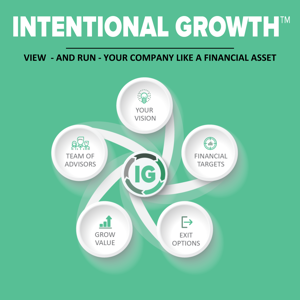
                    Intentional Growth™ is a podcast is a podcast for entrepreneurs and business owners wanting to view - and run - their company like a financial asset so they can have fun, create wealth, and make an impact. Truly make the entire journey of owning and running a company "worth it".