Intentional Growth

Intentional Growth

By Arkona - Intentional GrowthBusinessEntrepreneurshipInvestingManagement
Download on the App Store

Intentional Growth episodes

  • Building a Business Legacy
    What an amazing conversation I was able to have with Andrew Warner; a man who certainly knows his way around business podcasts, having done over 1,300 interviews himself via his own platform on Mixergy. Andrew was MORE than generous because, even with a 2 week old at home, he spent an hour with me talking about his journey as an entrepreneur and what roads he has traveled to get to where he is today.
    Andrew gave us some great insight into how he quickly built up a multi-million company with his brother and proceeded to exit the business and the grind it came with, before eventually reigniting his entrepreneurial spirit to get where he is today. There is a lot we can all learn from the vivid and amusing account of where his mind was at during the different phases of his life after business.
    In this episode, you’ll learn:
    The ideal type of business that kicks out cash
    What 1300+ interviews will teach you
    The fine line between financial goals and burnout
    Why you should find a way to put yourself out in the public
    What Andrew’s definition of legacy is
    How did Andrew Warner start out in business?
    Andrew always knew he wanted to sell… whatever he did he wanted to hustle and be passionate about what he was involved in. He found home in a partnership with his brother, trying a few web-based businesses before eventually hitting the jackpot with an online greetings-card business. Once Andrew gained an understanding of affiliate marketing and advertising space for email newsletters, the growth of the company was exponential.
    Andrew had some straight forward goals… to put 1 million dollars in the bank. The way to do that was, in his words, ‘to put in pennies and shit out dollars’.
    What did he do to make the company grow?
    By embedding a code that enabled him to capture the data from his greetings-card customers, he was able to harvest a captive audience for his regular newsletters. In the newsletters he would sell advertising space. Then he added another great money-making tool to his greetings-card signup process, selling the right for other companies to be able to offer their services to the same user. At one point he said he was paying 10 cents for each occasion a user populated a form, but was receiving $1.50 every time somebody signed up.
    What was his goal?
    He wanted to get rich and have $1 million in the bank, and leave a company that would outlast him. It took him 2-3 years to reach his goal of one million dollars in the bank but then he struggled to figure out what was next. Because Andrew is one determined dude, he couldn’t help himself but to keep competitions and benchmarks with himself even while he was on his “sabbatical“. He eventually defined it as: “let’s see how far I can run”.
    How long did the business last?
    After only 5 years, and tens of millions in revenue, Andrew and his brother hung up the towel of their company Bradford & Reed. But in his mind he’d wanted the company to last for hundreds of years. On his website he declares his exit strategy as ‘death’ (he’s inspired by the likes Apple and McDonalds, i.e. companies who outlived their owners), so although his business reached the initial financial goal, he didn’t hit his ultimate goal of leaving a legacy.
    Why did he stop so soon?
    51 min
  • Building a Business Legacy
    What an amazing conversation I was able to have with Andrew Warner; a man who certainly knows his way around business podcasts, having done over 1,300 interviews himself via his own platform on Mixergy. Andrew was MORE than generous because, even with a 2 week old at home, he spent an hour with me talking about his journey as an entrepreneur and what roads he has traveled to get to where he is today.
    Andrew gave us some great insight into how he quickly built up a multi-million company with his brother and proceeded to exit the business and the grind it came with, before eventually reigniting his entrepreneurial spirit to get where he is today. There is a lot we can all learn from the vivid and amusing account of where his mind was at during the different phases of his life after business.
    In this episode, you’ll learn:
    The ideal type of business that kicks out cash
    What 1300+ interviews will teach you
    The fine line between financial goals and burnout
    Why you should find a way to put yourself out in the public
    What Andrew’s definition of legacy is
    How did Andrew Warner start out in business?
    Andrew always knew he wanted to sell… whatever he did he wanted to hustle and be passionate about what he was involved in. He found home in a partnership with his brother, trying a few web-based businesses before eventually hitting the jackpot with an online greetings-card business. Once Andrew gained an understanding of affiliate marketing and advertising space for email newsletters, the growth of the company was exponential.
    Andrew had some straight forward goals… to put 1 million dollars in the bank. The way to do that was, in his words, ‘to put in pennies and shit out dollars’.
    What did he do to make the company grow?
    By embedding a code that enabled him to capture the data from his greetings-card customers, he was able to harvest a captive audience for his regular newsletters. In the newsletters he would sell advertising space. Then he added another great money-making tool to his greetings-card signup process, selling the right for other companies to be able to offer their services to the same user. At one point he said he was paying 10 cents for each occasion a user populated a form, but was receiving $1.50 every time somebody signed up.
    What was his goal?
    He wanted to get rich and have $1 million in the bank, and leave a company that would outlast him. It took him 2-3 years to reach his goal of one million dollars in the bank but then he struggled to figure out what was next. Because Andrew is one determined dude, he couldn’t help himself but to keep competitions and benchmarks with himself even while he was on his “sabbatical“. He eventually defined it as: “let’s see how far I can run”.
    How long did the business last?
    After only 5 years, and tens of millions in revenue, Andrew and his brother hung up the towel of their company Bradford & Reed. But in his mind he’d wanted the company to last for hundreds of years. On his website he declares his exit strategy as ‘death’ (he’s inspired by the likes Apple and McDonalds, i.e. companies who outlived their owners), so although his business reached the initial financial goal, he didn’t hit his ultimate goal of leaving a legacy.
    Why did he stop so soon?
    51 min
  • Building a Business Legacy
    What an amazing conversation I was able to have with Andrew Warner; a man who certainly knows his way around business podcasts, having done over 1,300 interviews himself via his own platform on Mixergy. Andrew was MORE than generous because, even with a 2 week old at home, he spent an hour with me talking about his journey as an entrepreneur and what roads he has traveled to get to where he is today.
    Andrew gave us some great insight into how he quickly built up a multi-million company with his brother and proceeded to exit the business and the grind it came with, before eventually reigniting his entrepreneurial spirit to get where he is today. There is a lot we can all learn from the vivid and amusing account of where his mind was at during the different phases of his life after business.
    In this episode, you’ll learn:
    The ideal type of business that kicks out cash
    What 1300+ interviews will teach you
    The fine line between financial goals and burnout
    Why you should find a way to put yourself out in the public
    What Andrew’s definition of legacy is
    How did Andrew Warner start out in business?
    Andrew always knew he wanted to sell… whatever he did he wanted to hustle and be passionate about what he was involved in. He found home in a partnership with his brother, trying a few web-based businesses before eventually hitting the jackpot with an online greetings-card business. Once Andrew gained an understanding of affiliate marketing and advertising space for email newsletters, the growth of the company was exponential.
    Andrew had some straight forward goals… to put 1 million dollars in the bank. The way to do that was, in his words, ‘to put in pennies and shit out dollars’.
    What did he do to make the company grow?
    By embedding a code that enabled him to capture the data from his greetings-card customers, he was able to harvest a captive audience for his regular newsletters. In the newsletters he would sell advertising space. Then he added another great money-making tool to his greetings-card signup process, selling the right for other companies to be able to offer their services to the same user. At one point he said he was paying 10 cents for each occasion a user populated a form, but was receiving $1.50 every time somebody signed up.
    What was his goal?
    He wanted to get rich and have $1 million in the bank, and leave a company that would outlast him. It took him 2-3 years to reach his goal of one million dollars in the bank but then he struggled to figure out what was next. Because Andrew is one determined dude, he couldn’t help himself but to keep competitions and benchmarks with himself even while he was on his “sabbatical“. He eventually defined it as: “let’s see how far I can run”.
    How long did the business last?
    After only 5 years, and tens of millions in revenue, Andrew and his brother hung up the towel of their company Bradford & Reed. But in his mind he’d wanted the company to last for hundreds of years. On his website he declares his exit strategy as ‘death’ (he’s inspired by the likes Apple and McDonalds, i.e. companies who outlived their owners), so although his business reached the initial financial goal, he didn’t hit his ultimate goal of leaving a legacy.
    Why did he stop so soon?
    51 min
  • You Can’t Increase Business Value by Making Cuts
    Our guest this week had to face up to tragedy and the realization that she owned a worthless company before turning things around to make the perfect exit.
    When her husband unexpectedly died, Kathleen Ferry had no option but to take over his business – a business that was struggling to adapt to a changing marketplace and one that was significantly over-staffed. Kathleen shared some excellent tips on how to streamline a business, and how planning a certain way can put you in the driving seat when it comes to transferring your business to the successor of your choice!
    Where was the company when she took it over?
    When Kathleen took over, after her husband and the General Manager of the plant were gone, she got the news that the company had been valued at next to nothing.  She had no choice but to keep the business going and try and turn things around to keep food on the table for the livelyhood of her and her kids. Her company was $1-2m in debt and needed some serious streamlining.
    What were the first key decisions she made?
    She brought in good-caliber senior staff: a head of sales and an operations manager.
    What was the streamlining process?
    After a year in charge it became clear that not only was the firm over-staffed; there were the wrong staff in certain senior positions. The rewarding of loyalty had been too influential in the process of recruitment. Kathleen cut 20% of the staff but only after she’d brought in an external consultant to prove that this needed to be done. Internally she had discussed trimming the workforce, but nobody would agree with her.
    How did she drive the business forwards after the streamlining?
    She had to tackle the “it’s always been done that way” culture. This involved her spending a lot of time standing on the factory floor and asking staff to explain what they were doing. As a result of this she implemented policy that significantly improved their cashflow, and a $2m credit line eventually became just $10,000 in working capital!
    “reduce your working capital of your business and make your business worth a ton!
    ‘buck the way things have always been done and find ways to reduce your need for capital!’
    Then she established a board of directors. This is what she regarded as the most important decision she made – the sounding board proved invaluable.
    How did the company cope during the financial crisis?
    They lost $100,000 per month for a time, but when the marketplace picked up they were in a stronger position than before. The training and realignment of processes they undertook during the down times helped significantly, and because they had reduced their debt to almost nothing, they were better prepared than most to ride out the storm.
    “reduce your need for capital and prepare yourself for any downturn ”
    “debt sucks… making money and loaning it is better!”
    What was put in place to help prepare the company for sale?
    Before there was a plan to sell, the company had already brought some angel investors to the table. This prompted the company to properly document their entire operation for the first time. Kathleen said this as a very useful exercise when it came to the eventual sale because it helped her understand the true inner workings and value of her company.
    How did the sale come about?
    The eventual buyers were a private equity group who had already acquired companies in the same industry. They were impressed with the potential of doing business with one of Kathleen’s big clients. Despite this interest, it was very much business as usual. Kathleen and the firm still made a 10-year growth plan (because they knew they needed one regarless of what happend
    51 min
  • You Can’t Increase Business Value by Making Cuts
    Our guest this week had to face up to tragedy and the realization that she owned a worthless company before turning things around to make the perfect exit.
    When her husband unexpectedly died, Kathleen Ferry had no option but to take over his business – a business that was struggling to adapt to a changing marketplace and one that was significantly over-staffed. Kathleen shared some excellent tips on how to streamline a business, and how planning a certain way can put you in the driving seat when it comes to transferring your business to the successor of your choice!
    Where was the company when she took it over?
    When Kathleen took over, after her husband and the General Manager of the plant were gone, she got the news that the company had been valued at next to nothing.  She had no choice but to keep the business going and try and turn things around to keep food on the table for the livelyhood of her and her kids. Her company was $1-2m in debt and needed some serious streamlining.
    What were the first key decisions she made?
    She brought in good-caliber senior staff: a head of sales and an operations manager.
    What was the streamlining process?
    After a year in charge it became clear that not only was the firm over-staffed; there were the wrong staff in certain senior positions. The rewarding of loyalty had been too influential in the process of recruitment. Kathleen cut 20% of the staff but only after she’d brought in an external consultant to prove that this needed to be done. Internally she had discussed trimming the workforce, but nobody would agree with her.
    How did she drive the business forwards after the streamlining?
    She had to tackle the “it’s always been done that way” culture. This involved her spending a lot of time standing on the factory floor and asking staff to explain what they were doing. As a result of this she implemented policy that significantly improved their cashflow, and a $2m credit line eventually became just $10,000 in working capital!
    “reduce your working capital of your business and make your business worth a ton!
    ‘buck the way things have always been done and find ways to reduce your need for capital!’
    Then she established a board of directors. This is what she regarded as the most important decision she made – the sounding board proved invaluable.
    How did the company cope during the financial crisis?
    They lost $100,000 per month for a time, but when the marketplace picked up they were in a stronger position than before. The training and realignment of processes they undertook during the down times helped significantly, and because they had reduced their debt to almost nothing, they were better prepared than most to ride out the storm.
    “reduce your need for capital and prepare yourself for any downturn ”
    “debt sucks… making money and loaning it is better!”
    What was put in place to help prepare the company for sale?
    Before there was a plan to sell, the company had already brought some angel investors to the table. This prompted the company to properly document their entire operation for the first time. Kathleen said this as a very useful exercise when it came to the eventual sale because it helped her understand the true inner workings and value of her company.
    How did the sale come about?
    The eventual buyers were a private equity group who had already acquired companies in the same industry. They were impressed with the potential of doing business with one of Kathleen’s big clients. Despite this interest, it was very much business as usual. Kathleen and the firm still made a 10-year growth plan (because they knew they needed one regarless of what happend
    51 min
  • You Can’t Increase Business Value by Making Cuts
    Our guest this week had to face up to tragedy and the realization that she owned a worthless company before turning things around to make the perfect exit.
    When her husband unexpectedly died, Kathleen Ferry had no option but to take over his business – a business that was struggling to adapt to a changing marketplace and one that was significantly over-staffed. Kathleen shared some excellent tips on how to streamline a business, and how planning a certain way can put you in the driving seat when it comes to transferring your business to the successor of your choice!
    Where was the company when she took it over?
    When Kathleen took over, after her husband and the General Manager of the plant were gone, she got the news that the company had been valued at next to nothing.  She had no choice but to keep the business going and try and turn things around to keep food on the table for the livelyhood of her and her kids. Her company was $1-2m in debt and needed some serious streamlining.
    What were the first key decisions she made?
    She brought in good-caliber senior staff: a head of sales and an operations manager.
    What was the streamlining process?
    After a year in charge it became clear that not only was the firm over-staffed; there were the wrong staff in certain senior positions. The rewarding of loyalty had been too influential in the process of recruitment. Kathleen cut 20% of the staff but only after she’d brought in an external consultant to prove that this needed to be done. Internally she had discussed trimming the workforce, but nobody would agree with her.
    How did she drive the business forwards after the streamlining?
    She had to tackle the “it’s always been done that way” culture. This involved her spending a lot of time standing on the factory floor and asking staff to explain what they were doing. As a result of this she implemented policy that significantly improved their cashflow, and a $2m credit line eventually became just $10,000 in working capital!
    “reduce your working capital of your business and make your business worth a ton!
    ‘buck the way things have always been done and find ways to reduce your need for capital!’
    Then she established a board of directors. This is what she regarded as the most important decision she made – the sounding board proved invaluable.
    How did the company cope during the financial crisis?
    They lost $100,000 per month for a time, but when the marketplace picked up they were in a stronger position than before. The training and realignment of processes they undertook during the down times helped significantly, and because they had reduced their debt to almost nothing, they were better prepared than most to ride out the storm.
    “reduce your need for capital and prepare yourself for any downturn ”
    “debt sucks… making money and loaning it is better!”
    What was put in place to help prepare the company for sale?
    Before there was a plan to sell, the company had already brought some angel investors to the table. This prompted the company to properly document their entire operation for the first time. Kathleen said this as a very useful exercise when it came to the eventual sale because it helped her understand the true inner workings and value of her company.
    How did the sale come about?
    The eventual buyers were a private equity group who had already acquired companies in the same industry. They were impressed with the potential of doing business with one of Kathleen’s big clients. Despite this interest, it was very much business as usual. Kathleen and the firm still made a 10-year growth plan (because they knew they needed one regarless of what happend
    51 min
  • How Great Entrepreneurs Exit Their Companies on Top
    Bo Burlingham is an absolute hero.  He was Editor at Large at INC. Magazine for years, Author of some of the business book classics like The Great Game of Business, Small Giants, Street Smarts and the Finish Big. His insights in Finish Big on how the greatest entrepreneurs exit on top lead me to create this podcast and build our firm. If it wasn’t for Bo, Solidity Financial wouldn’t be what it is today.
    He is undoubtedly the leading author on what it means to be a true Entrepreneur… one where there is a beginning, middle and end to a journey.  We felt it was high time we spoke to Bo about his experiences in putting together his trailblazing books…
    In this episode you’ll learn:
    How the greatest entrepreneurs exit their companies on top
    What the REAL journey of being an entrepreneur looks like
    How to finish big AND be a small giant
    Why 75% of entrepreneurs are unhappy after they sell their companies
    Why did Bo Burlingham write the book Finish Big?
    He’d been working for the magazine Inc for 25 years and never once had he heard anybody talk about the end game for the organization. This suddenly changed when his co-columnist Norm Brodsky received an offer for his company.This eventually formed a monthly column called “the offer”, which was basically an ongoing narrative on the trials and tribulations of the sale negotiations.
    The response they had was amazing – it turned out to be a topic that people simply couldn’t read about elsewhere – and it took off so much that at one point, the cover headline was “Norm Decides To Sell”. Alas, because certain things came to light towards the end of the sale,
    Norm didn’t sell after all, but the whole process made Bo realize that people were very interested in the subject, and that there was almost nothing else out there for people to read on the matter. So he decided to write his first book, which was to be based on the findings of a series of interviews with business owners who’d sold up.
    The regrets of selling a company…
    Through his interviews Bo found about half of the entrepreneurs were unhappy after they sold. He set about trying to understand the common themes in the back stories of those who were happy versus those who were unhappy.
    The 5 things entrepreneurs did to exit their company on top:
    They felt it was a fair process and got reasonable reward for the work they’d put into the business.
    They could look back at what they’ve done and feel pride that they’d contributed something to the world.
    They were at peace with what had happened to the other people that had been on the mission with them.
    They found something afterwards that they really became engaged in, i.e. something that gave them a life after business.
    Not an absolute constant but was true of some people…. their companies were doing well without them – they’d built a legacy.
    Bo felt that if an owner was missing just one of them, they were likely to have a very bad exit.
    How can you passionately grow a company that can thrive without you?
    To grow a company ‘artistically’ – with the kind of love that forms the basis of entrepreneurship – but then step away so the company doesn’t revolve around you like a hub and spoke can be the hardest part of being a business owner.
    Bo says this is the ultima

    54 min
  • How Great Entrepreneurs Exit Their Companies on Top
    Bo Burlingham is an absolute hero.  He was Editor at Large at INC. Magazine for years, Author of some of the business book classics like The Great Game of Business, Small Giants, Street Smarts and the Finish Big. His insights in Finish Big on how the greatest entrepreneurs exit on top lead me to create this podcast and build our firm. If it wasn’t for Bo, Solidity Financial wouldn’t be what it is today.
    He is undoubtedly the leading author on what it means to be a true Entrepreneur… one where there is a beginning, middle and end to a journey.  We felt it was high time we spoke to Bo about his experiences in putting together his trailblazing books…
    In this episode you’ll learn:
    How the greatest entrepreneurs exit their companies on top
    What the REAL journey of being an entrepreneur looks like
    How to finish big AND be a small giant
    Why 75% of entrepreneurs are unhappy after they sell their companies
    Why did Bo Burlingham write the book Finish Big?
    He’d been working for the magazine Inc for 25 years and never once had he heard anybody talk about the end game for the organization. This suddenly changed when his co-columnist Norm Brodsky received an offer for his company.This eventually formed a monthly column called “the offer”, which was basically an ongoing narrative on the trials and tribulations of the sale negotiations.
    The response they had was amazing – it turned out to be a topic that people simply couldn’t read about elsewhere – and it took off so much that at one point, the cover headline was “Norm Decides To Sell”. Alas, because certain things came to light towards the end of the sale,
    Norm didn’t sell after all, but the whole process made Bo realize that people were very interested in the subject, and that there was almost nothing else out there for people to read on the matter. So he decided to write his first book, which was to be based on the findings of a series of interviews with business owners who’d sold up.
    The regrets of selling a company…
    Through his interviews Bo found about half of the entrepreneurs were unhappy after they sold. He set about trying to understand the common themes in the back stories of those who were happy versus those who were unhappy.
    The 5 things entrepreneurs did to exit their company on top:
    They felt it was a fair process and got reasonable reward for the work they’d put into the business.
    They could look back at what they’ve done and feel pride that they’d contributed something to the world.
    They were at peace with what had happened to the other people that had been on the mission with them.
    They found something afterwards that they really became engaged in, i.e. something that gave them a life after business.
    Not an absolute constant but was true of some people…. their companies were doing well without them – they’d built a legacy.
    Bo felt that if an owner was missing just one of them, they were likely to have a very bad exit.
    How can you passionately grow a company that can thrive without you?
    To grow a company ‘artistically’ – with the kind of love that forms the basis of entrepreneurship – but then step away so the company doesn’t revolve around you like a hub and spoke can be the hardest part of being a business owner.
    Bo says this is the ultima
    54 min
  • How Great Entrepreneurs Exit Their Companies on Top
    Bo Burlingham is an absolute hero.  He was Editor at Large at INC. Magazine for years, Author of some of the business book classics like The Great Game of Business, Small Giants, Street Smarts and the Finish Big. His insights in Finish Big on how the greatest entrepreneurs exit on top lead me to create this podcast and build our firm. If it wasn’t for Bo, Solidity Financial wouldn’t be what it is today.
    He is undoubtedly the leading author on what it means to be a true Entrepreneur… one where there is a beginning, middle and end to a journey.  We felt it was high time we spoke to Bo about his experiences in putting together his trailblazing books…
    In this episode you’ll learn:
    How the greatest entrepreneurs exit their companies on top
    What the REAL journey of being an entrepreneur looks like
    How to finish big AND be a small giant
    Why 75% of entrepreneurs are unhappy after they sell their companies
    Why did Bo Burlingham write the book Finish Big?
    He’d been working for the magazine Inc for 25 years and never once had he heard anybody talk about the end game for the organization. This suddenly changed when his co-columnist Norm Brodsky received an offer for his company.This eventually formed a monthly column called “the offer”, which was basically an ongoing narrative on the trials and tribulations of the sale negotiations.
    The response they had was amazing – it turned out to be a topic that people simply couldn’t read about elsewhere – and it took off so much that at one point, the cover headline was “Norm Decides To Sell”. Alas, because certain things came to light towards the end of the sale,
    Norm didn’t sell after all, but the whole process made Bo realize that people were very interested in the subject, and that there was almost nothing else out there for people to read on the matter. So he decided to write his first book, which was to be based on the findings of a series of interviews with business owners who’d sold up.
    The regrets of selling a company…
    Through his interviews Bo found about half of the entrepreneurs were unhappy after they sold. He set about trying to understand the common themes in the back stories of those who were happy versus those who were unhappy.
    The 5 things entrepreneurs did to exit their company on top:
    They felt it was a fair process and got reasonable reward for the work they’d put into the business.
    They could look back at what they’ve done and feel pride that they’d contributed something to the world.
    They were at peace with what had happened to the other people that had been on the mission with them.
    They found something afterwards that they really became engaged in, i.e. something that gave them a life after business.
    Not an absolute constant but was true of some people…. their companies were doing well without them – they’d built a legacy.
    Bo felt that if an owner was missing just one of them, they were likely to have a very bad exit.
    How can you passionately grow a company that can thrive without you?
    To grow a company ‘artistically’ – with the kind of love that forms the basis of entrepreneurship – but then step away so the company doesn’t revolve around you like a hub and spoke can be the hardest part of being a business owner.
    Bo says this is the ultima
    54 min
  • Is Your Company Worth Anything?
    Eric Gustafson’s story is a great example of how the very best exit planning isn’t really a plan at all – it’s just a continuation of good business practice.
    Eric ran a tight ship, so when all of the stars aligned to make it the right time for a sale, the business was ready for it and the process of sale was a synch. Listen to his story or read the highlights to find out how he did it…
    How Eric rode out the storm to become the exit master
    There was a huge blizzard that brought Minneapolis to a standstill for a month and almost bankrupted his printing business early on in its life. Thankfully things picked up in the following month and they survived, and then it wasn’t long before monthly profits of $40,000 per month became $200,000 per month.
    How did this happen?
    By getting a hold of the data within the company and using it to empower the sales team. They implemented what was referred to as a “Telemagic system” back then, which was essentially the CRM system of its day.
    What made Eric’s company think about selling?
    The marketplace was changing. Margins were going down and more customers were doing their printing in-house.
    How was the company valued and sold?
    Eric used a personal contact who had raised private equity to buy two of his friends’ businesses, so he knew that throughout negotiations he was dealing with someone he could trust. Eric and the rest of his ownership team didn’t have a dollar amount in mind – the valuation was quite simply a fair multiple of easily agreeable figures.
    “A fair multiple is only fair if you put the time in to build the value of your company!”
    Did anything need to be done with the numbers in the lead up to the sale?
    Almost nothing needed to change. The company had been following good habits for a long time, running their financials every month in the proper way. The company benefited greatly from their advisory board which was made up of experienced heads from different industries. These were paid positions, but the range of experience around the table combined with their ability to speak more freely than an internal board of directors made it a very good investment.
    How long did the process take?
    The idea to sell came about two years before the ultimate sale, but because of the quality of the financial data, the due diligence only took two weeks!
    How did he cope after the business?
    Very well indeed because in his words “I didn’t have a skill set, so I wasn’t emotionally invested”. Because Eric had no background in printing and from the outset hired capable staff to handle the most challenging day-to-day tasks, he could easily walk away.
    Book recommendation
    The E Myth: Why Most Businesses Don’t Work and What to Do About It
    Wise words for the road
    “it’s good to deal with people you trust”
    “your business is worth more if you’re not involved”
    “you can have your cake and eat it too, but it doesn’t just happen”
    “pretend you’re outside of your business for a year… how would it run?”
    Contact Eric
    Phone: 612-239-7833
    46 min

About Intentional Growth

From the publisher's feed

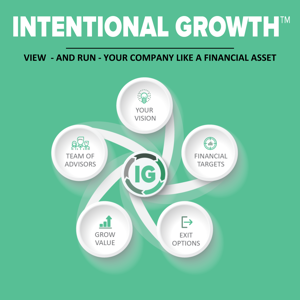
Intentional Growth™ is a podcast is a podcast for entrepreneurs and business owners wanting to view - and run - their company like a financial asset so they can have fun, create wealth, and make an impact. Truly make the entire journey of owning and running a company "worth it".