Intentional Growth

Intentional Growth

By Arkona - Intentional GrowthBusinessEntrepreneurshipInvestingManagement
Download on the App Store

Intentional Growth episodes

  • Is Your Company Worth Anything?
    Eric Gustafson’s story is a great example of how the very best exit planning isn’t really a plan at all – it’s just a continuation of good business practice.
    Eric ran a tight ship, so when all of the stars aligned to make it the right time for a sale, the business was ready for it and the process of sale was a synch. Listen to his story or read the highlights to find out how he did it…
    How Eric rode out the storm to become the exit master
    There was a huge blizzard that brought Minneapolis to a standstill for a month and almost bankrupted his printing business early on in its life. Thankfully things picked up in the following month and they survived, and then it wasn’t long before monthly profits of $40,000 per month became $200,000 per month.
    How did this happen?
    By getting a hold of the data within the company and using it to empower the sales team. They implemented what was referred to as a “Telemagic system” back then, which was essentially the CRM system of its day.
    What made Eric’s company think about selling?
    The marketplace was changing. Margins were going down and more customers were doing their printing in-house.
    How was the company valued and sold?
    Eric used a personal contact who had raised private equity to buy two of his friends’ businesses, so he knew that throughout negotiations he was dealing with someone he could trust. Eric and the rest of his ownership team didn’t have a dollar amount in mind – the valuation was quite simply a fair multiple of easily agreeable figures.
    “A fair multiple is only fair if you put the time in to build the value of your company!”
    Did anything need to be done with the numbers in the lead up to the sale?
    Almost nothing needed to change. The company had been following good habits for a long time, running their financials every month in the proper way. The company benefited greatly from their advisory board which was made up of experienced heads from different industries. These were paid positions, but the range of experience around the table combined with their ability to speak more freely than an internal board of directors made it a very good investment.
    How long did the process take?
    The idea to sell came about two years before the ultimate sale, but because of the quality of the financial data, the due diligence only took two weeks!
    How did he cope after the business?
    Very well indeed because in his words “I didn’t have a skill set, so I wasn’t emotionally invested”. Because Eric had no background in printing and from the outset hired capable staff to handle the most challenging day-to-day tasks, he could easily walk away.
    Book recommendation
    The E Myth: Why Most Businesses Don’t Work and What to Do About It
    Wise words for the road
    “it’s good to deal with people you trust”
    “your business is worth more if you’re not involved”
    “you can have your cake and eat it too, but it doesn’t just happen”
    “pretend you’re outside of your business for a year… how would it run?”
    Contact Eric
    Phone: 612-239-7833

    46 min
  • Is Your Company Worth Anything?
    Eric Gustafson’s story is a great example of how the very best exit planning isn’t really a plan at all – it’s just a continuation of good business practice.
    Eric ran a tight ship, so when all of the stars aligned to make it the right time for a sale, the business was ready for it and the process of sale was a synch. Listen to his story or read the highlights to find out how he did it…
    How Eric rode out the storm to become the exit master
    There was a huge blizzard that brought Minneapolis to a standstill for a month and almost bankrupted his printing business early on in its life. Thankfully things picked up in the following month and they survived, and then it wasn’t long before monthly profits of $40,000 per month became $200,000 per month.
    How did this happen?
    By getting a hold of the data within the company and using it to empower the sales team. They implemented what was referred to as a “Telemagic system” back then, which was essentially the CRM system of its day.
    What made Eric’s company think about selling?
    The marketplace was changing. Margins were going down and more customers were doing their printing in-house.
    How was the company valued and sold?
    Eric used a personal contact who had raised private equity to buy two of his friends’ businesses, so he knew that throughout negotiations he was dealing with someone he could trust. Eric and the rest of his ownership team didn’t have a dollar amount in mind – the valuation was quite simply a fair multiple of easily agreeable figures.
    “A fair multiple is only fair if you put the time in to build the value of your company!”
    Did anything need to be done with the numbers in the lead up to the sale?
    Almost nothing needed to change. The company had been following good habits for a long time, running their financials every month in the proper way. The company benefited greatly from their advisory board which was made up of experienced heads from different industries. These were paid positions, but the range of experience around the table combined with their ability to speak more freely than an internal board of directors made it a very good investment.
    How long did the process take?
    The idea to sell came about two years before the ultimate sale, but because of the quality of the financial data, the due diligence only took two weeks!
    How did he cope after the business?
    Very well indeed because in his words “I didn’t have a skill set, so I wasn’t emotionally invested”. Because Eric had no background in printing and from the outset hired capable staff to handle the most challenging day-to-day tasks, he could easily walk away.
    Book recommendation
    The E Myth: Why Most Businesses Don’t Work and What to Do About It
    Wise words for the road
    “it’s good to deal with people you trust”
    “your business is worth more if you’re not involved”
    “you can have your cake and eat it too, but it doesn’t just happen”
    “pretend you’re outside of your business for a year… how would it run?”
    Contact Eric
    Phone: 612-239-7833
    46 min
  • Is Your Company Worth Anything?
    Eric Gustafson’s story is a great example of how the very best exit planning isn’t really a plan at all – it’s just a continuation of good business practice.
    Eric ran a tight ship, so when all of the stars aligned to make it the right time for a sale, the business was ready for it and the process of sale was a synch. Listen to his story or read the highlights to find out how he did it…
    How Eric rode out the storm to become the exit master
    There was a huge blizzard that brought Minneapolis to a standstill for a month and almost bankrupted his printing business early on in its life. Thankfully things picked up in the following month and they survived, and then it wasn’t long before monthly profits of $40,000 per month became $200,000 per month.
    How did this happen?
    By getting a hold of the data within the company and using it to empower the sales team. They implemented what was referred to as a “Telemagic system” back then, which was essentially the CRM system of its day.
    What made Eric’s company think about selling?
    The marketplace was changing. Margins were going down and more customers were doing their printing in-house.
    How was the company valued and sold?
    Eric used a personal contact who had raised private equity to buy two of his friends’ businesses, so he knew that throughout negotiations he was dealing with someone he could trust. Eric and the rest of his ownership team didn’t have a dollar amount in mind – the valuation was quite simply a fair multiple of easily agreeable figures.
    “A fair multiple is only fair if you put the time in to build the value of your company!”
    Did anything need to be done with the numbers in the lead up to the sale?
    Almost nothing needed to change. The company had been following good habits for a long time, running their financials every month in the proper way. The company benefited greatly from their advisory board which was made up of experienced heads from different industries. These were paid positions, but the range of experience around the table combined with their ability to speak more freely than an internal board of directors made it a very good investment.
    How long did the process take?
    The idea to sell came about two years before the ultimate sale, but because of the quality of the financial data, the due diligence only took two weeks!
    How did he cope after the business?
    Very well indeed because in his words “I didn’t have a skill set, so I wasn’t emotionally invested”. Because Eric had no background in printing and from the outset hired capable staff to handle the most challenging day-to-day tasks, he could easily walk away.
    Book recommendation
    The E Myth: Why Most Businesses Don’t Work and What to Do About It
    Wise words for the road
    “it’s good to deal with people you trust”
    “your business is worth more if you’re not involved”
    “you can have your cake and eat it too, but it doesn’t just happen”
    “pretend you’re outside of your business for a year… how would it run?”
    Contact Eric
    Phone: 612-239-7833
    46 min
  • Selling Your Business to a Private Equity Group
    We have an interesting character on this week’s interview on Life After Business… there are not many pro baseball players who also happen to be experts in private equity! Bobby Kingsbury is now part of the a different type of team when he joined MCM Capital.  He managed to land the gig when giving hitting lessons to the son of Mark E. Mansour, co-founder of the original fund.
    In today’s episode, you will learn:
    How private equity groups (PEGs) are structured
    Where private equity groups get their money
    What it could be like to partner / sell to a PEG
    How PEGs value companies
    Understand how PEGS look at potential deals
    Why a private equity group WOULDN’T buy you
    Having been a pro for the Pittsburgh Pirates for six years and having competed in the 2004 Olympics, it must have have been a bit of a shock to the system. Thankfully for us he went on to develop a brilliant insight into one of the most important aspects of the exit planning process, private equity.
    What is private equity?
    It is basically a liquidation option for a private business owner. A Private Equity Group is a pool of money, managed by a team of professionals.  Their goal is to grow that pool of money for the owners of the fund and the way they do it is by buying companies, making them healthier, stronger, and better and then eventually selling them again anywhere between 3-8 years out. It’s a way to diversify a portfolio by selling all or a portion of the business to a private equity fund.
    How does a private equity firm work?
    Bobby’s firm (MCM Capital) has eight professionals divided into deal teams. The main division of responsibility lies between transactions and raising equity. A firm will rely on limited partners, i.e. endowments, universities, pension funds etc. It is basically the job of the firm to make investment decisions on their behalf in the same way as a fund might invest in stocks & shares. The difference here is that a private equity firm is in the business of buying up companies.
    A private equity firm needs to have a good eye for corporate management. Although they clearly need to seek out the right deals and understand the numbers, the ultimate success or failure of their investments will depend on how effectively they operate after the investment. This doesn’t mean that a private equity firm has to be hands-on day-to-day (in fact it is Bobby’s preference to keep that kind of involvement to a minimum) but it absolutely does mean that a private equity firm must build strong relationships with the businesses they invest in, right from the very beginning of negotiations. Even in the event of a total buyout where the whole executive team sell up and disappear into the sunset, if a private equity firm hasn’t built the right relationships, it will likely end in disaster.
    What are the standard investment offerings?
    Typically four or five years to deploy capital. Funds will generally be spread across approximately ten businesses, each occupying a roughly equal percentage of investment. Pretty much all private equity investment is leveraged in some way, with Bobby’s firm preferring to invest in businesses using 50% equity and 50% bank financing. Many private equity firms prefer to use more leverage, typically putting up 30-35% equity and borrowing the rest. This increases the potential return/IRR but of course comes with a higher risk attached.
    How is the value of a business normally decided?
    Multiples of EBITDA. As a rule a smaller business will be afforded a smaller multiple than a larger business, and certain industries like aerospace, defence and life science will command higher multip
    43 min
  • Selling Your Business to a Private Equity Group
    We have an interesting character on this week’s interview on Life After Business… there are not many pro baseball players who also happen to be experts in private equity! Bobby Kingsbury is now part of the a different type of team when he joined MCM Capital.  He managed to land the gig when giving hitting lessons to the son of Mark E. Mansour, co-founder of the original fund.
    In today’s episode, you will learn:
    How private equity groups (PEGs) are structured
    Where private equity groups get their money
    What it could be like to partner / sell to a PEG
    How PEGs value companies
    Understand how PEGS look at potential deals
    Why a private equity group WOULDN’T buy you
    Having been a pro for the Pittsburgh Pirates for six years and having competed in the 2004 Olympics, it must have have been a bit of a shock to the system. Thankfully for us he went on to develop a brilliant insight into one of the most important aspects of the exit planning process, private equity.
    What is private equity?
    It is basically a liquidation option for a private business owner. A Private Equity Group is a pool of money, managed by a team of professionals.  Their goal is to grow that pool of money for the owners of the fund and the way they do it is by buying companies, making them healthier, stronger, and better and then eventually selling them again anywhere between 3-8 years out. It’s a way to diversify a portfolio by selling all or a portion of the business to a private equity fund.
    How does a private equity firm work?
    Bobby’s firm (MCM Capital) has eight professionals divided into deal teams. The main division of responsibility lies between transactions and raising equity. A firm will rely on limited partners, i.e. endowments, universities, pension funds etc. It is basically the job of the firm to make investment decisions on their behalf in the same way as a fund might invest in stocks & shares. The difference here is that a private equity firm is in the business of buying up companies.
    A private equity firm needs to have a good eye for corporate management. Although they clearly need to seek out the right deals and understand the numbers, the ultimate success or failure of their investments will depend on how effectively they operate after the investment. This doesn’t mean that a private equity firm has to be hands-on day-to-day (in fact it is Bobby’s preference to keep that kind of involvement to a minimum) but it absolutely does mean that a private equity firm must build strong relationships with the businesses they invest in, right from the very beginning of negotiations. Even in the event of a total buyout where the whole executive team sell up and disappear into the sunset, if a private equity firm hasn’t built the right relationships, it will likely end in disaster.
    What are the standard investment offerings?
    Typically four or five years to deploy capital. Funds will generally be spread across approximately ten businesses, each occupying a roughly equal percentage of investment. Pretty much all private equity investment is leveraged in some way, with Bobby’s firm preferring to invest in businesses using 50% equity and 50% bank financing. Many private equity firms prefer to use more leverage, typically putting up 30-35% equity and borrowing the rest. This increases the potential return/IRR but of course comes with a higher risk attached.
    How is the value of a business normally decided?
    Multiples of EBITDA. As a rule a smaller business will be afforded a smaller multiple than a larger business, and certain industries like aerospace, defence and life science will command higher multip
    43 min
  • Selling Your Business to a Private Equity Group
    We have an interesting character on this week’s interview on Life After Business… there are not many pro baseball players who also happen to be experts in private equity! Bobby Kingsbury is now part of the a different type of team when he joined MCM Capital.  He managed to land the gig when giving hitting lessons to the son of Mark E. Mansour, co-founder of the original fund.
    In today’s episode, you will learn:
    How private equity groups (PEGs) are structured
    Where private equity groups get their money
    What it could be like to partner / sell to a PEG
    How PEGs value companies
    Understand how PEGS look at potential deals
    Why a private equity group WOULDN’T buy you
    Having been a pro for the Pittsburgh Pirates for six years and having competed in the 2004 Olympics, it must have have been a bit of a shock to the system. Thankfully for us he went on to develop a brilliant insight into one of the most important aspects of the exit planning process, private equity.
    What is private equity?
    It is basically a liquidation option for a private business owner. A Private Equity Group is a pool of money, managed by a team of professionals.  Their goal is to grow that pool of money for the owners of the fund and the way they do it is by buying companies, making them healthier, stronger, and better and then eventually selling them again anywhere between 3-8 years out. It’s a way to diversify a portfolio by selling all or a portion of the business to a private equity fund.
    How does a private equity firm work?
    Bobby’s firm (MCM Capital) has eight professionals divided into deal teams. The main division of responsibility lies between transactions and raising equity. A firm will rely on limited partners, i.e. endowments, universities, pension funds etc. It is basically the job of the firm to make investment decisions on their behalf in the same way as a fund might invest in stocks & shares. The difference here is that a private equity firm is in the business of buying up companies.
    A private equity firm needs to have a good eye for corporate management. Although they clearly need to seek out the right deals and understand the numbers, the ultimate success or failure of their investments will depend on how effectively they operate after the investment. This doesn’t mean that a private equity firm has to be hands-on day-to-day (in fact it is Bobby’s preference to keep that kind of involvement to a minimum) but it absolutely does mean that a private equity firm must build strong relationships with the businesses they invest in, right from the very beginning of negotiations. Even in the event of a total buyout where the whole executive team sell up and disappear into the sunset, if a private equity firm hasn’t built the right relationships, it will likely end in disaster.
    What are the standard investment offerings?
    Typically four or five years to deploy capital. Funds will generally be spread across approximately ten businesses, each occupying a roughly equal percentage of investment. Pretty much all private equity investment is leveraged in some way, with Bobby’s firm preferring to invest in businesses using 50% equity and 50% bank financing. Many private equity firms prefer to use more leverage, typically putting up 30-35% equity and borrowing the rest. This increases the potential return/IRR but of course comes with a higher risk attached.
    How is the value of a business normally decided?
    Multiples of EBITDA. As a rule a smaller business will be afforded a smaller multiple than a larger business, and certain industries like aerospace, defence and life science will command higher multip
    43 min
  • Selling Your Business to a Private Equity Group
    We have an interesting character on this week’s interview on Life After Business… there are not many pro baseball players who also happen to be experts in private equity! Bobby Kingsbury is now part of the a different type of team when he joined MCM Capital.  He managed to land the gig when giving hitting lessons to the son of Mark E. Mansour, co-founder of the original fund.
    In today’s episode, you will learn:
    How private equity groups (PEGs) are structured
    Where private equity groups get their money
    What it could be like to partner / sell to a PEG
    How PEGs value companies
    Understand how PEGS look at potential deals
    Why a private equity group WOULDN’T buy you
    Having been a pro for the Pittsburgh Pirates for six years and having competed in the 2004 Olympics, it must have have been a bit of a shock to the system. Thankfully for us he went on to develop a brilliant insight into one of the most important aspects of the exit planning process, private equity.
    What is private equity?
    It is basically a liquidation option for a private business owner. A Private Equity Group is a pool of money, managed by a team of professionals.  Their goal is to grow that pool of money for the owners of the fund and the way they do it is by buying companies, making them healthier, stronger, and better and then eventually selling them again anywhere between 3-8 years out. It’s a way to diversify a portfolio by selling all or a portion of the business to a private equity fund.
    How does a private equity firm work?
    Bobby’s firm (MCM Capital) has eight professionals divided into deal teams. The main division of responsibility lies between transactions and raising equity. A firm will rely on limited partners, i.e. endowments, universities, pension funds etc. It is basically the job of the firm to make investment decisions on their behalf in the same way as a fund might invest in stocks & shares. The difference here is that a private equity firm is in the business of buying up companies.
    A private equity firm needs to have a good eye for corporate management. Although they clearly need to seek out the right deals and understand the numbers, the ultimate success or failure of their investments will depend on how effectively they operate after the investment. This doesn’t mean that a private equity firm has to be hands-on day-to-day (in fact it is Bobby’s preference to keep that kind of involvement to a minimum) but it absolutely does mean that a private equity firm must build strong relationships with the businesses they invest in, right from the very beginning of negotiations. Even in the event of a total buyout where the whole executive team sell up and disappear into the sunset, if a private equity firm hasn’t built the right relationships, it will likely end in disaster.
    What are the standard investment offerings?
    Typically four or five years to deploy capital. Funds will generally be spread across approximately ten businesses, each occupying a roughly equal percentage of investment. Pretty much all private equity investment is leveraged in some way, with Bobby’s firm preferring to invest in businesses using 50% equity and 50% bank financing. Many private equity firms prefer to use more leverage, typically putting up 30-35% equity and borrowing the rest. This increases the potential return/IRR but of course comes with a higher risk attached.
    How is the value of a business normally decided?
    Multiples of EBITDA. As a rule a smaller business will be afforded a smaller multiple than a larger business, and certain industries like aerospace, defence and life science will command higher multip
    43 min
  • Why I Love My Business
    The psychology of exits… we have a real intellectual take on exit planning and your state of mind this week. In a colorful episode, Allie Harding gives us an academic take on the importance of identity in business, and how this can affect life after it. Understanding the psychology behind the exit is a crucial part of a successful transition.
    Allie has built up two consultancy companies off the back of extensive academic study, including a PHD in Business Psychology.
    You know how we always say that a successful exit from a business is as much about life after business as it is about the transaction? (the clue is in the title of the podcast!) Well Allie has the science to back this up. Listen and learn!
    How does business change the identity of different people?
    Allie has advised hundreds of business owners down the years. She can define them in 3 separate categories:
    1.) Ready Rogers:
    These are the easiest to deal with when it comes to exit because their self-awareness is at such a level they can walk away and know exactly how they will cope with life after business. They probably have many interests outside of their business, and are already in the habit of disconnecting from work in order to stimulate their mind elsewhere.
    2.) Moderate Michaels:
    They might need some help with their guiding principles but can still be persuaded to change their mindset to help them manage their time after they sell. Their business is basically their life, but the original creative energy they had that helped them build up their business in the first place can still be harnessed with the right guidance.
    3.) Foolish Freds:
    This is the bracket of entrepreneurs who simply are their business. Their entire life revolves around it; their happiness, their sadness, their friends, perhaps even their family. When it comes to exit planning they struggle immensely with the concept of change, both in the sense of readying their business for sale and also afterwards in adapting to a different lifestyle.
    What is the best way to find out how much the business is part of someone’s identity?
    Getting to know the owner is absolutely the best way.  However, along with the multitude of personality tests out there OrangeKiwi has a 15-minute online survey specific to the topic.  It should be given to them by a trusted advisor that can walk them through the results in a no threatening way.
    What is it that entrepreneurs people need to replace once they retire?
    Relatedness/relationships, competency and autonomy. Without daily interaction with colleagues and customers, it can be very hard to replace these things if you aren’t prepared.
    The 3 main stages that a business owner must face before a successful exit:
    1. The exploratory stage:
    Answering existential questions about what you do and don’t want for your business, and who you are if not your business. This should be taking place long before a sale. In Allie’s words, “the bridge to the future [outside of the business] is being built while they’re running their business”.
    2. The strategic phase:
    This is about the systematic building of value in the business in preparation for the sale. See our chat with the absolute expert in this field, John Warrillow.
    3. The execution:
    The detail of the deal and the negotiation. It’s all too easy to concentrate on
    34 min
  • Why I Love My Business
    The psychology of exits… we have a real intellectual take on exit planning and your state of mind this week. In a colorful episode, Allie Harding gives us an academic take on the importance of identity in business, and how this can affect life after it. Understanding the psychology behind the exit is a crucial part of a successful transition.
    Allie has built up two consultancy companies off the back of extensive academic study, including a PHD in Business Psychology.
    You know how we always say that a successful exit from a business is as much about life after business as it is about the transaction? (the clue is in the title of the podcast!) Well Allie has the science to back this up. Listen and learn!
    How does business change the identity of different people?
    Allie has advised hundreds of business owners down the years. She can define them in 3 separate categories:
    1.) Ready Rogers:
    These are the easiest to deal with when it comes to exit because their self-awareness is at such a level they can walk away and know exactly how they will cope with life after business. They probably have many interests outside of their business, and are already in the habit of disconnecting from work in order to stimulate their mind elsewhere.
    2.) Moderate Michaels:
    They might need some help with their guiding principles but can still be persuaded to change their mindset to help them manage their time after they sell. Their business is basically their life, but the original creative energy they had that helped them build up their business in the first place can still be harnessed with the right guidance.
    3.) Foolish Freds:
    This is the bracket of entrepreneurs who simply are their business. Their entire life revolves around it; their happiness, their sadness, their friends, perhaps even their family. When it comes to exit planning they struggle immensely with the concept of change, both in the sense of readying their business for sale and also afterwards in adapting to a different lifestyle.
    What is the best way to find out how much the business is part of someone’s identity?
    Getting to know the owner is absolutely the best way.  However, along with the multitude of personality tests out there OrangeKiwi has a 15-minute online survey specific to the topic.  It should be given to them by a trusted advisor that can walk them through the results in a no threatening way.
    What is it that entrepreneurs people need to replace once they retire?
    Relatedness/relationships, competency and autonomy. Without daily interaction with colleagues and customers, it can be very hard to replace these things if you aren’t prepared.
    The 3 main stages that a business owner must face before a successful exit:
    1. The exploratory stage:
    Answering existential questions about what you do and don’t want for your business, and who you are if not your business. This should be taking place long before a sale. In Allie’s words, “the bridge to the future [outside of the business] is being built while they’re running their business”.
    2. The strategic phase:
    This is about the systematic building of value in the business in preparation for the sale. See our chat with the absolute expert in this field, John Warrillow.
    3. The execution:
    The detail of the deal and the negotiation. It’s all too easy to concentrate on
    34 min
  • Why I Love My Business
    The psychology of exits… we have a real intellectual take on exit planning and your state of mind this week. In a colorful episode, Allie Harding gives us an academic take on the importance of identity in business, and how this can affect life after it. Understanding the psychology behind the exit is a crucial part of a successful transition.
    Allie has built up two consultancy companies off the back of extensive academic study, including a PHD in Business Psychology.
    You know how we always say that a successful exit from a business is as much about life after business as it is about the transaction? (the clue is in the title of the podcast!) Well Allie has the science to back this up. Listen and learn!
    How does business change the identity of different people?
    Allie has advised hundreds of business owners down the years. She can define them in 3 separate categories:
    1.) Ready Rogers:
    These are the easiest to deal with when it comes to exit because their self-awareness is at such a level they can walk away and know exactly how they will cope with life after business. They probably have many interests outside of their business, and are already in the habit of disconnecting from work in order to stimulate their mind elsewhere.
    2.) Moderate Michaels:
    They might need some help with their guiding principles but can still be persuaded to change their mindset to help them manage their time after they sell. Their business is basically their life, but the original creative energy they had that helped them build up their business in the first place can still be harnessed with the right guidance.
    3.) Foolish Freds:
    This is the bracket of entrepreneurs who simply are their business. Their entire life revolves around it; their happiness, their sadness, their friends, perhaps even their family. When it comes to exit planning they struggle immensely with the concept of change, both in the sense of readying their business for sale and also afterwards in adapting to a different lifestyle.
    What is the best way to find out how much the business is part of someone’s identity?
    Getting to know the owner is absolutely the best way.  However, along with the multitude of personality tests out there OrangeKiwi has a 15-minute online survey specific to the topic.  It should be given to them by a trusted advisor that can walk them through the results in a no threatening way.
    What is it that entrepreneurs people need to replace once they retire?
    Relatedness/relationships, competency and autonomy. Without daily interaction with colleagues and customers, it can be very hard to replace these things if you aren’t prepared.
    The 3 main stages that a business owner must face before a successful exit:
    1. The exploratory stage:
    Answering existential questions about what you do and don’t want for your business, and who you are if not your business. This should be taking place long before a sale. In Allie’s words, “the bridge to the future [outside of the business] is being built while they’re running their business”.
    2. The strategic phase:
    This is about the systematic building of value in the business in preparation for the sale. See our chat with the absolute expert in this field, John Warrillow.
    3. The execution:
    The detail of the deal and the negotiation. It’s all too easy to concentrate on
    34 min

About Intentional Growth

From the publisher's feed

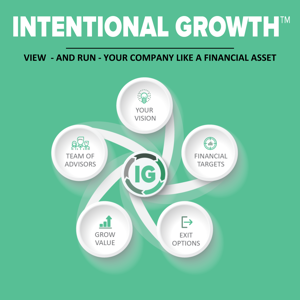
Intentional Growth™ is a podcast is a podcast for entrepreneurs and business owners wanting to view - and run - their company like a financial asset so they can have fun, create wealth, and make an impact. Truly make the entire journey of owning and running a company "worth it".