Intentional Growth

Intentional Growth

By Arkona - Intentional GrowthBusinessEntrepreneurshipInvestingManagement
Download on the App Store

Intentional Growth episodes

  • Why I Love My Business
    The psychology of exits… we have a real intellectual take on exit planning and your state of mind this week. In a colorful episode, Allie Harding gives us an academic take on the importance of identity in business, and how this can affect life after it. Understanding the psychology behind the exit is a crucial part of a successful transition.
    Allie has built up two consultancy companies off the back of extensive academic study, including a PHD in Business Psychology.
    You know how we always say that a successful exit from a business is as much about life after business as it is about the transaction? (the clue is in the title of the podcast!) Well Allie has the science to back this up. Listen and learn!
    How does business change the identity of different people?
    Allie has advised hundreds of business owners down the years. She can define them in 3 separate categories:
    1.) Ready Rogers:
    These are the easiest to deal with when it comes to exit because their self-awareness is at such a level they can walk away and know exactly how they will cope with life after business. They probably have many interests outside of their business, and are already in the habit of disconnecting from work in order to stimulate their mind elsewhere.
    2.) Moderate Michaels:
    They might need some help with their guiding principles but can still be persuaded to change their mindset to help them manage their time after they sell. Their business is basically their life, but the original creative energy they had that helped them build up their business in the first place can still be harnessed with the right guidance.
    3.) Foolish Freds:
    This is the bracket of entrepreneurs who simply are their business. Their entire life revolves around it; their happiness, their sadness, their friends, perhaps even their family. When it comes to exit planning they struggle immensely with the concept of change, both in the sense of readying their business for sale and also afterwards in adapting to a different lifestyle.
    What is the best way to find out how much the business is part of someone’s identity?
    Getting to know the owner is absolutely the best way.  However, along with the multitude of personality tests out there OrangeKiwi has a 15-minute online survey specific to the topic.  It should be given to them by a trusted advisor that can walk them through the results in a no threatening way.
    What is it that entrepreneurs people need to replace once they retire?
    Relatedness/relationships, competency and autonomy. Without daily interaction with colleagues and customers, it can be very hard to replace these things if you aren’t prepared.
    The 3 main stages that a business owner must face before a successful exit:
    1. The exploratory stage:
    Answering existential questions about what you do and don’t want for your business, and who you are if not your business. This should be taking place long before a sale. In Allie’s words, “the bridge to the future [outside of the business] is being built while they’re running their business”.
    2. The strategic phase:
    This is about the systematic building of value in the business in preparation for the sale. See our chat with the absolute expert in this field, John Warrillow.
    3. The execution:
    The detail of the deal and the negotiation. It’s all too easy to concentrate on
    34 min
  • The Exit Planning Institute
    What a show we have in store for you today! Crammed full of useful stats and insight from a man who could legitimately call himself an exit planning godfather.
    Chris shared with us his starter guide to exit planning along with some of the more interesting top-level philosophies that go with it. Also discussed were weighty economic matters… is the US able to cope with the aging baby boomers predicted to transition 4.5 million companies and a predicted $10 trillion worth of assets in the next decade? As the owner of the Exit Planning Institute, Chris Snider sure knows exit planning! We strongly advise you listen to his conversation with us this week, but if you just want the quick & dirty summary, read on….
    What is the Exit Planning Institute?
    In Chris’ words: “We don’t view ourselves as an association… we view our members more as customers. Our job is provide a compelling platform for them to launch their practices. It’s up to us to provide resources to enable them to produce revenue and do well by their clients.”
    Vital statistics from the industry:
    There are 6 million privately held business in the US market today, 2 out of 3 of which are owned by baby boomers. Within 8 years, all baby boomers will be over 60 years old.
    Since 2013 in surveys of owners, 3 out of 4 businesses say they want to exit their businesses in the next ten years, which is approximately 4.5 million privately held businesses and $10 trillion of wealth. That represents the biggest transfer of wealth in history.
    The success rates of exit transactions are 20-30%.
    50% of exits are not on the business owners’ terms.
    75% of business owners regret exiting a business a year after they do.
    What does an owner want from the exit planning process?
    Owners don’t want plans, they want results!
    What are the “three legs of the stool” in exit planning?
    The owner has plans for their “third act”, i.e. what they will do with their life after business.
    The owner plans their financial affairs outside of the business, i.e. estate planning, tax planning to maximize the net proceeds etc.
    “The Business leg”: the owner plans to maximize the value of the business.
    All three legs need equal attention in the exit planning process. Too often people concentrate on the third leg of the process and ignore the other two. The theory says, in short, if one of the legs is missing from the plan, the stool won’t stand.
    What are the differences between the mindsets of business owners and their advisors?
    Owners tend to be “right brained” and think holistically, i.e. in concepts and strategies. But most advisors are technical, “left brain” thinkers i.e. big on process detail. Advisors are naturally inclined to proceed into the solution without properly getting into the mind of the owner. This is one of the reasons why so many businesses are sold without due consideration of the personal factors that exist outside of the business.
    If you are an advisor, what should you do?
    Really get to know the business owner, but be patient before having the in-depth, sensitive discussions about the personal side. Make sure the rapport is built before getting into too much detail.
    If you are an owner, what should you do?
    If the advisor has made the effort to get to know you, ask them for a process. Ask them to walk you through how it’s going to go. A lot of people say they know what they’re talking about and might
    37 min
  • The Exit Planning Institute
    What a show we have in store for you today! Crammed full of useful stats and insight from a man who could legitimately call himself an exit planning godfather.
    Chris shared with us his starter guide to exit planning along with some of the more interesting top-level philosophies that go with it. Also discussed were weighty economic matters… is the US able to cope with the aging baby boomers predicted to transition 4.5 million companies and a predicted $10 trillion worth of assets in the next decade? As the owner of the Exit Planning Institute, Chris Snider sure knows exit planning! We strongly advise you listen to his conversation with us this week, but if you just want the quick & dirty summary, read on….
    What is the Exit Planning Institute?
    In Chris’ words: “We don’t view ourselves as an association… we view our members more as customers. Our job is provide a compelling platform for them to launch their practices. It’s up to us to provide resources to enable them to produce revenue and do well by their clients.”
    Vital statistics from the industry:
    There are 6 million privately held business in the US market today, 2 out of 3 of which are owned by baby boomers. Within 8 years, all baby boomers will be over 60 years old.
    Since 2013 in surveys of owners, 3 out of 4 businesses say they want to exit their businesses in the next ten years, which is approximately 4.5 million privately held businesses and $10 trillion of wealth. That represents the biggest transfer of wealth in history.
    The success rates of exit transactions are 20-30%.
    50% of exits are not on the business owners’ terms.
    75% of business owners regret exiting a business a year after they do.
    What does an owner want from the exit planning process?
    Owners don’t want plans, they want results!
    What are the “three legs of the stool” in exit planning?
    The owner has plans for their “third act”, i.e. what they will do with their life after business.
    The owner plans their financial affairs outside of the business, i.e. estate planning, tax planning to maximize the net proceeds etc.
    “The Business leg”: the owner plans to maximize the value of the business.
    All three legs need equal attention in the exit planning process. Too often people concentrate on the third leg of the process and ignore the other two. The theory says, in short, if one of the legs is missing from the plan, the stool won’t stand.
    What are the differences between the mindsets of business owners and their advisors?
    Owners tend to be “right brained” and think holistically, i.e. in concepts and strategies. But most advisors are technical, “left brain” thinkers i.e. big on process detail. Advisors are naturally inclined to proceed into the solution without properly getting into the mind of the owner. This is one of the reasons why so many businesses are sold without due consideration of the personal factors that exist outside of the business.
    If you are an advisor, what should you do?
    Really get to know the business owner, but be patient before having the in-depth, sensitive discussions about the personal side. Make sure the rapport is built before getting into too much detail.
    If you are an owner, what should you do?
    If the advisor has made the effort to get to know you, ask them for a process. Ask them to walk you through how it’s going to go. A lot of people say they know what they’re talking about and might
    37 min
  • The Exit Planning Institute
    What a show we have in store for you today! Crammed full of useful stats and insight from a man who could legitimately call himself an exit planning godfather.
    Chris shared with us his starter guide to exit planning along with some of the more interesting top-level philosophies that go with it. Also discussed were weighty economic matters… is the US able to cope with the aging baby boomers predicted to transition 4.5 million companies and a predicted $10 trillion worth of assets in the next decade? As the owner of the Exit Planning Institute, Chris Snider sure knows exit planning! We strongly advise you listen to his conversation with us this week, but if you just want the quick & dirty summary, read on….
    What is the Exit Planning Institute?
    In Chris’ words: “We don’t view ourselves as an association… we view our members more as customers. Our job is provide a compelling platform for them to launch their practices. It’s up to us to provide resources to enable them to produce revenue and do well by their clients.”
    Vital statistics from the industry:
    There are 6 million privately held business in the US market today, 2 out of 3 of which are owned by baby boomers. Within 8 years, all baby boomers will be over 60 years old.
    Since 2013 in surveys of owners, 3 out of 4 businesses say they want to exit their businesses in the next ten years, which is approximately 4.5 million privately held businesses and $10 trillion of wealth. That represents the biggest transfer of wealth in history.
    The success rates of exit transactions are 20-30%.
    50% of exits are not on the business owners’ terms.
    75% of business owners regret exiting a business a year after they do.
    What does an owner want from the exit planning process?
    Owners don’t want plans, they want results!
    What are the “three legs of the stool” in exit planning?
    The owner has plans for their “third act”, i.e. what they will do with their life after business.
    The owner plans their financial affairs outside of the business, i.e. estate planning, tax planning to maximize the net proceeds etc.
    “The Business leg”: the owner plans to maximize the value of the business.
    All three legs need equal attention in the exit planning process. Too often people concentrate on the third leg of the process and ignore the other two. The theory says, in short, if one of the legs is missing from the plan, the stool won’t stand.
    What are the differences between the mindsets of business owners and their advisors?
    Owners tend to be “right brained” and think holistically, i.e. in concepts and strategies. But most advisors are technical, “left brain” thinkers i.e. big on process detail. Advisors are naturally inclined to proceed into the solution without properly getting into the mind of the owner. This is one of the reasons why so many businesses are sold without due consideration of the personal factors that exist outside of the business.
    If you are an advisor, what should you do?
    Really get to know the business owner, but be patient before having the in-depth, sensitive discussions about the personal side. Make sure the rapport is built before getting into too much detail.
    If you are an owner, what should you do?
    If the advisor has made the effort to get to know you, ask them for a process. Ask them to walk you through how it’s going to go. A lot of people say they know what they’re talking about and might
    37 min
  • The Exit Planning Institute
    What a show we have in store for you today! Crammed full of useful stats and insight from a man who could legitimately call himself an exit planning godfather.
    Chris shared with us his starter guide to exit planning along with some of the more interesting top-level philosophies that go with it. Also discussed were weighty economic matters… is the US able to cope with the aging baby boomers predicted to transition 4.5 million companies and a predicted $10 trillion worth of assets in the next decade? As the owner of the Exit Planning Institute, Chris Snider sure knows exit planning! We strongly advise you listen to his conversation with us this week, but if you just want the quick & dirty summary, read on….
    What is the Exit Planning Institute?
    In Chris’ words: “We don’t view ourselves as an association… we view our members more as customers. Our job is provide a compelling platform for them to launch their practices. It’s up to us to provide resources to enable them to produce revenue and do well by their clients.”
    Vital statistics from the industry:
    There are 6 million privately held business in the US market today, 2 out of 3 of which are owned by baby boomers. Within 8 years, all baby boomers will be over 60 years old.
    Since 2013 in surveys of owners, 3 out of 4 businesses say they want to exit their businesses in the next ten years, which is approximately 4.5 million privately held businesses and $10 trillion of wealth. That represents the biggest transfer of wealth in history.
    The success rates of exit transactions are 20-30%.
    50% of exits are not on the business owners’ terms.
    75% of business owners regret exiting a business a year after they do.
    What does an owner want from the exit planning process?
    Owners don’t want plans, they want results!
    What are the “three legs of the stool” in exit planning?
    The owner has plans for their “third act”, i.e. what they will do with their life after business.
    The owner plans their financial affairs outside of the business, i.e. estate planning, tax planning to maximize the net proceeds etc.
    “The Business leg”: the owner plans to maximize the value of the business.
    All three legs need equal attention in the exit planning process. Too often people concentrate on the third leg of the process and ignore the other two. The theory says, in short, if one of the legs is missing from the plan, the stool won’t stand.
    What are the differences between the mindsets of business owners and their advisors?
    Owners tend to be “right brained” and think holistically, i.e. in concepts and strategies. But most advisors are technical, “left brain” thinkers i.e. big on process detail. Advisors are naturally inclined to proceed into the solution without properly getting into the mind of the owner. This is one of the reasons why so many businesses are sold without due consideration of the personal factors that exist outside of the business.
    If you are an advisor, what should you do?
    Really get to know the business owner, but be patient before having the in-depth, sensitive discussions about the personal side. Make sure the rapport is built before getting into too much detail.
    If you are an owner, what should you do?
    If the advisor has made the effort to get to know you, ask them for a process. Ask them to walk you through how it’s going to go. A lot of people say they know what they’re talking about and might
    37 min
  • Sell Your Family Business to Your Kids
    Are you a parent thinking about handing down your business to your kids, but you’re not sure how to divide the earnings and the responsibility?Or are you about to inherit your family business but are unsure how it should be divided among your siblings who don’t work in the business as much as you do?  These scenarios and more will be covered off in our chat with Jon Schindel – a man who’s been doing this for 13 years and has really seen it all when it comes to family negotiations.   
    Handing a family business down to the next generation is a notoriously difficult process…  This week we thought we’d speak to an expert in succession planning to help give you the heads up if you ever find yourself in that situation.
    What’s the most common problem you face in the first meeting you have with a family?
    People don’t know what succession planning really is, and they are overwhelmed by the amount of possible options. The key here is to not worry too much about all of the potential different roads – it’s about sitting the family down as a group and finding some kind of common ground, and then finding the right frameworks and conventions to fit with that.
    How do you broach giving up control of the business yourself?
    First of all, you need to define exactly what YOU want out of the transition, i.e. a large payout that can see you through retirement, a retained interest in the business, a partial relinquishment of day-to-day work or a complete exit.
    Then make an honest assessment of who in your family is capable of picking up the slack in your absence.
    Then work out the boring stuff that can easily be defined in numbers, i.e. how quickly do you want to exit the business, and do you want to relinquish all shares or retain a stake?
    How do you divide up the different shares and wages for the inheriting members of the family?
    Frank discussions are required. The parents need to be clear from the outset with who gets what and why.
    Practically, how can you give people different amounts of responsibility going forward?
    A good way of doing this in succession planning is by creating different classes of share, i.e. “A-shares” that might carry the authority to manage day-to-day matters and “B-shares” that are non-voting shares. In theory you can create as many different share classes as you want, which gives you the freedom to define just how much say each member of the family can have over the future running of the business.
    How do you find the dollar amount?
    Think of it as if you were selling externally. Start off with a proper valuation and then value the shares from there. There are other things to consider when estate planning but a good rule of thumb is to start with a fair valuation.
    Who drives the shareholder agreement?
    It has to come from the parents, but it’s very important to make sure that the needs of the company are prioritized above anything else. Whatever the agreements may have been with the family, it has to be absolutely concrete that the company can afford to honor them.
    What is normally the biggest challenge in succession planning?
    The redistribution of responsibility is nearly always more awkward than the money. Honesty and transparency are so important to make this work.
    What happens if the children don’t have enough money to buy out the parents?
    Promissory notes are one option. But another option that is often overlooked is for the inheriting relatives to obtain a loan a
    40 min
  • Sell Your Family Business to Your Kids
    Are you a parent thinking about handing down your business to your kids, but you’re not sure how to divide the earnings and the responsibility?Or are you about to inherit your family business but are unsure how it should be divided among your siblings who don’t work in the business as much as you do?  These scenarios and more will be covered off in our chat with Jon Schindel – a man who’s been doing this for 13 years and has really seen it all when it comes to family negotiations.   
    Handing a family business down to the next generation is a notoriously difficult process…  This week we thought we’d speak to an expert in succession planning to help give you the heads up if you ever find yourself in that situation.
    What’s the most common problem you face in the first meeting you have with a family?
    People don’t know what succession planning really is, and they are overwhelmed by the amount of possible options. The key here is to not worry too much about all of the potential different roads – it’s about sitting the family down as a group and finding some kind of common ground, and then finding the right frameworks and conventions to fit with that.
    How do you broach giving up control of the business yourself?
    First of all, you need to define exactly what YOU want out of the transition, i.e. a large payout that can see you through retirement, a retained interest in the business, a partial relinquishment of day-to-day work or a complete exit.
    Then make an honest assessment of who in your family is capable of picking up the slack in your absence.
    Then work out the boring stuff that can easily be defined in numbers, i.e. how quickly do you want to exit the business, and do you want to relinquish all shares or retain a stake?
    How do you divide up the different shares and wages for the inheriting members of the family?
    Frank discussions are required. The parents need to be clear from the outset with who gets what and why.
    Practically, how can you give people different amounts of responsibility going forward?
    A good way of doing this in succession planning is by creating different classes of share, i.e. “A-shares” that might carry the authority to manage day-to-day matters and “B-shares” that are non-voting shares. In theory you can create as many different share classes as you want, which gives you the freedom to define just how much say each member of the family can have over the future running of the business.
    How do you find the dollar amount?
    Think of it as if you were selling externally. Start off with a proper valuation and then value the shares from there. There are other things to consider when estate planning but a good rule of thumb is to start with a fair valuation.
    Who drives the shareholder agreement?
    It has to come from the parents, but it’s very important to make sure that the needs of the company are prioritized above anything else. Whatever the agreements may have been with the family, it has to be absolutely concrete that the company can afford to honor them.
    What is normally the biggest challenge in succession planning?
    The redistribution of responsibility is nearly always more awkward than the money. Honesty and transparency are so important to make this work.
    What happens if the children don’t have enough money to buy out the parents?
    Promissory notes are one option. But another option that is often overlooked is for the inheriting relatives to obtain a loan a
    40 min
  • Sell Your Family Business to Your Kids
    Are you a parent thinking about handing down your business to your kids, but you’re not sure how to divide the earnings and the responsibility?Or are you about to inherit your family business but are unsure how it should be divided among your siblings who don’t work in the business as much as you do?  These scenarios and more will be covered off in our chat with Jon Schindel – a man who’s been doing this for 13 years and has really seen it all when it comes to family negotiations.   
    Handing a family business down to the next generation is a notoriously difficult process…  This week we thought we’d speak to an expert in succession planning to help give you the heads up if you ever find yourself in that situation.
    What’s the most common problem you face in the first meeting you have with a family?
    People don’t know what succession planning really is, and they are overwhelmed by the amount of possible options. The key here is to not worry too much about all of the potential different roads – it’s about sitting the family down as a group and finding some kind of common ground, and then finding the right frameworks and conventions to fit with that.
    How do you broach giving up control of the business yourself?
    First of all, you need to define exactly what YOU want out of the transition, i.e. a large payout that can see you through retirement, a retained interest in the business, a partial relinquishment of day-to-day work or a complete exit.
    Then make an honest assessment of who in your family is capable of picking up the slack in your absence.
    Then work out the boring stuff that can easily be defined in numbers, i.e. how quickly do you want to exit the business, and do you want to relinquish all shares or retain a stake?
    How do you divide up the different shares and wages for the inheriting members of the family?
    Frank discussions are required. The parents need to be clear from the outset with who gets what and why.
    Practically, how can you give people different amounts of responsibility going forward?
    A good way of doing this in succession planning is by creating different classes of share, i.e. “A-shares” that might carry the authority to manage day-to-day matters and “B-shares” that are non-voting shares. In theory you can create as many different share classes as you want, which gives you the freedom to define just how much say each member of the family can have over the future running of the business.
    How do you find the dollar amount?
    Think of it as if you were selling externally. Start off with a proper valuation and then value the shares from there. There are other things to consider when estate planning but a good rule of thumb is to start with a fair valuation.
    Who drives the shareholder agreement?
    It has to come from the parents, but it’s very important to make sure that the needs of the company are prioritized above anything else. Whatever the agreements may have been with the family, it has to be absolutely concrete that the company can afford to honor them.
    What is normally the biggest challenge in succession planning?
    The redistribution of responsibility is nearly always more awkward than the money. Honesty and transparency are so important to make this work.
    What happens if the children don’t have enough money to buy out the parents?
    Promissory notes are one option. But another option that is often overlooked is for the inheriting relatives to obtain a loan a
    40 min
  • Sell Your Family Business to Your Kids
    Are you a parent thinking about handing down your business to your kids, but you’re not sure how to divide the earnings and the responsibility?Or are you about to inherit your family business but are unsure how it should be divided among your siblings who don’t work in the business as much as you do?  These scenarios and more will be covered off in our chat with Jon Schindel – a man who’s been doing this for 13 years and has really seen it all when it comes to family negotiations.   
    Handing a family business down to the next generation is a notoriously difficult process…  This week we thought we’d speak to an expert in succession planning to help give you the heads up if you ever find yourself in that situation.
    What’s the most common problem you face in the first meeting you have with a family?
    People don’t know what succession planning really is, and they are overwhelmed by the amount of possible options. The key here is to not worry too much about all of the potential different roads – it’s about sitting the family down as a group and finding some kind of common ground, and then finding the right frameworks and conventions to fit with that.
    How do you broach giving up control of the business yourself?
    First of all, you need to define exactly what YOU want out of the transition, i.e. a large payout that can see you through retirement, a retained interest in the business, a partial relinquishment of day-to-day work or a complete exit.
    Then make an honest assessment of who in your family is capable of picking up the slack in your absence.
    Then work out the boring stuff that can easily be defined in numbers, i.e. how quickly do you want to exit the business, and do you want to relinquish all shares or retain a stake?
    How do you divide up the different shares and wages for the inheriting members of the family?
    Frank discussions are required. The parents need to be clear from the outset with who gets what and why.
    Practically, how can you give people different amounts of responsibility going forward?
    A good way of doing this in succession planning is by creating different classes of share, i.e. “A-shares” that might carry the authority to manage day-to-day matters and “B-shares” that are non-voting shares. In theory you can create as many different share classes as you want, which gives you the freedom to define just how much say each member of the family can have over the future running of the business.
    How do you find the dollar amount?
    Think of it as if you were selling externally. Start off with a proper valuation and then value the shares from there. There are other things to consider when estate planning but a good rule of thumb is to start with a fair valuation.
    Who drives the shareholder agreement?
    It has to come from the parents, but it’s very important to make sure that the needs of the company are prioritized above anything else. Whatever the agreements may have been with the family, it has to be absolutely concrete that the company can afford to honor them.
    What is normally the biggest challenge in succession planning?
    The redistribution of responsibility is nearly always more awkward than the money. Honesty and transparency are so important to make this work.
    What happens if the children don’t have enough money to buy out the parents?
    Promissory notes are one option. But another option that is often overlooked is for the inheriting relatives to obtain a loan a
    40 min
  • Plan to Sell Your Business
    This week on Life After Business we have the benefit of an appearance from an absolute master, Sam Thompson. This man built up his business, hired the right partners and then sold to them at a price that everybody was happy with. He sold at the perfect time… with time left to spare. It took him seven years of careful planning, but Sam is an example of just how much can be gained by thinking about your exit at the earliest opportunity. He even took heed of the advice from one of our previous guests on the LAB podcast, John Warrillow.
    Sam combined his exit planning with a rock-solid strategy for his next career and basically achieved the ultimate life after business.
    When did he first take on his partners?
    The first partner came on board four years after he started.
    Why did they buy in?
    Sam openly courted partners because he knew he needed them to grow the business. They were all incentivised with bonus shares which proved to be a very effective strategy.
    What were the company sales?
    Approximately $5m for a number of years, then post 9-11 they had to radically change the business model to be less dependant on people flying in. They bought a warehouse and focussed on teambuilding for local businesses.
    Why did he decide to sell?
    There wasn’t one event. He thought about exiting casually, went to seminars, and bought the book Built-to-Sell by John Warrillow. There was agreement among the partners that they needed to do something.
    What was the first thing he did after he decided to sell?
    He empowered his team of employees to have more responsibility by promoting a number of people, and thus safeguarded the value of the business without him.
    How did he cope with the delegation?
    It was tough, but worth it.
    How long did it take?
    Seven years in total.
    How did he prepare himself for life after business?
    He did some research, went to a convention and eventually became certified to be a business intermediary.
    How did they value the business?
    When Sam wanted to sell, the other partners didn’t, so the only way he could exit would be for the partners to buy his share. They arrived at a figure by using the average of an accountant’s valuation and a less conservative valuation from a business broker.
    What were the stumbling blocks?
    The main stumbling block was how much Sam would be missed, but because of the increased responsibility that Sam had given other members of the business, this was eventually overcome.
    What was their agreement?
    Originally there was an SBA loan along with a promissory note of 10%. Basically he got a loan from a bank that was financed using the company cash flow and a personal guarantee on a stream of payments of a certain period of time.
    Would he have got more money from a third party?
    Probably, but the exit option he chose felt better for him and everyone overall.
    What happened next?
    He stayed on for a year first but then said to the partners after six months that it was time to stop – they didn’t need him. All of the key employees stayed on after the sale and the business continued to be successful.
    What would he do differently?
    The transaction went well but maybe he should have used an exit planner.
    Wise words for the road:
    “You want a business attorney when selling a business. They know how to get these dea

    32 min

About Intentional Growth

From the publisher's feed

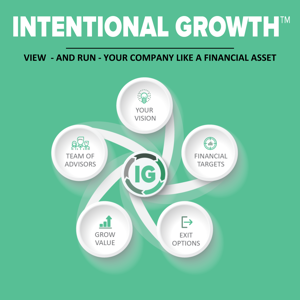
Intentional Growth™ is a podcast is a podcast for entrepreneurs and business owners wanting to view - and run - their company like a financial asset so they can have fun, create wealth, and make an impact. Truly make the entire journey of owning and running a company "worth it".