Intentional Growth

Intentional Growth

By Arkona - Intentional GrowthBusinessEntrepreneurshipInvestingManagement
Download on the App Store

Intentional Growth episodes

  • Built to Sell with John Warrillow
    In this week’s episode of Life After Business we hear from the speaker, author, entrepreneur, and current owner of The Value Builder System: John Warrillow. John shares his story and the lessons he learned after building and selling multiple businesses as well as the inner workings of his pioneering value builder system. John wanted to fill the role of “Robin Hood” for business owners in a sea of “mercenaries” (buyers) by helping them maximize the value of their company and helping them to level the playing field.
    If you’re pushed for time, don’t worry – you can still benefit from some of John’s advice below:
    Understand the key drivers of a company’s value:
    Like anything in life, a company value can be dissected into separate parts and analyzed individually, i.e. revenue, growth potential etc. Understanding what a financial buyer looks for when they buy a company puts you on the same page and takes away the advantage that the buyer has. You can focus on the key drivers and eliminate the reasons a buyer would discount the price of your company.
    What are the 8 drivers?
    Be mindful of a business that is too dependent on you personally:
    However good your numbers may look; what are the chances of the buyer being able to achieve the same profits once you’re gone?
    Have an intermediary to run the business exit planning process for you:
    Use someone who specializes in exit planning AND the merger and acquisition process. Even if you’re confident in your business skills, because exiting your business is most likely a one-time event, an intermediate usually pays from themselves. They do if for a living, therefore, they have many experiences to pull from that could save you TONS of money. Worst case scenario, they help eliminate (or minimize) your emotion from the deal, which is usually the top deal killer.
    Use a specific ‘deal lawyer’:
    However good your own legal team may have been during your incorporation and the current day-to-day operations of your company, getting an M&A deal over the goal line is a significantly different skill set. Also keep in mind that your current lawyer may want to keep you as a client. How does this affect their motives and would they be 100% all-in during the sale of your business to a third party when they are potentially working themselves out of a job?
    Be wary of low-price offers that leave you with equity:
    It’s easy to be seduced by a big company offering to acquire you and promising that you will generate vast increases of wealth in future revenue. Can they really back those claims up? What markets or services will they be tapping in to that you haven’t already? 
    What did he do after the sale?
    When John sold his research company to a big public conglomerate, he convened everyone in the boardroom with the buyer and tried to spell out the benefits to the employees, i.e. opportunities for career progression at a bigger company.
    He continued to run the business as its own division and became an employee of the wider group for about a year.
    He eventually developed The Value Builder System: a statistically proven way of improving the value of a company by up to 71%. In his research study of over 20,000+ businesses, companies that achieve a Value Builder Score of of 80+ (out of a possible 100) go on to sell at a 71% premium compared to the average-scoring business of 59.
    What does a successful exit from your business look like?
    A business owner that exits their business and gets a fair market value or premium over the market value.
    The seller
    44 min
  • Don’t Regret Selling Your Company
    After a breakup, it might seem like a good idea to jump right into another relationship.  There’s a hole to be filled and you have so much to give. But is it a good idea? Maybe. Does it feel good? Usually. Do you usually end up regretting it? Most likely, yes.
    Many of us have gone through some form of rebound relationship—it’s an easy trap! You know the one…you wake up one day and realize you are officially over the first relationship and don’t really want to be in the one you are in now—it was just a placeholder.  Whoops.
    Usually, there is some emotional fallout, maybe even financial, hopefully none of which is irreversible. The biggest challenge is swallowing your pride, ripping off the Band-Aid, and moving on.
    Unfortunately, a business rebound can have much bigger consequences…
    Starting a business just because you used to have one is not a good reason to embark on a new venture. There are plenty of people that become serial entrepreneurs. To become a successful serial entrepreneur, future businesses must accomplish a specific financial or industry need, the expected returns are very clear, and the relationship with the business has very clear boundaries. 
    How do you know if you are in a business rebound?
    You feel the need to have a quick response to, “What do you do?”
    You essentially bought another “job.”  You need to work 60 hours a week to keep the company going.
    At the base level, your company is just “something to do” to distract yourself from boredom.
    There’s a complete lack of passion. There’s no bounce-out-of-bed that you used to have when you started your first business.
    You have no exit plan and aren’t thinking of ways for the business to thrive without you at the helm.
    You started or bought your company just to be around other people.
    You wanted to keep the title of CEO, President, or Founder.
    How did you get here? It is estimated that 75% of business owners are unhappy that they sold the business at the 12-month mark post-sale. There can be a huge sense of loss owners face after they leave their business. A second business is another chance to identify with something. To create the sense of purpose that you need to be happy.
    The risk of not knowing what you want…
    If you go into a business not knowing what you want, you’re going to have a bad time. You will become aimless without a destination and your expectations will never be met. Partially, because you had no expectations or goals to begin with.
    A business should be born because passion, skillsets, and energy meet where there is a need and market for a solution.
    In our interview, Kristy describes her rebound story with her second company
    Kristy and her husband sold a large manufacturing and energy retrofitting company in their mid-20s. They experienced something that many 25-year-olds don’t get to, a large influx of cash.
    “It was like winning the lottery”
    There are many challenges that come with easy money, especially at such a young age. They decided to start an investment management firm and a real estate company because that is what all their friends were doing. Kristy describes their euphoria as the “Midas Touch.”  They felt like they couldn’t lose.
    Kristy explains many challenges they had in the seven years of owning their investment firm. The company was sucking their cash dry and there was no end in sight.
    Kristy and her husband both dealt with the realization that it was over in much different ways. Kristy saw it for what it was “a rebound business” from their first one. She took it as a challenge to find out who she really was and search for something that would give her purpose.
    Find out more about how Kristy and Phil moved on and into their current success after a roller coaster of a cou

    53 min
  • Don’t Regret Selling Your Company
    After a breakup, it might seem like a good idea to jump right into another relationship.  There’s a hole to be filled and you have so much to give. But is it a good idea? Maybe. Does it feel good? Usually. Do you usually end up regretting it? Most likely, yes.
    Many of us have gone through some form of rebound relationship—it’s an easy trap! You know the one…you wake up one day and realize you are officially over the first relationship and don’t really want to be in the one you are in now—it was just a placeholder.  Whoops.
    Usually, there is some emotional fallout, maybe even financial, hopefully none of which is irreversible. The biggest challenge is swallowing your pride, ripping off the Band-Aid, and moving on.
    Unfortunately, a business rebound can have much bigger consequences…
    Starting a business just because you used to have one is not a good reason to embark on a new venture. There are plenty of people that become serial entrepreneurs. To become a successful serial entrepreneur, future businesses must accomplish a specific financial or industry need, the expected returns are very clear, and the relationship with the business has very clear boundaries. 
    How do you know if you are in a business rebound?
    You feel the need to have a quick response to, “What do you do?”
    You essentially bought another “job.”  You need to work 60 hours a week to keep the company going.
    At the base level, your company is just “something to do” to distract yourself from boredom.
    There’s a complete lack of passion. There’s no bounce-out-of-bed that you used to have when you started your first business.
    You have no exit plan and aren’t thinking of ways for the business to thrive without you at the helm.
    You started or bought your company just to be around other people.
    You wanted to keep the title of CEO, President, or Founder.
    How did you get here? It is estimated that 75% of business owners are unhappy that they sold the business at the 12-month mark post-sale. There can be a huge sense of loss owners face after they leave their business. A second business is another chance to identify with something. To create the sense of purpose that you need to be happy.
    The risk of not knowing what you want…
    If you go into a business not knowing what you want, you’re going to have a bad time. You will become aimless without a destination and your expectations will never be met. Partially, because you had no expectations or goals to begin with.
    A business should be born because passion, skillsets, and energy meet where there is a need and market for a solution.
    In our interview, Kristy describes her rebound story with her second company
    Kristy and her husband sold a large manufacturing and energy retrofitting company in their mid-20s. They experienced something that many 25-year-olds don’t get to, a large influx of cash.
    “It was like winning the lottery”
    There are many challenges that come with easy money, especially at such a young age. They decided to start an investment management firm and a real estate company because that is what all their friends were doing. Kristy describes their euphoria as the “Midas Touch.”  They felt like they couldn’t lose.
    Kristy explains many challenges they had in the seven years of owning their investment firm. The company was sucking their cash dry and there was no end in sight.
    Kristy and her husband both dealt with the realization that it was over in much different ways. Kristy saw it for what it was “a rebound business” from their first one. She took it as a challenge to find out who she really was and search for something that would give her purpose.
    Find out more about how Kristy and Phil moved on and into their current success after a roller coaster of a cou
    53 min
  • Ep #2: Don’t Regret Selling Your Company with Kristy Gusick
    After a breakup, it might seem like a good idea to jump right into another relationship.  There’s a hole to be filled and you have so much to give. But is it a good idea? Maybe. Does it feel good? Usually. Do you usually end up regretting it? Most likely, yes.
    Many of us have gone through some form of rebound relationship—it’s an easy trap! You know the one…you wake up one day and realize you are officially over the first relationship and don’t really want to be in the one you are in now—it was just a placeholder.  Whoops.
    Usually, there is some emotional fallout, maybe even financial, hopefully none of which is irreversible. The biggest challenge is swallowing your pride, ripping off the Band-Aid, and moving on.
    Unfortunately, a business rebound can have much bigger consequences… Starting a business just because you used to have one is not a good reason to embark on a new venture. There are plenty of people that become serial entrepreneurs. To become a successful serial entrepreneur, future businesses must accomplish a specific financial or industry need, the expected returns are very clear, and the relationship with the business has very clear boundaries. 
    How do you know if you are in a business rebound?
    You feel the need to have a quick response to, “What do you do?”
    You essentially bought another “job.”  You need to work 60 hours a week to keep the company going.
    At the base level, your company is just “something to do” to distract yourself from boredom.
    There’s a complete lack of passion. There’s no bounce-out-of-bed that you used to have when you started your first business.
    You have no exit plan and aren’t thinking of ways for the business to thrive without you at the helm.
    You started or bought your company just to be around other people.
    You wanted to keep the title of CEO, President, or Founder.
    How did you get here? It is estimated that 75% of business owners are unhappy that they sold the business at the 12-month mark post-sale. There can be a huge sense of loss owners face after they leave their business. A second business is another chance to identify with something. To create the sense of purpose that you need to be happy.
    The risk of not knowing what you want…
    If you go into a business not knowing what you want, you’re going to have a bad time. You will become aimless without a destination and your expectations will never be met. Partially, because you had no expectations or goals to begin with.
    A business should be born because passion, skillsets, and energy meet where there is a need and market for a solution.
    In our interview, Kristy describes her rebound story with her second company
    Kristy and her husband sold a large manufacturing and energy retrofitting company in their mid-20s. They experienced something that many 25-year-olds don’t get to, a large influx of cash.
    “It was like winning the lottery”
    There are many challenges that come with easy money, especially at such a young age. They decided to start an investment management firm and a real estate company because that is what all their friends were doing. Kristy describes their euphoria as the “Midas Touch.”  They felt like they couldn’t lose.
    Kristy explains many challenges they had in the seven years of owning their investment firm. The company was sucking their cash dry and there was no end in sight.
    Kristy and her husband both dealt with the realization that it was over in much different ways. Kristy saw it for what it was “a rebound business” from their first one. She took it as a challenge t
    53 min
  • Don’t Regret Selling Your Company

    After a breakup, it might seem like a good idea to jump right into another relationship.  There’s a hole to be filled and you have so much to give. But is it a good idea? Maybe. Does it feel good? Usually. Do you usually end up regretting it? Most likely, yes.

    Many of us have gone through some form of rebound relationship—it’s an easy trap! You know the one…you wake up one day and realize you are officially over the first relationship and don’t really want to be in the one you are in now—it was just a placeholder.  Whoops. (more…)

    53 min
  • Events That Trigger the Sale of Your Business
    There is a small (minuscule, really) fraction of entrepreneurs that build their company with the end in mind. Then there is everyone else. The problem is no one tells you about the financial and emotional ramification the lack of planning has on your satisfaction and happiness in a life after business.
    Think about all the things that could potentially impact your decision to maintain ownership of your business. A triggering event can come from anywhere at any time.
    Are you ready for it?
    Of course, there are the typical business environment factors that lead the triggering point, competition, decreasing margins, employee issues, growth problems, financial struggles, etc.
    Even more common are the wide variety of personal tragedies that can trigger the want or need to sell a business: divorce, death, disability, family conflicts, child issues, being burnt out, or one of the worst—boredom.
    One of the most unexpected, and most welcome, triggering events is an offer you just can’t refuse.
    If you are like most entrepreneurs you are thinking to yourself, “I am good at chaos, I can handle the situation as it arises.” You are probably right. You are most likely very good at handling the unknown as it is thrown at you. That is how you have succeeded in the past, no?
     
    So what’s the point?
    There are many more factors to selling than to get the best price.
    The challenge of transitioning out of a business is that it is not just a technical process but an emotional journey as well. Owners that do not focus on who they are and what makes them happy prior to selling their business have a significant chance of being unhappy after the exit of their business.
    If you are too busy doing there is no time to reflect.
    With no time to reflect on what you want from your company and why the chances of unintended consequences are huge. Once the sale is complete and you are fully transitioned out of your business there is no way to redo any of your actions.
    You will have a long time to ponder what you wish you had done differently.
    Wouldn’t it be great to leave with a huge smile on your face because you were in control of the process, dictated the outcome, and excited for what was next to come?
    How and when do you decide to sell you business? Will it be a result of some external factor or will it be of your own choosing—guided by the plan you have put in place.
    14 min

About Intentional Growth

From the publisher's feed

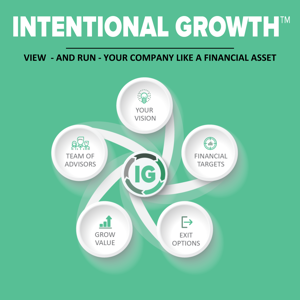
Intentional Growth™ is a podcast is a podcast for entrepreneurs and business owners wanting to view - and run - their company like a financial asset so they can have fun, create wealth, and make an impact. Truly make the entire journey of owning and running a company "worth it".