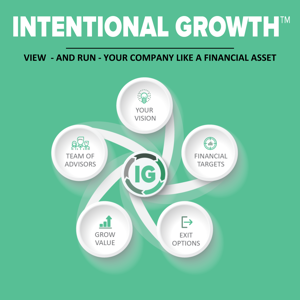
Intentional Growth

Intentional Growth

By Arkona - Intentional GrowthBusinessEntrepreneurshipInvestingManagement
Download on the App Store

Intentional Growth episodes

  • #313: The Role of a CFO as a Guide in Value Creation and M&A
    Ep. #1 [THEME FOUR]
     
    Many owners (me included back when I was running the family business) often lumped anyone who works on numbers together in one big group and many times view that group as a cost center in the business. 
     
    Have you ever heard yourself – or another business owner – say my “finance team” or “accounting people” are handling it? You may have also said or heard a statement like: “We just need to get paid, pay our vendors, and get our monthly results in so we can see how much cash we have so we can keep growing.” 
     
    This shouldn’t surprise to most because many business owners did not have a tour of duty in Private Equity or work at a Big Four Accounting Firm prior to starting their business. Why should we expect any owner to understand how all the financial and accounting functions work, exactly what good looks like, and how all those functions roll up into a comprehensive financial forecast. This forecast should answer the only questions that matter: can we afford our growth, desired distributions, and taxes on the way towards the targeted equity valuation and timing?
     
    In order to view – and run – your company like a financial asset, it takes a team with a strategic financial leader (the CFO) to produce valuable information you feel comfortable making decisions and take action based on. 
     
    On today’s show Arkona co-founders, Ryan Tansom and Pat Hobby, explain all the roles in the financial department and how each function is crucial in getting closer to your ultimate goal, taking it one month at a time.
     
    They break down the roles of bookkeeper, accountant (which he explains can be viewed as a totally separate department), controller and, of course, CFO. You will get very detailed insight on the role of each position and how the CFO plays into the equation
     
    After explaining each individual role, Pat puts all the pieces together and describes how the finance department can be the driving force for all the business owner's decisions and how the business owner can feel confident moving toward their long-term goal without worrying about whether they have the money to grow or not.
     
    // WATCH THE INTERVIEW ON YOUTUBE: Intentional Growth™ Podcast
     
    What You Will Learn
    How the CFO provides the current – and future – financial impact of the business owner’s goals and ideas and their impact on cash flow and the future value of a business.
    How the CFO is the missing link to finally take away the mental stress from the owner who mentally keeps track of the future financial impact of operational decisions in the business
    The difference between finance and accounting and why they are two very distinguishable departments.
    How to separate the roles of each internal finance team member (bookkeeper, CPA, controller, accountant, CFO).
    How to not GROW yourself out of bu
    1 hr 25 min
  • #312: [Owner Success Stories]: Demystifying Business Valuations by Comparing Two Offers with Chris Yates
    Ep. #4 [THEME THREE]
     
    In this last episode of the series, “Demystifying Business Valuations,” we have Chris Yates, the owner of Rhodium Weekend, a community of online entrepreneurs, on the show to share the story of how he sold his business, Centurica. Chris received two offers from different buyers that were wildly different. In this episode, we hammer home the concept of intrinsic financial value vs. strategic transaction value by unpacking the differences in Chris’s offers. 
     
    In the first half of this episode, Chris goes in-depth with the first offer he got from a strategic buyer–an Amazon aggregator–that wanted to do an “acquihire” (essentially wanting to purchase the company for the people and processes). Chris describes how the purpose of the deal drove the deal structure and terms and how it eventually blew the deal up.
     
    In the second half, Chris walks us through how he doubled down and focused on the intrinsic financial value of the company by getting a bank to pre-approve an SBA loan (ultimately determining the intrinsic financial value of the company based on the risk of the cash flow). 
     
    Getting clear on the intrinsic financial valuation helped Chris during the second negotiation for a few reasons. First, he knew what his valuation was regardless of the specific buyer. Second, Chris was able to clearly negotiate the terms and deal structure efficiently because he knew what the company’s intrinsic value was worth. In addition, there are limitations to “creative” deal structures when an SBA is used. 
     
    Being approached by a buyer can cause a rush of emotions for you as the business owner. However, in this series, we have consistently discussed how getting clarity on the intrinsic financial value is crucial so you can weigh all your options against what you know the company is worth.
     
    //WATCH THE INTERVIEW ON YOUTUBE: Intentional Growth™ Podcast
     
    What You Will Learn
    How to structure an LOI so a buyer can’t steal your clients, processes, and systems. 
    Why Chris decided to exit even though he was getting fed opportunity from old and existing clients.
    What was driving the acquihire buyer to want Centurica so badly.
    How Chris got into the mind of the acquihire buyer to really understand why they wanted his company.
    Why understanding what he wanted and why helped Chris negotiate with a buyer that initially had an unappealing offer.
    How Chris realized that ALL of the decision makers need to be sitting at the deal table.
    The uncertainties Chris had in the first deal and why he wished he had set the terms instead of reacting to each offer (and pulled away at the beginning knowing it wouldn't work).
    Chris’s thought process after the first deal fell apa
    1 hr 13 min
  • #311: Strategic Transaction Value - The Value of a Business Based on the Buyer's Purpose of the Deal
    Ep. #3 [THEME THREE]
     
    So far in this series, we’ve been demystifying business valuations by focusing on how a company is valued–as it stands today based on the risk of its cash flow–so you can view and run your company like a financial asset. By focusing on growing the intrinsic financial value–and how the net proceeds correlate to your timeline and ability to hit your financial targets–you will have choices in the future.
     
    With that context in mind, we’re now going to dive into what you can do to maximize your valuation and net proceeds if you want to sell your company to a third party (e.g., strategic buyer or private equity firm). Today’s show focuses on the strategic transaction value which is driven by the reasons buyers buy a company or as we call it “the purpose of the deal…”
     
    What happens if the current company financials are not the primary reason behind the buyer’s purpose of the deal? 
     
    Every entrepreneur and business owner can tell one heck of a story–about the history and future potential of the company. And when it comes to a strategic buyer, we’ve barely ever met an owner who doesn’t know why a strategic buyer would buy their company and what they should do with it. Too often, during the sale to a third party, this story is left to “finance people” to show the numbers and explain the story. 
     
    On today’s show we have Ted Schlueter and Eric Coonrod who have partnered up to solve this issue. They help companies maximize value to a third party buyer through “Branding for Buyout.” Ted helps companies market themselves by increasing the perceived value to a buyer through strategic branding with the target buyers in mind. Eric is an investment banker who focuses on the transactional value and deal structure side of a deal.
     
    We discuss how the story of a company can increase the purchase price of a business (branding), why past marketing data is a huge metric that buyers will look at when acquiring a company, and how successful (pilot) market penetration campaigns can open up opportunities to a buyer and increase desirability and the multiple of your business. Overall, this episode really clarifies how marketing and deal structures fit hand in hand and put more money in your pocket.
     
    //WATCH THE INTERVIEW ON YOUTUBE: Intentional Growth™ Podcast
     
    What You Will Learn
    What buyers look for in an acquisition and why they actually buy a company.
    Ways Ted and Eric figure out the “purpose of the deal” and why the buyer wants to buy the company and how to leverage that reason to increase the sale price.
    Why the role of marketing is so important when getting ready for a buyout.
    Ways to increase the intrinsic value using M&A trends
    1 hr 17 min
  • #310: Intrinsic Financial Value–The Value of a Business Based on the Risk of Its Cash Flow with David Diehl
    Ep. #2 [THEME THREE]
     
    If you focus on growing the intrinsic financial value of your company (the value based on the risk of the cash flow), you can engineer the future valuation you want as long as you have enough time and capital–all while focusing on the right strategies that de-risk the company’s cash flow (therefore increasing the multiple) while increasing your normalized EBITDA. A lot of business owners don’t understand how intrinsic financial value works, but we haven’t done a deep dive on it yet. Until now.
     
    Dave Diehl is back on the show. He is the CEO of Prairie Capital, a nationwide investment banking firm that specializes in helping business owners transition via ESOPs, management buyouts, and third party buyers. 
     
    In this interview, Dave talks about the different types of risk within a company–from the financial buyer's view–and how an entrepreneur can lower that risk and, therefore, increase the valuation. He is the perfect guest for this topic because Prairie does 425+ ESOP valuation updates each year and works on countless transactions that are valued and structured based on the intrinsic valuation of the company. 
     
    This episode is quite literally a treasure trail to help see your company's valuation through the eyes of a financial investor and understand how to increase the equity value over the course of a couple of years.
     
    //WATCH THE INTERVIEW ON YOUTUBE: Intentional Growth™ Podcast
     
    What You Will Learn
    How a financial buyer perceives risk in a company.
    Dave’s thoughts on the discounted cash flow (DCF) approach vs. the market approach to a valuation.
    How a financial buyer views past cash flows compared to future projections and the weight they place on each when determining the value of a company.
    The value of being able to tell the story of the business using the financials, answering questions, and how it all contributes to the trust a buyer has in a seller and their perception of risk.
    Why focusing time on management and a future successor is something every entrepreneur needs to focus on.
    Why the intrinsic financial value can only yield a certain valuation and how the deal structure and payoff proves that point.
    What the capital stack approach to a valuation is and why it matters.
    The market approach vs. a discounted cash flow model vs. a capital stack.
    Why external events (like a pandemic) can affect your purchase price (even if you have done everything right).
    What re-trading a deal is and how it can be dependent on the external economic climate.
    59 min
  • #309: Demystifying Business Valuations: Methods to Value a Business, Normalized EBITDA, and Multiples
    Ep. #1 [THEME THREE]
     
    There are so many terms, philosophies, and methods regarding business valuations that many owners tend to ignore, or they delay addressing their company’s valuation until they want to sell, which is often too late. 
     
    In the previous theme, we covered how you can measure and monitor the value of a business–by integrating it into your company’s financials–while you own it. In order to do this, we need to understand how a company is valued and the key concepts and levers that influence that value. 
     
    Arkona co-founders Ryan Tansom and Pat Hobby are back to kick off the next theme:  Demystifying Business Valuations. They explain the difference between intrinsic financial value and strategic transaction value and how they relate to normalized EBITDA, multiples, enterprise value, equity value, and finally how much money is going into your pocket after a sale (net proceeds). During this episode, Ryan and Pat unpack how companies are valued so you can begin to see–and run–your business like a financial asset.
     
    //WATCH THE INTERVIEW ON YOUTUBE: Intentional Growth™ Podcast
     
    What You Will Learn
    Why knowing the value of your company today is crucial to view–and run–your company as a financial asset.
    That intrinsic financial value +/- the purpose of the deal = strategic transaction value.
    Why the intrinsic value of a business is based on its cash flows.
    Why planning into the future using the intrinsic value of the company increases the options you will have when you actually want to sell.
    How to get a premium over the intrinsic financial value of a company.
    How the purpose of the deal and the buyer impact the transaction value.
    The difference between enterprise value, equity value, and net proceeds.
    How normalized (or adjusted) EBITDA works, how to calculate it, and why it matters.
    Why knowing the value of your company in real time helps you make decisions and in line with your long-term goals.
    The THREE numbers you should focus on in order to increase your net proceeds in the future when and if you decide to sell.
     
    // USE YOUR FINANCIALS TO CLARIFY A PATH TOWARDS A MORE VALUABLE BUSINESS: Intentional Growth Financial Assessment
     
    Bio:
    Pat Hobby started his career as an auditor at EY and over the years held various finance positions before launching his own outsourced CFO services company. As one of his clients continued to grow and needed more assistance, he joined the company full-time for more than 20 years. He helped the
    1 hr 2 min
  • #308: Quarterly Economic and M&A Market Update with ITR Economics, GF Data, and ButcherJoseph
    QUARTERLY ECONOMIC AND M&A MARKET UPDATE
     
    There’s a lot going on in the world today that could make a business owner feel anxious and question what to do next with their company. Should you sell your business? Acquire other companies? Reinvest? Play the long game and grow intrinsic value? What about the labor market, geopolitics, and supply chains, and their impact on my growth potential and future value of the business?
    ANSWERS AND DISCUSSIONS TO ALL THE QUESTIONS ABOVE START IN THIS FIRST EPISODE OF OUR QUARTERLY ECONOMIC AND M&A MARKET UPDATE SERIES
    They are going to be segmented into three sections. Below are each of the three organizations, the topics, and we listed the starting point for each segment - along with the main highlights - so you can jump to one section if you’d like. 
     
    View Section:
    ITR Economics, Brian Beaulieu // 05:20
    GF Data, Bob Wegbreit // 41:45 
    ButcherJoseph, Jeff Buettner // 1:19:30
    First, you will get insights into the current macroeconomic environment, market trends and things to keep an eye on in the future; second, you will hear updates on the data behind recent private transactions, valuations, and deal volume and structures; and lastly, you will hear stories from people who are doing deals in the M&A market. This episode will be a bit longer because we had each organization give a bit about themselves, their company’s background, as well as where they get their information. 
    WHY ARE WE DOING THIS?
    We want to bring to you resources - typically only accessed by people at the heart of private M&A deals and the capital markets - so you can make better decisions, grow the value of your company, and get where you want to go faster. 
     
    Middle- and lower-market privately held business owners (we’re defining that as around $2M to $250M in revenue) need more information–on the economy, capital markets, and the M&A market–that is timely, relevant, and useful to them. So many resources are spent gathering and publishing information that is geared toward the public markets, and we believe that privately held marketplaces need - and deserve - more attention. 
     
    //WATCH THE INTERVIEW ON YOUTUBE: Intentional Growth™ Podcast
     
    What You Will Learn
     
    ITR Economics, Brian Beaulieu // 05:20
    The first segment (05:20) is from ITR economics where Brian Beaulieu goes over an analysis of current market trends and what to expect in the future as a business owner with consumer trends, increases in interest rates, and the predicted 2030 depression. Since 1948, ITR Economics has provided business leaders with economic information, insight, analysis, and strategy. ITR Economics is the oldest privately held, continuously operating economic research and consulting firm in the US.
    How ITR Economics uses rate of change in their forecasts
    The cause of business cycles and why people fear them because there’s no context 
    Why the bond market foreshadows high interests rates
    ITRs insight to the 2030 depression and how to shift your mindset towards it
    The consumer and leading indicator trends
     
    GF Data, Bob Wegbreit // 41:45 
    In the second segment (41:45), Bob from GF Data, a data aggregator on private-equity sponsored M&A transactions with enterprise values of $10-250 million, talks about M&

    1 hr 46 min
  • #307: [Owner Success Stories] Are You Running a Lifestyle Business or Are You Creating a Valuable Asset?
    Ep. #3 [THEME TWO]
     
    We have two business owners, Rob Dube and Cindy Banchy, on the show to wrap up our second theme, “Are You Creating a Lifestyle Business or a Valuable Asset.” They share how they shifted their mindset to think about their company like an asset, what their future goals are, and how their lives - and businesses - have changed since they adapted this new mindset. 
     
    Rob and Cindy discuss the three areas they focused on to help them run their company like and as an asset: trust your people, understand your financials (using the three financial statements), and follow your vision. Both of them dive deep into those three areas and pretty much give away the start-to-finish foundational points that will allow you to turn your business into a valuable asset, create future options, and how to successfully sit in the “owner’s box” instead of the management team.
     
    //WATCH THE INTERVIEW ON YOUTUBE: Intentional Growth™ Podcast
     
    What You Will Learn
    What it took for Cindy and Rob to shift their mindset to view their company like a financial asset and not just a job.
    Why Rob believes financials truly tell the story of the health of a business.
    How each business owner views their company and their relationship with the business and management team.
    Ownership roles vs. management roles and how that relates to normalized EBITDA.
    How each business owner separated their ego from their business to better run their business like an asset.
    How Rob and Cindy built the trust around their people so they can step away for weeks at a time.
    How Rob and Cindy manage their rhythm between their managers without stepping on each others’ toes.
    The intrinsic benefits of understanding the financials.
    How combining the three financial statements has allowed Cindy and Rob to understand how much they can pay themselves and give out for raises.
    Why culture can add asset value to the right buyer and also allow your business to better run as an asset.
     
    // USE YOUR FINANCIALS TO CLARIFY A PATH TOWARDS A MORE VALUABLE BUSINESS: Intentional Growth Financial Assessment
     
    Bio:
    Cindy Banchy:
    Cindy is the President and Regional Master for Vanguard Cleaning Systems of Minnesota, a commercial cleaning master franchise located in Minneapolis. Prior to Vanguard, Cindy was with IBM from 1989 through 2005.
    Cindy loves spending time taking adventure travels to new countries, competing in long-distance triathlons, taking epic lo
    1 hr 5 min
  • #306: The Business Owner’s Dilemma: Solving for Current Cash Flow vs. Long Term Business Value Creation
    EP. #2 [THEME TWO]
     
    Should you reinvest your business’s profits or take home distributions instead? In this episode, Ali Nasser, founder and CEO of AltruVista, is on the show to help us answer this question and continue our current theme: are you running a lifestyle business or creating a valuable asset?
     
    Ali talks about the three critical dilemmas that are on every entrepreneur's mind when it comes to growing your business and lifestyle. He explains how to think about reinvesting in your company vs. taking the money home and investing (or spending) outside your company, how to plan for an exit, and how to create a legacy you are proud of. The first topic he challenges us to get clarity on is… well, you guessed it, what do you want long-term? Ali walks us through different reinvestment strategies as well as how to plan for an eventual exit based on the capital you need for your lifestyle and legacy (which is tightly integrated into the Intentional Growth™ Principle #2 - Financial Targets). 
     
    Many entrepreneurs feel trapped when it comes to thinking about an exit, which is why we’ve been talking about how to view your company as a financial asset that gives you choices to exit when and how you want if you build a company worth what you want–or need–it to be worth. If you know what you want long-term and how much it costs to live the lifestyle you want–while saving some money for low-risk investments–you will find clarity on the right mix of reinvesting back in the business and saving outside the business so you can hit your long-term financial goals.
     
    //WATCH THE INTERVIEW ON YOUTUBE: Intentional Growth™ Podcast
     
    What You Will Learn
    The Three Dilemmas that every entrepreneur deals with. 
    The six categories that define the entrepreneur wealth spectrum (WISE).
    Lifestyle wealth versus legacy wealth and how it ties into net proceeds. 
    How to navigate the intersection of wealth planning and life planning.
    Exit planning versus a value enhancement strategy.
    Why you need to know what you want from your company–both financially and emotionally–before creating an investment or exit strategy.
    The different reinvesting options every business owner has–demonstrated by Ali’s IOD chart.
    How to think about risk as it relates to investing in your business and all the other asset classes outside of your company.
    Why and when it’s important to diversify your net worth outside of your business.
    Why it’s so important to understand your own perception of risk and how that compares to the real risk when investing in any asset.
    1 hr 15 min
  • #305: How to View Your Company as a Financial Asset by Clarifying Ownership & Management Roles & Focusing on 3 Financial Targets
    EP. #1 [THEME TWO]
     
    Today, we kick off a new theme: are you running a lifestyle business or are you growing a valuable asset?
    In this episode, Arkona co-founders Ryan Tansom and Pat Hobby break down what it takes to view your business as a financial asset - regardless of when you want to sell - so you can focus on growing the value of the company. By running your business as a financial asset, you can focus your time, money, and energy on areas that will increase the company’s valuation by creating sustainable, predictable, and transferable cash flow. The more valuable your company is, the more choices you will have down the road and it will allow you to create wealth, enjoy work, and make an impact. 
    Ryan and Pat dive deep into some key concepts that will help you walk away with a clear understanding of the metrics that you need to focus on - and what they mean - in order to see what your company is worth today and how you can project out the value of the company years into the future. It all starts by clearly understanding the difference between your ownership role versus your management role and three financial targets.
    // WATCH THE INTERVIEW ON YOUTUBE: Intentional Growth™ Podcast
     
    What You Will Learn
    The difference between a lifestyle business and long-term value creation.
    The three financial targets that will help you view your business as a financial asset.
    The number one thing holding people back from long-term value creation.
    The difference between ownership and management roles, why they matter, and how it impacts your decision-making.
    How to clearly see the interaction and tradeoffs between funding growth, distribution, and taxes.
    What EBITDA and Normalized EBITDA is, why it matters, and how it is used to value a business.
    How the three financial statements are used to project out the value of a company.
    Why you need to use - and integrate - all three financial statements and why business owners typically don’t.
    How to integrate enterprise value, equity value, and net proceeds into the three financial statements so you can project out the value of your business year into the future.
    The importance of creating a financial “path” to creating long-term value.
     
    // USE YOUR FINANCIALS TO CLARIFY A PATH TOWARDS A MORE VALUABLE BUSINESS: Intentional Growth Financial Assessment
     
    Bio:
    Pat started at EY before creating his own outsourced CFO services company. There, he advised over 15 companies. He ended up joining one of those clients as they continued to grow,
    1 hr 21 min
  • #304: [Owner Success Stories] What Do You Want From Your Business and Why?
    EP. #4 [THEME ONE]
     
    This is a very special episode to cap off our first series “What Do You Want From Your Business and Why.” We have a panel of four business owners–along with Dr. Stacy Feiner–who are willing to share their personal journeys about getting clear on what they wanted from their businesses and how it impacted their decision-making, stakeholders, and personal happiness. 
     
    The group shares their stories about what led them to feel lost and confused and how they overcame it by learning more about themselves and their stakeholder ecosystem. They explain what drove them to seek outside help (coaching with Dr. Stacy Feiner) instead of trying to solve the problem themselves and the enormous progress they have achieved since.
     
    // WATCH THE INTERVIEW ON YOUTUBE: Intentional Growth™ Podcast
     
    What You Will Learn
    The personal struggles these entrepreneurs were going through that led them to seek outside help.
    How coaching can eliminate personal and mental blind spots. 
    What it’s like after having clarity on what you want and why, and how that impacts your business, stakeholders, and decision-making.
    Why and how relationships with the people around you (both business and personal) can improve and grow as a result of coaching.
    The impact of not having tools and resources to help you communicate what you want with your stakeholders.
    How conflict with others and internal anxiety can be reduced–or eliminated–if you do the hard work to look inside and get clarity on what you want and why.
    What it was like for these business owners to look back on their struggles they had prior to finding clarity through coaching.
    The importance of momentum while working with a coach.
    How these business owners aligned what they wanted with the “stakeholder ecosystem.”
    The group’s comments toward people who are skeptical of coaching.
     
    // USE YOUR FINANCIALS TO CLARIFY A PATH TOWARDS A MORE VALUABLE BUSINESS: https://arkona.io/intentional-growth-financial-assessment
     
    Bio:
    Dr. Stacy Feiner is a professional coach for top performers who are ready to solve emotionally-charged problems in their professional lives in order to focus on growth.
    Conner Krizancic is a founder of Good Wolf Marketing and was a Division 1 college football player that has now shifted to business, brand building, and marketing strategy.
    Rachel Wallis-Andreasson has been at Wallis Companies since 1993. She first served ont he acquisition team, spent a year at territory manager, and finally moved up to the corporate headquarters.
    1 hr 35 min

About Intentional Growth

From the publisher's feed

Intentional Growth™ is a podcast is a podcast for entrepreneurs and business owners wanting to view - and run - their company like a financial asset so they can have fun, create wealth, and make an impact. Truly make the entire journey of owning and running a company "worth it".