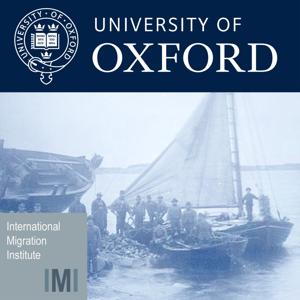
International Migration Institute

International Migration Institute

By Oxford UniversityEducation
Download on the App Store

International Migration Institute episodes

  • Humanitarian non-state actors and the delocalised EU border of the Central Mediterranean
    Paolo Cuttitta looks at how different humanitarian non-state actors (from large-scale international organisations to small local NGOs) operate in different spaces of the delocalised EU border Non-state actors have become increasingly important players within the European–North African migration and border regime. Paolo Cuttitta's research looks at how different humanitarian non-state actors (from large-scale international organisations to small local NGOs) operate in different spaces (international waters as well as North African countries of transit/origin such as Tunisia, Libya and Egypt) of the delocalised EU border. The question is whether and in how far their activities can be considered as part of the processes of denationalisation and/or depoliticisation of the border; in how far these actors are just supporting states in their delocalised migration and border policies and in how far they are pushing forward their own agendas instead. Can attempts to repoliticise the border generate processes of counter-delocalisation?
    34 min
  • 'To have and have not': International migration, poverty and inequality in Algeria
    Mouhoub el Mouhoud considers the effects of emigration on poverty and inequality by drawing on an original survey conducted in Algeria This presentation considers the effects of emigration on poverty and inequality by drawing on an original survey conducted in Algeria. It is the first household survey in Algeria that specifically addresses the issues of migration and remittances and provides the information necessary to evaluate their impacts on poverty and inequality. Furthermore, unlike many household surveys, this survey also collects information on pensions (a very important income source) received in the country of origin based on overseas work for returning migrants. It focuses on two regions (Kabylia and Tlemcen) which differ in terms of diaspora organisation, migration history and regional insertion. Semiparametric descriptive analysis is complemented by a parametric model, which allows for the estimation of counterfactual household income and the calculation of the impact of migration on the distribution of income across households.
    The main findings are that remittances, including foreign pensions, do not significantly change the Gini coefficient in either region. However, the simulations suggest that migration has reduced poverty by nearly 16 percentage points (40 per cent), with the effect in Kabylia (Idjeur) being twice as large as Tlemcen (Nedroma) insofar as concerns extreme poverty. Foreign transfers, especially foreign pensions, have a strong positive impact on very poor families in Idjeur but much less in Nedroma, where poor families suffer from a ‘double loss’ due to the fact that that their migrants do not provide local income nor do they send much money home. This difference between the two regions may be explained by the fact that communities in Kabylia are more structured, and that Kabyle emigrant communities overseas replicate these structures, reinforcing strong social norms in favour of remitting behaviour. Finally, this article presents results consistent with the finding in the literature showing an inverse U-shaped relationship between past migration and inequality, but suggests a nuanced interpretation due to the inequality-inducing effects of foreign pensions.
    45 min
  • The cultural tranmission of the fertility transition: Evidence from internal migrations in 19th century France
    Hillel Rapoport (Paris School of Economics) looks at theories of migrants' social remittances in a historical context relating to fertility in 19th century France France experienced a demographic transition earlier than richer and more educated countries. This presentation offers a novel explanation for this puzzle that emphasises the diffusion of culture and information through internal migration. It tests how migration affected fertility by building a decennial bilateral migration matrix between French regions for 1861–1911. The identification strategy uses exogenous variation in transportation costs resulting from the construction of railways. The results suggest the convergence towards low birth rates can be explained by the diffusion of low-fertility norms by migrants, especially by migrants to and from Paris.
    46 min
  • From coffee to industry: Changes in migrants' characteristics in metropolitan areas in Brazil
    Presenting his PhD research, Visiting Fellow Guilherme Ortega explores migrant characteristic in Campinas metropolitan area, Brazil The overall aim of this work is to investigate the migratory processes of Campinas Metropolitan Area in Brazil and the flows and sociodemographic characteristics of migrants, in light of the different economic and political contexts through which Brazil has passed since the 1980s. The end of slavery in Brazil in 1888 enabled the creation of a rural labour market and altered the structure of mass consumption, thanks also to the rise of coffee exports. The accumulation of capital that proceeded from this export enabled investment in infrastructure and industry, particularly the textile and cotton industries. The end of slavery also marked the beginning of European immigration, by which those European migrants would later head for the city’s industries. The Brazilian metropolises emerged due to a tendency in countries such as Brazil, which have low investment in production, of concentrating industrial parks in a single region, seeking to take advantage of transportation infrastructure, public services, teaching institutions and an appropriately qualified workforce.
    Between 1980 and 1985, thanks to the end of the Brazilian military dictatorship and the external capital inflows there was an intensification of industrial and urban growth in major centres. The cost of transport, land and services increased, and part of the industry was forced to abandon big centres like São Paulo – a process understood as ‘diseconomies of agglomeration’ – which enabled the development of new economies and agglomerations around the city. The processes of economic, social and political transformation provide us with the idea that internal and international migration processes were also influenced and changed, both in relation to flows and, particularly, in relation to the characteristics of these migrants, due to changes in the industrial process and in the labour market. Lastly we must recognise the influence of industrialisation and migration processes in the structuring of space, particularly within the cities of the metropolitan areas in Brazil in which residents lived in differing ways according to their varying financial resources With this in mind, we investigate the importance of migrant destination, i.e. the area in which they live within the metropolitan area, taking into account their sociodemographic characteristics, to explore the dynamics of labour relations.

    24 min
  • Emigration and the distribution of income per natural: Evidence from Egypt
    Joachim Jarreau investigates whether the benefits of migration actually reach the poorest households We study the impact of emigration on income distribution of Egyptian households, using longitudinal data covering 1998–2012. Controlling for selection of migrants and work participation of non-migrants, we find that remittances tend to increase income inequality at origin. However taking into account income earned abroad by migrants, adjusted for PPP differences, yields larger gains from migration and a negative impact on inequality of ‘income per natural’. We study the dependence of this effect with the saving share of migrants’ earnings. Positive selection of migrants tends to make migration inequality-increasing, while low transferability of skills in destination countries, primarily in the Gulf region, has the opposite effect. We argue that a focus on remittances is too restrictive to account for the whole benefits of migration to origin households, when transfer costs are high. We confirm this with household panel regressions showing that migration episodes have a significant and large impact in the medium-term on household permanent income, controlling for pre-departure characteristics. The medium-term benefits from migration have an inequality-reducing effect in particular in rural areas.
    41 min
  • Birthplace, bloodline and beyond: How 'Liberian citizenship' is currently constructed in Liberia and abroad
    Robtel Neajai Pailey interrogates how Liberian citizenship has been constructed across time and space This presentation interrogates whether or not an ‘authentic’ Liberian citizen actually exists based on multi-sited fieldwork conducted between June 2012 and July 2013. Using actor-oriented analysis as my theoretical framework, I examine the interfaces between 202 Liberian respondents – namely, homeland Liberians in Monrovia, Liberia’s capital; Liberian diasporas in London, Washington, Freetown, and Accra; permanent and circular returnees; executive and legislative members of government, including the four sponsors of Liberia’s 2008 proposed dual citizenship bill – showing that their conceptualisations of 'Liberian citizenship' differ according to their lived experiences and social locations, and ultimately influence participation, or lack thereof, in post-war recovery. I argue that contemporary constructions of ‘Liberian citizenship’ transcend the legal definition enshrined in the country’s 1973 Aliens and Nationality Law—moving from passive, identity-based citizenship to more active, practice-based citizenship.
    I use inverted commas to encase the term ‘Liberian citizenship’ throughout because it refers to the constantly shifting conceptualisations and practices of citizenship over space and time. Citizenship, in my analysis, is not only a bundle of rights and privileges embedded in constructions of legal, national and cultural identity, but it is also a set of practices and interactions embodied in the life-worlds of respondents in Liberia and across transnational spaces.
    48 min
  • The micro-politics of mobility and immobility
    Jørgen Carling looks at the politics of the individual and the role of power relations in mobility and immobility This presentation is part of the 2016 IMI Hilary Term seminar series, which seeks to interrogate the relationship between migration, politics and political change. The series offers a wide range of (inter)disciplinary, methodological and theoretical approaches to the study of the processes and outcomes that link migration, emigrants and immigrants with politics and political change.
    The series seeks to discuss both how political actors govern migrants’ actions and movements ‘from above’, through policies and resources, and how migrants may shape politics ‘from below’, and can be grassroots ‘agents of change’. Key themes highlighted in this collection of seminars include research on diasporas, transnational engagement, im/migrant politics in origin and receiving countries and political change, and the implications of migration as manifestation of social transformation. The seminar series is organised and coordinated by IMI postdoctoral fellows Dr. Marieke Van Houte and Dr. Ali R. Chaudhary who are currently working on TRANSMIC, a Marie Curie-funded project, which explores the topic of migration, politics and political change.
    48 min
  • Ethnicity, socialization, policy preferences or social structure? Disentangling and comparing the sources of migrants' political preferences across Europe
    Laura Morales compares the political party preferences of migrants across Europe The objective of this paper is to study the party preferences of migrants in a comparative perspective. While long considered politically quiescent, recent studies show that migrants participate politically in their settlement countries. While in the US there is a long tradition of studies of ethnic minorities’ party preferences, European scholars have only recently addressed the issue using mainly case studies.
    Drawing on prior studies on the voting behavior of migrants and ethnic minorities, we test several hypotheses related to individual and contextual factors explaining the formation and the direction of migrants’ party preferences. Using data from individual surveys conducted in the context of the Localmultidem project (http://www.um.es/localmultidem/) to samples of migrant groups and natives in 7 European cities across 5 different countries (Budapest, London, Madrid, Barcelona, Milan, Zurich, and Geneva), our results suggest that individual factors are more important to explain the formation of party preference but that contextual factors affect the difference between migrants and natives in their party choice.
    48 min
  • Cross border migration as the transnational social question
    Thomas Faist shows how the 'transnational social question' relates to political conflicts around the inequalities connected to cross-border migration in immigration and emigration contexts On a world scale, distress and social instability are reminiscent of the social inequalities that obtained in a large part of nineteenth-century Europe. At that time the 'social question' was the central subject of extremely volatile political conflicts between the ruling classes and working-class movements. Are we now on the verge of a new social conflict, this time on a cross-border scale, characterised by manifold boundaries – such as those between capital and labour, North and South, developed and underdeveloped or developing countries?
    Looking at cross-border migration, this lecture exemplifies crucial mechanisms resulting in the reproduction of old inequalities and the emergence of new inequalities. The lecture shows how the 'transnational social question' relates to political conflicts around the inequalities connected to cross-border migration in immigration and emigration contexts. Among the processes relevant for the understanding of the transnational social question are marketisation, securitisation, and developmentalism.
    42 min
  • When the diaspora takes charge: state making and diaspora return in Rwanda
    Simon Turner explores state and nation building in Rwanda since its 1994 genocide Over the past sixty years, Rwanda has experienced massive population displacements due to ethnic tensions, war and genocide. These movements of populations have in turn caused radical transformations of the political landscape in the country. This presentation explores state and nation building in Rwanda since the genocide when the Tutsi diaspora returned in large numbers and created a state that was meant to be radically different to the pre-genocide state. I argue that the returning diaspora sees the country as virgin soil and that the diaspora itself has a great responsibility to develop the country and prevent it ‘sliding back’ into ‘genocide ideologies’. This creates a new political elite of returnees with a strong ideology of top-down developmentalism. Furthermore, I argue that the Rwandan state is performed – and hence made – through regulating populations according to when and where they moved across the borders.
    29 min

About International Migration Institute

From the publisher's feed

Podcasts recorded by the International Migration Institute

More shows like International Migration Institute

Philosophy for Beginners by Oxford University

Philosophy for Beginners

330 Listeners

Approaching Shakespeare by Oxford University

Approaching Shakespeare

332 Listeners

General Philosophy by Oxford University

General Philosophy

70 Listeners

Anthropology by Oxford University

Anthropology

72 Listeners

Aesthetics and Philosophy of Art lectures by Oxford University

Aesthetics and Philosophy of Art lectures

77 Listeners

Philosophy of Religion by Oxford University

Philosophy of Religion

41 Listeners

Theoretical Physics - From Outer Space to Plasma by Oxford University

Theoretical Physics - From Outer Space to Plasma

57 Listeners

The Secrets of Mathematics by Oxford University

The Secrets of Mathematics

42 Listeners

Critical Reasoning for Beginners by Oxford University

Critical Reasoning for Beginners

30 Listeners

Kant's Critique of Pure Reason by Oxford University

Kant's Critique of Pure Reason

77 Listeners