Keble College

Keble College

By Oxford UniversityEducation
Download on the App Store

Keble College episodes

  • Creating Cyborgs
    Professor Kevin Warwick from Reading University talks about his innovative research in the area of robotics and cyborgs.
    1 hr 3 min
  • Creativity Lecture 4: Two Sides of the Creativity Coin - Innovation and Lock-in
    Professor Steve Rayner (University of Oxford) presents creative and innovative potential solutions to the energy crisis and problems caused by climate change. Steve Rayner is Director of the Insitute for Science, Innovation and Society (InSIS) at the Saïd Business School of the University of Oxford, from where he also directs the Oxford Programme on the Future of Cities. He is also a Professorial Fellow of Keble College, Oxford and Honorary Professor of Climate Change and Society at the University of Copenhagen. His most recent book is Unnatural Selection: The Challenges of Engineering Tomorrow's People (Earthscan, 2009).
    57 min
  • Creativity Lecture 3: Creativity - Abduction or Improvisation?
    Tim Ingold (University of Aberdeen) discusses his current research, on the comparative anthropology of the line, exploring issues on the interface between anthropology, archaeology, art and architecture. Tim Ingold is Professor of Social Anthropology and Head of the School of Social Science at the University of Aberdeen. He has carried out ethnographic fieldwork in Lapland, and has written on the role of animals in human society, on language and tool use, and on environmental perception and skilled practice. His key publications include: Evolution and Social Life (Cambridge University Press), Tools, Language and Cognition in Human Evolution (co-edited, with Kathleen Gibson, Cambridge University Press), The Perception of the Environment (Routledge) and Lines: A Brief History (Routledge).

    42 min
  • Creativity Lecture 2: Creative Selves, Creative Expression
    Professor Richard Harper (Microsoft Research, Cambridge) presents on how to design for 'being human' in an age when human-as-machine type metaphors, deriving from Turing and others, tend to dominate thinking in the area. Richard Harper is Principal Researcher at Microsoft Research in Cambridge and co-manages the Socio-Digital Systems group. Trained as a sociologist, he has recently published his book, Texture: Human expression in the age of communication overload, (MIT Press).Amongst his prior books is the IEEE award winning The Myth of the Paperless Office (MIT Press), co-authored with Abi Sellen. He is currently working on an edited collection called At Home with Smart Technologies: the future of domestic life (Springer). His work is not only theoretical or sociological, but also includes the design of real and functioning systems, for work and for home settings, for mobile devices and for social networking sites. Numerous patents have derived from his work.
    41 min
  • Creativity Lecture 1: Soul Dust - the Science and Art of Consciousness
    Nicholas Humphrey, a theoretical psychologist based in Cambridge, presents his work on the evolution of human intelligence and consciousness. Part of the Creativity Lecture Series by the Keble College Advanced Studies Centre. Nicholas Humphrey studied mountain gorillas with Dian Fossey in Rwanda, he was the first to demonstrate the existence of "blindsight" after brain damage in monkeys, he proposed the celebrated theory of the "social function of intellect". His books include Consciousness Regained, The Inner Eye, A History of the Mind, Leaps of Faith, The Mind Made Flesh, Seeing Red and most recently Soul Dust: the Magic of Consciousness (Princeton University Press). He has been Professor at the London School of Economics.
    1 hr 10 min
  • Partial Differential Equations: Origins, Developments and Roles in the Changing World
    Professor Gui-Qiang G. Chen presents in his inaugural lecture several examples to illustrate the origins, developments, and roles of partial differential equations in our changing world. While calculus is a mathematical theory concerned with change, differential equations are the mathematician's foremost aid for describing change. In the simplest case, a process depends on one variable alone, for example time. More complex phenomena depend on several variables - perhaps time and, in addition, one, two or three space variables. Such processes require the use of partial differential equations. The behaviour of every material object in nature, with timescales ranging from picoseconds to millennia and length scales ranging from sub-atomic to astronomical, can be modeled by nonlinear partial differential equations or by equations with similar features. The roles of partial differential equations within mathematics and in the other sciences become increasingly significant. The mathematical theory of partial differential equations has a long history. In the recent decades, the subject has experienced a vigorous growth, and research is marching on at a brisk pace.
    53 min
  • Understanding Creativity
    Dr Chris Gosden gives a talk on creativity and artefacts and the development of tools and objects throughout human history. Delivered in Keble College as part of the OXford Alumni Weekend 2010.
    40 min

About Keble College

From the publisher's feed

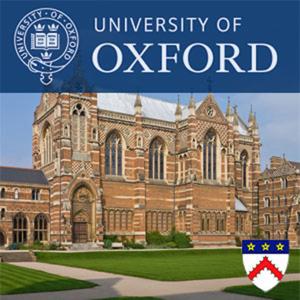
One of the largest of the constituent colleges of the University of Oxford with 410 undergraduate and 235 graduate students. It was the wish of our founders in 1870 to extend access to the University…

More shows like Keble College

Psychiatry by Oxford University

Psychiatry

57 Listeners

Philosophy for Beginners by Oxford University

Philosophy for Beginners

330 Listeners

Approaching Shakespeare by Oxford University

Approaching Shakespeare

329 Listeners

Aesthetics and Philosophy of Art lectures by Oxford University

Aesthetics and Philosophy of Art lectures

77 Listeners

Theoretical Physics - From Outer Space to Plasma by Oxford University

Theoretical Physics - From Outer Space to Plasma

59 Listeners

The Secrets of Mathematics by Oxford University

The Secrets of Mathematics

41 Listeners

Critical Reasoning for Beginners by Oxford University

Critical Reasoning for Beginners

30 Listeners

Oxford Physics Public Lectures by Oxford University

Oxford Physics Public Lectures

12 Listeners

CortexCast - A Neuroscience Podcast by Oxford University

CortexCast - A Neuroscience Podcast

4 Listeners

Poetry with Alice Oswald by Oxford University

Poetry with Alice Oswald

25 Listeners