Keble College

Keble College

By Oxford UniversityEducation
Download on the App Store

Keble College episodes

  • Delete!
    Viktor Mayer-Schönberger looks at the important role that forgetting has played throughout human history, the surprising phenomenon of perfect remembering in the digital age, and why we must reintroduce our capacity to forget. Professor Viktor Mayer-Schönberger discusses the themes of his new book 'Delete' with Helen Margetts, Professor of Society and the Internet at the Oxford Internet Institute. 'Delete' looks at the surprising phenomenon of perfect remembering in the digital age, and reveals why we must reintroduce our capacity to forget. Digital technology empowers us to find and share information as never before, but we do not always foresee the consequences of these new powers. Potentially humiliating content on Facebook is enshrined in cyberspace for future employers to see. Google remembers everything we've searched for and when. The digital realm remembers what is sometimes better forgotten, and this has profound implications for us all. In conversation, Viktor Mayer-Schönberger and Helen Margetts will look at the important role that forgetting has played throughout human history, from the ability to make sound decisions unencumbered by the past to the possibility of second chances. The written word made it possible for humans to remember across generations and time, yet now digital technology and global networks are overriding our natural ability to forget - the past is ever present, ready to be called up at the click of a mouse. Can the dangers of everlasting digital memory, whether it's outdated information taken out of context or compromising photos the Web won't let us forget, be avoided? Things touched upon included: the Panopticon, self-censorship, social networking sites and employers, memory and time, 'the curse of perfect episodic memory', decision making in the present, cognitive psychology, forgetting and forgiving, memory and mood, organisational change, compartmentalisation of data storage (and making connections across silos), creating a comprehensive image from disparate data, information context, anonymisation, 'solving the problem', information privacy rights and law, information ecology post-9/11, the age of information retention, digital abstinence, Web 2.0, cognitive adjustment (can we share conditionally?), and ... reviving forgetting.

    33 min
  • RoboCup
    Dr. Steven Cameron takes us on a trip to RoboCup. Tiny players roll across the pitch, others lumber unsteadily or roll by. The goals keep coming but the players never tire. It's football, but not as we know it. Say hello to the future of sport.
    51 min
  • Internet Governance and Regulation: The Future of the Internet - and How to Stop It
    What lies around the corner for the Internet .. and how do we avoid it? How can we study and affect the future of the Internet using the distributed power of the network itself? This is Jonathan Zittrain's inaugural lecture at the University of Oxford. This inaugural lecture by Professor Jonathan Zittrain proposes a theory about what lies around the corner for the Internet, how to avoid it, and how to study and affect the future of the internet using the distributed power of the network itself, using privacy as a signal example. Jonathan Zittrain holds the Chair in Internet Governance and Regulation at Oxford University and is also the Jack N. and Lillian R. Berkman Visiting Professor for Entrepreneurial Legal Studies at Harvard Law School. His research interests include battles for control of digital property and content, cryptography, electronic privacy, the roles of intermediaries within Internet architecture, and the useful and unobtrusive deployment of technology in education.
    1 hr 1 min
  • Societies in Transition: Technology and Transition in the 21st Century
    Professor Rayner talks about society in the 21st century the impacts of science and technology, particularly cyber-technology and the Internet. He also asks how the new technology will change society and what it means to be a person. Professor Steve Rayner is the James Martin Professor of Science and Civilisation, Said Business School.
    1 hr 2 min
  • Societies in Transition: Becoming Roman in Britain
    Lecture on Britain under Roman rule and the incorporation of Britain into the Roman world. Professor Gosden also talks about the significance of our environment, the outside, material world, and how it influences historical events in ancient history. Professor Chris Gosden is the Professor of European Archaeology, Oxford University.
    58 min

About Keble College

From the publisher's feed

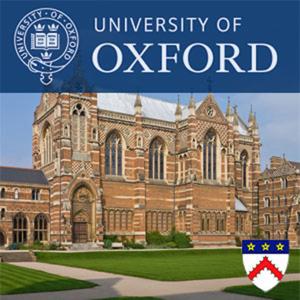
One of the largest of the constituent colleges of the University of Oxford with 410 undergraduate and 235 graduate students. It was the wish of our founders in 1870 to extend access to the University…

More shows like Keble College

Psychiatry by Oxford University

Psychiatry

57 Listeners

Philosophy for Beginners by Oxford University

Philosophy for Beginners

330 Listeners

Approaching Shakespeare by Oxford University

Approaching Shakespeare

329 Listeners

Aesthetics and Philosophy of Art lectures by Oxford University

Aesthetics and Philosophy of Art lectures

77 Listeners

Theoretical Physics - From Outer Space to Plasma by Oxford University

Theoretical Physics - From Outer Space to Plasma

59 Listeners

The Secrets of Mathematics by Oxford University

The Secrets of Mathematics

41 Listeners

Critical Reasoning for Beginners by Oxford University

Critical Reasoning for Beginners

30 Listeners

Oxford Physics Public Lectures by Oxford University

Oxford Physics Public Lectures

12 Listeners

CortexCast - A Neuroscience Podcast by Oxford University

CortexCast - A Neuroscience Podcast

4 Listeners

Poetry with Alice Oswald by Oxford University

Poetry with Alice Oswald

25 Listeners