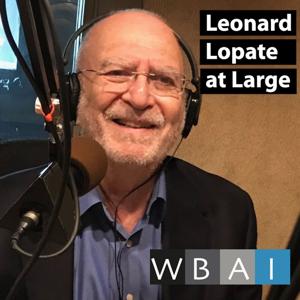
Leonard Lopate at Large on WBAI Radio in New York

Leonard Lopate at Large on WBAI Radio in New York

By Leonard Lopate at Large on WBAI Radio in New YorkArts
Download on the App Store

Leonard Lopate at Large on WBAI Radio in New York episodes

  • Frederick Wiseman tells Leonard about his new documentary "Monrovia, Indiana." (10/25/18)
    Located in mid-America, Monrovia, Indiana is primarily a farming community. Frederick Wiseman’s film “Monrovia, Indiana” is about the day-to-day experiences living and working in the town, with emphasis on community organizations and institutions, religion and daily life in this farming community. In this installment of “Leonard Lopate at Large,” Frederick Wiseman, one of the nation’s preeminent documentarians, discusses this latest project as well as a career that includes over 40 films.
    57 min
  • Harlow Giles Unger joins Leonard for a discussion of founding father Dr. Benjamin Rush. (10/22/18)
    Remembered primarily as America's leading, most influential physician, Dr. Benjamin Rush led the Founding Fathers in calling for abolition of slavery, equal rights for women, improved medical care for injured troops, free health care for the poor, slum clearance, citywide sanitation, an end to child labor, free universal public education, humane treatment and therapy for the mentally ill, prison reform and an end to capital punishment. In this installment of “Leonard Lopate at Large,” New York Times bestselling author Harlow Giles Unger talks about his new book “Dr. Benjamin Rush: The Founding Father Who Healed a Wounded Nation” about this American patriot too often confined to the footnotes of history.
    57 min
  • Richard Clarke tells Leonard about his book "Warnings." (10/19/18)
    "'Warnings: Finding Cassandras To Stop Catastrophes’ by Richard Clarke and R.P. Eddy is an important book for many sectors and fields of study…Cassandra [is] a Greek myth of a prophet whose dogged warnings are ignored. The book is split between analyzing past events where the dismissed Cassandras accurately predicted catastrophes, and current possible Cassandras around issues such as climate change, pandemic disease, AI and astroids.” – Dale Peterson, Medium. In this installment of “Leonard Lopate at Large” on WBAI, Leonard discusses “Warnings” with Richard Clarke, along with the author’s career working for Presidents Bill Clinton and George W. Bush as a counterterrorism expert on the National Security Council.
    57 min
  • Andrew J. Muscato talks about his documentary on Anthony "The Mooch" Scaramucci (10/18/18)
    As is often the case when a documentary filmmaker chooses to present their story in an unbiased way, the director must be prepared for unexpected events to take their project in a completely different direction. What began as director Anthony J. Muscato’s effort to introduce Americans to the polarizing figure of Anthony ‘The Mooch’ Scaramucci and his historically short 10-day tenure as President Trump’s White House communications director, morphed into a story about a new kind of Beltway creature creeping into our politics. Don’t miss Leonard’s conversation with Anthony about “Mooch” and his experience profiling the unique figure that inspired the film.
    56 min
  • D. D. Guttenplan tells Leonard about his book "The Next Republic."(10/17/18)
    “D.D. Guttenplan’s new book, “The Next Republic: The Rise of a New Radical Majority,” is about how the fledgling progressive grassroots movement can achieve lasting change in Trump’s America…[the book] provides hope, pragmatism and strategy in equal measure. The analysis of past eras shows how movements must grow through persistence and a bottoms-up approach, as opposed to the myth of the magnanimous leader. There are a lot of parallels to be observed in the book on the oligarchic and racial struggles of today and yore.” - Russell Whitehouse, International Policy Digest. In this installment of “Leonard Lopate at Large” on WBAI, D.D. Guttenplan unpacks the research behind “The Next Republic” and what his findings mean for future political movements in America.
    57 min
  • Dr. Dawn Wright and Christine Arena talk about the short film series Let Science Speak. (10/16/18)
    The six-part series of short documentary films entitled “Let Science Speak” was made in direct response to escalating efforts to suppress environmental science and silence scientists. “More than anything, this series is about not only science and why science matters, but who we are as scientists,” Dr. Dawn Wright, one of the scientists featured in “Let Science Speak,” told Kara Howland of the blog TV Goodness. “Some of us are parents, some of us are people of faith, we’re all people who care about our communities.” On Tuesday’s “Leonard Lopate at Large,” join Dr. Wright along with series creator Christine Arena for a discussion of why science matters.
    58 min
  • Lisa Brennan-Jobs talks about growing up as the estranged daughter of Steve Jobs. (10/15/18)
    “We had lunch on a large covered balcony overlooking the sea. Bono asked my father about the beginning of Apple. Did the team feel alive? Did they sense it was something big and they were going to change the world? My father said it did feel that way as they were making the Macintosh, and Bono said it was that way for him and the band, too, and wasn’t it incredible that people in such disparate fields could have the same experience? Then Bono asked, ‘So, was the Lisa computer named after her?’ There was a pause. I braced myself—prepared for his answer. My father hesitated, looked down at his plate for a long moment, and then back at Bono. ‘Yeah, it was,’ he said. I sat up in my chair. ‘I thought so,’ Bono said. ‘Yup,’ my father said. I studied my father’s face. What had changed? Why had he admitted it now, after all these years? Of course it was named after me, I thought then. His lie seemed preposterous now. I felt a new power that pulled my chest up. ‘That’s the first time he’s said yes,’ I told Bono. ‘Thank you for asking.’ As if famous people needed other famous people around to release their secrets.” - excerpt from Lisa Brennan-Jobs’s memoir “Small Fry,” courtesy of Vanity Fair. In today's installment of "Leonard Lopate at Large," Lisa discusses her life growing up with the most important technological visionary of our time.

    1 hr
  • Director Ruth Beckermann discusses her documentary "Waldheim Waltz" (10/12/18)
    “With Austria currently the only West European nation since World War II governed by the far right, it’s time (heck, it’s long past time) that someone of Ruth Beckermann’s intelligence made a film investigating the country’s odious collective whitewashing of its Nazi-era past. In her incisive documentary ‘The Waldheim Waltz,’ the director treats former U.N. Secretary General Kurt Waldheim as a poster boy of the phenomenon. Using only footage from the 1970s and ’80s, some of which she shot herself while protesting Waldheim’s successful bid for the Austrian presidency, Beckermann methodically reveals the timeline of revelations detailing her subject’s Nazi affiliations, and how notwithstanding the evidence, a majority of the electorate in 1986 still voted him into office.” - Jay Weissberg, Variety. In this installment of “Leonard Lopate at Large,” “Waldheim Waltz” director Ruth Beckermann discusses this important documentary.
    53 min
  • Anne Diebel and Tyler Maroney tell Leonard about paper terrorism. (10/11/18)
    Mark Pitcavage, a senior research fellow with the Anti-Defamation League, defines paper terrorism as “the use of bogus legal documents and filings, or the misuse of legitimate ones, to intimidate, harass, threaten, or retaliate against public officials, law enforcement officers, or private citizens.” In Anne Diebel and Tyler Maroney’s article in this month’s issue of Harper’s, “Paper Terrorism: Anti-government vigilantes wield a subtle weapon,” the two journalists dive into this method of warfare that is mostly unknown to the general public. Join Leonard for a crash course in what paper terrorism is and why it’s so dangerous.
    57 min
  • Dr. Henry Marsh on what it's like to be a brain surgeon. (10/10/18)
    “Henry Marsh is in the business of admitting his mistakes. It’s right there in the title of his second memoir — ‘Admissions: Life as a Brain Surgeon’ — and it was the central theme of his first, ‘Do No Harm,’ published in his native England to wide acclaim, in 2014, and then here a year later. One of the reasons patients find condescension from doctors especially loathsome is that it diminishes them — if you’re gravely ill, the last thing you need is further diminishment. But the desires of patients, Marsh notes, are often paradoxical. They also pine for supreme confidence in their physicians, surgeons especially, because they’ve left their futures — the very possibility of one at all, in some cases — in their doctors’ custody. ‘So we quickly learn to deceive,’ Marsh writes, ‘to pretend to a greater level of competence and knowledge than we know to be the case, and try to shield our patients a little from the frightening reality they often face.’” – Jennifer Senior, the New York Times. Join Leonard for a rare glimpse of the personal experience of a brain surgeon.
    56 min

About Leonard Lopate at Large on WBAI Radio in New York

From the publisher's feed

Leonard Lopate, the Peabody and James Beard Award-winning broadcaster, is back on WBAI where he began his radio career. Tune in weekdays from 1-2pm at 99.5fm New York or you can listen to the show…