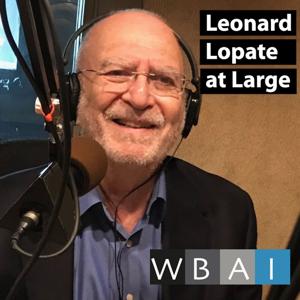
Leonard Lopate at Large on WBAI Radio in New York

Leonard Lopate at Large on WBAI Radio in New York

By Leonard Lopate at Large on WBAI Radio in New YorkArts
Download on the App Store

Leonard Lopate at Large on WBAI Radio in New York episodes

  • Craig Unger tells Leonard about Trump's connection to the Russian mafia. (September 13, 2018)
    “On November 9, 2016, just a few minutes after Donald Trump was elected president of the United States, a man named Vyacheslav Nikonov approached a microphone in the Russian State Duma (their equivalent of the US House of Representatives) and made a very unusual statement. ‘Dear friends, respected colleagues!’ Nikonov said. ‘Three minutes ago, Hillary Clinton admitted her defeat in US presidential elections, and a second ago Trump started his speech as an elected president of the United States of America, and I congratulate you on this.’ Nikonov is a leader in the pro-Putin United Russia Party and, incidentally, the grandson of Vyacheslav Molotov — after whom the ‘Molotov cocktail’ was named. His announcement that day was a clear signal that Trump’s victory was, in fact, a victory for Putin’s Russia. Longtime journalist Craig Unger opens his new book, ‘House of Trump, House of Putin,’ with this anecdote. The book is an impressive attempt to gather up all the evidence we have of Trump’s numerous connections to the Russian mafia and government and lay it all out in a clear, comprehensive narrative.” – Sean Illing, Vox. On Thursday’s “Leonard Lopate at Large,” Craig tells Leonard about just how deep President Trump’s connections to the Russian mob go.

    57 min
  • Craig Unger tells Leonard about Trump's connection to the Russian mafia. (September 13, 2018)
    “On November 9, 2016, just a few minutes after Donald Trump was elected president of the United States, a man named Vyacheslav Nikonov approached a microphone in the Russian State Duma (their equivalent of the US House of Representatives) and made a very unusual statement. ‘Dear friends, respected colleagues!’ Nikonov said. ‘Three minutes ago, Hillary Clinton admitted her defeat in US presidential elections, and a second ago Trump started his speech as an elected president of the United States of America, and I congratulate you on this.’ Nikonov is a leader in the pro-Putin United Russia Party and, incidentally, the grandson of Vyacheslav Molotov — after whom the ‘Molotov cocktail’ was named. His announcement that day was a clear signal that Trump’s victory was, in fact, a victory for Putin’s Russia. Longtime journalist Craig Unger opens his new book, ‘House of Trump, House of Putin,’ with this anecdote. The book is an impressive attempt to gather up all the evidence we have of Trump’s numerous connections to the Russian mafia and government and lay it all out in a clear, comprehensive narrative.” – Sean Illing, Vox. On Thursday’s “Leonard Lopate at Large,” Craig tells Leonard about just how deep President Trump’s connections to the Russian mob go.
    57 min
  • Michele Gelfand discusses her book "Rule Makers, Rule Breakers." (September 12, 2018)
    Why, wonders University of Maryland psychology professor Michele Gelfand, are the clocks in Brazil so often wrong, while in Germany the clocks can be counted on? What explains the difference between New Zealand, where prostitution is legal, and Singapore, where chewing gum brings severe sanctions? In “Rule Makers, Rule Breakers,” Gelfand traces all of this, and so much more, to a single variable: the “tightness” of a culture. She explains the origins of tight (or loose) cultures in countries, in states, in companies, even in families—and then takes readers through the myriad implications, from politics to parenting. Join Leonard as he asks Michele about the research that went into this unique work.
    57 min
  • Authors Kathleen Hill and Steven Gaines tell Leonard about memoir writing. (September 11, 2018)
    Beginning with a Best American award-winning narrative, Kathleen Hill’s memoir “She Read To Us In The Late Afternoons” explores defining moments of a life illuminated by novels, read in Nigeria and France and at home in New York. “One of These Things First” by Steven Gaines is a wry and poignant reminiscence of a 15-year-old gay Jewish boy in Brooklyn in the early sixties and his unexpected trajectory from a life behind a rack of dresses in his grandmother’s bra and girdle store, to Manhattan’s fabled Payne Whitney Psychiatric Clinic, a fashionable Charenton for wealthy neurotics and Ivy League alcoholics. On Tuesday’s installment of “Leonard Lopate at Large,” Kathleen Hill and Steven Gaines join Leonard in-studio for a discussion about what makes a great memoir.
    55 min
  • Maxine Rosaler tells Leonard about her novel “Queen for a Day.” (September 10, 2018)
    In her novel “Queen for a Day,” Maxine Rosaler tells the stories of mothers of children with autism. DeWitt Henry compared Queen for a Day to Tim O'Brien's “The Things They Carried.” “Like O’Brien, Rosaler explores the mettle and morality of Mimi Slavitt on the ‘battlefield of her existence…' In all, the writing is generously unsentimental, spiritually probing and filled with piercing intimacies.” At the center of the novel is the flawed heroine Mimi Slavitt, who drives herself beyond her limits to do everything she can to help her son Danny. Mimi is grief-stricken, frantic, neurotic and bold, with a keen sense of irony that serves to offset her frequent descents into despair. Kirkus Reviews, which nominated Queen for a Day for The Kirkus Prize, called it “An engrossing and compassionate collection showing motherhood in its most unrelenting form.” Midwest Book Reviews called it "an extraordinary read from beginning to end." Alison Lurie wrote of being impressed and moved by "the intelligence and sympathy with which the author presents her afflicted characters.” The novel has also been nominated for a National Book Award, among other prizes. As a writer of literary fiction who is also the mother of a child with autism, Maxine has been able to tell the story of the struggles of the mothers of children with disabilities in a way it has not been told before. Join Leonard for a conversation with Maxie about the important truths contained in this work of fiction.
    56 min
  • James Irsay talks to Leonard about his storied career in music and radio. (August 31, 2018)
    James Irsay, celebrated concert pianist and the host of the classical music program “Morning Irsay” Friday mornings from 10am to noon on WBAI, has been a fixture of New York City’s FM dial for decades. As a music student he studied with Jorge Bolet, John Ogdon, Sasha Gorodnitzki, Ernst Krenek, Peter “PDQ Bach” Schickele and Jacob Druckman. As a performer, Irsay has performed with Itzak Perlman, Pinchas Zuckerman, Raymond Lewenthal and Alan Titus. His radio show has won the Major Armstrong Award the Corporation for Public Broadcasting Award and the National Public Radio, Ohio State Award. Join two icons of New York radio for a fun, freewheeling conversation.
    57 min

About Leonard Lopate at Large on WBAI Radio in New York

From the publisher's feed

Leonard Lopate, the Peabody and James Beard Award-winning broadcaster, is back on WBAI where he began his radio career. Tune in weekdays from 1-2pm at 99.5fm New York or you can listen to the show…