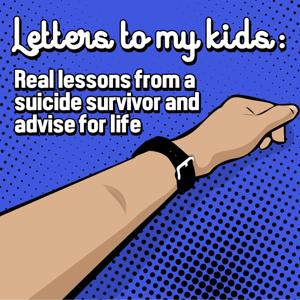
Letters to my kids: A suicide survivor's lessons and advice for life

Letters to my kids: A suicide survivor's lessons and advice for life

By Letters to my kids: A 2-time suicide survivor and advocate for realistic optimism.
Download on the App Store

Letters to my kids: A suicide survivor's lessons and advice for life episodes

  • Episode 36: Part 1 - Procrastination: Time and tide waits for no one
    Episode 36: Part 1 - Procrastination: Time and tide waits for no one
    Music: “Just A Blip” by Andy G. CohenFrom the Free Music ArchiveReleased under a Creative Commons Attribution International License
    http://time.com/5322514/stop-procrastinating-tips/
    - From time to time, everybody leaves a task lingering on their to-do list for a few hours — or days, or weeks — too long. Procrastination is a normal, near-universal phenomenon — which makes it all the more important to understand why it strikes and what to do about it. “Procrastination is not just avoiding or delaying a task,” says David Ballard, head of the American Psychological Association’s Center for Organizational Excellence. “It also has to include an aspect that’s counterproductive, irrational or unnecessary.”
    - Those triggers typically fall into one of four camps: expectancy, value, time or impulsivity, says Alexander Rozental, a procrastination researcher and a clinical psychologist at the Karolinska Institutet in Sweden. In other words, “People procrastinate because of a lack of value [associated with the task]; because they expect that they’re not going to achieve the value they’re trying to achieve; because the value is too far from you in terms of time; or because you’re very impulsive as a person,” Rozental says. Strategies for overcoming procrastination will vary depending on why it happens in the first place.
    "It is easier to resist at the beginning than at the end."- Leonardo da Vinci
    - If timing is the issue: Many people are inherently more productive at certain times of day. Ballard recommends working around these natural productivity ebbs and flows when you schedule your days. “If you know you work better in the mornings on certain kinds of tasks, schedule it for then,” he says. “Don’t try to do it at a time when you’re tired and it’s harder for you to do.”
    - If you get overwhelmed by big tasks: Many people procrastinate because they’re anxious about the outcome of a project, don’t think they can complete it well or fear failure, Rozental says. If that’s the case, it may help to break it into smaller sub-tasks.
    - “If you don’t believe in yourself enough to actually conduct a particular task, you can try to do it in smaller and more manageable parts to increase your self-efficacy,” Rozental recommends.
    - If you struggle with delayed gratification: Some people have a hard time thinking of a project as important or rewarding unless they’re squeezing it in just before a deadline. In this case, too, breaking a long-term assignment into multiple smaller ones may help, Ballard says. “Find ways to reward yourself along the way,” he recommends. You can even schedule your most frequent diversions — think checking social media or completing non-urgent chores and errands — for the gaps between these smaller chunks to get a quick hit of an enjoyable activity, Ballard adds. “You get those activities done, you get a break and you can shift your mindset for a few minutes,” he says.
    "You can’t just turn on creativity like a faucet. You have to be in the right mood. What mood is that? Last-minute panic."- Bill Watterson
    - If you’re easily distracted: First, Ballard recommends optimizing your environment. “Put your cell phone away, turn off notifications on your computer and don’t have 10 tabs open at the same time,” he says.
    - If you’re struggling with something larger: Sometimes, what looks like procrastination may actually be a symptom of something more serious, such as depression, anxiety or attention problems, Ballard says. If your behavior is causing you distress or significantly affecting your performance at work, school or home, don’t be afraid to consult a professional. “Get some additional support and help from a professional who can help you manage those so it’s not getting in the way of your job performance or functioning,” he says.
    "Procrastination is the bad habit of putting of until the day after tomorrow what should have been done the day before ye
    11 min
  • Episode 35 : Part 4 - Finding your passion: Searching for the holy grail?
    Episode 35 : Part 4 - Finding your passion: Searching for the holy grail?
    Music: “Just A Blip” by Andy G. CohenFrom the Free Music ArchiveReleased under a Creative Commons Attribution International License
    www.oprah.com/supersoulsunday/the-secret-to-finding-your-passion-hint-its-not-what-you-think_1
    - The last thing you want to do is live an unfulfilled, passionless life. A life where you hate your work, take the stress of a crappy job home with you each day, and bide your time until you can retire and be free of the monotony. Avoid the following seven mistakes when trying to find your passions:
    - Assuming Passions are Reserved for Experts. Who comes to mind when you think of somebody who has a passionate career? If you’re a sports fan, maybe you think of a professional athlete. If you’re a literature buff, maybe you think of a great writer. If you’re a tech nerd, maybe you think of Steve Jobs. It’s true that we’re more likely to enjoy doing something we’re good at, but nobody is born an expert at something, so don’t write off the interests that excite you even if you’re a novice.
    "Without passion man is a mere latent force and possibility, like the flint which awaits the shock of the iron before it can give forth its spark." -Henri Frederic Amiel
    - Overlooking Your Biggest Fans. Real quick: name one of your best friend’s passions. Your friend may never have told you that the thing you named was her passion, but you just knew. Yet it’s difficult to pinpoint our own. One huge mistake you may be making as you search for your passions is overlooking your biggest fans – the people who know and love you. If you can’t pinpoint what you are passionate about, ask your family and friends what they think your passions are.
    - Thinking of Passion as a Verb. You probably think of somebody who is passionate about something active, like painting or sports. This is a mistake. When you’re searching for your passion to pursue work you love, you tend to get stuck on the idea that your passion has to be something that you do, rather than something you believe in, so knitting or playing hockey or painting come to mind. Your passion doesn’t have to be something you do. It can be something you believe in.
    "Only passions, great passions, can elevate the soul to great things." -Denis Diderot
    - Believing That Passions Last a Lifetime. Close your eyes and picture yourself ten years ago. How much have you changed between then and now? How much have you grown and evolved? Chances are, you’re not the same person as you were back then. Yet we tend to expect that we’ll stick with the same passions throughout our entire lives. We humans are fluid and ever-changing, and the notion that our passions are something we are passionate about for life is misguided.
    - Rejecting Passions Because They Seem Frivolous. We want to be the type of people who pursue passions that could change the world. We’re good people, so we want to pursue passions around social causes. And you probably are passionate about a certain social cause. But a less philanthropic passion is just as worthy, and just as you can’t pick your family, you can’t choose what lights that fire for you. Don’t reject your passions because they don’t conform to a set of standards you’ve set.
    "You have to be burning with an idea, or a problem, or a wrong that you want to right. If you’re not passionate enough from the start, you’ll never stick it out." -Steve Jobs
    - Expecting Too Much from Passions. You have a specific idea of what a passion does.Passionate people teach us that passions make our hearts beat faster, get us up in the morning, and consume us completely. So you want your passions to motivate you and drive you to the finish line. But sometimes, your passion is just something that quietly tugs at you.
    - Discounting Your Personality. Have you ever looked at somebody who was clearly so fired up about something and wondered whether you’ll ever feel the same way? Why? Well, because you are n
    13 min
  • Episode 35 : Part 3 - Finding your passion: Searching for the holy grail?
    Episode 35 : Part 3 - Finding your passion: Searching for the holy grail?
    Music: “Just A Blip” by Andy G. CohenFrom the Free Music ArchiveReleased under a Creative Commons Attribution International License
    https://www.lifehack.org/articles/featured/how-to-find-your-passion.html
    - So what should you do? How to find your passion in life? Here are some suggestions: Ask yourself: Is there something you already love doing? Do you have a hobby, or something you loved doing as a child, but never considered it as a possibility? Whether it’s reading comic books, collecting something, making something, creating or building, there is probably a way you could do it for a living.
    - Find out What do you love to talk about, learn about and/or teach others about? With nearly 7 billion people on the planet, chances are that there's a market out there hungry for information, products or resources on your topic. Or there's a company looking for someone with your unique set of gifts and interests to join their team. If you're having trouble coming up with ideas, ask close friends and family (the honest ones) what you never seem to shut up about.
    - Brainstorm. Nothing comes to mind right away? Well, get out a sheet of paper, and start writing down ideas. Anything that comes to mind, write it down. There are no bad ideas at this stage. Write everything down, and evaluate them later. Notice any themes? What subjects are you constantly gravitating toward? What are you already spending your time, money and energy on? What theme(s) have been recurring in your life again and again?
    "There is no passion to be found playing small—in settling for a life that is less than the one you are capable of living." -Nelson Mandela
    - Ask around, and surf for possibilities. Ask other people for ideas. See what others have discovered as their passions. Look all over the Internet for ideas. The more possibilities you find, the more likely your chances of finding your true passion.
    - Love everything you do. From this moment forward, if you don't like something, you've got two choices: stop doing it (quit, delegate it, hire it out) OR love it with all your heart. Anything else is madness. Remember, we human beings are creatures of habit. You can't be whiny, complainy and miserable for 80 percent of your day and expect to be enthusiastic and passionate in the last 20 percent. And if you're feeling really stuck on this whole "finding your passion" thing, this is the fastest way to get your motor running. Know this: Truly successful people are never the victim of their circumstances. They realize they have ultimate power in any situation and take responsibility for their experience.
    - Give it a try first. It’s best to actually test your new idea before jumping into it as a career. Do it as a hobby or side job at first, so that you can see if it’s really your true calling. Don’t quit your job just yet.If you find your calling, your passion, don’t just turn in your resignation tomorrow. It’s best to stay in your job while you’re researching the possibilities. If you can do your passion as a side job, and build up the income for a few months or a year, that’s even better. It gives you a chance to build up some savings (and if you’re going into business for yourself, you’ll need that cash reserve), while practicing the skills you need.
    - Do as much research as possible. Know as much about your passion as possible. If this has been a passion for awhile, you may have already been doing this. At any rate, do even more research. Read every website possible on the topic, and buy the best books available. Find other people, either in your area or on the Internet, who do what you want to do for a living, and quiz them about the profession. How much do they make? What training and education did they need? What skills are necessary? How did they get their start? What recommendations do they have?
    "If you don’t love what you do, you won’t do it with much conviction or passio
    12 min
  • Episode 35 : Part 2 - Finding your passion: Searching for the holy grail?
    Episode 35 : Part 2 - Finding your passion: Searching for the holy grail?
    Music: “Just A Blip” by Andy G. CohenFrom the Free Music ArchiveReleased under a Creative Commons Attribution International License
    https://www.lifehack.org/articles/featured/how-to-find-your-passion.html
    - How to cultivate a “growth” mind-set in the young, future-psychology-experiment subjects of America? If you’re a parent, you can avoid dropping new hobbies as soon as they become difficult. Beyond that, there’s not a clear way to develop a growth mind-set about interests, other than knowing that it’s a valid way to think, and that your passion might still be around the corner.
    “Don’t worry about what the world needs. Ask what makes you come alive and do that, because what the world needs is people who have come alive.” -Howard Thurman
    -The Legend of Baggar Vance—a movie about a down-on-his-luck golfer who enlists the help of an inspirational golf caddy (Baggar Vance) to perfect his game. In one of the scenes, Baggar says to the golfer: “Inside each and every one of us is one true authentic swing. Something we were born with. Something that’s ours and ours alone. Something that can’t be taught to you or learned. Something that got to be remembered.” Your passion—your one true authentic gift—has to be remembered.
    "I would rather die of passion than of boredom." -Vincent Van Gogh
    - For so long, we have been searching, trying new things, exploring jobs, careers, and “attractive” passions outside of myself—without ever trying to remember what passions have been with us all along. But how could a passion be so…plain? Aren’t passions supposed to be artistic, exotic, or inspirational? Aren’t passions supposed to wow people?So if you’re struggling to find your passion, even after trying what feels like doing everything, do this: sit down, open your journal, pour a cup of tea, and try to remember your passions.
    "I have to face life with a newly found passion. I must rediscover the irresistible will to learn, to live and to love." -Andrea Bocelli
    - Think back on your life, and remember things you wanted to be, the habits you developed naturally, the games you played, the books you read, and see how they may apply to your life and career today. You might be surprised by the connection points that have been right under your nose all along.
    - If you dread going to your job, or find yourself constantly lacking motivation, or find what you’re doing dull and repetitive, you need to start looking for a new job. Staying in your current job will not only continue to make you unhappy, but you are not realizing your full potential in life.
    - Imagine this instead: You get up early, jumping out of bed, excited to go to work. You might put in more hours than the average person, but it doesn’t seem difficult to you, because your work hours just zoom right by. You are often in that state of mind, often referred to as “flow,” where you can lose track of the world and time, losing yourself in the task at hand. Work is not work as many people refer to it, but something that is fun and interesting and exciting. It’s not a “job” but a passion. If you’ve got a job you dislike, or even hate, this will sound like a pipe dream to you. And if you never put in the effort to find what you’re passionate about, you’re right: such a thing will never be possible.
    - But dare to dream, dare to imagine the possibilities, and dare to actually search for what you love, and it is not only a possibility, but a probability.

    12 min
  • Episode 35 : Part 1 - Finding your passion: Searching for the holy grail?
    Episode 35 : Part 1 - Finding your passion: Searching for the holy grail?Music: “Just A Blip” by Andy G. CohenFrom the Free Music ArchiveReleased under a Creative Commons Attribution International License
    https://tinybuddha.com/blog/try-this-if-youre-struggling-to-find-your-passion/
    "Passion without purpose is like a shot without a target."- Ifeanyi Enoch Onuoha
    - Carol Dweck, a psychology professor at Stanford University, remembers asking an undergraduate seminar recently, “How many of you are waiting to find your passion?” “Almost all of them raised their hand and got dreamy looks in their eyes,” she told me. They talked about it “like a tidal wave would sweep over them.” 
    - What Dweck asked her students is a common refrain in American society. The term “Follow your passion” has increased ninefold in English books since 1990. “Find something you love to do and you’ll never have to work a day in your life” is another college-counseling standby of unknown provenance.
    "Vision without action is a daydream; action without vision is a nightmare" -Honda Soichiro
    - That’s why he and two co-authors—Dweck and Greg Walton of Stanford—recently performed a study that suggests it might be time to change the way we think about our interests. Passions aren’t “found,” they argue. They’re developed. In a paper that is forthcoming in Psychological Science, the authors delineate the difference between the two mind-sets. One is a “fixed theory of interests”—the idea that core interests are there from birth, just waiting to be discovered—and the other is a “growth theory,” the idea that interests are something anyone can cultivate over time.
    - The authors then repeated a similar procedure, but they had students read first about either the fixed theory of interests or the growth theory. Again, those who learned that interests are fixed throughout a person’s life were less captivated by an article that mismatched their interests. The authors believe this could mean that students who have fixed theories of interest might forgo interesting lectures or opportunities because they don’t align with their previously stated passions. Or that they might overlook ways that other disciplines can intersect with their own.
    - People who have a growth mind-set about their own intelligence tend to be less afraid of failure, according to her research, because they believe smarts are cultivated, not inherent. Interests are related to, but distinct from, abilities, the study authors told me: You can be interested in something but not very good at it. “I’ve been playing guitar for 25 years, but I can’t say that my abilities have gotten that much better in the past 10 years,” O’Keefe said.
    "Pleasure in the job puts perfection in the work" - Aristotle
    - The authors also had students learn about either fixed or growth theory and then exposed them to a new interest: Astronomy. First, they had them watch a video made by The Guardian for a general audience about Stephen Hawking’s ideas. It was easy to understand and entertaining. Then the authors had the students read a highly technical, challenging article in the academic journal Science about black holes. Despite saying just moments ago, after viewing the video, that they were fascinated by black holes, the students who were exposed to the fixed theory of interests said they were no longer interested in black holes after reading the difficult Science article.
    12 min
  • Episode 34 : Part 3 - Bad habits - Fighting and overcoming them
    Episode 34 : Part 3 - Bad habits - Fighting and overcoming them
    Music: “Just A Blip” by Andy G. CohenFrom the Free Music ArchiveReleased under a Creative Commons Attribution International License
    https://www.psychologytoday.com/us/blog/fulfillment-any-age/201108/5-steps-breaking-bad-habitshttps://www.developgoodhabits.com/break-bad-habit/
    - And what did they notice? Mindful smoking “Smells like stinky cheese and tastes like chemicals. Yuck.”
    - Now the prefrontal cortex, that youngest part of our brain from an evolutionary perspective, it understands on an intellectual level that we shouldn’t smoke and it tries its hardest to help us change our behavior, to help us stop smoking, to help us stop eating that second, that third, that fourth cookie—we call this cognitive control, we’re using cognition to control our behavior. Unfortunately this is also the first part of our brain that goes offline when we get stressed out which, isn’t that helpful.
    - When we get curious, we step out of our old, fear-based reactive habit patterns. This isn’t to say that, poof, magically we quit smoking but over time as we learn to see more and more clearly the results of our actions we let go of old habits and form new ones. The paradox here is that mindfulness is just about being really interested in getting close and personal with what’s actually happening in our bodies and minds from moment to moment. 
    "Even the most fickle are faithful to a few bad habits." -Mason Cooley
    - This might sound too simplistic to affect behavior, these are bite-sized pieces of experiences that we can manage from moment to moment rather than getting clobbered by this huge, scary craving that we choke on. Everyone has at least one bad habit.
    - They started with chronic lateness: When you consistently fail to show up on time for social engagements or meetings, are you actually trying to exert control over those you keep waiting? They now are living on your time, not theirs.
    "Nothing happens until the pain of remaining the same outweighs the pain of change." – Arthur Burt
    - Decide that you really want to change and convince yourself that you can. You can only change what you decide you want to change. All psychological models of change emphasize the importance of commitment as a necessary first step. If you don't see a problem, you won't work on changing your behavior. 
    - Once you've decided you want to change, convince yourself that you are able to achieve your change goals. You need to strengthen your sense of self-efficacy, or belief that you can accomplish what you want. Seeing other people change successfully is inspiring, but you need to see yourself as having what it takes to make those changes in yourself.
    "I think that you can fall into bad habits with comedy... It's a tightrope to stay true to the character, true to the irony, and allow the irony to happen." -Ben Kingsley
    12 min
  • Episode 34 : Part 2 - Bad habits - Fighting and overcoming them
    Episode 34 : Part 2 - Bad habits - Fighting and overcoming them
    Music: “Just A Blip” by Andy G. CohenFrom the Free Music ArchiveReleased under a Creative Commons Attribution International License
    https://www.psychologytoday.com/us/blog/fulfillment-any-age/201108/5-steps-breaking-bad-habitshttps://www.developgoodhabits.com/break-bad-habit/
    - Change the larger pattern: Here we are widening the context that surrounds the habit-pattern. By looking at and changing the larger pattern you are actually not only making it easier to tackle the core habit, but are practicing putting your willpower in place on smaller, easier pattern-breaking behaviors. This can add to your sense of empowerment.
    - Use prompts: These are reminders to help you break the pattern by creating positive triggers and alerts to keep you on track: Putting your running shoes at the side of your bed so you see them first thing in the morning, or putting an alert on your phone to leave for the gym, or check-in with yourself and gauge your stress level on the way home before it gets too high and out of your control.
    - Get support: Get a running buddy, or a party buddy, or someone you can call, or an online forum you can tap into when you those cravings start to kick in and you are struggling. 
    "My bad habits aren't my title. My strengths and my talent are my title." -Layne Staley
    - Support & reward yourself: At some point in your efforts to break a habit you reach a day or point where you go: Why am I bothering to struggle with this? You are feeling discouraged, you feel you are emotionally making your life seemingly harder, and there is little payoff.
    - Be persistent and patient: That’s the name of the game, of course: realizing that it will take time for the new brain connects to kick in, for the old brain-firings to calm down, for new patterns to replace the old. Don’t beat yourself up for slip-ups or use them as rationales for quitting. Take it one day at the time.
    - Consider getting professional help: If you’ve done the best you can and you are still struggling, consider seeking professional support. This may be a doctor who can prescribe meds for the underlying anxiety and depression, a therapist who cannot only help you unravel the source and driver for your habits, but also create some steady support and accountability.
    "Most people don't have that willingness to break bad habits. They have a lot of excuses and they talk like victims." - Carlos Santana
    - A Simple Way to Break a Bad Habit: Studies show that even when we’re really trying to pay attention to something like maybe this talk—at some point, about half of us will drift off into a daydream or have this urge to check our Twitter feed. What’s going on here? It turns out that we’re fighting one of the most evolutionarily conserved learning processes currently known in science, one that’s conserved back to the most basic nervous systems known to man.
    - The Habit-Forming Brain: This reward based learning process is called positive and negative reinforcement and basically goes like this: We see some food that looks good, our brain says, “Calories! Survival!” We eat the food: We taste it, it tastes good. Especially with sugar, our bodies send the signal to our brain that says: “Remember what you’re eating and where you found it.” We lay down this context-dependent memory and learn to repeat the process next time: see food, eat food, feel good. Repeat.
    - Trigger, behavior, reward. Simple right? Well after a while our creative brains say, “You know what? You can use this for more than just remembering where food is. Next time you feel bad, why don’t you try eating something good so you’ll feel better?” Each time we do this, we learn to repeat the process and it becomes a habit.
    "The habits that too years to build, do not take a day to change." -Susan Powter
    - Curiosity Killed the Cravings: What if instead of fighting our brains or trying to force ourselves to pay attention, we instead tapped into thi
    12 min
  • Episode 34 : Part 1 - Bad habits - Fighting and overcoming them
    Episode 34 : Part 1 - Bad habits - Fighting and overcoming them
    Music: “Just A Blip” by Andy G. CohenFrom the Free Music ArchiveReleased under a Creative Commons Attribution International License
    https://www.psychologytoday.com/us/blog/fixing-families/201712/how-break-bad-habits
    https://www.psychologytoday.com/us/blog/fulfillment-any-age/201108/5-steps-breaking-bad-habits
    - It's easy to think of habits falling into black and white categories -- exercising good, biting your nails bad. But habits also sit on a continuum in our ability to exercise control over them: Some are mild, like taking off your shoes and dumping in the middle of the living every night. Habits become hard to break to because they are deeply wired by constant repetition into our brains. 
    - But habits are also patterns of behavior and it is the breaking of patterns that are the key to breaking the habits themselves. Usually there is a clear trigger to starts the pattern. Sometimes the triggers are emotional — the wanting a drink or cigarette or nail-biting driven by stress. Other times the trigger is more simply situational and environmental.
    "All bad habits start slowly and gradually and before you know you have the habit, the habit has you." -Zig Ziglar
    - But these patterns are also usually wrapped in larger ones: This is where are routines come to run our lives. Overall these auto-pilot habit / routine behaviors are evolutionary-wise and practically a good thing; They keep us from having to re-invent the wheel of our daily lives by making an infinite numbers of decisions all day long, which in turn, provide us with more brain-space to think about more important and creative things. The downside of these routinized patterns comes when those patterns land more in the bad-column than the good.
    "I have the same friends and the same bad habits." -Nate Silver
    - As a quick recap, our habits are driven by a 3-part loop in sequence:
    Trigger (the stimulus that starts the habit)Routine (the doing of the habit and behaviour itself)Reward (the benefit associated with the behaviour)The reason why it can be so hard to break a bad habit, is because there are parts of your brain that associate your cravings with the bad habits. [1]
    - So if you have habits you want to break, here are some steps to get you started:
    Define the concrete behavior you want to change or develop
    "Chains of habit are too light to be felt until they are too heavy to be broken." - Warren Buffett
    Identify the triggers
    Deal with the triggers
    Develop a substitute plan
    - The key here is mapping this out before that triggers have a chance to kick in.
    "The secret of change is to focus all your energy NOT on fighting the old but on BUILDING the new." – Socrates
    12 min
  • Episode 33 - Part 3 : Family Enstrangement: Choosing to run and cutting your losses
    Episode 33 - Part 3 : Family Enstrangement: Choosing to run and cutting your losses
    Music: “Just A Blip” by Andy G. CohenFrom the Free Music ArchiveReleased under a Creative Commons Attribution International License
    https://www.psychologytoday.com/us/blog/insight-is-2020/201406/estranged-your-parents-or-siblings-overviewhttps://www.huffingtonpost.com/karl-a-pillemer-phd/estranged-children_b_1267734.html
    - It's always nice to have a support system, especially in times of dire need. And while parents might represent beacons of hope and safety for lots of people, there are many people out there who feel the opposite. While it may seem strange, estrangement is actually more common than you think among US families -- for a multitude of reasons, there are lots of people out there who purposely have no relationship with their parents.
    - Several people who are disconnected from their parents took to Whisper, the popular app that provides an anonymous platform for people to share their most honest thoughts, to explain what it's really like to be estranged.
            Family doesn't mean the same thing to everyone        'Parents' is just a word         Sometimes the right decisions are the most difficult ones        Parents should help shape and support who you are, not make you feel bad about it
          Just because you can't be around your family doesn't mean you don't love them        Is it possible to ever forgive your parents for years of abuse?I don't talk to my dad because of years of abuse. 
    "The surest sign of the estrangement of the opinions of two persons is when they both say something ironical to each other and neither of them feels the irony." -Friedrich Nietzsche
    - Among the saddest people I met in interviews with older Americans for the book “30 Lessons for Living“ were those living in this situation. The destruction of the parent-child bond was a persistent source of melancholy, a feeling of incompleteness that weighed down the soul. 
    - Fortunately, the elders interviewed for the project offered suggestions from their long experience for avoiding family rifts or patching them up before they occur. Here are several of their tips:
    - See the potential rift early and defuse it.The elders acknowledge that once the rift sets in, it takes on a life of its own and becomes much more difficult to repair. The time to act is when the first warning signs show themselves. 
    - Act immediately after the rift occurs. The elders warn that the viewpoints of both parties harden quickly; in a relatively short time it becomes easier not to make the effort to reconcile than to try to do so. The new reality sets in fast; therefore, the time to “make things better” is as soon as possible after the blow-up.
     
    "Estrangement shows itself precisely in the elimination of distance between people." - Theodor Adorno
    - It’s often the parent who needs to compromise. Older mothers and fathers tend to invest more in the relationship as they get older and therefore stand to lose more by letting it disintegrate. Particularly acute is the separation from grandchildren that can occur as a result of the rift. Many elders recommended that parents try their best to “forgive the unforgivable.” Some have had the worst happen, stood on the brink of the rift and decided that it still wasn’t worth the end of the relationship with the child.
    "There could have never been two hearts so open, no tastes so similar, no feelings so in unison, no countenances so beloved. Now they were as strangers; nay, worse than strangers, for they could never become acquainted. It was a perpetual estrangement." - Jane Austen
    13 min
  • Episode 33 - Part 2 : Family Enstrangement: Choosing to run and cutting your losses
    Episode 33 - Part 2 : Family Enstrangement: Choosing to run and cutting your losses
    Music: “Just A Blip” by Andy G. CohenFrom the Free Music ArchiveReleased under a Creative Commons Attribution International License
    https://www.psychologytoday.com/us/blog/insight-is-2020/201406/estranged-your-parents-or-siblings-overview
    - Estrangements from family are one of the most psychologically painful experiences anyone could experience. It almost goes without saying that estranging yourself from family is absolutely counter-intuitive: Who, after all, would think to terminate a relationship with someone who raised you?
    - Adding more stress to the already-stressful mix, society tends to project harsh judgment on people who reject their family – even as disturbed as some families can be. Overall, Agllias (2013) explains that family estrangement is often experienced as a considerable loss; its ambiguous nature and social disenfranchisement can contribute to significant grief responses, perceived stigma, and social isolation in some cases. 
    - How to conduct a family estrangement most effectively – and least painfully for you. If you’re considering estranging yourself from family, never initiate a full-blown estrangement without first trying an approach of measured contact.
    "There is not so agonizing a feeling in the whole catalogue of human suffering as the first conviction that the heart of the being whom we most tenderly love is estranged from us." - Henry Bulwer
    - To try measured contact, decide the exact frequency of contact you would like to try with the family (e.g., once every two weeks, once per month). Next, decide the type of communication are comfortable with (e.g., in-person visit, telephone call, email, text). After that, decide the length of time you are willing to try out the new plan of measured contact before determining if another more extreme approach is necessary (e.g., 3 months, 6 months).
    - If you determine after your period of measured contact that you need to stop talking to your family altogether, explain to your family that you need to take a break from talking – but still do not pursue full-blown estrangement. Try writing a letter or calling your family members to say that you want to take a break, and tell them clearly the amount of time you are taking (e.g., another 3 months, 6 months). 
    "When once estrangement has arisen between those who truly love each other, everything seems to widen the breach." -Mary Elizabeth Braddon
    - Estrangements are messy and emotional for all parties involved. If you can avoid an estrangement and find a way to improve the relationship dynamics with measured contact, that may cause you less stress in the long run. If your family lives nearby, it is worth asking your family members if they would consider going for a couple of sessions to talk to a therapist.
    - Finally, taking good care of your physical and mental health is never more important than during a period of estrangement. Cortisol levels go through the roof when people get stressed, and nothing adds stress like the anxiety and guilt that so frequently come with major family conflicts. 
    "The children of warriors in our country learn the grace and caution that come from a permanent sense of estrangement."-Pat Conroy
    12 min

About Letters to my kids: A suicide survivor's lessons and advice for life

From the publisher's feed

Real lessons from a suicide survivor and advice for life. From a 2-time suicide survivor and advocate for realistic optimism