
Sign up to save your podcasts
Or

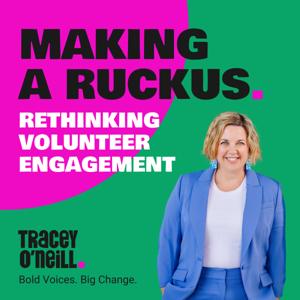


I read a lot of volunteering strategy documents. Most of them don't make me stop.
The new Points of Light US National Volunteer Strategy did.
One line on page 13, Principle 2: make volunteering a core strategic function, not an add-on.
People in volunteer engagement have been making this argument for decades. But I have never seen it named as a principle in a national strategy, with the why and the how laid out alongside it.
In this episode, I unpack why this framing matters. Why the standard advice in most national strategies and frameworks — invest in infrastructure — only takes organisations so far. What the gap between investment and change actually looks like in practice. And the question every organisation should be asking about volunteer engagement, starting Monday morning.
Want to hear more?
Sign up for my newsletter for more rethinking on volunteer engagement, impact, and making a ruckus.
Be Bold. Stay Curious. Keep making a Ruckus.
Links:
Connect:
What if some of the most important work in volunteer engagement happens long before anyone ever signs up to volunteer?
In this episode of Making a Ruckus, I explore the idea of hidden impact – the conversations, connections and moments of belonging that rarely appear in our reports, but shape communities in profound ways.
Drawing on a story from last week's conversation with Tom Gill and introducing the thinking behind my emerging Campfire Model, I challenge the assumption that community connection only matters if it leads to recruitment.
Instead, I ask a different question: what if connection is an outcome in its own right?
If you've ever felt that your impact reports capture what volunteers do but miss what volunteer engagement creates, this episode will encourage you to look beyond hours, headcounts and applications, and reconsider what counts as meaningful work.
Because perhaps our role isn't just to process people once they arrive.
Perhaps it's to make the distance between community and volunteering shorter in the first place.
Want to hear more?
Sign up for my newsletter for more rethinking on volunteer engagement, impact, and making a ruckus.
Be Bold. Stay Curious. Keep making a Ruckus.
Links:
Connect:
Tom Gill doesn't work in the volunteering sector. He's a cultural placemaking consultant and writer for The Guardian, who spends his career studying how cities and communities create connection.
So, when he wanted to find community for himself, he didn't start with the research. He went looking for it in person, in his own neighbourhood.
In this episode, Tom and I talk about what he found: what happened when he tried to volunteer, why the invitation to get involved can feel more like a job application than an invitation at all, and what gets lost when connection moves online.
This one's for anyone who shapes how people first encounter your organisation, and for anyone who's wondered what volunteering might look like if we designed it around people and place rather than process.
Want to hear more? Sign up for my newsletter at www.traceyoneillconsulting.com.au for fortnightly thinking on volunteer engagement, impact, and making a ruckus.
Be Bold. Stay Curious. Keep making a Ruckus.
Mentioned:
Organisations mentioned
Connect:
"What gets measured gets managed."
It's one of the most repeated phrases in leadership and reporting. But what if it's led us to pay attention to all the wrong things?
In this episode of Making a Ruckus: Rethinking Volunteer Engagement, Tracey explores what happens when volunteer engagement is reduced to numbers, headcounts and hours. Through two powerful stories from her own practice, she reflects on the moments that shaped how she thinks about impact, attention, and the limits of measurement.
Because sometimes the numbers tell us everything is fine when something important has been lost. And sometimes the most significant impact of volunteering ripples out in ways no annual report could ever capture.
If you've ever struggled to explain the true value of volunteering to leaders, boards or funders — or wondered whether the reports you're producing are telling the whole story — this conversation is for you.
Perhaps the question isn't whether we're measuring enough.
Perhaps it's whether we're noticing what matters.
Want to hear more? Sign up for my newsletter at www.traceyoneillconsulting.com.au for more rethinking on volunteer engagement, impact, and making a ruckus.
Be Bold. Stay Curious. Keep making a Ruckus.
Mentioned:
Connect:
What if the most important impacts of volunteering can't be counted?
In this episode of Making a Ruckus, Tracey is joined by volunteerism researcher, writer, and thought leader Sue Carter Kahl, whose work has challenged volunteer engagement professionals around the world to rethink how we understand and talk about impact.
Sue shares insights from more than 30 years in the sector, including the research behind her doctoral dissertation, Making the Invisible Visible, and her ongoing work exploring the multidimensional value of volunteering.
Together, Tracey and Sue unpack why so many organisations remain stuck reporting volunteer numbers, hours, and dollar values — and why, even when we do get more creative with data, it often still doesn't shift minds or unlock resources. Because the real barrier might not be the data at all. It might be the unexamined beliefs about volunteering that are unintentionally shaping decisions at every level of our organisations.
They explore:
This conversation is about more than impact reporting. It's about what's at stake when we reduce volunteering to economic value — and what we risk losing if we start to commodify community. It's about the future of volunteer engagement itself: the stories we tell, the assumptions we challenge, and the role volunteering can play in building stronger, more connected communities.
If you've ever felt frustrated that volunteer reports don't capture what you know is happening in your community, this conversation will give you practical ideas, fresh language, and permission to think differently.
Because not everything that matters can be counted. And not everything that can be counted is what matters most.
Want to hear more? Sign up for my newsletter at www.traceyoneillconsulting.com.au for weekly thinking on volunteer engagement, impact, and making a ruckus.
Be Bold. Stay Curious. Keep making a Ruckus.
Mentioned:
Connect:
Season 3 of Making a Ruckus opens with a question that came out mid-sentence in a workshop, surprised the room, and hasn't left Tracey since.
What if the real work of volunteer engagement is the work we keep putting off?
Drawing on two stories from her own career, Tracey reflects on what happens when relationship-building gets squeezed out by operational demands, why the most important impacts of volunteering stay invisible to the leaders who most need to see them, and what it costs when nobody notices.
Whether you're a leader of volunteer engagement, CEO, board member, or someone passionate about creating meaningful volunteer experiences, this episode will challenge you to think differently about what volunteering makes possible.
Because if we can't see the value volunteering creates, we can't protect it, resource it, or make the case for it.
Want more? Sign up for my newsletter at www.traceyoneillconsulting.com.au for weekly thinking on volunteer engagement, impact, and making a ruckus.
Be Bold. Stay Curious. Keep making a Ruckus.
Connect:
Over the past couple of months on Making a Ruckus, I’ve been exploring volunteer engagement through the lens of Volunteer Love Languages.
Not to label people.
But to notice something that doesn’t always get talked about.
That people don’t just volunteer in different ways — they experience volunteering differently.
And that shapes what keeps them there.
Some people stay because they can contribute.
Some stay because they feel seen.
Some stay because of the connection.
Some stay because they have something that reminds them of what they’ve done.
Some stay because the space feels warm, human… like they belong.
In this final episode, I bring all five love languages together and explore what they reveal about the volunteer experience — and why paying attention to this can help you create environments where more people feel connected, valued and able to stay.
If you’ve been listening along, this episode will help you see the full picture.
If you’re new, it’s a great place to start — and then go back and explore each episode in the series.
Be Bold. Stay Curious. Keep making a Ruckus.
Connect:
Physical touch is one of the most misunderstood — and often avoided — aspects of volunteer engagement.
In professional settings, it raises important questions about boundaries, safety, and risk.
So many organisations respond by removing it altogether.
But what gets lost when we do that?
In this episode, Tracey explores the love language of Physical Touch — not as something to apply, but as a way of understanding how some volunteers express care, offer reassurance, and create a sense of safety for others.
This conversation moves beyond touch itself, and into something deeper:
presence, human connection, and care that is experienced — not just delivered.
We’ll explore:
• Why physical touch can feel uncomfortable in volunteer settings
• What science tells us about touch, connection, and the nervous system
• The difference between physical touch and embodied presence
• How trauma-informed practice and consent shape safe interactions
• How to recognise volunteers who bring warmth and emotional awareness
• The hidden emotional labour of presence-based roles
• How to create environments that balance connection with clear boundaries
This episode invites leaders to reconsider what professionalism looks like — and what might be lost when warmth and connection is removed in the name of safety.
Because sometimes the most powerful thing a volunteer offers…
is simply being there.
Be Bold. Stay Curious. Keep making a Ruckus.
Connect:
Receiving Gifts is often the volunteer love language that makes organisations the most uncomfortable.
Volunteering is frequently framed as altruistic — something people do without expecting anything in return. Because of this, tangible gestures of appreciation can feel unnecessary, or they become standardised tokens given to everyone.
But what if gifts aren’t really about the object at all?
In this episode of Making a Ruckus, Tracey explores Receiving Gifts as a volunteer love language — and how tangible symbols can help people hold onto moments of contribution, recognition and belonging.
Drawing on stories from practice, including a powerful moment with a volunteer named Rae, this episode explores:
why gifts can feel complicated in volunteer cultures
how tangible gestures anchor memories of contribution
the difference between generic recognition and meaningful symbols
how policies and fairness can unintentionally make appreciation feel impersonal
ways leaders can design recognition that reinforces belonging rather than branding
Because sometimes the most meaningful gift isn’t what it costs.
It’s what it represents.
Be Bold. Stay Curious. Keep making a Ruckus.
Connect:
When the Moments Between the Tasks Matter Most
Some volunteers stay because of the moments between the tasks.
For volunteers who value Quality Time, shared experience isn’t a bonus — it’s what gives volunteering meaning.
Not every volunteer role naturally includes long conversations or team bonding. And this episode isn’t about adding hours to your already busy schedule as a leader of volunteers.
This episode is about attention.
It’s about how time is structured, who it’s shared with, and what our patterns of presence quietly communicate.
In this episode, we explore:
Volunteering can be organised, efficient and well-managed…and still make people feel disconnected.
Efficiency keeps programs running.
Quality Time keeps people staying.
Be Bold. Stay Curious. Keep making a Ruckus.
Connect:
From the publisher's feed

90,869 Listeners

802 Listeners
4 Listeners

2,247 Listeners
44 Listeners
25 Listeners