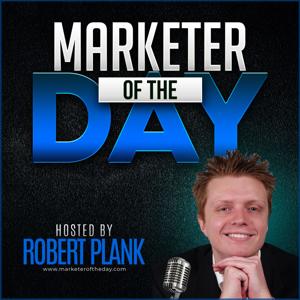
Marketer of the Day with Robert Plank: Business Growth & Entrepreneur Stories

Marketer of the Day with Robert Plank: Business Growth & Entrepreneur Stories

Download on the App Store

Marketer of the Day with Robert Plank: Business Growth & Entrepreneur Stories episodes

  • 163: Business is People and People Are Of Value: Fight Fear, Doubt, and Worry Using Sympathy, Empathy, and Compassion with Michael Ross
    Michael Ross joins Robert Plank to discuss self-image, responsibility, and the people behind a business relationship. He draws on a difficult personal history and a turning point during incarceration to explain why the way someone sees themselves can influence the choices they believe are available.
    Michael recalls a mentor who believed in him when he had accumulated a long list of people and circumstances to blame. That relationship challenged him to take responsibility and reconsider a pattern of taking from others. He describes moving toward a different question: how could he contribute and help someone else?
    The conversation examines labels built around past behavior, mistakes, or addictions. Michael argues that repeatedly defining a person by a failure can make it harder to imagine a different action. Recognizing value does not erase responsibility; in his account, it creates a stronger reason to make choices that support a better future.
    Robert and Michael connect that perspective with customers who bring their own fear, doubt, worry, and experience into a buying decision. Sympathy, empathy, and compassion help a business understand the person rather than treat them only as a transaction. The episode is a personal account of changing direction, with a business principle running through it: serving people well requires recognizing their value and responding to what they actually need, while remaining accountable for your own part in the relationship.
    Seeing the person behind the past or the transaction
    Distinguish responsibility for a choice from a permanent identity.
    Notice when blame prevents a useful next action.
    Recognize the fears and experiences a customer brings to a conversation.
    Build trust through contribution and genuine concern for people.
    Resources mentioned
    A Clear View: Unleashing the Power of a Positive Self-Image
    https://www.youtube.com/watch?v=n_zsSwWUeL8
    29 min
  • 162: Clarity, Simplicity, and Focus: Find the Right Coach to Achieve Maximum Greatness with Unstoppable Entrepreneur Kelly Roach
    Kelly Roach joins Robert Plank to discuss the clarity and focus an overwhelmed entrepreneur needs to move a business forward. Drawing on her corporate operating experience and coaching work, she identifies gaps in business knowledge, discomfort with sales, and excessive information consumption as recurring obstacles.
    Kelly recommends examining strengths and weaknesses before deciding what to learn or delegate. Some gaps require an employee, contractor, specialist, or outside service; others require the owner to develop a skill. Sales receives special attention because obtaining clients and generating income make it possible to fund the support needed for growth.
    The conversation challenges the assumption that more educational content always helps. Webinars, newsletters, podcasts, and programs can crowd out execution if the owner never decides which information will be used. Simplifying those inputs creates more room to apply a clear next step. Kelly describes a client whose offer became clearer during a short group coaching conversation and who then made a first sale after a stalled restart.
    Choosing a coach also begins with a specific result. Kelly encourages entrepreneurs to define the stage they want to reach and look for relevant help, rather than purchase general motivation without a clear purpose. The episode connects the value of outside perspective with the owner's responsibility to make decisions and act. It is especially relevant to someone who has gathered plenty of advice but is still struggling to choose what to do first.
    Creating room for the work that moves the business
    Assess the skills and support the next stage actually requires.
    Learn to sell rather than postpone the conversation about customers.
    Limit educational inputs to information you intend to apply.
    Choose coaching around a clear result and a relevant gap.
    Resources mentioned
    Kelly Roach, the Unstoppable Entrepreneur
    https://www.youtube.com/watch?v=tbLUzmFNsK4
    26 min
  • 161: Affiliate Marketing, Domain Investing and E-Commerce: Think, Act, and Adapt As An Entprepreneur with Michael Jackness
    Michael Jackness talks with Robert Plank about moving through affiliate marketing, premium domain names, and ecommerce as conditions changed. His story is a practical account of spotting opportunities, testing an idea, and recognizing when a once-successful business model needs a different direction.
    Mike's early affiliate business grew from discovering a poker referral program and offering books to people who signed up through him. Industry changes eventually made that work less attractive. After stepping away and traveling by RV, he applied his search marketing experience to keyword domains, considering search demand, advertising costs, comparable sales, and the possibility of developing a real business around a name.
    The domain examples include WebsiteHosting.com, WordPressThemes.com, and Treadmill.com. Mike explains that a strong name still needed a useful business behind it. With Treadmill.com, sending visitors away through affiliate reviews was confusing shoppers who expected to buy a treadmill on the site. Turning it into a store created a clearer experience and brought a different set of operational challenges.
    Learning ecommerce meant evaluating platforms, talking with manufacturers, testing suppliers, and dealing with the realities of shipping heavy products. Mike eventually moved toward lighter products and his own brands. Throughout the conversation, he returns to learning through manageable experiments rather than committing everything to an untested assumption. The episode is especially useful for entrepreneurs deciding whether to improve their current model or redirect their skills toward a better opportunity.
    Knowing when to develop, test, or change direction
    Evaluate a domain as part of a potential business rather than a name alone.
    Pay attention when visitor expectations and the buying experience do not match.
    Test suppliers and operations before expanding heavily.
    Treat changing market conditions as a reason to reassess the model.
    Resources mentioned
    Michael Jackness
    Ecommerce Crew
    https://www.youtube.com/watch?v=4uL0JsIwa0Y
    42 min
  • 160: Create Systems and Outsource: Grow Your Business and Get Your Life Back with Ric Thompson
    Ric Thompson joins Robert Plank to discuss reclaiming time through systems and a coordinated team. His approach challenges the expectation that one virtual assistant should be able to handle design, development, research, publishing, administration, and every other task an owner wants to stop doing.
    Ric describes moving toward specialists whose work can be coordinated, rather than depending on an all-purpose helper. A developer and a designer solve different problems, and clear responsibilities make it easier to match the assignment with the person. The discussion also distinguishes strategic advice from execution: someone asked to complete a task may not be the right person to decide the business strategy behind it.
    Testing with a small project is part of the process. Ric recommends learning how a provider communicates and delivers before handing over a larger assignment. Repeated work such as website updates, video editing, research, and content publishing gives an owner practical places to begin, especially when someone else can do it faster, more economically, or to a higher standard.
    An early client spent twenty hours each week formatting promotional email for several platforms. Turning that production work over to a team released a substantial block of the client's time without requiring a new business idea. The episode asks owners to look at the work they already repeat and decide which parts truly require their attention, which need a system, and which are ready for a capable specialist.
    Delegating repeatable work to the right person
    Separate strategic questions from clearly defined production tasks.
    Use specialists when the work requires different skills.
    Start with a limited assignment to evaluate the working relationship.
    Identify recurring tasks that consume time without requiring the owner.
    https://www.youtube.com/watch?v=mY_K-KkzlDI
    38 min
  • 159: Use Dreams to Achieve Breakthroughs: Find Guidance, Understanding, Confidence and Business Success with Amy Coello
    Amy Coello joins Robert Plank for a conversation about dreams, personal interpretation, and the ideas people carry from sleep into their waking lives. She describes her own dream-study practice and the meaning she finds in recurring imagery, emotions, and remembered fragments, alongside an analytical background from work in the legal field.
    Amy explains how she approaches dream recall: creating a quieter environment, reducing distractions, and writing down whatever is remembered, even when it is only an image or feeling. In her account, paying consistent attention makes more material available for reflection. Robert shares his own brief experience of becoming aware that he was dreaming after trying a technique involving looking at his hands.
    The discussion includes dreams Amy interprets as connected with business ideas and emotional concerns. One gave her a detailed concept for a spiritual course; another client's imagery became a starting point for discussing childhood rejection. These are the guest's personal experiences and interpretations, rather than evidence that a dream predicts an event or establishes a fact about another person.
    Robert and Amy also discuss lucid dreaming, recurring dreams, and the difference between remembering an experience and deciding what significance to give it. For a listener interested in reflective practices, the episode introduces Amy's method and the kinds of questions she brings to a dream journal. Its business connection is the creative material and self-examination she believes can emerge when an experience is noticed, recorded, and considered instead of immediately forgotten.
    Remembering and reflecting on dream experiences
    Record fragments and emotions rather than wait for a complete narrative.
    Notice recurring themes without treating an interpretation as an established fact.
    Consider how a remembered image might prompt a useful personal question.
    Hear Robert's account of briefly recognizing that he was dreaming.
    Resources mentioned
    Amy Coello
    https://www.youtube.com/watch?v=0xMtxsePuL4
    33 min
  • 158: Promote Affiliate Offers, Build Your List, and Create Your Own Products with Top 100 Clickbank Affiliate John Lagoudakis
    John Lagoudakis talks with Robert Plank about affiliate marketing, email lists, and learning what customers buy before creating a product. His experience includes becoming a leading ClickBank affiliate, losing a large share of that income when advertising conditions changed, and rebuilding around assets that gave him a more direct relationship with his audience.
    John explains why promoting an established offer can be useful research. A product with demonstrated demand provides a different starting point from spending months building something based on assumptions. He favors concentrating on one niche and one workable strategy long enough to understand it, rather than constantly moving between unrelated opportunities.
    A change affecting direct affiliate advertising became a turning point in his business. John says most of his income disappeared, while an email list he had begun building provided another direction. The discussion examines what happens to visitors who leave a sales page without purchasing and why capturing a relevant contact can create a chance to follow up rather than starting from zero each time.
    John also shares the role of automation during a difficult personal period, when traffic and evergreen webinars continued operating while his attention was elsewhere. Later partnerships brought lead-generation work beyond the internet-marketing niche. The conversation closes the loop between marketing claims and evidence, including a proposal whose promised search traffic did not stand up to his own research. It is a candid discussion of focus, vulnerability to platform changes, and understanding the numbers behind an offer.
    Learning demand while building a more durable audience
    Investigate whether an offer already attracts buyers.
    Recognize the risk of depending on one advertising method.
    Create a relevant reason for visitors to stay in contact.
    Check marketing forecasts instead of accepting impressive numbers at face value.
    Resources mentioned
    John Lagoudakis
    https://www.youtube.com/watch?v=a0lTkvXlsmM
    34 min
  • 157: Become a “Cool” Business, Provide a Superior Customer Experience and Compete in the Internet Age with D. Anthony Miles
    D. Anthony Miles joins Robert Plank to discuss customer experience, competition, and what makes a business worth choosing when shoppers can compare alternatives from a phone. Their conversation examines the relationship before, during, and after a purchase, including the small service decisions that can give a customer a reason to return.
    D. Anthony Miles argues that competing on price alone leaves a business exposed. Customers can move between products, and past purchases do not guarantee lasting loyalty. He discusses benchmarking competitors, understanding switching costs, and building customer support that makes buying feel less uncertain. The aim is to identify what customers value and make that value visible through the experience they receive.
    Robert contributes examples from his own life. Free oil changes brought him back to a car dealership and kept the relationship active after the original sale. A birthday message from his dentist stood out even though he assumed it was automated. Both illustrate how a useful or thoughtful follow-up can keep a business present without making every interaction another sales pitch.
    D. Anthony Miles also compares his visits to Apple and Microsoft stores and discusses the difference between creating something new and adapting an existing idea. The examples are drawn from the market at the time of the interview, while the broader questions remain useful for evaluating a business: What happens after someone buys? How easy is it to get help? What gives a customer a reason to remember you and come back?
    Making the customer relationship a competitive strength
    Look beyond the transaction to the complete customer experience.
    Study competitors without assuming imitation creates a distinctive business.
    Make support and follow-up part of the offer.
    Give customers clear reasons to stay beyond a lower price.
    Resources mentioned
    MDICorpVEntures.com
    https://www.youtube.com/watch?v=ode-PLV_tcs
    36 min
  • 156: Listen, Focus, Balance, Pivot: Get It All Done and Pursue Your Entrepreneurial Dreams with Audrey Bell-Kearney
    Audrey Bell-Kearney joins Robert Plank to discuss listening, focus, balance, and the changes a business idea needs as it meets the real world. Her stories range from creating Big Beautiful Dolls to developing HerTube, showing both the excitement of a new concept and the difficulty of explaining and operating it.
    Audrey describes working with a doll-collecting friend and a manufacturer to move an idea toward prototypes. A later version drew inspiration from her daughter's prom dress and connected with a web series. These projects required more than creative ideas: they also needed production, distribution, promotion, and people who could take responsibility for different parts of the work.
    A coach's reaction to an expensive website helped reveal another problem. The site looked attractive but did not give visitors a clear action. Audrey connects that experience with learning to narrow her own role and delegate. Developing HerTube brought further adjustments as filmmakers, business owners, and investors responded to different versions of the concept. A simpler comparison eventually made the network easier for investors to understand.
    The conversation also considers the cost of constant work. When Audrey learned her daughter's school performance was suffering, she changed the way she organized family and business time. Listening becomes a recurring theme: hearing a customer, a coach, an investor, or a family member can reveal a problem that more activity alone will not solve. The episode offers a candid view of choosing priorities and changing direction without abandoning the larger ambition.
    Building while listening to the people around you
    Give visitors a clear next action instead of relying on an attractive site.
    Separate the roles needed to produce and distribute the work.
    Simplify a pitch when people repeatedly misunderstand it.
    Adjust the work schedule when important personal responsibilities need attention.
    HerTube.tv
    Dasia Doll
    "What's Your Big Idea?" Book
    Talk Business With Audrey
    https://www.youtube.com/watch?v=f4Ohe49uvso
    38 min
  • 155: Crowdfunding: Get Funded Today on Kickstarter and Indiegogo with Zach Smith
    Zach Smith joins Robert Plank to discuss rewards-based crowdfunding as a way to test a product idea and finance the work of making it real. The interview moves beyond a campaign's headline total to the preparation, costs, early support, and fulfillment responsibilities behind the launch.
    Zach explains why a funding goal must be connected to the numbers. Prototypes, manufacturing, shipping, overhead, and other expenses affect whether the creator can deliver what backers expect. A goal can help create momentum, but an appealing campaign does not fix a product whose economics were never worked out. He uses high-profile crowdfunding examples to show the difference between raising money and successfully fulfilling orders.
    Preparation includes finding people willing to support the project before it goes live. Zach discusses friends, family, and an initial group of committed backers, along with the role early activity can play in introducing a campaign to more people. Examples include NOMATIC products and a posture-related product whose campaign initially struggled before receiving additional marketing support.
    The conversation also covers continuing to take preorders after the original campaign and moving toward production and delivery. Platform features described in the recording reflect that period. The lasting business question is whether people will make a real commitment to the product, not simply say the idea sounds interesting. This episode gives prospective creators a more operational view of the work behind a public crowdfunding success.
    What a crowdfunding launch needs behind the campaign page
    Calculate the costs required to manufacture and deliver the rewards.
    Develop early support before the launch date.
    Distinguish interest and praise from actual pledges.
    Treat fulfillment planning as part of the campaign from the beginning.
    Resources mentioned
    Zach Smith from Funded Today
    Funded Today
    Crowdfunding Success Matrix
    Funded Today Blog
    Crowdfunding Cashback Network
    https://www.youtube.com/watch?v=FhOnBXCzN7k

    33 min
  • 154: Crush It On Instagram: Build an Audience, Generate Leads, and Increase Sales with Luke Bender
    Luke Bender joins Robert Plank to discuss using Instagram with a more deliberate audience and content routine. The recording captures his approach during an earlier stage of the platform, combining original photographs, relevant ideas, personal interests, and active participation rather than simply uploading images and hoping to be discovered.
    Robert examines Luke's waterskiing and surfing photographs, which Luke turns into distinctive quote images using his own material. The example shows how a familiar content format can carry a recognizable personal style instead of looking like the same stock image repeated across unrelated accounts.
    Luke describes finding communities around larger accounts in his niche and paying attention to people actively interacting with recent posts. He also discusses the routine, posting frequency, and numerical targets he used at the time. Those growth tactics and benchmarks belong to the recording period, rather than a current recommendation or a promise about what a new account will achieve.
    The conversation considers likes, comments, audience activity, and the connection between a follower and a prospective customer. Behind the platform-specific details is a useful set of content questions: does the material fit a recognizable audience, does it show something distinctive about the person or business, and is anyone responding? The episode offers a historical example of turning a social account into a regular marketing activity with attention to both the images and the people seeing them.
    Creating recognizable content for a relevant audience
    Use original material to make a familiar format more distinctive.
    Understand the communities connected with your subject.
    Treat historical growth targets as examples rather than forecasts.
    Look at actual audience response alongside the follower total.
    Resources mentioned
    Luke Bender from LukeBender.com
    Resources
    Typorama (generate quote pictures)
    Later app (for posting)
    Iconosquare (analytics)
    https://www.youtube.com/watch?v=WjJOlEpgglc
    28 min

About Marketer of the Day with Robert Plank: Business Growth & Entrepreneur Stories

From the publisher's feed

Marketer of the Day with Robert Plank is a daily business podcast for entrepreneurs, solopreneurs, consultants, agency owners, coaches, authors, speakers, and expert-led service businesses that want…