
Sign up to save your podcasts
Or

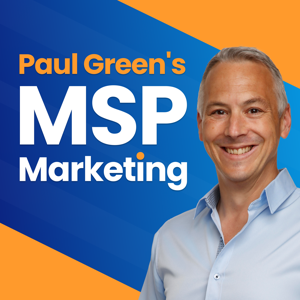

Most MSP owners are drowning in marketing tasks, telling themselves they’re saving money or keeping control, when in reality they’re just burning through their time. Let’s discuss how to change that. Also this week, many MSPs use AI badly for marketing, and it costs MSPs 5 figures to win a new client.
Welcome to Episode 329 of the MSP Marketing Podcast with me, Paul Green, powered by the MSP Marketing Edge.
You’d be mad to do all of your MSPs marketing yourself, and if that sentence annoys you a little, there’s a good chance that you are exactly the person who needs to hear it. Because most MSP owners are drowning in marketing tasks, telling themselves they’re saving money or keeping control, when in reality they’re burning the one resource they can never replace… their time. Right now, I want to talk about which marketing jobs you absolutely should outsource, which ones you must keep ownership of, and how to focus your limited time on the activities that deliver the biggest return.
So let’s talk about time, because for MSP owners and managers, time is the real bottleneck. You don’t have a lack of ideas, you don’t have a lack of tools, you don’t even have a lack of willingness. What you have is too many things competing for your attention. And marketing is often the thing that’s squeezed into the cracks between the tickets, the meetings, and the client fires.
The goal of marketing isn’t for you to do more, it’s for you to do less of the wrong things and more of the right things.
And here’s the core principle that I want you to adopt. You should outsource anything that someone else could be trained to do well, and you should keep ownership of anything that requires judgement, direction and deep understanding of your business. Most MSPs get this completely backwards. They clinging very tightly to low value tasks and then outsource high level thinking, which is absolute madness, right?
Let’s start with what you should almost always outsource. Anything repetitive. Anything admin heavy. Anything that’s process driven, things like loading social media posts, scheduling blogs, uploading videos, formatting newsletters, whether that’s email or print making, LinkedIn connection requests, cleaning lists, basic CRM updates, repurposing content, chasing webinar registrations, creating transcripts and pulling simple reports. None of those tasks that I was just mentioning require you. They just require instructions. They require an SOP. If someone can be trained to do it once, they can be trained to do it again and again and again.
And every hour you spend doing those things is an hour you are not spending on strategy, leadership, relationships or growth. Now let’s talk about what you absolutely should not outsource. You should never outsource ownership of your marketing direction. You should never outsource deciding who you are targeting, what you stand for, what message you want to be known for or what success looks like. You shouldn’t outsource thinking, you shouldn’t outsource high level decision making, and you definitely should not outsource responsibility. Strategy for your marketing lives with you, direction lives with you, and accountability lives with you. Even if you have a marketing agency, a virtual assistant, a marketing assistant, or even if you have a content team, they should be executing your thinking and not replacing it. Because trust me on this, no one else in the entire world understands your MSP, your clients, your ambition, your risk tolerance, the way that you do.
Many MSPs say, Oh, I haven’t got time for marketing, and what they really mean is, I don’t have time to do admin marketing tasks. But the high ROI marketing doesn’t look like admin, it looks like deciding where you want to focus. It means deciding and choosing the story you want to tell. Reviewing performance and adjusting direction. It means recording short videos, writing rough outlines, approving content, shaping campaigns, all of that stuff is founder level work. I’m a founder. I’m not doing the marketing tasks of editing my podcast or my YouTube videos or putting my blogs onto the website or LinkedIn newsletters. I shape all of that content and I do actually still write it myself because I’m a writer at heart, but I don’t do the little tasks of actually loading it. I have a much better member of my team who does that for me so I don’t have to do it. She does a much better job than I would do as well. And all of this doesn’t take hours a day, you just need a little bit of focus to decide what you’re doing and what you are not doing, and then train other people to do the rest of it for you.
Understand this, the smartest MSP owners design their marketing so that they personally spend the smallest amount of time possible on the activities that create the biggest impact. They think, decide, approve and guide and other people build, load, schedule and repeat. If you try to do everything yourself, marketing becomes a burden. If you outsource everything, marketing loses its soul. So the sweet spot is owning the brain and delegating the hands. I like that phrase.
The MSPs who grow consistently aren’t the ones that are trying to do every marketing task themselves. The ones that grow the fastest of the ones who protect their time, take ownership of the thinking, the direction of the decisions, and they let other people handle the mechanics. And that is not laziness and it’s not losing control. That… is leadership.
AI is changing the way that MSPs do their marketing forever, but not in the way most people think. This isn’t a story about tools, prompts, or automations, it’s about why the rise of AI might actually make being more human your biggest competitive advantage.
Cast your mind back for a moment to the year 2008. That was the year the first Iron Man film came out, which still feels impossible to me, to put that in context, someone who was born that year is now 17 or 18, which is nuts, right? Anyway, imagine if back then I’d said to you, Hey, in the near future there’s going to be some technology that can write your marketing for you. It can generate images, analyse your marketplace, plan campaigns, basically do almost anything you can think of and it’ll cost you about $20 a month. So you’d have thought I was mad or you’d have been bouncing off the walls with excitement, probably both. And of course, that future is now.
There’s an AI tool for almost anything, isn’t there? Writing, images, research, analysis, videos, strategy, ideas… and yes, of course it’s changed the game, but not in the way that most MSPs think it has. Because here’s what I really believe, the start of the AI revolution is also the start of a new content marketing revolution. For years, content marketing was dominated by the people who could produce the most content the old fashioned way, using humans. You either wrote it yourself or you paid someone else to do it. Output was the advantage. But now anyone, regardless of writing ability, can churn out hundreds of blog posts, emails and social posts today at the push of a button. There was already too much content online back then, and now there’s 10 times more, maybe a hundred times more, maybe a thousand times more. And we are barely at day one of our journey with AI.
So does that mean that content marketing is dead? Oh, no. No way at all. Not even close. But I do think there’s a big shift happening because when information becomes infinite, it stops being valuable. When people are overwhelmed with answers, the brain gives up trying to analyse them all and just hands the decision over to the heart. And the heart doesn’t look for more information, it looks for someone it trusts, someone it likes, someone it believes understands them. In other words, as information becomes commoditised, personality becomes the differentiator.
I think people are going to stop seeking information from content and start seeking wisdom from people.
And that’s the real marketing opportunity for you and your MSP, to put your authentic personality at the centre of everything you do. To be more human at exactly the same time that your competitors are flooding the internet with AI generated slop. Because as long as humans are making buying decisions – and in managed services that is going to be for a long time yet – trust, familiarity and personality will matter more than ever.
And this doesn’t mean that you shouldn’t use AI, I think quite the opposite. AI is an incredible amplifier, it’s a great assistant if you use it in the right way. You can train a GPT on you, your knowledge, your experience, your opinions, your tone, your sense of humour. You can ask AI to repurpose your content in your voice as long as you prompt it, well review it properly and correct it. You can ask AI to interview you in depth to pull ideas and insights out of your head. You can even use AI to generate images and visuals that feature you in different situations.
I like to think of this as the Iron Man approach to marketing. If you imagine Iron Man versus the Terminator, the Terminator is an agent, it has a mission and it executes that mission with no further input. It’s efficient, but soulless. Whereas Iron Man on the other hand, is Tony Stark, a very human personality surrounded by AI tools like Jarvis and Friday that enhance him, support him, and make him more effective without replacing who he actually is. Two very different approaches using AI. And I know exactly which one I would back. It’s the Tony Stark one, the Iron Man one.
The MSPs who win over the next few years won’t be the ones who automate themselves out of authenticity. They’ll be the ones who stay human, stay visible, and use AI to amplify what already makes them distinctive.
Featured guest: Shawn Walsh is the Founder and CEO of Encore Strategic and co-author (with Dave Cava) of The Pumpkin Plan for Managed Service Providers. His signature “Profit. Grow. Exit.®” methodology has helped countless MSPs increase profitability and business value.
Known for his practical, no-nonsense approach to business growth, Shawn brings together his law enforcement leadership background, real-world MSP experience, and passion for teaching to deliver actionable insights that drive results. His upcoming book, Profit. Grow. Exit. (April 2026), continues his mission of helping business owners build valuable, exit-ready businesses.
Have you ever actually sat down and worked out how much it really costs your MSP to win a brand new client? Not what you think it costs, but the true figure once you account for time, effort, marketing, sales, and wasted opportunities. Most MSPs massively underestimate this. And my guest today doesn’t guess at this number. He measures it, he sees it across the channel, and he understands exactly what the average MSP is spending to land a single new customer. And I’m going to warn you now, when you hear the real figure it’s going to change how you think about marketing and growth.
Hi, I am Shawn Walsh and I am the CEO of Encore Strategic.
And thanks so much for being here on the podcast, Shawn. You and I met very briefly at ScaleCon at the back end of last year in New Orleans, and we had literally a five minute conversation. I could barely get to your booth. You were surrounded mobbed by MSPs, which was an amazing thing to see at such a great conference. But it’s great to have you on the podcast now. And we are going to talk today about a subject where you and I agree is so difficult for most MSPs to get their heads round. And that is, how much does it actually cost you to win a brand new client? We’re going to explore that today, and I know you’ve got some advice on figuring that out, and of course, trying to adjust that price as well because it is often a scary figure when MSPs figure it out. Let’s first of all just have a look at you. So tell us about you, Shawn. What do you do with MSPs right now and what’s your kind of background?
Yeah, so what we do is we do peer groups for MSP owners. We also do COO and service manager groups, and then we also do direct consulting and coaching with MSPs to help them increase profitability, grow market share, and prepare for exit.
And how did you get into doing this, and how long have you been doing it for?
So I ran an MSP for many years, and I am the stereotypical, started it up in a spare bedroom in the house, grew to the basement and then out to an office. And we grew it to locations in four states in the US and then we were acquired by a $350 million services company and private equity backed and they bought the company. And I just wasn’t good at being retired. So too much stuff going on in my head. And I have always had a passion for teaching. I’ve taught college, I’ve taught high school. I work as a dive instructor, as a scuba instructor, as a side hustle. So I love teaching and I love sharing knowledge.
That’s really cool. I want to do scuba. That’s one of my semi-retirement plans because like you, I never intend to retire. So yeah. Whereabouts are you based in the states?
I am actually here in Aruba right now where we have an office where we run our peer groups out of Aruba occasionally. And it’s a nice, beautiful ocean here. And so anytime you want to come to Aruba and be a guest speaker, we can take you out and get you scuba shirt.
Amazing, right I’m in… my people will talk to your people, we’ll make that happen. That sounds really cool. So one of the things before we get on to talking about the cost of acquisition, the cost of acquiring a client, I would imagine, and I don’t do coaching, I work closely with MSPs but it’s always very much on practical things of improving their marketing and their websites and putting in place a lead generation system. But often conversations, I notice how much, and I’ve been doing this for just 10 years with MSPs, but 20 years overall, so like you, I’ve probably noticed how much MSPs hold themselves back through overthinking things, through emotional things, through worry, through fear. Do you see that? Because you are working with them on all of their business and obviously you’ve been there and you’ve done that and you’ve come through the other side and had the successful exit. Do you see that a lot? And is that a lot of the work that you do working on the mindset and the emotional stuff?
Absolutely. I mean, we’re taking people who are great engineers, but as many of us who come from the engineering background of things, we can sometimes hyper fixate on some of those details and not often the right ones. And looking at the business more holistically is really one of the things, the key things that we kind of focus on in our coaching and consulting and in our peer groups. Making sure that they’re not just working on one leg of the stool to take an old analogy. We have to work on the business holistically and we have to balance out all the aspects of it. And one of the areas is, as you well know, that MSPs suffer in paying attention to the sales and marketing side. And it’s because it’s the one we struggle with the most.
Technology is black and white. It’s easy. You tell a computer to do something, it does exactly what you tell it to do. Sales is not like that. Sales is very fuzzy and sometimes people aren’t comfortable in that. But really you have to get comfortable being uncomfortable because if you’re going to scale your company, you have got to be able to build a sales and marketing team, except for some very rare exceptions, owner led sales is just not going to get you to that big payday when you want to exit.
Yeah, I completely agree and I completely agree as well that it’s the most difficult thing. It’s so far away from the technical skillset, but that’s why I’ve dedicated what is left of my working career. I say that I’m only 51, but I intend to spend the rest of my working career continuing to make marketing easy for MSPs for exactly that reason, because it’s the big difficult missing piece in most MSPs businesses. They’ve got the operations, the customer service, everything is there except they just don’t know how to win clients. And that leads very nicely into our core subject, which is the cost of acquiring clients. So I know that MSPs, the vast majority of MSPs, haven’t a clue. Not a clue. I suspect that you have exactly the same experience. And when you ask MSPs to estimate how much they think they’ve spent to acquire a client, do you often find that they’re coming in way under what they’ve actually spent?
You know what, they’re not even able to come up with a number.
In most cases, MSPs really don’t think about what they’re spending on trying to get sales.
And one of the biggest things MSPs suffer from is what I refer to as random acts of marketing. They go, they spend a bunch of money on one thing, it doesn’t work. They say, oh, the heck with it. They don’t do it anymore for a while, and then they go do something else again. And we need that consistency on the sales and marketing. I mean, it’s a numbers game and it’s about consistent efforts, and they don’t really do that. And then because of the fact they’re not doing it regularly, they’re not really budgeting for things.
But one of the things that we do is we make them break down a budget, a very detailed budget. So now all of a sudden we’re getting to see, Hey, wait a second, there’s a lot of highs and lows here. We need to smooth this out. And then we start calculating it. And in our peer groups, we do a lot of financial accountability. And we finally decided we really needed to not only track the typical financial numbers that most MSPs track, like your service gross margin, your EBITDA, things like that. But we started tracking how many leads are you getting in, what do those leads cost, how many of those leads go to a first meeting, how many first meetings go to proposal, how many proposals go to close. And what about the salaries of the people who are doing that work. What does that cost you? And whatever marketing you’re doing. And we realised it’s a very significant amount of money. And honestly, I hadn’t really given it much thought since I had sold my company, and I saw an article and it had the data and it said that the average cost of an MSP client was $32,000. Yeah, so now one of my questions is how much do you think it costs you to get a new client? I checked the data and it was solid. I think the range I’m seeing right now is about $28,000 to $32,000 to get a new client in and people have no idea that it’s that high.
And take that client to 28 to 32, what kind of lifetime revenue would you expect from a client like that?
Right, and that’s one of the other things we’re calculating now is what’s the lifetime value of a client? And it’s typically three to five years. In some cases, if you’re really good, you might get longer, but that’s the average. Three to five is what you’re going to get. So that’s a pretty heavy cost and especially if you want to be bringing on about two new clients a month, which is what most MSPs are shooting for. So that’s $64,000 a month in client acquisition costs, that’s a salary every month. So you better make sure you’re doing it correctly and you better make sure, just like all the other numbers, we spend so much time monitoring service metrics, and let’s bring down our average time per endpoint. Hey, our average time per endpoint went from 40 minutes to 32 minutes. Yay. But nobody’s going, Hey, we got our client acquisition costs down from $32,000 a client down to $24,000. Yay. So we really need to be monitoring that.
And the thing that I am seeing is that as we’re monitoring this with our coaching clients and our peer groups now, people are taking it a lot more seriously than they did before. Before it was kind of like, oh, sales, that’s not me. I’m going to push that aside. Now they’re like, Hey, wait a second. This is costing me real money and I want to grow my company, so let’s pay attention to this. So that’s a good thing. Obviously people paying more attention to where their money’s going and their efforts, that’s good stuff, but you need to dial that in. One of the things that we did with some of our groups recently is we had everybody read Alex Hormozi’s book, $100M Leads. And I really like that book because he does a great job of breaking this whole concept of client acquisition costs and lifetime value down to some very, very simple metrics. And he breaks the whole process of acquiring leads down into some very simple terms that even non-sales professionals are able to completely understand and embrace. And we had a really good response with the groups on that, and I think we’re already starting to see the benefits of people paying attention to those numbers.
That makes perfect sense. And if you loved that book, then you have to read his newish book, which came out at the back end of last year, it was September or October last year, $100M Money Models, which in my opinion, is the best of the three books he’s written. There’s $100M Leads, $100M Offers, and the money models one is almost about how to make more money out of the clients you get. So it doesn’t solve the problem, well, he’s already solved the problems of how to acquire the clients and how to put the offers together, but the money models book just absolutely blew my mind. And I think he or whoever’s doing his writing with him has matured enough that they’re able to explain very complicated concepts so so simply, they’re great books and everything Alex Hormozi does on YouTube and everything written is absolutely worth looking at.
I was just going to say, I had to laugh when I was first introduced to his stuff and I thought, who’s this gym rat that I’m going to listen to? But check his background, he actually really does have the business chops to back up what he is saying. But you hit it right on the head. I mean, he does a very good job of taking very complex stuff and really boiling it down to its essence.
We had Nate Freedman on the podcast, I forget when it was a few months ago, of Tech Pro Marketing and MSP Sites, and he’s part of Alex Hormozi’s programme, and I can’t remember how much he spent to be part of it, but it was a huge amount of money. And in fact I sat with Nate at ScaleCon, which is where you and I first met last year, and he said, well, he was going to do it again because it puts so much value within his business. So yeah, there we go. That’s the big takeaway from this is Alex Hormozi, I think we talk about him every three weeks on the podcast.
Shawn, let’s wrap this up. So clients acquisition cost of up to $32,000… terrifying. Lifetime value, you’re only going to keep them for 3 to 5 years on average… terrifying. And if you were to look at that and you were a new MSP in the marketplace, you’d almost throw your hands up and say, Oh, what’s the point, I’m on a loser to get started. So what kind of advice now are you giving to the MSPs that you’re working with on either reducing down that client acquisition cost or mitigating the cost by extending the client and making sure and guaranteeing that they stay 7 to 10 years rather than that 3 to 5 years?
Well, two things. Number one, read Alex’s books upfront. Don’t wait for the last thing that you do in your company is to build a sales team like I did. You want to be consistent. You don’t have to go out and do grandiose things in your marketing and your sales, you just have to do a few things consistently. You’re going to get much better results. You’re going to drive down that client acquisition cost and monitor the cost because what gets monitored gets managed. So we want to do that.
The other thing, my self-serving plug here, go out and get my book, The Pumpkin Plan for Managed Service Providers, and use those lessons to make sure that you maximise the value and profit you get from your MSP clients so that you’re not spending a lot of money to get what we like to refer to as a cheap pain-in-the-ass client. And you actually get the client that you’re going to make money with and the one that’s going to stick with you and is going to be aligned with your core values and value what you do.
Yeah, that makes perfect sense. So thank you. So that book, again, The Pumpkin Plan for Managed Service Providers, and in terms of your peer groups and everything else, if we want to hang out with you and Aruba, maybe do some scuba diving on the side, how do we find out about those peer groups and get in touch with you?
Absolutely, [email protected]. You can also find me on LinkedIn. I am very active on there and on there regularly, so feel free to reach out to me on social media anytime.
 View all episodes
 By Paul Green's MSP Marketing Edge

4.6
1717 ratings
Most MSP owners are drowning in marketing tasks, telling themselves they’re saving money or keeping control, when in reality they’re just burning through their time. Let’s discuss how to change that. Also this week, many MSPs use AI badly for marketing, and it costs MSPs 5 figures to win a new client.
Welcome to Episode 329 of the MSP Marketing Podcast with me, Paul Green, powered by the MSP Marketing Edge.
You’d be mad to do all of your MSPs marketing yourself, and if that sentence annoys you a little, there’s a good chance that you are exactly the person who needs to hear it. Because most MSP owners are drowning in marketing tasks, telling themselves they’re saving money or keeping control, when in reality they’re burning the one resource they can never replace… their time. Right now, I want to talk about which marketing jobs you absolutely should outsource, which ones you must keep ownership of, and how to focus your limited time on the activities that deliver the biggest return.
So let’s talk about time, because for MSP owners and managers, time is the real bottleneck. You don’t have a lack of ideas, you don’t have a lack of tools, you don’t even have a lack of willingness. What you have is too many things competing for your attention. And marketing is often the thing that’s squeezed into the cracks between the tickets, the meetings, and the client fires.
The goal of marketing isn’t for you to do more, it’s for you to do less of the wrong things and more of the right things.
And here’s the core principle that I want you to adopt. You should outsource anything that someone else could be trained to do well, and you should keep ownership of anything that requires judgement, direction and deep understanding of your business. Most MSPs get this completely backwards. They clinging very tightly to low value tasks and then outsource high level thinking, which is absolute madness, right?
Let’s start with what you should almost always outsource. Anything repetitive. Anything admin heavy. Anything that’s process driven, things like loading social media posts, scheduling blogs, uploading videos, formatting newsletters, whether that’s email or print making, LinkedIn connection requests, cleaning lists, basic CRM updates, repurposing content, chasing webinar registrations, creating transcripts and pulling simple reports. None of those tasks that I was just mentioning require you. They just require instructions. They require an SOP. If someone can be trained to do it once, they can be trained to do it again and again and again.
And every hour you spend doing those things is an hour you are not spending on strategy, leadership, relationships or growth. Now let’s talk about what you absolutely should not outsource. You should never outsource ownership of your marketing direction. You should never outsource deciding who you are targeting, what you stand for, what message you want to be known for or what success looks like. You shouldn’t outsource thinking, you shouldn’t outsource high level decision making, and you definitely should not outsource responsibility. Strategy for your marketing lives with you, direction lives with you, and accountability lives with you. Even if you have a marketing agency, a virtual assistant, a marketing assistant, or even if you have a content team, they should be executing your thinking and not replacing it. Because trust me on this, no one else in the entire world understands your MSP, your clients, your ambition, your risk tolerance, the way that you do.
Many MSPs say, Oh, I haven’t got time for marketing, and what they really mean is, I don’t have time to do admin marketing tasks. But the high ROI marketing doesn’t look like admin, it looks like deciding where you want to focus. It means deciding and choosing the story you want to tell. Reviewing performance and adjusting direction. It means recording short videos, writing rough outlines, approving content, shaping campaigns, all of that stuff is founder level work. I’m a founder. I’m not doing the marketing tasks of editing my podcast or my YouTube videos or putting my blogs onto the website or LinkedIn newsletters. I shape all of that content and I do actually still write it myself because I’m a writer at heart, but I don’t do the little tasks of actually loading it. I have a much better member of my team who does that for me so I don’t have to do it. She does a much better job than I would do as well. And all of this doesn’t take hours a day, you just need a little bit of focus to decide what you’re doing and what you are not doing, and then train other people to do the rest of it for you.
Understand this, the smartest MSP owners design their marketing so that they personally spend the smallest amount of time possible on the activities that create the biggest impact. They think, decide, approve and guide and other people build, load, schedule and repeat. If you try to do everything yourself, marketing becomes a burden. If you outsource everything, marketing loses its soul. So the sweet spot is owning the brain and delegating the hands. I like that phrase.
The MSPs who grow consistently aren’t the ones that are trying to do every marketing task themselves. The ones that grow the fastest of the ones who protect their time, take ownership of the thinking, the direction of the decisions, and they let other people handle the mechanics. And that is not laziness and it’s not losing control. That… is leadership.
AI is changing the way that MSPs do their marketing forever, but not in the way most people think. This isn’t a story about tools, prompts, or automations, it’s about why the rise of AI might actually make being more human your biggest competitive advantage.
Cast your mind back for a moment to the year 2008. That was the year the first Iron Man film came out, which still feels impossible to me, to put that in context, someone who was born that year is now 17 or 18, which is nuts, right? Anyway, imagine if back then I’d said to you, Hey, in the near future there’s going to be some technology that can write your marketing for you. It can generate images, analyse your marketplace, plan campaigns, basically do almost anything you can think of and it’ll cost you about $20 a month. So you’d have thought I was mad or you’d have been bouncing off the walls with excitement, probably both. And of course, that future is now.
There’s an AI tool for almost anything, isn’t there? Writing, images, research, analysis, videos, strategy, ideas… and yes, of course it’s changed the game, but not in the way that most MSPs think it has. Because here’s what I really believe, the start of the AI revolution is also the start of a new content marketing revolution. For years, content marketing was dominated by the people who could produce the most content the old fashioned way, using humans. You either wrote it yourself or you paid someone else to do it. Output was the advantage. But now anyone, regardless of writing ability, can churn out hundreds of blog posts, emails and social posts today at the push of a button. There was already too much content online back then, and now there’s 10 times more, maybe a hundred times more, maybe a thousand times more. And we are barely at day one of our journey with AI.
So does that mean that content marketing is dead? Oh, no. No way at all. Not even close. But I do think there’s a big shift happening because when information becomes infinite, it stops being valuable. When people are overwhelmed with answers, the brain gives up trying to analyse them all and just hands the decision over to the heart. And the heart doesn’t look for more information, it looks for someone it trusts, someone it likes, someone it believes understands them. In other words, as information becomes commoditised, personality becomes the differentiator.
I think people are going to stop seeking information from content and start seeking wisdom from people.
And that’s the real marketing opportunity for you and your MSP, to put your authentic personality at the centre of everything you do. To be more human at exactly the same time that your competitors are flooding the internet with AI generated slop. Because as long as humans are making buying decisions – and in managed services that is going to be for a long time yet – trust, familiarity and personality will matter more than ever.
And this doesn’t mean that you shouldn’t use AI, I think quite the opposite. AI is an incredible amplifier, it’s a great assistant if you use it in the right way. You can train a GPT on you, your knowledge, your experience, your opinions, your tone, your sense of humour. You can ask AI to repurpose your content in your voice as long as you prompt it, well review it properly and correct it. You can ask AI to interview you in depth to pull ideas and insights out of your head. You can even use AI to generate images and visuals that feature you in different situations.
I like to think of this as the Iron Man approach to marketing. If you imagine Iron Man versus the Terminator, the Terminator is an agent, it has a mission and it executes that mission with no further input. It’s efficient, but soulless. Whereas Iron Man on the other hand, is Tony Stark, a very human personality surrounded by AI tools like Jarvis and Friday that enhance him, support him, and make him more effective without replacing who he actually is. Two very different approaches using AI. And I know exactly which one I would back. It’s the Tony Stark one, the Iron Man one.
The MSPs who win over the next few years won’t be the ones who automate themselves out of authenticity. They’ll be the ones who stay human, stay visible, and use AI to amplify what already makes them distinctive.
Featured guest: Shawn Walsh is the Founder and CEO of Encore Strategic and co-author (with Dave Cava) of The Pumpkin Plan for Managed Service Providers. His signature “Profit. Grow. Exit.®” methodology has helped countless MSPs increase profitability and business value.
Known for his practical, no-nonsense approach to business growth, Shawn brings together his law enforcement leadership background, real-world MSP experience, and passion for teaching to deliver actionable insights that drive results. His upcoming book, Profit. Grow. Exit. (April 2026), continues his mission of helping business owners build valuable, exit-ready businesses.
Have you ever actually sat down and worked out how much it really costs your MSP to win a brand new client? Not what you think it costs, but the true figure once you account for time, effort, marketing, sales, and wasted opportunities. Most MSPs massively underestimate this. And my guest today doesn’t guess at this number. He measures it, he sees it across the channel, and he understands exactly what the average MSP is spending to land a single new customer. And I’m going to warn you now, when you hear the real figure it’s going to change how you think about marketing and growth.
Hi, I am Shawn Walsh and I am the CEO of Encore Strategic.
And thanks so much for being here on the podcast, Shawn. You and I met very briefly at ScaleCon at the back end of last year in New Orleans, and we had literally a five minute conversation. I could barely get to your booth. You were surrounded mobbed by MSPs, which was an amazing thing to see at such a great conference. But it’s great to have you on the podcast now. And we are going to talk today about a subject where you and I agree is so difficult for most MSPs to get their heads round. And that is, how much does it actually cost you to win a brand new client? We’re going to explore that today, and I know you’ve got some advice on figuring that out, and of course, trying to adjust that price as well because it is often a scary figure when MSPs figure it out. Let’s first of all just have a look at you. So tell us about you, Shawn. What do you do with MSPs right now and what’s your kind of background?
Yeah, so what we do is we do peer groups for MSP owners. We also do COO and service manager groups, and then we also do direct consulting and coaching with MSPs to help them increase profitability, grow market share, and prepare for exit.
And how did you get into doing this, and how long have you been doing it for?
So I ran an MSP for many years, and I am the stereotypical, started it up in a spare bedroom in the house, grew to the basement and then out to an office. And we grew it to locations in four states in the US and then we were acquired by a $350 million services company and private equity backed and they bought the company. And I just wasn’t good at being retired. So too much stuff going on in my head. And I have always had a passion for teaching. I’ve taught college, I’ve taught high school. I work as a dive instructor, as a scuba instructor, as a side hustle. So I love teaching and I love sharing knowledge.
That’s really cool. I want to do scuba. That’s one of my semi-retirement plans because like you, I never intend to retire. So yeah. Whereabouts are you based in the states?
I am actually here in Aruba right now where we have an office where we run our peer groups out of Aruba occasionally. And it’s a nice, beautiful ocean here. And so anytime you want to come to Aruba and be a guest speaker, we can take you out and get you scuba shirt.
Amazing, right I’m in… my people will talk to your people, we’ll make that happen. That sounds really cool. So one of the things before we get on to talking about the cost of acquisition, the cost of acquiring a client, I would imagine, and I don’t do coaching, I work closely with MSPs but it’s always very much on practical things of improving their marketing and their websites and putting in place a lead generation system. But often conversations, I notice how much, and I’ve been doing this for just 10 years with MSPs, but 20 years overall, so like you, I’ve probably noticed how much MSPs hold themselves back through overthinking things, through emotional things, through worry, through fear. Do you see that? Because you are working with them on all of their business and obviously you’ve been there and you’ve done that and you’ve come through the other side and had the successful exit. Do you see that a lot? And is that a lot of the work that you do working on the mindset and the emotional stuff?
Absolutely. I mean, we’re taking people who are great engineers, but as many of us who come from the engineering background of things, we can sometimes hyper fixate on some of those details and not often the right ones. And looking at the business more holistically is really one of the things, the key things that we kind of focus on in our coaching and consulting and in our peer groups. Making sure that they’re not just working on one leg of the stool to take an old analogy. We have to work on the business holistically and we have to balance out all the aspects of it. And one of the areas is, as you well know, that MSPs suffer in paying attention to the sales and marketing side. And it’s because it’s the one we struggle with the most.
Technology is black and white. It’s easy. You tell a computer to do something, it does exactly what you tell it to do. Sales is not like that. Sales is very fuzzy and sometimes people aren’t comfortable in that. But really you have to get comfortable being uncomfortable because if you’re going to scale your company, you have got to be able to build a sales and marketing team, except for some very rare exceptions, owner led sales is just not going to get you to that big payday when you want to exit.
Yeah, I completely agree and I completely agree as well that it’s the most difficult thing. It’s so far away from the technical skillset, but that’s why I’ve dedicated what is left of my working career. I say that I’m only 51, but I intend to spend the rest of my working career continuing to make marketing easy for MSPs for exactly that reason, because it’s the big difficult missing piece in most MSPs businesses. They’ve got the operations, the customer service, everything is there except they just don’t know how to win clients. And that leads very nicely into our core subject, which is the cost of acquiring clients. So I know that MSPs, the vast majority of MSPs, haven’t a clue. Not a clue. I suspect that you have exactly the same experience. And when you ask MSPs to estimate how much they think they’ve spent to acquire a client, do you often find that they’re coming in way under what they’ve actually spent?
You know what, they’re not even able to come up with a number.
In most cases, MSPs really don’t think about what they’re spending on trying to get sales.
And one of the biggest things MSPs suffer from is what I refer to as random acts of marketing. They go, they spend a bunch of money on one thing, it doesn’t work. They say, oh, the heck with it. They don’t do it anymore for a while, and then they go do something else again. And we need that consistency on the sales and marketing. I mean, it’s a numbers game and it’s about consistent efforts, and they don’t really do that. And then because of the fact they’re not doing it regularly, they’re not really budgeting for things.
But one of the things that we do is we make them break down a budget, a very detailed budget. So now all of a sudden we’re getting to see, Hey, wait a second, there’s a lot of highs and lows here. We need to smooth this out. And then we start calculating it. And in our peer groups, we do a lot of financial accountability. And we finally decided we really needed to not only track the typical financial numbers that most MSPs track, like your service gross margin, your EBITDA, things like that. But we started tracking how many leads are you getting in, what do those leads cost, how many of those leads go to a first meeting, how many first meetings go to proposal, how many proposals go to close. And what about the salaries of the people who are doing that work. What does that cost you? And whatever marketing you’re doing. And we realised it’s a very significant amount of money. And honestly, I hadn’t really given it much thought since I had sold my company, and I saw an article and it had the data and it said that the average cost of an MSP client was $32,000. Yeah, so now one of my questions is how much do you think it costs you to get a new client? I checked the data and it was solid. I think the range I’m seeing right now is about $28,000 to $32,000 to get a new client in and people have no idea that it’s that high.
And take that client to 28 to 32, what kind of lifetime revenue would you expect from a client like that?
Right, and that’s one of the other things we’re calculating now is what’s the lifetime value of a client? And it’s typically three to five years. In some cases, if you’re really good, you might get longer, but that’s the average. Three to five is what you’re going to get. So that’s a pretty heavy cost and especially if you want to be bringing on about two new clients a month, which is what most MSPs are shooting for. So that’s $64,000 a month in client acquisition costs, that’s a salary every month. So you better make sure you’re doing it correctly and you better make sure, just like all the other numbers, we spend so much time monitoring service metrics, and let’s bring down our average time per endpoint. Hey, our average time per endpoint went from 40 minutes to 32 minutes. Yay. But nobody’s going, Hey, we got our client acquisition costs down from $32,000 a client down to $24,000. Yay. So we really need to be monitoring that.
And the thing that I am seeing is that as we’re monitoring this with our coaching clients and our peer groups now, people are taking it a lot more seriously than they did before. Before it was kind of like, oh, sales, that’s not me. I’m going to push that aside. Now they’re like, Hey, wait a second. This is costing me real money and I want to grow my company, so let’s pay attention to this. So that’s a good thing. Obviously people paying more attention to where their money’s going and their efforts, that’s good stuff, but you need to dial that in. One of the things that we did with some of our groups recently is we had everybody read Alex Hormozi’s book, $100M Leads. And I really like that book because he does a great job of breaking this whole concept of client acquisition costs and lifetime value down to some very, very simple metrics. And he breaks the whole process of acquiring leads down into some very simple terms that even non-sales professionals are able to completely understand and embrace. And we had a really good response with the groups on that, and I think we’re already starting to see the benefits of people paying attention to those numbers.
That makes perfect sense. And if you loved that book, then you have to read his newish book, which came out at the back end of last year, it was September or October last year, $100M Money Models, which in my opinion, is the best of the three books he’s written. There’s $100M Leads, $100M Offers, and the money models one is almost about how to make more money out of the clients you get. So it doesn’t solve the problem, well, he’s already solved the problems of how to acquire the clients and how to put the offers together, but the money models book just absolutely blew my mind. And I think he or whoever’s doing his writing with him has matured enough that they’re able to explain very complicated concepts so so simply, they’re great books and everything Alex Hormozi does on YouTube and everything written is absolutely worth looking at.
I was just going to say, I had to laugh when I was first introduced to his stuff and I thought, who’s this gym rat that I’m going to listen to? But check his background, he actually really does have the business chops to back up what he is saying. But you hit it right on the head. I mean, he does a very good job of taking very complex stuff and really boiling it down to its essence.
We had Nate Freedman on the podcast, I forget when it was a few months ago, of Tech Pro Marketing and MSP Sites, and he’s part of Alex Hormozi’s programme, and I can’t remember how much he spent to be part of it, but it was a huge amount of money. And in fact I sat with Nate at ScaleCon, which is where you and I first met last year, and he said, well, he was going to do it again because it puts so much value within his business. So yeah, there we go. That’s the big takeaway from this is Alex Hormozi, I think we talk about him every three weeks on the podcast.
Shawn, let’s wrap this up. So clients acquisition cost of up to $32,000… terrifying. Lifetime value, you’re only going to keep them for 3 to 5 years on average… terrifying. And if you were to look at that and you were a new MSP in the marketplace, you’d almost throw your hands up and say, Oh, what’s the point, I’m on a loser to get started. So what kind of advice now are you giving to the MSPs that you’re working with on either reducing down that client acquisition cost or mitigating the cost by extending the client and making sure and guaranteeing that they stay 7 to 10 years rather than that 3 to 5 years?
Well, two things. Number one, read Alex’s books upfront. Don’t wait for the last thing that you do in your company is to build a sales team like I did. You want to be consistent. You don’t have to go out and do grandiose things in your marketing and your sales, you just have to do a few things consistently. You’re going to get much better results. You’re going to drive down that client acquisition cost and monitor the cost because what gets monitored gets managed. So we want to do that.
The other thing, my self-serving plug here, go out and get my book, The Pumpkin Plan for Managed Service Providers, and use those lessons to make sure that you maximise the value and profit you get from your MSP clients so that you’re not spending a lot of money to get what we like to refer to as a cheap pain-in-the-ass client. And you actually get the client that you’re going to make money with and the one that’s going to stick with you and is going to be aligned with your core values and value what you do.
Yeah, that makes perfect sense. So thank you. So that book, again, The Pumpkin Plan for Managed Service Providers, and in terms of your peer groups and everything else, if we want to hang out with you and Aruba, maybe do some scuba diving on the side, how do we find out about those peer groups and get in touch with you?
Absolutely, [email protected]. You can also find me on LinkedIn. I am very active on there and on there regularly, so feel free to reach out to me on social media anytime.

32,246 Listeners

30,609 Listeners
362 Listeners
5 Listeners

8,077 Listeners
2 Listeners
9 Listeners