
Sign up to save your podcasts
Or



Why am I leaving my safe London life, packing away my podcast awards and returning to the very culture that traumatised me?
After 11 years in my beautiful canalside flat, I am giving away 70% of my belongings, shedding my "London Sangeeta" identity, and taking nothing with me but my mother’s burnt orange silk sari. I am going back to the lush green backwaters of Kerala.
In this deeply vulnerable bridging episode, I am opening up about a mystical vision in a Kerala temple that changed the entire trajectory of my life. For years on Masala Podcast, we have talked about the cultural taboos that damage South Asian women. Now, we are entering a new era.
Modern women are exhausted. We are burnt out by a misogynistic world that masquerades as progressive, constantly telling us we are never enough. To survive, we have to stop playing by their rules. Over the next six solo episodes, we are going to explore ancient Indian feminist wisdom to heal modern feminist issues. We will dive into the raw, unapologetic power of the fierce goddesses—and learn how to re-wild ourselves.
The culture that hurt me is going to heal me. I want to be guided by the Goddess on this new path and I want to be your guide, if you’ll let me.
In this episode, we explore:
MY FREE 5-DAY "BAD DAUGHTER" COURSE!
Resources & Links I've mentioned on this episode:
✨ My Substack piece on the power of female anger in the Serpent Temple:
📖 My inspiring memoir, Bad Daughter
🌿 Follow my journey moving to Kerala on Instagram: @SoulSutras
Let me know what you think of this new direction!
Email me at [email protected] or send me a DM on Instagram.
⏱️ Episode Chapters:
0:00 - The Burnt Orange Sari & Leaving London
01:30 - Decluttering 21 Years & Leaving My Trophies
03:15 - Why I Rejected Kerala For 50 Years
05:00 - A Mystical Vision in the Temple
07:30 - Shedding My "London Sangeeta" Identity
09:15 - Discovering Raw Goddess Energy
11:00 - Modern Feminist Issues & Patriarchal Brainwashing
12:45 - Re-wilding Ourselves with Ancient Wisdom
14:30 - What's Coming Next on Masala Podcast
15:30 - Taking My Mother Back to Kerala
ABOUT MASALA PODCAST:
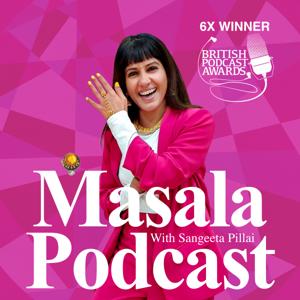
Masala Podcast (winner of 6 British Podcast Awards, 1 Audio Product Award & Spotify SoundUp Award) is the UK's biggest South Asian feminist podcast.
Created and hosted by Sangeeta Pillai, this is a highly respected podcast exploring intersectional feminist topics around culture, sex, sexuality, menopause, periods, trauma and fierce feminist rebellion.
Sangeeta and Masala Podcast have been been featured extensively in the press from BBC Radio, Guardian, Metro, Cosmopolitan, Evening Standard, Stylist, Eastern Eye to Huffington Post. As well as on giant billboards in New York, London, Dublin, Cardiff & Glasgow.
Is It Culture or Is It Control? The Truth About 'Honour'-Based Abuse
SPECIAL EPISODE IN PARTNERSHIP WITH THE UK GOVERNMENT
What do you think of when you hear the words ‘Honour’-Based Abuse? If you think it doesn’t happen to people like you, in cosmopolitan cities like London, then this is a must-listen episode.
This week, I, Sangeeta Pillai, am talking about something deeply important and often misunderstood: ‘Honour’-Based Abuse (HBA). This isn't just a distant headline; it's a reality for thousands of women in the UK, from all walks of life. I’ll share my own personal story of facing an arranged marriage, and we'll unpack the shocking statistics that show HBA is more common than you think.
Let’s do what we always do on Masala Podcast. Let's grab a cup of chai, sit down, and talk about the things we’re not supposed to talk about. Because pressure, control, and fear are not our culture.
Support Resources
If you or someone you know is experiencing ‘honour’-based abuse, please know that you are not alone and confidential, free help is available.
In This Episode, We Talk About:
Thank you for listening to Masala Podcast. Please share this episode with your friends and family—you never know who might need to hear it.
Connect with me on Instagram at @soulsutras or email me at [email protected] with your thoughts - I'd love to hear from you.
This episode is edited by The Podcasting Company @https://www.linkedin.com/company/thepodcastingcompany/
Breaking the Cycle of South Asian Cultural Shame | Masala Podcast
I'm peeling back the layers on a tough topic for South Asian diaspora experience: Cultural Shame. This isn't just about feeling "different"; it’s about the deep-rooted psychological burden of feeling that our culture, our bodies, and our very existence are "wrong" in a Western context.
1. Why We Feel Cultural Shame
We didn't wake up with this feeling; it was designed. We explore the "why" behind our embarrassment and our "Log Kya Kehenge" thinking:
The Colonial Hangover: Centuries of being told our traditions were "uncivilized" created a deep-seated internalized racism within all of us. It’s so deep-rooted that we don’t even know it’s there. Like everything we’re unaware of, it manifests in so many areas of our lives from school, to work to relationships.
The Integration Trap: The pressure to "fit in" to survive and succeed in Western spaces means we learn (often subconsciously) to hide our true South Asian selves. We learn that being more Western, being more accepted in the world we live in.
Generational Weight: Our parents' survival instincts taught them to also blend in and now draw attention to their more Desi parts. And growing up with those values, we turned into our cultural baggage.
2. How Cultural Shame Manifests in Our Lives
Shame isn't just a feeling; it’s a set of behaviours that are deeply rooted in our bodies and minds.
The "Log Kya Kahenge" Filter: We might learn that others are judging us and this might dictate our career, clothes, and relationships.
Code-Switching: We feel the exhaustion of switching versions of ourselves between home and the outside world. And yet, sometimes this is so embedded in us, we don’t even realise that we’re doing it.
Policing How We Look: The shame is subtle yet it’s there. It might surround our hair, our skin tone, and our physical presence. This would explain why we might style our hair to look more Western, why we might wear more “neutral” clothing.
3. What We Can Do to Change
In this episode, I share how we can begin the work of reclaiming our identity:
Radical Vulnerability: Speaking the "shameful" things out loud to strip them of their power and that might even mean admitting it to ourselves.
Curating Our Own Culture: Perhaps we could start by picking and choosing those parts of our heritage that nourish us, those parts of ourselves that we have ignored for such a long time.
This episode is an invitation to stop hiding, to embrace those beautiful parts of our identity. It’s time to move from shame to radical South Asian pride.
I wrote a longer article here about cultural shame and some solutions:
https://soulsutras.co.uk/unpacking-cultural-shame-south-asian-diaspora/
#MasalaPodcast #SouthAsianIdentity #CulturalShame #DesiMentalHealth #LogKyaKahenge #SouthAsianFeminism #HealingTrauma #DiasporaStories #SangeetaPillai #BrownGirlProblems #UnlearningShame
Have you ever looked at your life and thought it looked perfect on the outside—maybe even "Instagrammable"—yet felt a deep, invisible ache inside? In this episode of the Masala Podcast, host Sangeeta Pillai gets more personal than ever to break the silence around a global epidemic: Loneliness.
Sangeeta shares the raw reality of her own "peak" moment—standing in London’s Leicester Square looking at her own face on a giant billboard, only to realize she had no one to call and share the news with. We dive into why so many South Asian women feel like they are living inside a "glass bubble," disconnected even when surrounded by family, friends, or a partner.
In this episode, we discuss:
This is a conversation for every woman who has ever felt like she was "carrying a beautiful story with no one to tell it to". It’s time to stop the numbing and start the healing.
The Pleasure is All Yours: Stop Waiting & Start Owning Your Fire
Why is female pleasure still the ultimate taboo? In our community, we talk about marriage, children, and duty—but we rarely talk about a woman’s right to her own sexual satisfaction.
This week on the Masala Podcast, we’re exploring the psychology of pleasure and the biology of bliss. This episode is a deep dive into sexual agency—the radical idea that you are the primary driver of your own enjoyment. We are moving past the silence and into a space of embodied empowerment.
What We’re Unlocking Today:
Practical Takeaways: This episode is packed with practical intimacy tips and body-connection exercises. I’m sharing the exact tools I used to unlearn shame and reconnect with my erotic self. From pelvic floor awareness to mindful touch, this is the toolkit you didn't get in school.
KEY TOPICS: Female Sexuality, Sexual Agency, Pleasure Ownership, Masturbation Taboos, South Asian Women, Somatic Pleasure, Orgasm Equality, Self-Discovery.
Mentioned in this episode:
The Anti-Retreat in tropical Kerala
Real Kerala spirituality. Real sisterhood. No wellness BS.
For most of my life, I thought being a "strong" South Asian woman meant carrying my burdens in silence. I thought if I just worked harder, ignored the tightness in my chest, and kept moving, the ghosts of the past would stay where they belonged.
But our bodies don't forget.
In this week’s episode, I’m being super vulnerable to talk about trauma—not as a clinical term, but as a lived experience. I'm sharing the moments I felt broken, the exhaustion of a constantly "on-edge" nervous system, and the realisation that "just talking about it" wasn't going to be enough to set me free.
I’m walking you through my personal "healing map"—a journey that took me beyond the therapist’s couch and into the world of somatic and holistic recovery. I share what it really felt like to try:
This isn't a "how-to" guide; it’s a my personal healing story. It’s an invitation for you to stop "coping" and start truly thriving. If you’ve ever felt disconnected from yourself, or like you’re carrying a weight that isn’t yours to hold, this episode is for you.
RESOURCES FOR THE THERAPIES I MENTION IN THIS PODCAST EPISODE
EMDR:
https://emdraa.org/emdr-resources/
https://www.traumatherapistinstitute.com/blog/Essential-Techniques-for-Effective-EMDR-Resourcing
HYNOTHERAPY:
https://my.clevelandclinic.org/health/treatments/22676-hypnosis
ACUPUNCTURE:
https://www.ncbi.nlm.nih.gov/books/NBK532287/
CRANIOSACRAL THERAPY:
https://share.google/KQg4WcYwi1XZ8SPch
TANTRA:
https://somananda.org/tantra/
Topics covered on this podcast: South Asian Mental Health, Somatic Healing, Intergenerational Trauma, Inner Child Work, EMDR Therapy, Tantra for Healing, Holistic Recovery, Nervous System Regulation, Feminist Podcast.
Can you ever truly be a "good" daughter while staying true to yourself?
In this episode: understand the the Mother Wound, learn how to stop passing it on.
The bond between a mother and daughter is often described as sacred, but for so many of us, it's a complex battlefield of unspoken expectations, inherited trauma, and deep-seated guilt. In this raw and revealing episode of the Bad Daughter miniseries, I get vulnerable, revealing my own pain around my mother - so you can understand yourself better and start exploring how to heal your own mother-daugher wound.
In this episode, we peel back the layers of the most influential relationship in a woman’s life: the one with her mother/daughter. We go deep into the "Mother Wound"—the intergenerational pain passed down through lineages of women particularly South Asian women—and explore how cultural pressures can turn love into a burden. From the weight of "log kya kahenge" (what will people say) to the silent sacrifices our mothers made, we discuss why this relationship often feels like a tug-of-war between loyalty and liberation.
Inside this episode, we explore:Whether you are navigating a strained relationship, grieving a connection you never had, or trying to ensure you don’t pass the same patterns to your own children, this conversation is a vital step toward emotional freedom.
We’re talking about the trauma we inherit without asking for it, and how to set boundaries without feeling like a "bad daughter." It’s time to stop the cycle. 🛑
Enjoyed my book extract? Here's where you can buy my book Bad Daughter:
https://baddaughter.co.uk/about/
Join me on my women only "Anti-Retreat" in tropical Kerala:
https://baddaughter.co.uk/kerala-retreats/
Mentioned in this episode:
The Anti-Retreat in tropical Kerala
Real Kerala spirituality. Real sisterhood. No wellness BS.
Masala Podcast is back with the Bad Daughter miniseries. Where we carry on exploring taboo topics, have provocative conversations and challenge patriarchy. Let's go!
GOODBYE GOOD GIRL, HELLO BAD DAUGHTER!
Are you constantly editing yourself, tweaking yourself, minimising yourself to fit into what the world wants you to be? In this episode, I’ll be exploring Good Girl vs Bad Daughter. In fact, we're throwing the good girl script out the window. Because I promise you, when we own our Bad Daughter self - that’s when we really start living our lives. Are you ready?
I was taught so many rules about being the "good daughter":
It's not just in South Asian culture, women in every culture are taught to be a good girlfriend, a good sister, a good wife, good colleague and so on.
HOW DOES THIS GOOD GIRL IDEA AFFECT US?
Women grow up in a world that teaches us to shrink ourselves, to make ourselves smaller in order to be more palatable to everyone else. Here are some stats:
Source: Good Girls Report © Good Shout Community 2025
WHAT PRACTICAL STEPS CAN YOU TAKE?
It feels like an uphill battle but there are things you can do. We start by going to the source of where our beliefs where shaped. Take a piece of paper and write a few things down:
Now choose ONE "good daughter" rule that you're ready to question. Write it down on a piece of paper, exactly as you learnt it. For example: "Good daughters always ……….
Here comes the fun bit: tear that paper up and see how good it feels!
WANT MORE? CHECK OUT MY BOOK BAD DAUGHTER
I was called a “Bad Daughter” for defying the rigid expectations placed on “good Indian girls.” But in my rebellion, I found my voice. Nothing could stop me. Not a harrowing childhood in a Mumbai slum, not my father’s violence, not even my mother’s brutal violence. With a fire in my belly, I battled patriarchy, built a new life in London, creating a successful podcast & platform to inspire other women to find their own freedom. I also went on a massive healing journey with psychotherapy, hypnotherapy, EMDR, acupuncture to Tantra as well as going back to my roots in tropical temples in Kerala (I share all the details in my book!)
Bad Daughter is a feminist story of resilience and unapologetic survival as well as a rousing, inspiring invitation to go after your dreams.
BUY ON AMAZON
BUY ON MY WEBSITE
Mentioned in this episode:
The Anti-Retreat in tropical Kerala
Real Kerala spirituality. Real sisterhood. No wellness BS.
Tantra and Kamasutra secrets - plus Three Interactive Sensual Meditations
SPICY LIVE EPISODE WITH TANTRA & KAMASUTRA EXPERTS, RECORDED AT LONDON PODCAST FESTIVAL
Explore the power of pleasure and learn how to tap into own your own body’s innate sensuality.
Hint: it’s not about sex positions.
Learn Tantra and Kamasutra secrets - plus Three Interactive Meditations to activate your sensuality! All, in one super spicy Masala Podcast episode recorded in front of a live audience at the London Podcast Festival 2023.
Meet my two amazing pleasure warrior guests: Tantra Sexuality Shaman Amba Kahly and Kamasutra Expert Seema Anand. They will teach you ancient Indian pleasure secrets & how to use your sacred sexuality to enrich every area of life.
On this podcast, you'll learn Three Sensual Meditation techniques:
1) The Jingling Girdle mediation 2) The Sensual Chocolate meditation 3) The Full Body Tantra meditation.
You’ll learn how to unlock your body’s natural pleasure channels. Top tip: keep a square of chocolate handy for this interactive meditation session. No, it's just about Tantric Sex or about about Kamasutra positions. Or just about having sex. Explore the power of pleasure and learn how to tap into own your own body’s innate sensuality. Hint: it’s not about Kamasutra positions.
Ready? Get set to feel all tingly & amp up your pleasure in this live and interactive episode of Masala Podcast.
Mentioned in this episode:
Inspiring feminist memoir Bad Daughter
Bad Daughter is my story of going from Mumbai’s slums to New York’s Billboards, with a healing stopover in Kerala. But it’s your story too. It doesn’t matter where you come from, it doesn’t matter what happened to you. You still get to have the life you want. That's the message of this book.
"Can I be a feminist and ask a man to get rid of mice?" An fun, light hearted episode asking questions about feminism. And mice infestations.
Are you a strong feminist? Are you proud of what you've achieved? I know that I am. I own my own house, I pay my own bills, I buy my own jewellery. But when a mouse crept into my bedroom - I suddenly wanted a man to come get rid of it.
In this episode, I talk about being a strong feminist and yet screeching like a little girl when I mouse dared to come into my bedroom. I talk about wanting a man to come sort out the mouse for me. I ask the question: can you be a strong feminist and still ask for help?
This is the latest episode of my new season called Masala Podcast Unfiltered. Where I, your host Sangeet Pillai, will be more raw, more unfiltered. I want to explore the usual Masala Podcast themes: from feminism, motherhood, sex, patriarchy, menopause, bodies, mental health and much more. These short episodes will go deep and personal, using a rich story telling format. Expect evocative stories, taboo topics and thoughtful musings that ask deep questions about what it means to be a South Asian feminist today.
Masala Podcast has won 6 British Podcast Awards, 1 Audio Production Award & the Spotify SoundUp 2018 award. Also featured on giant billboards in New York, London, Dublin, Cardiff & Glasgow.
More about Masala Podcast:
https://www.soulsutras.co.uk/about-masala-podcast/
Mentioned in this episode:
Inspiring feminist memoir Bad Daughter
Bad Daughter is my story of going from Mumbai’s slums to New York’s Billboards, with a healing stopover in Kerala. But it’s your story too. It doesn’t matter where you come from, it doesn’t matter what happened to you. You still get to have the life you want. That's the message of this book.
From the publisher's feed

31,916 Listeners

171,951 Listeners

3,601 Listeners

233 Listeners

593 Listeners