
Sign up to save your podcasts
Or

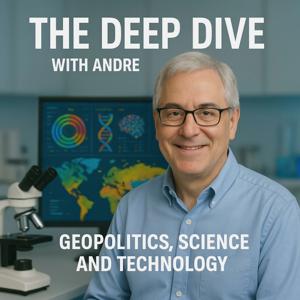

The provided text offers a comprehensive overview of mass spectrometry (MS), detailing its fundamental principles and the mechanisms of various components. It explains how samples are ionized—either "hard," causing fragmentation, or "soft," preserving the molecule—and how mass analyzers separate ions based on their mass-to-charge ratio, with examples like quadrupoles, time-of-flight, and Orbitraps. The text then illustrates how detectors convert ion signals into a mass spectrum for data interpretation, including molecular and fragment ion peaks. Finally, it highlights the diverse and transformative applications of MS, ranging from proteomics and metabolomics to pharmaceutical development, clinical diagnostics, environmental monitoring, food safety, and forensic analysis.
Research done with the help of artificial intelligence, and presented by two AI-generated hosts.
 View all episodes
 By Andre Paquette


3.7
33 ratings
The provided text offers a comprehensive overview of mass spectrometry (MS), detailing its fundamental principles and the mechanisms of various components. It explains how samples are ionized—either "hard," causing fragmentation, or "soft," preserving the molecule—and how mass analyzers separate ions based on their mass-to-charge ratio, with examples like quadrupoles, time-of-flight, and Orbitraps. The text then illustrates how detectors convert ion signals into a mass spectrum for data interpretation, including molecular and fragment ion peaks. Finally, it highlights the diverse and transformative applications of MS, ranging from proteomics and metabolomics to pharmaceutical development, clinical diagnostics, environmental monitoring, food safety, and forensic analysis.
Research done with the help of artificial intelligence, and presented by two AI-generated hosts.
14,395 Listeners

5,537 Listeners
12,232 Listeners
4,187 Listeners
1,625 Listeners

22 Listeners

16,321 Listeners