
Sign up to save your podcasts
Or



This is the lightly edited audio from a recent livestream episode we hosted with Nora Barrows-Friedman.
Nora Barrows-Friedman is a staff writer and associate editor at The Electronic Intifada, and is the author of In Our Power: US Students Organize for Justice in Palestine (Just World Books, 2014). She hosts the Electronic Intifada (EI) Livestreams that we all watch on Thursdays at noon eastern time.
In this discussion, we talk about some of Nora's background as a journalist, her work covering student organizing around Palestine, and her recent piece, "Israel abducted starving children at Gaza "aid" sites, then tortured them."
Nora also shares some of EI's journalistic methodology covering a war that is so highly propagandized. We also get into some of the differences between "Israeli" media and US corporate media in terms of how they cover the acts of the Israeli military and government and the genocide and war crimes that have taken place in Palestine. And we talk about how merely comparing reporting from the two contexts tears their atrocity propaganda narratives to shreds.
As many public officials, media personalities, and governments, who have facilitated and supported the genocide in Gaza shift their tone in recent days, we talk about what we think about this phenomenon. And we discuss concepts of accountability and justice as they relate to this horrific phase in human history.
If you appreciate the work that we do, until August 29th we are offering 30% off the first month of a monthly subscription or 30% off the first year if you sign up for a yearly subscription at patreon.com/millennialsarekillingcapitalism. This discount is available for all tiers starting with $5 a month, use discount code: 06E4A.
We hear from families in Gaza that prices have gone down a bit as some food has reached the markets in the last couple of days. There is a new tool called Lifeline4Gaza.com that some mutual aid organizers have put together that I wanted to share with folks as well. It allows people to find peer-to-peer authenticated campaigns from Gaza that have not received necessary support. At the top of the page will be campaigns who have received the least over the last 5 days. In a time where many families are in desperate need and where there is food available or purchase, a few dollars - and you sharing these campaigns - can make a critical difference for families in need.
We hosted an emergency livestream with Hala Sabbah of the Sameer Project back on July 21st to talk about the absolutely horrific situation in Gaza as a result of the US-funded and supported Israeli enacted genocide. Since conditions have not changed substantially, I wanted to also make sure to get a lightly edited version of that conversation out to our audio podcast feed. Just a reminder that due to our own limitations these days most of our work is on our YouTube page, where we host multiple conversations per week.
This is our third conversation with Hala Sabbah from the Sameer Project since its founding during this genocide. We have a playlist with all three.
You can support the Sameer Project via their linktree which we will include in the show description as well
Another conversation we held this week that I will link in the show description is our interview of Nora Barrows-Friedman of the Electronic Intifada, which we just hosted on Monday.
Please continue to do what you can, wherever you can, to support people in Gaza and to put political pressure on all of those complicit in this genocide to make their position untenable.
Tomorrow, Thursday August 7th at 10 AM EDT we will host a livestream with socialist and Pro-Palestine barrister Franck Magennis. We encourage people to tune into that conversation as well. And on Monday August 11th we'll have a livestream with Abdaljawad Omar once again.
For the month of August if folks contribute at the $5 per month level or hiring we're offering a 30% discount to new patrons for their first month, or if you do a yearly subscription you can get 30% off the entire year. You can do that at patreon.com/millennialsarekillingcapitalism or if you prefer to make a one-time contribution you can do so via our buymeacofee page: https://buymeacoffee.com/makcapitalism
In this conversation we're exited to welcome Alana Lentin back to the show to talk about her new book The New Racial Regime: Recalibrations of White Supremacy, which works with the concept of the racial regime put forth by Cedric Robinson in his book Forgeries of Memory and Meaning. The book features a foreword by Elizabeth Robinson, long time interlocutor, partner in critical media work, and life partner of Cedric Robinson.
We talk about this project which starts with an analysis of the war on so-called Critical Race Theory, and the attendant fascistic agenda, the "whitelash" against Black Studies, and gets deep into zionist counterinsurgency efforts throughout academia, as well as the so-called "war on antisemitism," and how we make sense of "the processes through which racial colonial rule is ideologically resecured."
It's a really interesting read and I definitely recommend people pick it up.
Alana Lentin is a teacher and writer, and identifies as a Jewish European woman who is a settler on Gadigal-Wangal land (Sydney, Australia). Her work focuses on a critical theorization of race, racism and antiracism.
She is a Professor of Cultural and Social Analysis at Western Sydney University. She is the author and editor of multiple books, including Why Race Still Matters and Racism and Anti-Racism in Europe.
More about Dr. Lentin and her work can be found at her website.
This also is the first episode that Josh and Jared have recorded together since October of 2023, and it was great to collaborate again on an episode!
We hosted with the Sameer Project last week. With the forced starvation of Palestinians in Gaza, it is absolutely critical that we ways to continue getting support their way. We we'll put a link to donate to the Sameer Project and to that conversation in the show description.
And of course if you appreciate the work that we do on audio podcasts like this, and through our video feed on Youtube, the best way to support our work is to become a patron show for as little as $1 a month, or support us through our BuyMeACoffee page.
Our music as always is courtesy of Televangel
Correction: in the interview Jared said it was the "National Federation of Teachers" which is not accurate (or a thing). It was the National Educators Association, however that vote from the a majority of the 7,000 delegates of the largest US teacher's union was rejected by the union's board. Read more here.
Now here is our conversation with Alana Lentin on The New Racial Regime
The title of the episode is a reference to this tweet.
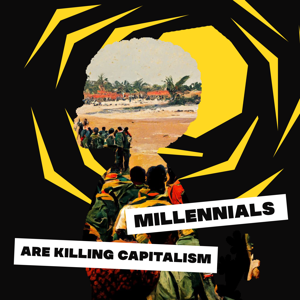
Source of the image in the thumbnail.
Some References:
Dylan Rodríguez on Lexical Warfare & Counterinsurgency
"Stop Asian Hate" as Zionist Policing with Dylan Rodríguez
"Rosa Luxemburg and the Primitive Accumulation of Whiteness" by Siddhant Issar, Rachel H. Brown, and John McMahon
The War on Anti-Semitism with Anna-Esther Younes
Institute for the Critical Study of Zionism
Anti-Zionism, Anti-Semitism, Decolonization & Islamophobia with Alana Lentin (MAKC episode)
Prior audio episodes with Alana Lentin
This is part two of a two-part episode. This part of the conversation deals more with the actions that led to Mann's political imprisoment and his experiences as a political prisoner.
In this two-part episode, we are joined by special cohost PM, and we speak with veteran civil rights organizer Eric Mann about his journey from his upbringing in New York to his involvement in political struggles during the 1960s. Mann discusses his early influences, including his parents' activism. He reflects on his work with the Congress of Racial Equality (CORE) and the Student Nonviolent Coordinating Committee (SNCC), highlighting key campaigns such as the Trailways boycott and the 1968 Columbia University student strike.
Mann also recounts his time as a political prisoner, offering insights into the carceral system and the impact of incarceration on his life and activism. He emphasizes the importance of building a black-led united front against imperialism and shares his ongoing work with the Labor Community Strategy Center in Los Angeles. Mann's narrative highlights the importance of organizing, strategic alliances, and the ongoing liberation struggle. Eric Mann is the co-director of the Labor/Community Strategy Center in South Central Los Angeles. He is the author of Comrade George: An Investigation into the Life, Political Thought, and Assassination of George Jackson, Playbook for Progressives: The 16 Qualities of the Successful Organizer, and the forthcoming We Made the Revolution with Our Bodies on the Line. PM Irvin is a PhD candidate researching the political thought of W.E.B. Du Bois and 20th-century Black radicalism This episode was edited and produced by Aidan Elias. Music, as always, by Televangel. If you like what we do and want to support our ability to have more conversations like this. Please consider becoming a Patron. You can do so for as little as a 1 Dollar a month. We bring you these conversations totally independently with no corporate, state, or grant funding.In this two-part episode, we are joined by special cohost PM, and we speak with veteran civil rights organizer Eric Mann about his journey from his upbringing in New York to his involvement in political struggles during the 1960s. Mann discusses his early influences, including his parents' activism. He reflects on his work with the Congress of Racial Equality (CORE) and the Student Nonviolent Coordinating Committee (SNCC), highlighting key campaigns such as the Trailways boycott and the 1968 Columbia University student strike.
Mann also recounts his time as a political prisoner, offering insights into the carceral system and the impact of incarceration on his life and activism. He emphasizes the importance of building a black-led united front against imperialism and shares his ongoing work with the Labor Community Strategy Center in Los Angeles. Mann's narrative highlights the importance of organizing, strategic alliances, and the ongoing liberation struggle. Eric Mann is the co-director of the Labor/Community Strategy Center in South Central Los Angeles. He is the author of Comrade George: An Investigation into the Life, Political Thought, and Assassination of George Jackson, Playbook for Progressives: The 16 Qualities of the Successful Organizer, and the forthcoming We Made the Revolution with Our Bodies on the Line. PM Irvin is a PhD candidate researching the political thought of W.E.B. Du Bois and 20th-century Black radicalism This episode was edited and produced by Aidan Elias. Music, as always, by Televangel. If you like what we do and want to support our ability to have more conversations like this. Please consider becoming a Patron. You can do so for as little as a 1 Dollar a month. We bring you these conversations totally independently with no corporate, state, or grant funding.In this conversation we talk with Garrett Felber about their latest book A Continuous Struggle: The Revolutionary Life of Martin Sostre.
In discussing this new political biography, we cover Sostre's ideological and political journey, history as a jailhouse lawyer, his forms of organizing practice, and the ways that people supported his campaign for freedom from political imprisonment. We talk about the influence of Great Depression era Harlem, Black and Puerto Rican Nationalism, Marxism-Leninism, national liberation movements, armed struggle, Women's Liberation, and Anarchism on Sostre's political thought and practice. Although much of what we know about Martin Sostre has to do with political letters and writings during the time of his incarceration, Felber also shares insights that few know about Sostre's life, community organizing, and institution building on the outside.
Garrett Felber is an educator, writer, and organizer. They are the author of Those Who Know Don't Say: The Nation of Islam, the Black Freedom Movement, and the Carceral State, and coauthor of The Portable Malcolm X Reader, with Manning Marable. Felber is a cofounder of the abolitionist collective Study and Struggle and is currently building a radical mobile library, the Free Society People's Library, in Portland, Oregon.
Yesterday we hosted Garrett Felber along with Russell Shoatz III on a livestream where we talked about some of the resonances between Martin Sostre's life, political thought, and approaches to political prisoner defense work and that of Russell "Maroon" Shoatz and we also discussed CURBfest which is expanding to the West Coast for the first time this year.
Tomorrow Thursday the 29th we will host a livestream on Sundiata Jawanza's Freedom Campaign including a quickly approaching parole hearing. We encourage all of you to go to the website and send letters of support for his release. The website says that letters were due on May 19th, but there is still just a little time if you can get a letter in the mail today or at least submit one electronically or contribute to the legal support fund that would be great.
There are a number of other initiatives we want to share related to this episode, the campaign to free the Mississippi 5 which Garrett Felber mentions in this episode and the exoneration effort for Martin Sostre and his codefendant who is still with Geraldine (Robinson) Pointer. Links for that are in the show description.
If you like the work that we do, please contribute to our patreon or BuyMeACoffee accounts. These episodes each take hours of preparation, recording time, and production time and listeners like you are the only means of support for that work. Over the last month we've seen a 10% decline in recurring support. We know people are under financial strain right now, but if more of you who listen are able to contribute even a dollar a month it helps make this show possible and sustainable. Thank you for your support!
Links:
Martin Sostre and Geraldine (Robinson) Pointer's names should have been cleared after they were framed. By signing and adding your name, you're supporting our effort to make what's been delayed for far too long a reality for these two transformational former political prisoners (Petition / for more information)
Sundiata Jawanza (livestream, legal support fund, website, Jericho Movement page)
Free the Mississippi 5
Garrett Felber along with Russell Shoatz III on a (MAKC) livestream
Those Who Know Don't Say: The Nation of Islam, the Black Freedom Movement, and the Carceral State (MAKC episode)
A Continuous Struggle: The Revolutionary Life of Martin Sostre (version for people outside the walls/ incarcerated readers edition)
Martin Sostre - Letters From Prison
Orisanmi Burton episode on the Rx Program
This is the conclusion of our two part conversation with Tariq Khan on his book The Republic Shall Be Kept Clean: How Settler Colonial Violence Shaped Antileft Repression.
In part one of the conversation we laid out many of the general dynamics between anti-indigenous settler colonial violence in the 19th Century and the development of the earliest iterations of anticommunism in the so-called United States, long before McCarthyism or even what's recognized by historians as the first Red Scare. In this conversation we talk about some of the legal precedents that the Trump administration has dusted off for some of his attempts to remove or exclude people for political views.
Because we recorded this conversation in December before Trump took office for his second term, we did not directly address several of his actions that draw from this history. The renaming of Denali as Mt. McKinley, drawing directly on laws used to deport anarchists to go after immigrants for their political views, and continuing the genocidal legacy of this settler colonial empire in fueling the genocide in Gaza. In addition to McKinley who was assassinated by an anarchist motivated in part by the US's war in the Philippines, we talk about contrasting figures like Teddy Roosevelt, John Hay, and Albert and Lucy Parsons and the influence that the later half of the 19th century, and 1877 in particular, had on their political trajectories. In addition we talk about the history of lynching and sexual violence and the relationship this practice had to disciplining anarchists alongside its roles for white society and as a repression mechanism against solidarity across racial lines.
Dr. Tariq Khan is a historian with an interdisciplinary approach to understanding the intertwined forces underlying and shaping our social, political, economic, and cultural institutions. He has wide-ranging research, writing, and teaching experience in the fields of global capitalism, transnational studies, U.S. history, psychology, sociology, ethnicity & race studies, gender studies, colonialism & postcolonialism, labor & working-class history, radical social movements, history "from below," public history, and community-based research and teaching.
A few things to shout-out. Recently I had the pleasure of joining the good people of Tankie Group Therapy on the East is a Podcast. I also recently joined Nick Estes from the Red Nation Podcast for a discussion of J. Sakai's book Settlers and went on Saturdays with Renee with Renee Johnston and Jared Ball. Recent episodes on our YouTube channel include Freedom Archives, Abdaljawad Omar, Momodou Taal, Steven Salaita, and a couple of discussions on Pakistan, India, and Kashmir. Make sure you're subscribed to our YouTube channel so you can catch all of that work as well.
If you like the work that we do, please support our show via patreon you can do so for as little as $1 a month and now you can also make a one-time contribution through BuyMeACoffee. Your support is what makes this show possible.
In this episode, we speak with Edward Ongweso Jr about "artificial intelligence" and its implications, particularly concerning corporate interests and historical parallels with labor control. Edward critiques the term "artificial intelligence" for obscuring the underlying digital technologies and algorithmic systems that serve corporate agendas, emphasizing the narrow view of intelligence that excludes human cognitive elements. The conversation delves into the historical roots of computation, drawing parallels between modern AI and 19th-century plantation management techniques aimed at maximizing productivity and control.
We also explore the exploitation of global south workers in AI development, likening it to racialized regimes of chattel slavery. Furthermore, Ongweso critiques the concept of surveillance capitalism, arguing that surveillance has been integral to capitalism since its origins, particularly post-World War II, through marketing revolutions, the military-industrial complex, and financialization. The discussion concludes with an analysis of techno-authoritarianism, highlighting Silicon Valley's historical hostility to democracy and its prioritization of technologies that advance surveillance and social control. Edward is a writer and editor based in Brooklyn, NY. Most of his work centers around tech criticism, labor and financial reporting, and book reviews. He is also the co-host of This Machine Kills, a podcast started in 2020 to discuss the political economy of technology. Support us via Patreon or BuyMeACoffee Relevant Links: Surveillance capitalism vs techno-feudalism vs techno-authoritarianism A Materialist Approach to the Tech Industry: From Household to Military Tech with Dwayne Monroe
In this episode, we speak with Dr. Charles H.F. Davis III about the increasingly repressive conditions on university campuses, particularly in the context of Columbia University's caving in to federal pressures under the thumb of Trump's administration. We explore the broader implications of these concessions at the expense of liberalized notions of intellectual and academic freedom, student activism, and the role of universities as sites of political struggle. Dr. Davis highlights the historical and ongoing repression of student activism, particularly pro-Palestinian movements, and critiques the legal and institutional frameworks that perpetuate these violences. We also delve into the limitations of liberalism in fending off fascist infringement and the active participation of universities in maintaining these structures of domination. We also touch on the historical collaboration between Zionist organizations and U.S. universities, the erosion of diversity and inclusion initiatives, and the broader implications for the future of higher education. Dr. Charles H.F. Davis III is a third-generation educator, organizer, and artist. He is a faculty member in the Center for the Study of Higher and Postsecondary Education and director of the Campus Abolition Research Lab at the University of Michigan. His research and teaching broadly explore the racialized consequences of higher education on society, including the role of colleges and universities in limiting the life-making possibilities of Black and other racialized communities.
Edited/produced by Aidan Elias, music as always is by Televangel
If you like what we do and want to support our ability to have more conversations like this. Please consider becoming a Patron or supporting us at BuyMeACoffee.com/MAKCapitalism. You can do so for as little as a 1 Dollar a month at patreon or by making a one time contribution through BuyMeACoffee.
Longer bio:
Dr. Charles H.F. Davis III is a third-generation educator, organizer, and artist committed to the lives, love, and liberation of everyday Black people. Dr. Davis is a faculty member in the Center for the Study of Higher and Postsecondary Education and director of the Campus Abolition Research Lab at the University of Michigan. His research and teaching broadly explore the racialized consequences of higher education on society, including the role of colleges and universities in limiting the life-making possibilities of Black and other racially minoritized communities. Dr. Davis has produced nearly three dozen scholarly publications, which have been cited in amicus curiae brief to the Supreme Court of the United States and included as expert testimony before the California State Assembly. He is co-editor of Student Activism, Politics, and Campus Climates in Higher Education (Routledge) and author of the forthcoming Campus Abolition and Police-Free Futures on Johns Hopkins University Press. For his intellectual contributions, Dr. Davis been nationally-recognized by the National Association of Student Personnel Administrators, as a 2020 Emerging Scholar by Diverse: Issues in Higher Education, a recipient of the National Academy of Education/Spencer Postdoctoral Fellowship, a 2024 Inductee to the Martin Luther King, Jr. College of Ministers and Laity's Collegium of Scholars at Morehouse College and, most recently, was named a Senior Fellow at the Center on the Developing Child at Harvard University. At the institutional level, Dr. Davis' teaching and service have been recognized as the 2023 recipient of the John Matlock Cornerstone Award for his contributions to the success of African American students at the University of Michigan and the 2024 Diversity, Inclusion, Justice, and Equity Award at the U-M Marsal Family School of Education.
In this episode we interview Tariq Khan on his book The Republic Shall Be Kept Clean: How Settler Colonial Violence Shaped Antileft Repression.
We'll be releasing this conversation as a two part episode on this excellent book which studies how anticommunism within the US is deeply intertwined with settler colonialism, anti-indigenous thought, and genocidal violence. This helps us to reframe our often twentieth century centric view of anti-left repression in the US. Khan's work on the 19th century in particular also helps us to see the ways things like race science, eugenics, and phrenology were formed a backbone of the original assumptions of US policing, anti-anarchist repression, lynching, and regimes of deportation. Alongside and related to settler colonial violence against indigenous people, and anti-Black violence, we also through this conversation really get into how central the repression of anarchists in the 19th century was to the development of logics and technologies of anti-left repression in the so-called United States.
It is also important to see the resonance between US genocidal violence and state repression and that of the so-called State of Israel on Palestinians, something we explore a little bit more in part two of this discussion along with delving into William McKinley, Teddy Roosevelt and more.
This conversation was recorded this past December so we don't reference a lot of what has happened in the last couple of months, but pairing this conversation with a discussion we hosted on our YouTube channel a week ago with Dr. Charisse Burden-Stelly (CBS) helps us to see how many things we are constantly told represent the crossing of new red lines, or the onset of a fascism that is foreign to the US, are actually foundational pillars of US statecraft, warfare and policing with very long histories.
On the subject of our YouTube channel, we have once again been very busy over there, releasing eight episodes over the last two weeks. We are only 13 subscribers away from 10,000 on our YouTube page, so now is a great time to sign up for free if you haven't, and help us to hit that milestone. And you can catch up on all the conversations we've had over there recently and over the past year and a half if you've been following us there.
We also set-up a "Buy Me A Coffee" account which allows people to offer us one time support if they prefer doing that instead of the recurring contributions of patreon. You can support us in either place, and that is the only financial support we receive for these audio episodes, so we really appreciate whatever you can give to keep these conversations coming.
Music by Televangel
Guest bio:
Dr. Tariq Khan is a historian with an interdisciplinary approach to understanding the intertwined forces underlying and shaping our social, political, economic, and cultural institutions. He has wide-ranging research, writing, and teaching experience in the fields of global capitalism, transnational studies, U.S. history, psychology, sociology, ethnicity & race studies, gender studies, colonialism & postcolonialism, labor & working-class history, radical social movements, history "from below," public history, and community-based research and teaching. A few examples of his published works are his chapter "Living Social Dynamite: Early Twentieth-Century IWW-South Asia Connections," in the book Wobblies of the World: A Global History of the IWW, his chapter "Frantz Fanon," in the forthcoming anthology Fifty Key Scholars in Black Social Thought, and his new book The Republic Shall Be Kept Clean: How Settler Colonial Violence Shaped Antileft Repression
From the publisher's feed

1,861 Listeners

1,460 Listeners

1,585 Listeners

336 Listeners
3,320 Listeners

3,912 Listeners
934 Listeners

321 Listeners

546 Listeners
1,125 Listeners
1,012 Listeners
251 Listeners
605 Listeners
555 Listeners

487 Listeners