
Sign up to save your podcasts
Or



Ask Mai & Send Feedback
In this episode, Mai and Lee explore why so many business owners feel overwhelmed as their business grows, even when everything appears successful on the outside. The issue isn’t always structure, staffing, or systems. It’s how time is being managed day‑to‑day.
Mai shares her own experience of reaching a point where growth no longer felt exciting, but instead felt heavy, reactive, and difficult to sustain. To address this, Mai introduces us to the DRIP framework: Delegate, Replace, Invest, and Produce. It’s a practical approach to help business owners regain control of their time, reduce bottlenecks, and build a business that can scale without relying entirely on them.
Using real examples from her own business, Mai explains how small shifts, like auditing where your time goes, removing low‑value tasks, and structuring your calendar intentionally, can significantly increase capacity, productivity, and profitability.
In this episode, Mai talks about:
This episode is a reminder that scaling a business isn’t about doing more, it’s about doing the right work at the right level. When you take control of your calendar, you create the capacity to lead, think strategically, and grow your business in a sustainable way.
If you’d like a copy of Mai’s Replacement Ladder template, DM the word Ladder on Instagram at @the_maiharris.
You can also submit questions or topic ideas via the Ask Mai link at the top of the show notes.
Learn more about My Accounting Advantage
Disclaimer
The advice contained in this presentation is general in nature only and should not be acted on without first seeking professional advice.
Your personal circumstances have not been taken into account, and you should consider the appropriateness of the advice to your individual needs.
Ask Mai & Send Feedback
As the end of the financial year approaches, superannuation remains one of the most powerful, and most commonly missed, tax planning strategies available.
In this episode of the My Accounting Advantage podcast, Mai explains how the right superannuation strategies, implemented before 30 June, can materially reduce tax while supporting long‑term wealth creation.
She breaks down the difference between concessional and non‑concessional contributions, how salary sacrifice and top‑ups can be used strategically, and why tax savings should be viewed as a return on investment rather than a compliance outcome.
Mai also discusses when a self‑managed super fund may be appropriate, the responsibility and compliance involved, and why control over investment choices is often a key driver for business owners and investors.
A key focus of the episode is the importance of tax planning before year‑end, including reviewing projected taxable income and identifying unused concessional contribution caps from prior years, a strategy that can unlock significant tax savings when cash flow allows.
In this episode, Mai covers:
Decisions made at EOFY without proper advice can’t always be undone. Taking the time to assess your position, understand your available strategies, and plan ahead can make a lasting difference, not only to your tax bill, but to your long‑term financial outcomes.
Mai has created an information pack to help understand super contributions and EOFY strategies. To get your copy:
Learn more about My Accounting Advantage
Disclaimer
The advice contained in this presentation is general in nature only and should not be acted on without first seeking professional advice.
Your personal circumstances have not been taken into account, and you should consider the appropriateness of the advice to your individual needs.
Ask Mai & Send Feedback
What happens when a long-term business owner walks in feeling exhausted, overwhelmed, and ready to shut everything down?
In this episode of the My Accounting Advantage podcast, Mai Harris takes us behind the scenes of a powerful real‑life case study that highlights the impact of seeking the right advice at the right time. What began as a conversation about exiting a business became an opportunity to reduce tax, protect wealth, and rebuild confidence, saving a client $17,500 in tax in just 90 minutes, and restoring much‑needed clarity and calm.
In one focused meeting, a business owner considering an exit discovered that with the right sequencing and thoughtful planning, she could exit calmly, protect what she had worked decades to build, and make decisions that supported her long‑term financial goals, rather than reacting under pressure.
Mai walks through how the business exit was carefully structured, how costly mistakes were avoided, and how strategic use of small business CGT concessions and superannuation contributions transformed what felt like a failure into a well‑planned, tax‑effective transition.
In this episode, Mai covers:
Before making any big financial moves, business or otherwise, pause and speak to an advisor who understands your bigger picture and how it will work together. What feels urgent today may look very different with the right strategy in place.
Mai has created a practical checklist to help you make informed decisions before acting. To get your copy:
Learn more about My Accounting Advantage
Disclaimer
The advice contained in this presentation is general in nature only and should not be acted on without first seeking professional advice.
Your personal circumstances have not been taken into account, and you should consider the appropriateness of the advice to your individual needs.
Ask Mai & Send Feedback
In this episode, Mai and Lee explore why so many investment mistakes aren’t caused by bad opportunities, but by doing things in the wrong order. From property purchases to business decisions, excitement often takes over before the right groundwork is done.
Mai introduces her SRS decision‑making framework: Structure, Risk, and Sequencing. It is a practical way to slow down, remove emotion, and make investment decisions that actually support long‑term goals. The discussion highlights how people often commit to major investments before understanding ownership structures, cash‑flow impact, or long‑term consequences.
Using real‑world examples, including property purchases, family trusts, SMSFs, land tax traps, and stamp duty mistakes, this episode shows why pausing and planning first can save significant stress, money, and regret later on.
In this episode, Mai talks about:
This episode is a reminder to slow down, ask better questions, and make decisions in the right order. With the right framework, investment decisions become clearer, calmer, and far more effective.
If you’d like a copy of Mai’s SRS framework, DM the word SRS on Instagram at @the_maiharris.
You can also submit questions or topic ideas via the Ask Mai linked at the top of the show notes.
Learn more about My Accounting Advantage
Disclaimer
The advice contained in this presentation is general in nature only and should not be acted on without first seeking professional advice.
Your personal circumstances have not been taken into account, and you should consider the appropriateness of the advice to your individual needs.
Ask Mai & Send Feedback
In this episode, Lee and Mai unpack a big mindset shift for business owners and individuals alike: why paying down your home loan isn’t always the best return on investment (ROI).
They explore how ROI applies to everyday financial decisions — from mortgages and offset accounts to superannuation and long‑term wealth strategies — and challenge the common belief that throwing every spare dollar at your home loan is always the smartest move.
The conversation also dives into self‑managed super funds (SMSFs), family pooling strategies, and how super can be used not just for retirement — but as a powerful wealth‑building and debt‑elimination tool.
In this episode, Mai talks about:
If you’ve ever wondered whether you’re parking your money in the right place, this episode will change the way you think about cash, tax, and long‑term planning.
Learn more about My Accounting Advantage
Disclaimer
The advice contained in this presentation is general in nature only and should not be acted on without first seeking professional advice.
Your personal circumstances have not been taken into account, and you should consider the appropriateness of the advice to your individual needs.
Ask Mai & Send Feedback
In this episode Lee and Mai take a deep dive into tax planning, business structures, and the smart (and legal) ways business owners can reduce tax, improve cash flow, and build long‑term wealth.
Following the strong response to last week’s Payday Super episode, this conversation tackles one of the most common questions business owners ask: “Am I paying too much tax?”
The answer, as Mai explains, is often yes — but not because the system is broken. It’s usually because the structure or strategy isn’t right.
In this episode, Mai talks about:
You can't know what you don't know. This could be the conversation that changes everything.
Learn more about My Accounting Advantage
Disclaimer
The advice contained in this presentation is general in nature only and should not be acted on without first seeking professional advice.
Your personal circumstances have not been taken into account, and you should consider the appropriateness of the advice to your individual needs.
Ask Mai & Send Feedback
We're back this week with a hugely important topic.
Payday Super is one of the biggest changes to hit Australian employers in years — and many businesses aren’t ready for the cash flow impact.
In this episode, Lee and Mai unpack what Payday Super actually means, why it’s a major shift from the current system, and how it could seriously affect small business cash flow if you’re not prepared.
From 1 July 2026, employers will be required to pay superannuation at the same time as wages, rather than quarterly. While the super rate itself isn’t changing, the timing is — and that timing could catch businesses off guard.
In this episode, Mai talks about:
This episode is a must-listen for any business owner who employs staff (or pays themselves wages).
Download our helpful checklist here: https://myaccountingadvantage.com.au/documents/MAA-Pay-Day-Super-2026-Checklist.pdf
Learn more about My Accounting Advantage
Disclaimer
The advice contained in this presentation is general in nature only and should not be acted on without first seeking professional advice.
Your personal circumstances have not been taken into account, and you should consider the appropriateness of the advice to your individual needs.
Ask Mai & Send Feedback
Welcome back to the My Accounting Advantage podcast.
In this episode, Mai tackles one of the biggest and most common questions Australians ask when it comes to building wealth: is buying an investment property really for everyone?
Property is often seen as the ultimate milestone — something you’re “meant” to do. But as Mai explains, it’s not always that simple. Whether you’re a PAYG employee, a couple with an existing mortgage, or a business owner, the right answer depends on your income, cash flow, risk appetite, and long‑term goals.
Mai breaks down why Australians are so drawn to property, the realities of negative gearing, and the often‑overlooked costs that can catch investors off guard. She also explains why modelling and professional advice should always come before buying — not after.
The conversation also explores alternative strategies, including investing through a self‑managed super fund, and when that approach may (or may not) make sense.
This episode is a practical, honest discussion designed to help you slow down, ask better questions, and make informed decisions, rather than following the crowd.
In this episode, Mai talks about:
Stay tuned for more weekly episodes where Mai shares practical insights, real conversations, and clear guidance to help you build long‑term wealth with confidence — not just get through tax time.
Learn more about My Accounting Advantage
Disclaimer
The advice contained in this presentation is general in nature only and should not be acted on without first seeking professional advice.
Your personal circumstances have not been taken into account, and you should consider the appropriateness of the advice to your individual needs.
Ask Mai & Send Feedback
Welcome to the very first episode of the My Accounting Advantage podcast.
This episode is all about getting to know the person behind the mic, Mai Harris.
Mai shares with us her journey, how she ended up Director and Principal Accountant of My Accounting Advantage, and why she’s so passionate about helping people do more with their money than just survive tax time.
You’ll hear about Mai’s approach to accounting, why she believes proactive advice makes such a difference, and what really matters to her when working with clients. This down‑to‑earth introduction sets the tone for the conversations to come – practical, honest, and focused on building long‑term wealth, not just ticking boxes.
In this episode, Mai talks about:
Stay tuned for weekly episodes where Mai shares practical insights and real conversations designed to expand your knowledge and help you build long‑term wealth with confidence.
Learn more about My Accounting Advantage
Disclaimer
The advice contained in this presentation is general in nature only and should not be acted on without first seeking professional advice.
Your personal circumstances have not been taken into account, and you should consider the appropriateness of the advice to your individual needs.
From the publisher's feed
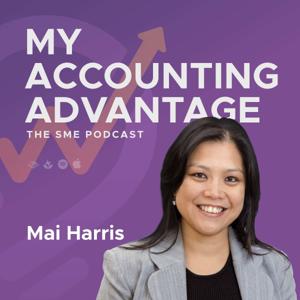
My Accounting Advantage is a practical, no‑fluff podcast for business owners, professionals, and property investors who want to make smarter financial decisions with confidence.
Hosted…
IG: www.instagram.com/the_maiharris/
Facebook: www.facebook.com/profile.php?id=61587008353108
Linkedin: www.linkedin.com/in/mai-harris-4a4698375/
Web: www.myaccountingadvantage.com.au/