
Sign up to save your podcasts
Or



Can a computer game really recreate the experience of the First World War?
In this episode, we look at Gallipoli, the latest First World War game from BlackMill Games, taking players to the Gallipoli peninsula and Mesopotamia. As it happens Chris, is the game's historical advisor. We discuss how history is translated into a computer game, what can be simulated, and where historical accuracy meets the demands of gameplay.
References: BlackMill Games (2026) Gallipoli: The Ottoman Front. Weir, P. (dir.) (1981) Gallipoli. Infinity Ward (2003) Call of Duty. Computer game. Activision. DICE (2016) Battlefield 1. Electronic Arts. Mendes, S. (2019) 1917. Kempshall, C. (2026) Star Wars Star Pilots: A History of Space Combat. DK.
What happens when a futuristic soldier finds himself in the trenches of the First World War?
Rogue Trooper first appeared in 2000 AD in 1981, a genetically engineered soldier fighting an apparently endless war on the poisoned planet of Nu Earth. In Blighty Valley, written by Garth Ennis and drawn by Patrick Goddard, Rogue is transported back to March 1918, where he finds himself alongside a British platoon caught up in the German Spring Offensive. Drawing on the traditions of British war comics, including Charley's War, the story explores comradeship, class, conscientious objection and the experience of ordinary soldiers.
References: Doctor Who: Twice Upon a Time (2017) Directed by Rachel Talalay. Written by Steven Moffat. [Television program]. Sherriff, R.C. (1928) Journey's End. Joyeux Noël (2005) Directed by Christian Carion. [Film]. Ennis, G. (2024) Rogue Trooper: Blighty Valley. Illustrated by P. Goddard. Oxford: 2000 AD.
Can a conscientious objector be a hero?
Branded is widely regarded as one of the finest episodes of Dad's Army, combining comedy with a thoughtful exploration of courage, duty, and prejudice.
When Captain Mainwaring discovers that the gentle Private Godfrey was a conscientious objector during the First World War, the platoon quickly brands him a coward. But the truth is far more complicated.
In this episode, Angus, Jessica and Chris discuss how accurately Branded portrays conscientious objection, what it reveals about attitudes to the First World War, and why this remarkable episode remains one of Dad's Army's most powerful, while never losing the humour that makes it such a classic.
References Perry, J. and Croft, D. (1969) Branded. Dad's Army. Series 3, Episode 11. Directed by Harold Snoad. BBC1, 20 November. Curtis, R. and Elton, B. (1983–1989) Blackadder. Television series. BBC. McKibbin, R. (1998) Classes and Cultures: England 1918–1951. Oxford: Oxford University Press. Philpott, W. (2009) Bloody Victory: The Sacrifice on the Somme and the Making of the Twentieth Century. London: Little, Brown. Hammett, J. (2022) Creating the People's War: Civil Defence Communities in Second World War Britain. Manchester: Manchester University Press.
Can a crime novel help us understand the long shadow cast by the First World War?
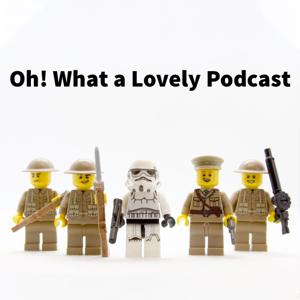
In this episode of Oh! What a Lovely Podcast, we explore Christina Koning's acclaimed Blind Detective series. The novels follow Frederick Rowlands, a veteran who lost his sight at Ypres and must navigate the challenges of postwar Britain using his memory, hearing, and sharp intuition.
Set against the backdrop of the 1920s and 1930s, the series combines engaging mystery stories with a rich portrayal of a nation living with the social, cultural, and personal consequences of the Great War.
Jessica, Chris, and Angus are joined by Christina Koning to discuss the inspiration behind Frederick Rowlands, the realities of blindness in the interwar years, and perhaps how crime fiction can illuminate the lasting legacy of the First World War.
References:Koning, C. (2023) Blind Detective. London: Allison & Busby. Faulks, S. (1993) Birdsong. London: Hutchinson. Barker, P. (1991) Regeneration. London: Viking. Barker, P. (1993) The Eye in the Door. London: Viking. Barker, P. (1995) The Ghost Road. London: Viking. Light, A. (1991) Forever England: Femininity, Literature and Conservatism between the Wars. London: Routledge. Chesterton, G. K. (1911) The Innocence of Father Brown. London: Cassell. Sayers, D. L. (1923) Whose Body?. London: T. Fisher Unwin. Winspear, J. (2004) Maisie Dobbs. London: John Murray.
What happens when a classic Agatha Christie story is reimagined with the memory of war lingering behind it?
In the latest episode of Oh! What a Lovely Podcast, Jessica, Chris and Angus are joined by Kemper Donovan, author and host of All About Agatha, to discuss Agatha Christie's The Seven Dials Mystery and its recent Netflix adaptation.
Unlike the familiar worlds of Poirot and Miss Marple, The Seven Dials Mystery blends mystery, comedy and espionage into a lighter and more adventurous story. The new adaptation embraces that spirit while reworking elements of the narrative for modern audiences, including giving the First World War a much greater role than it plays in the original novel.
References: Christie, A. (1929) The Seven Dials Mystery. London: William Collins Sons & Co. Chibnall, C. (2026) Agatha Christie's Seven Dials. Netflix. Wharmby, T. (dir.) (1981) The Seven Dials Mystery. London Weekend Television (ITV). Cannadine, D. (1990) The Decline and Fall of the British Aristocracy. New Haven: Yale University Press.
Was patriotism in the First World War really shared by all, or was it shaped and enforced from above?
In the latest episode of Oh What a Lovely Podcast, we speak with Richard Batten about his book For King and Country, an examination of patriotism in Devon during the First World War.
Using Devon as a case study, Richard explores how local elites tried to encourage, direct, and sometimes police patriotic behaviour on the Home Front. From recruitment drives and conscription tribunals to charity work, farming, and fishing, the conversation looks at the many ways people were expected to serve the nation between 1914 and 1918.
References: Batten, R. (2025) For King and Country: The Role of Patriotism in Mobilisation in the First World War. Barnsley: Pen & Sword History. Catriona Pennell (2012) A Kingdom United: Popular Responses to the Outbreak of the First World War in Britain and Ireland. Oxford: Oxford University Press Gregory, A. (2008) The Last Great War: British Society and the First World War. Cambridge: Cambridge University Press. Silbey, D. (2005) The British Working Class and Enthusiasm for War, 1914–1916. London: Frank Cass.
What does the First World War look like when it arrives not as a battle, but as an invasion of home, family, and childhood?
In this episode of Oh! What a Lovely Podcast, we discuss My Soul, A Shining Tree, a novel by Jamila Gavin that explores the opening months of the First World War through the experiences of children, civilians, and young soldiers caught up in the German invasion of Belgium in 1914.
References: Jamilia Gavin, My Soul, A Shining Tree (2025) Christopher Clark, The Sleepwalkers: How Europe Went to War in 1914 (2013)
What does the First World War look like when the story is driven not by battles, but by loss, hope and unanswered questions?
In this episode of Oh! What a Lovely Podcast, we turn to A Very Long Engagement, Jean Pierre Jeunet's 2004 French film set during and after the First World War. The story centres on Mathilde, a young woman who refuses to accept that her fiancé has died after being condemned by a French military tribunal and sent into No Man's Land.
As Mathilde begins her own investigation, the film moves between the violence of the trenches and the fragile hopes of life on the home front. Through a complex and shifting narrative, A Very Long Engagement reveals how chance, cruelty and survival shaped the fate of a group of soldiers caught up in the war.
Links: A Very Long Engagement, Dir. Jean-Pierre Jeunet (2004) Amilie, Dir. Jean-Pierre Jeunet (2001) Alien Resurrection, Dir. Jean-Pierre Jeunet (1997) Un long dimanche de fiançailles, Sébastien Japrisot (1991) Paths of Glory, Dir. Stanley Kubrick (1957)
Can a film about the First World War work without trenches or battles?
In this episode of Oh What a Lovely Podcast, Angus, Jessica and Chris discuss the 2025 film The Choral, which uses song, performance and collective experience to explore the impact of the First World War on a northern English community. We talk about what the film gets right, where it challenges expectations, and how it fits into wider portrayals of the war on screen.
Can a story about soldiers shaking hands in the snow carry a warning for the nuclear age?
This episode of Oh What a Lovely Podcast brings Jessica, Chris and Angus together with Anne Marie Einhaus for a conversation about Robert Graves short story Christmas Truce. The story appears in the Penguin Book of First World War Stories and follows an elderly veteran who recalls the rare moments in 1914 and 1915 when soldiers on both sides met peacefully in the frozen landscape between the trenches.
Through these memories the veteran describes friendship that cuts through wartime propaganda, as well as the swift return of violence. Set against a discussion with his grandson in the early 1960s, the story contrasts youthful optimism in the anti nuclear movement with the weary caution of lived experience. It is a thoughtful look at the limits of goodwill and the forces that shape conflict.
References: Graves, R. (2007) 'Christmas Truce', in Einhaus, A-M. (ed.) The Penguin Book of First World War Stories. London: Penguin Classics Keynes, G. (1962) A Bibliography of Siegfried Sassoon. London: R. Hart-Davis. Levy, D. (dir.) (1995) Silent Night (Stille Nacht)
From the publisher's feed

877 Listeners

3,179 Listeners

1,233 Listeners

2,092 Listeners

1,418 Listeners
185 Listeners

15,587 Listeners
34 Listeners

337 Listeners

2,433 Listeners
136 Listeners
117 Listeners
42 Listeners

21 Listeners
99 Listeners