
Sign up to save your podcasts
Or

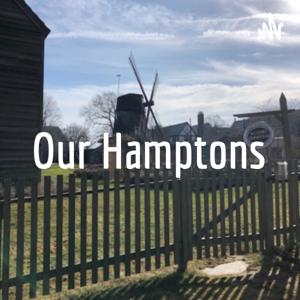


Esperanza and Irwin welcome the writer Tim Ferguson for a free wheeling dialogue on all things East End. Tim's resume includes being a columnist and op-ed editor at the Wall Street Journal and editor for Forbes Asia. Impressive as his body of work has been, it is his present day writing and blog posts specific to eastern Long Island that caught our attention. We've actually touched on some of Tim's articles in past episodes of Our Hamptons, including the 50 Year Anniversary of Bridgehampton Commons, and the Halt The Highway Movement of 1972. This particular era, the 60's, 70's 80's has always been a sweet spot for us. Totally relatable and within our lifetimes, but still hearkening back to a very different eastern Long Island.
Esperanza and Irwin discuss the fascinating story of the Montauk Shores Condominium. From its beginning in the 1940's as a campground on the ocean, the evolution of Montauk Shores is yet another metaphor for eastern Long Island becoming the Hamptons. A trailer park overlooking the Atlantic, and adjacent to iconic Ditch Plains, Montauk Shores was within reach of everyone. With amenities like a pool, clubhouse, basketball, shuffleboard, Montauk Shores evoked a bygone era. But like all good things, Montauk Shores was discovered, and an Architectural Digest article entitled "Why are billionaires flocking to this trailer park?" We attempt to answer that and more in this episode!
Esperanza and Irwin go back 50 years to what may have been the brouhaha of the century on eastern Long Island. The proposed Highway Bypass was to go north of Route 27 through North Sea, Watermill, Bridgehampton, Sagaponack, Wainscott, East Hampton and ultimately ending in eastern Amagansett. "Build it and they shall come", was one perspective, saying traffic will be even worse. Farmland would be decimated. In a 1974 letter to the East Hampton Star, Tom Twomey, the Chair of the Halt The Highway committee claimed "the super highway will make our Town a bedroom community for migrants from Western Suffolk. They will skyrocket our taxes and make possible new giant shopping centers". But a 1974 Star editorial made the point that we can't turn back the clock, the people were already there garnered support from residents wanting the summer traffic eased. Hindsight is always 20/20. The writer Tim Ferguson's thought that "The protective impulse of 50 years ago just bought us more trouble today" is a point of view many believe. Let us know what you think after you listen!
Esperanza and Irwin can barely contain their excitement for this podcast! Elizabeth Barlow Rogers is best known for her work as a driving force behind the resurrection of Central Park. 1970's New York City was a time of strife. Budget woes, crime, graffiti, defined NYC during this era, and the iconic Daily New headline, Ford to City: Drop Dead said it all. Central Park was in Ms. Barlow Rogers words, dying. In 1979, then Mayor Koch appointed her the first Central Park Administrator, and in 1980, she was one of the founders, and first president of the Central Park Conservancy. This non-profit combined public and private funding to rescue Central Park, and return it to its former glory. Great story, of course, and an essential part of this episode. But it's the Betsey Barlow circa 1965, buying a modest 1906 house in an unspoiled Wainscott that stole our hearts. Through Betsey's own words, reflections and observations, we'll share with you a Wainscott life spanning over 50 years, and a goodbye that very well may bring a tear to your eye.
Esperanza and Irwin welcome Nilay Oza and Peter Sabbeth of Oza Sabbeth Architects of Bridgehampton. Architecture is an art form that incorporates math, science and engineering. But it's also a business. Nilay and Peter generously share the delicate balancing act of sensibility to the site with the needs of the client. The familiar Our Hamptons themes of commodity vs community, and the mindset behind building (too?) big are discussed. While it is a regional issue, Nilay and Peter illustrate the challenges of working within the very diverse and different areas of the East End, overseen by municipalities whose codes don't often align. The role of AIA Peconic in all of this close a very spirited dialogue.
Esperanza and Irwin travel back to 1957-1960 East Hampton. Despite the death of Jackson Pollock the year before, the Abstract Expressionist movement was thriving. Yet the East End was a more conservative place back then, and the Art displayed was more staid landscapes than abstraction. At least until the artists Elizabeth Parker, John Little and Alfonso Ossorio decided to change that. Taking over the space at 53 Main Street from the defunct Maidstone Market, the Signa Gallery was born. And in the course of four seasons, the Signa was instrumental not only in charting a new direction for Art and galleries on eastern Long Island, but amplifying the an American Art Movement arguably born in Springs.
Esperanza and Irwin discuss the rich Ice Boating history on Mecox Bay. According to the Water Mill Museum, the sport itself originated in Holland in the early 1600's. The first known Ice Boat on Mecox was sailed by Daniel Hildreth and Charles Howell in 1837. The Mecox Bay Ice Yacht Club started with 12 members and 5 boats in 1927. Ice Boating was about speed, and the sport itself was physical, and very competitive. The racing on Mecox throughout the 20th century tended to be about one thing: winning. But changes in both climate and demographics has led to a decline in its popularity. The Mecox Bay Yacht Club closed down in 1990, and an effort 20 years later met with the opposition of newer residents concerned about the noise, traffic and "pollution" the Club and its non motorized Ice Boats would bring.
Esperanza and Irwin discuss the sheer beauty of Gerard Drive in Springs. Best seen on foot or on bike, Gerard Drive runs between Gardiners/Napeague Bay and Accabonac Harbor, and the vistas change depending on the direction you travel. But Gerard Drive's history is equally compelling. Daniel and Carolyn Gerard purchased the 250 lots for $125,000 in the 1930's from the Town, who constructed the road in exchange for 9 acres of parkland, named Carolyn Gerard Park. But the narrow strip of land was always plagued by flooding, and the Town has spent countless sums building revetments and culverts. But more importantly, Community Preservation Funds were used to purchase homes and remove them, returning Gerard Drive to its natural state. Impressive, in a region plagued by overbuilding. But it does lead one to ask, should Gerard Drive have been developed at all?
Esperanza and Irwin welcome onelandscape.org founder Margie Ruddick. With a graduate degree in Landscape Architecture from Harvard, Margie's projects have taken her from Shillim in Western Ghats, India to Queens Plaza in Long Island City, NY. With onelandscape.org, Margie's focus is the conservation of wild landscapes by integrating science, art, policy, and community. Margie lives part time in the Amagansett home purchased by her parents in 1957, and the east end has influenced and inspired her professional career. The farmland, forest, wetland, beaches, dunes, and bluffs from the village of Amagansett to the coastal Napeague stretch serve as a ONE LANDSCAPE “laboratory".
Hard to believe, but 2022 marked the 50th anniversary of Bridgehampton Commons. Esperanza and Irwin dive head first into the writer Tim Ferguson's article "When A Shopping Mall Came To The Hamptons". One could argue that the Commons served as a metaphor for all the changes on the east end in the past half century. A shift in demographics, land use, development, the benefits of amenities and convenience at the cost of suburbanization. Are we grateful for it's presence? Was it the beginning of the end? Was there a grand anniversary celebration? We discuss all of that, and more!
From the publisher's feed

37,993 Listeners

6,754 Listeners

4,048 Listeners

4,343 Listeners

9,605 Listeners

30,133 Listeners

87,098 Listeners

111,873 Listeners

12,507 Listeners

8,027 Listeners

6,064 Listeners
24 Listeners
12,693 Listeners

3,478 Listeners

653 Listeners