
Sign up to save your podcasts
Or

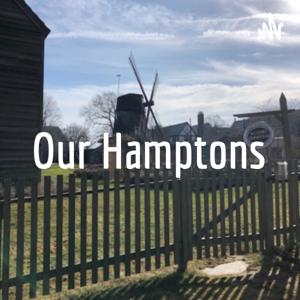


Esperanza and Irwin talk about the Shinnecock Summer School of Art, the first outdoors Art School in the US, founded in 1891. Students had the opportunity to learn from the renowned artist William Merritt Chase. Now, Chase was and is a well known Artist. But it was the Art Village cottages, grouped near the studio in the Shinnecock Hills, that is the off-radar part of the story. These properties, in different styles on curving streets created its own sense of wonder. What presented itself was almost whimsical, a storybook like setting. Best of all, it exists to this day. Listening is believing!
Esperanza and Irwin discuss the beginnings of the Southampton Summer Colony, inspired by Dr. David Goddard's "Colonizing Southampton". In September of 1863, a young Manhattan physician of means by the name of Theodore Gaillard Thomas went by horse and wagon out to visit the farms and rural villages of Long Island with his wife. The trip lasted many days. The couple spent their first two nights in Babylon staying at a rooming house, then pressed on to Quogue, Southampton, East Hampton and Montauk, finally spending a night out at the lighthouse with the keeper and his family there. During this sojourn, Thomas fell in love with the simple though bucolic communities of eastern Long Island and, after returning to Manhattan, vowed that sometime in the future he would return with some friends with the intention of establishing a summer colony there. He had become charmed by the farmland that went down to the ocean, the single Main Streets with the Presbyterian Church, the blacksmith shops, feed stores and dry goods stores that marked what were essentially old New England Communities. Dr. Thomas is considered to have been the founder of the Southampton Summer Colony as we know it today. Within four years, he had persuaded many others to build there. By 1882, there were 30 summer owners (a dozen “cottages”) where five years earlier there had been none. Two years later, Dr. Thomas and others in that group met in a Fifth Avenue apartment in Manhattan to found what was then called the Southampton Village Improvement Association to “beautify the principal streets” and “see to the removal of nuisances” so as to make Southampton even more attractive to possible future summer residents. As you might have imagined, they soon came into conflict with the local residents of the community—there were about 500 of them, who were enjoying the town as their ancestors had for 200 years before—farming the land, fishing the waters and otherwise engaging successfully in rural activities. Sound familiar?
Esperanza and Irwin welcome Ellin and Eliabeth Saltzman. In the early 1960's, Ellin and Renny Saltzman hired a 33 year old architect named Richard Meier to design a modernist family home in East Hampton. Small by today's standards at 4000 square feet, Ellin and her daughter Elizabeth reflect on 5 decades of summers spent in an ever changing East Hampton, as well as the future of their iconic home. A not to be missed Our Hamptons podcast.
Esperanza and Irwin discuss the proliferation of dairy farms on the east end in the not too distant past. If you define a dairy as any farm with more than eight cows, there were once 42 operational dairy farms in East Hampton alone, according to the East Hampton Farm Museum. At that time, “most of the milk was for local consumption,” said Robert Hefner, historic preservation consultant for East Hampton Village. By the 1960s, most dairies on the East End had been shuttered, with the last two operating into the early 1980s—Carwytham Farm in Bridgehampton and Cow Neck Farm in North Sea. We'll focus primarily in East Hampton with the Sherril, Hardscrabble, and Dune Alpin Farms. The dialogue about the Gould and Tillinghast farms, and their subsequent merger to form G&T took us to a side story: the beloved G&T Chicken House on Race Lane.
Esperanza and Irwin first met in 2000, when Esperanza was operating her art gallery, Art Solar on North Main Street, East Hampton. Irwin became a client of the gallery (though it took him a year to buy his first painting!). More importantly, it opened up a dialogue between Esperanza and Irwin, conversations that transcended Art, including the type of subjects you hear today on the podcast. I guess the groundwork for Our Hamptons started well before its May 2022 inception. Listen, and go back in time to where it all started, and how it got here!
Esperanza and Irwin talk of a few versions of Bonac Tonic. The first was a nickname used by bonackers when referring to Hampton Dairy brand iced tea beverage that comes in a green and yellow carton, and is real, fresh brewed tea. The second, and our topic for today, is defined by one of its founders, Grant Haffner, as the following: “Bonac Tonic is a collective of painters, sculptors, photographers, and other artists based in the Hamptons who curate local group shows with an emphasis on new and emerging artists,” explained Haffner. “Bonac Tonic formed in 2005 to reinvigorate the artscene". We'll talk about Grant, and the other founding members of Bonac Tonic, and some of the artists who passed through. There was an energy to Bonac Tonic, and what they brought to the east end art scene at the time was something special. We miss them!
Esperanza and Irwin have a story to tell. As scandalous ancestors go, Col. Henry Huddleston Rogers II would have been enough for most families. But then he had a daughter. The colonel’s namesake father, a partner in Standard Oil and noted “robber baron” of the Gilded Age, was one of the wealthiest men of his day. Amassing an estimated $100 million fortune, Rogers senior also acquired the nickname“Hell Hound” for his rapacious ways. It was meant as a compliment. Alas, young Harry was spoiled by his father’s money. As he aged into adulthood, after receiving his inheritance in 1910, various sources describe him as ruthless, or a bully, or a ruthless bully.In 1914 he used some of the money to build Black Point, the family’s summer estate inSouthampton, also known as the “Beach House,” adding a hunting lodge in nearby North Sea in the 1920s. The colonel commissioned John Russell Pope*, the architect responsible for the National Gallery of Art in Washington, D.C., to design his shooting box overlooking Scallop Pond. The Sag Harbor Express reported that, at the time, it “encompassed 2,000 acres on both sides of the pond and was the largest privately-owned estate on Long Island.” By all accounts, the Port of Missing Men (as it was dubbed) offered the proverbial good time that was had by all. One rumor is that he had duck blinds installed on the water that were wired directly to Wall Street. The colonel’s guests were able to remain unreachable to their wives but connected to the trading floor. Meanwhile, during Prohibition, there was a major liquor drop-off point conveniently close by, at the end of North Sea Road. Later, the drop-off point would become a notorious cathouse. The colonel and his wife, the former Mary Benjamin, had a daughter in 1902: Mary Millicent Abigail Rogers. The artistically inclined Millicent would go on to run through three husbands,plus Clark Gable. In 2011, her rich life became the subject of a biography, Searching for Beauty: The Life of Millicent Rogers, the American Heiress Who Taught the World About Style, by Cherie Burns. Listening is believing!
Esperanza and Irwin talk about the storied (and sordid) history of Ocean Castle, on Meadow Lane, Southampton. In 1929, the stock market crash doomed many, but apparently, not William F. Ladd. Apparently, his alleged bootlegging operation supported an unimaginable lifestyle. He commissioned the prestigious architectural firm of Peabody, Wilson and Brown to design what was described as a multi room fairy tale on over 300 feet of oceanfront. The next owner, Robert Harris rents the house in 1963 to fellow summer resident Donald Leas Jr, who hosts an after party there that trashes the place, including breaking 1600 windowpanes. By 1978, the eccentric theater producer Roy Radin acquires the property, hosts a nightmarish party that leads to sexual assault. And this pre-dates Barry Trupin, who in the midst of constructing Dragons Head down the road, rents the property and literally installs Coney Island within it! Too much to describe here, but listening will be believing!
Esperanza and Irwin welcome Glenn and Stacey, the proprietors of Cedar Cottage Springs. Like many places, Eastern Long Island rentals have dramatically changed. Seasonal rentals, have shifted from the previous Memorial Day to Labor Day season to shorter term rentals; often very short. Airbnb's dominate, and are the source of much displeasure. But for Glenn and Stacey, they are not renting their house, they are sharing their HOME. Two creative types, they've brought a warmth and quirkiness to a business that often lacks exactly that. They are immersed in our community, and our conversation takes in that, and much more.
Esperanza and Irwin reference a 2006 NY Times article by Dorothy Spears. It provides a unique perspective to present day, as it is a 20 year look back, written almost 20 years ago. The themes Ms. Spears writes about will be familiar. The youthful artists and writers who discovered the east end of Long Island in the 1950's and 60's encountered potato fields, endless green marshes, empty beaches and inviolable dunes. They made an artistic haven there, and what they saw and felt informed their plays and novels, their paintings and sculptures, for decades after. Quite a bit of that idyllic landscape is now gone, and many of the famous are gone as well. But there remained a circle of friends, then in their 70's or older, who continue to paint and write in the ever more crowded, less peaceful Hamptons. Their tales of that earlier era, when the Montauk Lighthouse was just a quick jaunt away, and most restaurants closed for the winter,serve as a reminder not only for what has been lost but also for what continues to endure. As timely then, as it is now.
From the publisher's feed

37,993 Listeners

6,754 Listeners

4,048 Listeners

4,343 Listeners

9,605 Listeners

30,133 Listeners

87,098 Listeners

111,873 Listeners

12,507 Listeners

8,027 Listeners

6,064 Listeners
24 Listeners
12,693 Listeners

3,478 Listeners

653 Listeners