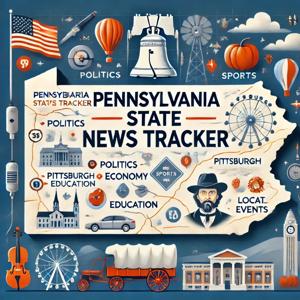
Pennsylvania is poised for significant developments across various sectors, from government and politics to business and the environment. Here’s a summary of recent key events and updates:
Top headlines include the tragic medical jet crash in Northeast Philadelphia, which claimed seven lives and injured 22 others, with ongoing investigations and recovery efforts[1]. The 2024 general election saw the highest voter turnout in 36 years, with 69% of the voting-age population casting ballots[1].
In government and politics, Governor Josh Shapiro unveiled his 2025-26 budget proposal, emphasizing workforce development, cost reductions in healthcare, housing, and energy, and significant investments in economic development and public safety. The budget also includes a plan to legalize adult-use cannabis, expected to generate $250 million annually in additional revenue for the Commonwealth[2].
On the local government front, the Pennsylvania Commonwealth Court is set to decide whether Lower Merion can restrict gun sales through zoning laws, a ruling that could impact local government authority on gun policies statewide[1].
In business and economy, Pittsburgh Regional Transit (PRT) is seeking a $117 million annual increase in state funding to prevent severe service cuts and layoffs. The agency warns that without this funding, it will face significant financial challenges as federal COVID-19 relief funds are depleted[1]. Additionally, President Trump’s new tariffs on imports from Canada, Mexico, and China are expected to raise prices on cars, gasoline, and groceries in Pennsylvania, potentially leading to higher costs for businesses and potential job losses in the state’s hospitality and agricultural sectors[1].
Community news highlights include the ongoing debate between incumbent Pittsburgh Mayor Ed Gainey and County Controller Corey O’Connor, who discussed budget concerns, housing policies, and other key issues in their first debate. Meanwhile, Lawrenceville business owner Thomas West has joined the mayoral race on the Republican side[1].
Environmental and weather updates note that despite a cold snap in January, long-term climate trends in Pittsburgh show a warming trend. Preliminary seasonal climate data for Pittsburgh indicates that winter 2024-25 averaged out 2.5°F below the 1991-2020 climate normal period, but overall, average winter temperatures in Pittsburgh have warmed an average of 5°F between 1970-2024[4].
Looking Ahead:
- The March 25 special election to fill the late Rep. Matt Gergely’s seat in Pennsylvania’s 35th state House District will be crucial, with control of the state House at stake.
- The outcome of the Pennsylvania Commonwealth Court’s decision on Lower Merion’s gun sale restrictions through zoning laws will have significant implications for local government authority on gun policies statewide.
- The implementation of Governor Shapiro’s 2025-26 budget proposal, including the legalization of adult-use cannabis, will be closely w
This content was created in partnership and with the help of Artificial Intelligence AI.