
Sign up to save your podcasts
Or

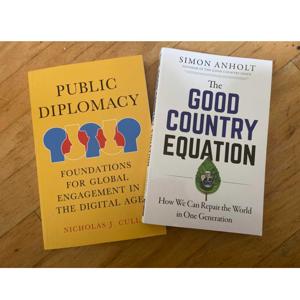


In the episode Simon introduces the fifth iteration of the Good Country Index (index.goodcountry.org/) now published in partnership with Diplomatic Courier. He explains the nature of the index as an aggregation of contributions to the global good. Nick pulls out particular countries for scrutiny including the USA at #46. They agree that the top of the table (with Sweden once again in first place ahead of Denmark and Germany) shows the collaborative nature of European countries. Other countries examined include Russia -- continuing a decline -- and China and the stark contrast between UAE at 65th and Qatar at 109th with an especially poor score in cultural contributions (136th). Countries performing well include Cyprus at 16th and South Africa at 44. The conversation wraps up considering how the index plays into actual policy.
In this season 2 opener Simon and Nick consider the implications of the Russian invasion of Ukraine for issues of international image. Simon argues that the crisis has revealed the degree of interconnection associated with advanced globalization as revealed by the almost instant pressure on corporations to withdraw from Russia. Side issues include implications for the images of countries remaining neutral in the war such as India and China. Nick contrasts the image problems displayed by Ukraine in 2014 with the country's impressive showing in 2022 suggesting that investment in 'Reputational Security' has paid off. Simon notes how the image of a dynamic leader like that of President Zelensky can facilitate the repositioning of a national reputation. Simon also raises questions about the opposition in Russia and proposes a theory about Alexei Navalny.
In this final episode of the season Simon and Nick consider the implications of recent developments in Afghanistan for our understanding of international image. Issues include the role of branding in the initial policy missteps towards Afghanistan in the 1990s and the prospects for a positive image of Afghanistan in the future.
This episode considers the image of Israel which, as Simon notes, was one of the worst when included in the Nation Brands Index. The heart of the problem seems to be the power of a conflict to taint the image of all combatants whatever its inherent rights and wrongs. Nick notes a string of innovative Israeli activities to show that Israel is more than a conflict. Simon recalls consistently advising governments of Israel that it would need to act jointly with Palestine to really improve its image. The bad image is shared. The pair consider the actual contributions of Israel to the world revealed in the Good Country index as evidence of the way in which the good is overshadowed. Simon attributes Israel's headwind to anti-Semitism but notes that Islamic countries face a similar attitude in external Islamophobia. The discussion concludes by considering the positive indicators of the Abraham Accords, but emphasizing all countries need to be as engages as possible in partnerships and collaborations from trade to development. Countries like Israel and Japan with a strong sense of distinctiveness and an exclusive approach to identity as at a disadvantage moving into the 21st century.
This episode focuses on the attitude of the mass media to the issue of national brands, international images and public diplomacy. Simon laments the enduring focus on the superficial message of rankings. Nick ponders the role of media as a component of national image in their own right and the possibility that the BBC is the 'goose that lays the golden egg' of British Soft Power. The conversation turns to the reputation of damaged places like Cambodia in the 1970s or more recently Rwanda and Syria. Nick talks about recent research on Great War propaganda suggesting that roots of distortion lay more in the popular press than in government bureaucracies. The episode concludes with an acceptance that the public seem to get the media that they deserve and that the flaws of international coverage track
This episode probes arguably the most successful cluster of national reputations the Nordic region, performing at the top of both the nation brands and good country indices. Issues include the question of how the positive reputation benefits Sweden, Norway, Denmark and Finland and the historical factors underpinning the phenomenon. Nick raises the issue of the demonization of the region in Kremlin-linked media while Simon considers negative messaging from within the region from its own far right. Simon looks back on the Danish cartoon crisis of 2006 as an exemplar for how a reputation can be damaged by a single incident.
This episode examines the crucial category of trust in communication and reputation with especial reference to the findings of the Edelman Trust Barometer for 2021 [https://www.edelman.com/trust/2021-trust-barometer]. The findings of this survey are alarming, being summarized as 'information bankruptcy'. Unlike national images, trust seems volatile with the highest degree of trust shifting from NGOs to 'people like the audience' to employers and businesses over the twenty years that the barometer has surveyed publics around the world. Simon points out that the decline of trust in government presents a crisis for democracy. Nick softens the blow by arguing that trust in local government is increasing. The pair consider the impact of COVID on trust, which seems to have boosted trust in one's own government but decreased trust in in media. The local nature of trust is seen as a problem for the UN and EU. The diffusion of trust suggests that the only way to bring people together to address large issues is through a partnership of different kinds of actors with the ability to elicit trust from different sorts of people. Simon and Nick conclude that the best way to rebuild trust is to develop critical thinking, ironic perhaps given that this process includes a reasoned mistrust. Such a process is essential for a healthy democratic future.
This episode considers the best way to structure and coordinate the elements within a nation's bureaucracy responsible for public diplomacy. It looks at best practices and common shortcomings. Simon and Nick agree that fitness for purpose seems to be the last things considered in setting up institutions. Proposals for good practice include Simon's suggestion for Iceland of a single 'house of Iceland' to house all elements of outreach. Nick notes the problem of elements undermining one another and the virtues of the German system of separate institutions for each function. Turning to structures of coordination, Simon recalls working within the British structure in the later Blair period. Nick stresses the value of a single agency or individual coordinating a collective effort, and the correlation of historical success with a special relationship between the senior official and head of state as with Churchill and Brendan Bracken or Reagan and Charles Z. Wick. Simon and Nick conclude that the best results seem to come from organizing a shorter-term collective campaign working to a collective objective.
This episode looks at one of the strongest soft power images: that of France, noting that it has displayed a downward adjustment at the top of the Nation Brands Index in recent years. Simon considers the strengths and weaknesses of the French image, with governance and people showing up as weaknesses. Nick reflects of older ideas of France and the impact of the colonial legacy on perceptions of the country. The conversation settles on the performance of Macron as a leader, his difficulties during the pandemic and the poor international reception of statements on Islam. Yet despite missteps he is favorably compared to Boris Johnson, whose erratic policies seem bound to wound if not kill the goose that lays the golden egg of British soft power.
This episode develops issues raised in the discussion of migration to examine how reputation connects to the process of a nation attracting the most highly skilled people. Simon and Nick consider which countries do this particularly well -- acknowledging the special place of the United States. They also flip the issue and think about the issue of diaspora and the implications of the apparent absence of the concept of a "US diaspora" except for groups compelled to live outside of the US because of political or ethnic discrimination. The issue of talent attraction is considered in both a global and regional context and -- by way of conclusion -- related to the wider attitude towards migration, with the achievements of high-profile specially recruited migrants serving as a way to swiftly show what all migrants can contribute given time, and thus serving as an argument for more welcoming systems of migration
From the publisher's feed