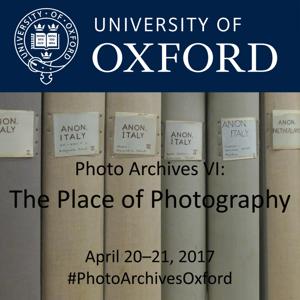
Photo Archives VI: The Place of Photography

Photo Archives VI: The Place of Photography

By Oxford UniversityEducation
Download on the App Store

Photo Archives VI: The Place of Photography episodes

  • Photo Archives VI: The Place of Photography and the Phases of Digitisation
    Nina Lager Vestberg (Norwegian University of Science and Technology) discusses the digital condition of photography through a phase model of digitisation. What do we talk about when we talk about digitisation? People working with photographic images tend to understand this concept in different ways, depending on whether they work in museums, archives, the stock photo industry, media outlets, publishing, or education. Photography holds a significant place in all these fields of endeavour, the impact of digitisation has likewise been varied across these different areas. Inspired by the sociologist Roland Robertson’s (1992) attempt at ‘mapping the global condition’ through the development of a ‘minimal phase model of globalisation’, this paper charts the digital condition of photography through a similar phase model of digitisation, in which the ‘place’ of photography is plotted against a set of cultural, social, technological and economic coordinates.

    21 min
  • Photo Archives VI: Archive, Exhibition, Book: 'The Family of Man' Reconstituted
    Shamoon Zamir (New York University Abu Dhabi) discusses the 'The Family of Man' exhibition and its related archives. Apart from early reviewers and commentators, everyone who has written on the famous The Family of Man Exhibition has done so without the benefit of having seen it at the Museum of Modern Art in 1955 in its original iteration. The reliance on the book of the exhibition has consequently substituted for the exhibition and greatly distorted our understanding of Edward Steichen’s curatorial design. Shown, according to one count, in more than 40 countries and seen by over 9 million people, The Family of Man was a defining event in the global history of photography. This paper attempts to explore the ways in which the Museum of Modern Art’s archives and the archives of the United States Information Agency help us revise this history and develop new perspectives on Steichen’s exhibition.
    27 min
  • Photo Archives VI: Archiving Royal Heirlooms: The publication of the Crown treasures of the Galerie d'Apollon (Louvre) and its materiality
    Pascal Griener (University of Neuchatel) discusses photographic reproductions of the French crown jewels made for their auction in 1887. During the second half of the nineteenth century, the royal heirlooms were exhibited in the Galerie d’Apollon in the Louvre. Even after the Third Republic, they remained very popular with the wider public. However, for political reasons, some diamonds from the French crown jewels were auctioned in the Louvre itself in May 1887. This paper analyses the major attempts made to picture these exceptional pieces, and to sell their reproductions in portfolios. The information delivered through these photographs as a group was anything but neutral in this context. The paper aims to reconstruct the functioning of these images within the framework of art history of this time.
    23 min
  • Photo Archives VI: From Trash to Treasure: Loss, Value, and the Photo Archive
    Catherine E. Clark (MIT) discusses the life cycle of anonymous photographic archives. This paper examines the trope of ‘trash to treasure’ in the history of photo archives. This paper’s key example is the revaluation and profit generation of an archive of amateur prints and albums collected in the 1980s by a French production company based in Marseille. They were used primarily for a show ‘Souvenirs, souvenirs’ that ran on ARTE in the 1980s. This paper will use this show and its archive to think through the life cycle of similar anonymous photographic archives. It asks: is there anything particularly photographic about trash-treasure narratives? What role does quantity play in producing photographic value? And how do photographs form new, secondary, affective meanings?
    24 min
  • Photo Archives VI: Saving Space, Mediating Place: Photography and the Reproduction of Collections and Archives
    Estelle Blaschke (University of Lausanne) discusses the development and growth in use of microfilm during the 1920s and 1930s. The use of photography as a copying machine in libraries and museums started around 1870. While the potential and the advantages of photographic reproduction for copying purposes were already discussed since the early days of photography, the idea and the practice matured during the 1920s and 1930s with the introduction of microfilm. This paper examines the technological developments and the formation of networks of people, research units, associations and public institutions during the 1920s and 1930s that solidified the idea of microfilm as an information technology of the future. The paper will ask how the medium played into the continued expansion and democratization of knowledge.
    12 min
  • Photo Archives VI: Photography as Protocol
    Kelley Wilder (De Montfort University) discusses photography as a scientific protocol This talk examines the idea that photography has entered into the protocols of archive practice, informing and perhaps deforming them beyond recognition. What might a photographic protocol be? And how could an image, a photographic image, act within the confines expected of protocols? The paper explores how photographic practices and the protocols of archiving have come together in the nineteenth and twentieth centuries. The paper also interrogates how far the idea of photographic protocols can lead to a better understanding of the place of photographs and photographic archives within disciplinary imperatives.
    21 min
  • Photo Archives VI: The Laboratory as Photo Archive
    Chitra Ramalingam (Yale University) discusses photographic collections within science laboratories Experimental practice in laboratories sometimes generates vast quantities of visual records. Such sites produce an imperative to analyse, store, and bring order to large collections of experimental images. Laboratory practice thus has a museological dimension rarely acknowledged in science studies, while laboratory image archives – when considered as collections rather than as individual images – have aesthetic and epistemic dimensions rarely explored in histories of art. This talk presents a few examples of modern physical laboratories, including the Kodak Research Laboratory and Los Alamos National Laboratory, that have functioned in part as photographic archives and explores the cultural forces under which their photo collections have variously been maintained together, dispersed, or destroyed.
    25 min
  • Photo Archives VI: Vision in Doubt: Arctic Photography, Victorian Geology, and its Anglo-American Debates
    Luke Gartlan (University of St Andrews) discusses Victorian arctic photography in The Arctic Regions (1873) and an unpublished album. William Bradford's The Arctic Regions has often been cited as an exemplar of the Victorianera photobook. Published in 1873 by the renowned firm of Sampson Low, Marston, Low, and Searle, this imposing volume marked a new phase in private efforts to profit from the trans-Atlantic interest in Arctic subjects. Yet the systematic first-person narrative and captioned prints of this photobook belie the shifting contexts, applications, and private debates that had accrued to these photographs in the intervening years between the voyages and the publication. This paper aims to contrast selections from The Arctic Regions with an unpublished, privately compiled photographic album in the National Library of Scotland, Edinburgh.
    24 min
  • Photo Archives VI: Sticking points: Photographic albums and the forgetful archives of Egyptian archaeology
    Christina Riggs (University of East Anglia) discusses the 'forgetfulness' of photo albums from excavations in colonial and interwar Egypt. Almost every archive associated with fieldwork from archaeology's 'golden age' includes photographic albums. The album was one way of ordering, and producing, the knowledge of the past that was archaeology’s ostensible goal. But like the process of photography itself, archival processes such as assembling an album also reflected - and shaped - knowledge of the present, and in particular, a knowledge of the places where archaeology did its work. This paper explores the quality of forgetfulness that albums enable, alongside the question of place, by considering the creation, form and content, and subsequent histories and uses of albums originating from excavations in colonial and interwar Egypt.
    27 min
  • Photo Archives VI: The Relational Album: Photographic Networks, Anthropology, and the Learned Society
    Christopher Morton (University of Oxford) discusses the concept of the relational museum applied to an album from the Anthropological Society in London. This paper takes the notion of the ‘relational museum’ – the concept that museum objects to some degree conceal the mass of relations that lie behind them – and applies it to a nineteenth-century album compiled at meetings of the Anthropological Society in London. The album is something of a ‘scrapbook’, as such this album is a particularly important ‘relational’ object, enabling a rich and nuanced insight into the relationships between photography, anthropological knowledge, and scientific networks in nineteenth-century London. The paper gives an overview of the album’s relational networks and suggest ways in which it shifts our understanding of photography and anthropology in a crucial period in the discipline’s early history.
    23 min

About Photo Archives VI: The Place of Photography

From the publisher's feed

This major international conference was convened by Geraldine Johnson (University of Oxford), Deborah Schultz (Regent's University London), and Costanza Caraffa (Kunsthistorisches Institut in Florenz—Max-Planck-Institut). It is the sixth in the Photo Archives conference series.

More shows like Photo Archives VI: The Place of Photography

Philosophy for Beginners by Oxford University

Philosophy for Beginners

330 Listeners

Approaching Shakespeare by Oxford University

Approaching Shakespeare

330 Listeners

John Locke Lectures in Philosophy by Oxford University

John Locke Lectures in Philosophy

35 Listeners

Anthropology by Oxford University

Anthropology

72 Listeners

Aesthetics and Philosophy of Art lectures by Oxford University

Aesthetics and Philosophy of Art lectures

76 Listeners

Theoretical Physics - From Outer Space to Plasma by Oxford University

Theoretical Physics - From Outer Space to Plasma

60 Listeners

Critical Reasoning: A Romp Through the Foothills of Logic by Oxford University

Critical Reasoning: A Romp Through the Foothills of Logic

38 Listeners

The Secrets of Mathematics by Oxford University

The Secrets of Mathematics

41 Listeners

Critical Reasoning for Beginners by Oxford University

Critical Reasoning for Beginners

30 Listeners

CortexCast - A Neuroscience Podcast by Oxford University

CortexCast - A Neuroscience Podcast

4 Listeners