
Sign up to save your podcasts
Or

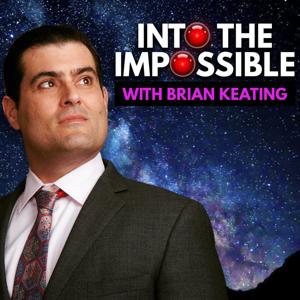

Please join my mailing list here 👉 https://briankeating.com/yt to win a meteorite 💥
From the electrifying environment of high-speed particle collisions to the challenge of sifting signals from heaps of experimental noise, you'll hear how Prof Whiteson and his team are pushing boundaries. They discuss bold new algorithms capable of spotting non-standard tracks—think wild trajectories that defy classical expectations and could reveal surprises nature has kept hidden. Practical questions about detector design, efficiency, and even the mathematics of “smooth” particle paths make for a rich, dynamic dialogue.
If you’re curious about how physicists ask the universe its most challenging questions, the frustrations and breakthroughs of innovation, and the fascinating interplay between theory and experiment, this episode will take you to the front lines of discovery. Plus, hear how machine learning might help us find not just the next weird particle, but perhaps the next Nobel-worthy revelation. Get ready for a fascinating journey into the impossible!
Daniel Whiteson is a physicist whose research spans a wide range of topics at UC Irvine. By day, he works on the ATLAS experiment, one of the major physics collaborations at the Large Hadron Collider, where he contributes to Higgs boson precision measurements and develops advanced techniques in machine learning, data acquisition, and trigger systems. His research group is known for applying machine learning innovations to physics problems, including projects beyond ATLAS—like using approximate symmetries or jet pattern matching. Recently, his team has been focused on machine learning projects to identify unusual particle tracks, always pushing the frontier between physics and data science.
Timestamps:
-
Join this channel to get access to perks like monthly Office Hours:
https://www.youtube.com/channel/UCmXH_moPhfkqCk6S3b9RWuw/join
📚 Get my books:
Think Like a Nobel Prize Winner, with productivity tips from 9 Nobel Prize winners: https://a.co/d/03ezQFu
Focus Like a Nobel Prize Winner, with life-changing interviews with 9 Nobel Prizewinners: https://a.co/d/hi50U9U
My tell-all cosmic memoir Losing the Nobel Prize: http://amzn.to/2sa5UpA
The first-ever audiobook from Galileo: Dialogue Concerning the Two Chief World Systems: Ptolemaic and Copernican https://a.co/d/iZPi9Un
Follow me to ask questions of my guests:
#universe #podcast #briankeating #intotheimpossible #science #astronomy #cosmology #cosmicmicrowavebackground #intotheimpossible #briankeating
Learn more about your ad choices. Visit megaphone.fm/adchoices
 View all episodes
 By Big Bang Productions Inc.

4.7
10471,047 ratings
Please join my mailing list here 👉 https://briankeating.com/yt to win a meteorite 💥
From the electrifying environment of high-speed particle collisions to the challenge of sifting signals from heaps of experimental noise, you'll hear how Prof Whiteson and his team are pushing boundaries. They discuss bold new algorithms capable of spotting non-standard tracks—think wild trajectories that defy classical expectations and could reveal surprises nature has kept hidden. Practical questions about detector design, efficiency, and even the mathematics of “smooth” particle paths make for a rich, dynamic dialogue.
If you’re curious about how physicists ask the universe its most challenging questions, the frustrations and breakthroughs of innovation, and the fascinating interplay between theory and experiment, this episode will take you to the front lines of discovery. Plus, hear how machine learning might help us find not just the next weird particle, but perhaps the next Nobel-worthy revelation. Get ready for a fascinating journey into the impossible!
Daniel Whiteson is a physicist whose research spans a wide range of topics at UC Irvine. By day, he works on the ATLAS experiment, one of the major physics collaborations at the Large Hadron Collider, where he contributes to Higgs boson precision measurements and develops advanced techniques in machine learning, data acquisition, and trigger systems. His research group is known for applying machine learning innovations to physics problems, including projects beyond ATLAS—like using approximate symmetries or jet pattern matching. Recently, his team has been focused on machine learning projects to identify unusual particle tracks, always pushing the frontier between physics and data science.
Timestamps:
-
Join this channel to get access to perks like monthly Office Hours:
https://www.youtube.com/channel/UCmXH_moPhfkqCk6S3b9RWuw/join
📚 Get my books:
Think Like a Nobel Prize Winner, with productivity tips from 9 Nobel Prize winners: https://a.co/d/03ezQFu
Focus Like a Nobel Prize Winner, with life-changing interviews with 9 Nobel Prizewinners: https://a.co/d/hi50U9U
My tell-all cosmic memoir Losing the Nobel Prize: http://amzn.to/2sa5UpA
The first-ever audiobook from Galileo: Dialogue Concerning the Two Chief World Systems: Ptolemaic and Copernican https://a.co/d/iZPi9Un
Follow me to ask questions of my guests:
#universe #podcast #briankeating #intotheimpossible #science #astronomy #cosmology #cosmicmicrowavebackground #intotheimpossible #briankeating
Learn more about your ad choices. Visit megaphone.fm/adchoices
14,378 Listeners

26,250 Listeners
1,353 Listeners
321 Listeners

836 Listeners
569 Listeners
547 Listeners

934 Listeners
4,170 Listeners

2,359 Listeners

1,645 Listeners
506 Listeners
329 Listeners

21 Listeners
381 Listeners