
Sign up to save your podcasts
Or

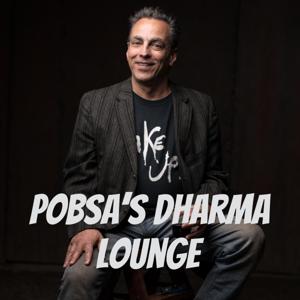


In this first of a series of discussions regarding the evolution of personal practice, Pobsa and Barrie Risman discuss, among other things, what it means to "evolve one's yoga". What aspects of practice change over time and what, if anything, remains the same.
From there, they go on to discuss the student/teacher relationship and how it has generally changed with the commodification of yoga into a consumer/provider relationship and what that means for yoga practice and teaching itself.
Please consider supporting our podcast by subscribing, rating, commenting and sharing with others! Word of mouth is the best way to get this podcast to others.
Dana can be offered via this link.
In an exchange between Ananda and the Buddha, the Buddha tells Ananda, "It is much better to talk of what you know than to speculate foolishly." Sound advice, but what do we actually know?
In this episode, Pobsa explains how our perceptions are constructed and thus open to inaccuracy. After describing several ways we "fool ourselves" he offers some practices to correct for all-too-common cognitive biases.
If you wish to learn more about the nature of the mind according to the Buddha's teaching in the Satipatthana-Sutta, as well as tools for critical thinking based upon neuro- and cognitive science, you can join Pobsa for a four-week course starting Sept 9. All sessions will be recorded if you cannot make the live session.
Registration Information:
https://www.mindfulnessyoga.net/minding-the-mind.html
For Dana Offerings, greatly appreciated: https://www.mindfulnessyoga.net/dana.html
In this wide-ranging conversation with Daniel Simpson we explore questions around how to make use of texts such as The Yoga-Sutra which come from a world-denying, renunciate worldview extolling dis-embodiment and celibacy in a contemporary yoga practice setting which prioritizes embodiment and tends toward body and sex positivity. What elements should be adapted, which should be fully integrated, and what should be rejected as inappropriate for our purposes? Along the way we discuss the ground-breaking work of scholars such as Georg Feurstein, and more recent scholarship from people like Mark Singleton and James Mallinson.
We touch upon the neo-liberal focus on the self that has become such a driving force in both contemporary yoga and mindfulness and use sutra 1.33 regarding the "four immeasurables" (aka 'four brahma-viharas) to distinguish the more isolationist project of Classical Yoga and the pro-social project of Buddhist Yoga. In turning toward a more general discussion on dharma, political concerns arise with examples from Brexit and illiberal so-called "progressive" authoritarianism that lead to ever increasing discord and polarization are touched upon. We end with Daniel's "origin story" filled with at least two of the classic "sex, drugs, and rock and roll."
LINKS:
Our previous discussion on Daniel's podcast: Ancient Futures
My conversation with Scott Johnson on Scott's podcast: Still Points
Daniel's conversation with Scott Johnson on Scott's podcast: Still Points
Daniel's Ancient Futures Website
My review of The Truth of Yoga at Goodreads
The Yoga Tradition by Georg Feurerstein
Roots of Yoga by James Mallinson and Mark Singleton
The Yoga Sutras of Patanjali by Swami Satchidananda
The Yoga-Sutra of Patanjali by Chip Hartranft
Swans
In his first teaching, the Buddha presented his yoga practice as a middle way between sensory deprivation and indulgence, showing that both extremes were caught in notions of the self. The Middle Way is an alternative path between the two extremes, but is one that is made step by step by each practitioner. There is no "one way" to be the Middle Way and in the ever-changing circumstances we find ourselves in life, we are always having to adjust accordingly. This requires constant attention to the changing and unique situations we find ourselves in.
Please support this podcast by subscribing, sharing, and rating where possible.
Dana (financial support) is also gratefully appreciated and accepted here.
Inspired by a conversation with some students and remembering a song from the Sex Pistols, Pobsa shares about problems and how to work with their inevitability. This episode ends with a somewhat humorous and quite telling story of the Buddha and a Brahman who sought relief from his 85 problems.
Click here to contact Pobsa with any questions, comments, or suggestions for future episodes.
Click here to offer dana to Pobsa. Remember, dana is the practice of sharing gifts and any and all offerings are gratefully accepted.
Click here to hear the Sex Pistols.
In this episode, Pobsa introduces a form of "objectless meditation" which is a form of meditation that embodies simply maintaining open awareness, without directing the mind to any particular object. He does this through a graduated process of two other meditations that can function as "stand alone" meditations designed to develop stability (Mountain Meditation) and reflectivity of mind (Lake Meditation).
Another way to support this podcast is through the practice of DANA. ALL dana, no matter how small you may think it is, is greatly appreciated and will be acknowledged in following episodes.
I think you will enjoy this wide-ranging conversation with Barrie Risman as much as I did! Prompted by a Facebook post, I reached out to Barrie and she gracefully accepted my invitation to chat about some of the philosophical aspects of the Yoga Tradition(s).
Barrie’s alignment-oriented approach to postural practice is grounded in principles of healthy, functional movement. Her events weave together the technical precision of alignment-based practice with principles of yoga philosophy distilled from decades of intensive study and made accessible and relevant to practitioners from all walks of life.
She teaches yoga around the globe through her ongoing classes, workshops, mentoring programs, and trainings, both online and in person. Her work has been featured in Yoga Journal, Yoga International, and on CBC Television.
PLEASE consider supporting this podcast by SUBSCRIBING, COMMENTING, and REVIEWING!
There's a major discrepancy between the contemporary definition and understanding of "mindfulness" and how it is described and understood in the Buddhist traditions. In this episode, Pobsa details the difference and why it matters. There are two places where he mis-spoke: when mentioning the ground-breaking work of Willoughby Britton, he says she discovered that only 4 out of 1800 studies on mindfulness had control groups but the number was 40. And the closing analogy correctly stated is: "mindfulness is like the hand that takes a sheaf of grain in its grip and wisdom the hand that holds the scythe that cuts it down."
The episode where Pobsa introduces principles of meditation is here.
To offer dana to Pobsa please click here.
After a discussion about gratitude, Poep Sa shares a practice from the Japanese Pure Land School of Buddhism that helps cultivate an attitude of gratitude and appreciation for the myriad ways our lives our supported by other beings, processes and things.
If you'd like to support this Podcast, consider offering dana.
When asked what he taught, the Buddha said he taught only one thing: "Suffering and the end of suffering." However, the Pali/Sanskrit word duhkha points to a reality of existence more nuanced than the word "suffering" would lead us to expect. In this short episode, I introduce this concept, and some of the various ways it's been understood as a way to make sense of the statement often made by Buddhist yogis that "life is suffering."
To offer Dana, click here.
To read a more in-depth exploration of duhkha in the context of the Four Noble Truths, check out this blog essay.
From the publisher's feed