
Sign up to save your podcasts
Or



This week’s podcast is a big one. It’s a podversation with the new Managing Director of Strengthscope, David Lincoln.
Read more: https://www.strengthscope.com/how-to-transition-roles-the-strengths-way-podversation/
This week we’re talking about how you can transition into a new role using strengths principles by:
1. Knowing where you’ve come from and what got you here
2. Being clear on your outcomes
3. Bringing your strengths with you
4. Managing your greatest risks
5. Getting support for the transition
What is career wellbeing? Various researchers have tried to break it down into various elements including: career transitions you might make, your relationships at work, your relationship with the organisation, your work performance, your sense of purpose, learning and development and finally, your work-life blend.
So in today’s podcast, I want to give you some pointers on managing some of these elements of your career so that you can strengthen your career wellbeing and keep it strong.
Read more:
https://www.strengthscope.com/improve-your-career-wellbeing-part-1/
Now is a really good time to focus on your well-being and one of the central pillars of you feeling well is to connect with other humans.
We are social animals and the last few months have been particularly challenging for us as to how to practically connect socially with other people. Much of our interaction has been through screens or other technology, we’ve been told to be careful about physical proximity (like hugs and kisses and touch) with the rules on social distancing; even when we’re in the presence of others, we may be wearing a face-covering, potentially reducing our ability to connect well.
But in spite of all of this, we all have an innate evolutionary human drive to connect, so it’s important for our well-being and for the well-being of others, that we make the effort to do it, because the payback is huge.
Read more here:
https://www.strengthscope.com/supercharge-your-wellbeing/
https://www.strengthscope.com/managing-a-team-through-change/ Many teams are experiencing significant change as a result of the events of 2020 but change within teams presents a perennial challenge. Team membership is always fluid, goals and objectives need to be revisited, projects and focuses come and go.
This podcast focuses on what you can practically do to lead a team through change by ensuring they remain strong, fit and able to deal effectively with the challenges of change as they come up.
The current context for teams is more turbulent than ever. The threat or reality of redundancies, restructure and shifting priorities are more present now than they have been for a number of years.
This makes it even more important to look after your team’s health, whether you are a team member, line manager, business leader or a professional who supports teams in their development and performance.
Here are some practical tips to help check in on the health of your team. In doing this, I’ll be letting you know about some of the secret sauce we use at Strengthscope when we’re supporting teams on their journey towards sustainable high performance.
More offices and workplaces are now starting to open and more people are returning to work, and there’s an unusual atmosphere of normality combined with concerns about the unknown.
To ease those concerns and increase the feeling of normality, my headline advice is to go for familiarity and control, that will help ease any stress and tension you might be feeling, and that includes remembering your own strengths that can help you and risk areas which could hinder you.
This week, then, I want to talk about returning to work…the strengths way.
Read more:
https://www.strengthscope.com/returning-to-work-the-strengths-way/
Well-being at work is a hotter topic than ever and rightly so. We’re regularly being told that employees’ mental health is worsening and that stress-related absence is on the increase.
According to the UK’s official HR-representing body (the CIPD) between 2018-19, work-related stress increased in 40% of organisations and reporting of mental health conditions increased by 60%. Now this may be in part to do with the reduction of stigma associated with mental health and stress which is a good thing but nonetheless, the figures are stark. And events of 2020 will have an additional significant impact, once the data is in.
Today I want to talk to you about how strengths can help boost your well-being at work with some practical tips on doing that
In summery:
1. Find your own personal strengths that define you at your best and decide how you can use them more – this can help reduce symptoms of anxiety and depression and increase engagement.
2. Find your purpose, the difference you want to make in the world, and figure out how you can use your strengths to get you there.
3. Discover your overdrive risks, when they’re most likely to turn up and then have a plan to stop them stressing you, so you stay more in control of you.
4. Borrow others’ strengths when you need help and offer them yours when they do.
Read more:
https://www.strengthscope.com/how-strengths-can-boost-your-wellbeing-at-work/
Something we’re hearing from more and more organisations is how they’re looking to help their employees explore new opportunities in areas of the business that are continuing to do well even when faced with the challenges we’re seeing today.
Sometimes, this kind of role sidestep might mean a need to upskill and it may well also give people an opportunity to pursue areas of strength that they haven’t yet had much access to.
I have five steps for you: know your strengths; work on your resilience; find your strength opportunities; take your strengths with you; and beware your overdrive risks.
Read more:
https://www.strengthscope.com/sidestepping-into-a-new-role/
The new normal is a funny phrase because it makes you think that at some point, change is going to stop and normal is going to be forever and then we can all chill a bit and get a bit of certainty back.
Let’s hope that’s true but for now, one thing we know for sure is that there’s a lotT of change around and more change ahead. We don’t know what it will bring but we know it will mean that things won’t be the same as today.
That's alongside all the background questions about how we live our lives that keep rattling around without a definite answer:
Will I ever not to have to wear a mask again?
Will I have my job in 6 months?
Will my job be the same in 6 months?
Will I be going back to the office?
Will Zoom be a forever way of communicating?
Will handshakes ever be ok again?
Are shops going to come back or will I shop online forever? And so on and so on.
Today I want to talk to you about how to constantly adjust to new normal after new normal after new normal without freaking out and without checking out.
Read more:
https://www.strengthscope.com/adjusting-to-the-new-normal/
Are you a perfectionist? Perfectionism has significant negative health impacts. Learn how to keep it under control so that it remains in service to you rather than you becoming a slave to perfection.
https://www.strengthscope.com/how-to-aim-for-progress-not-perfection/
In a 2019 study of around 41,000 young people, researchers found that over the last 25 years, people across the US, Canada and the UK have become more perfectionistic in terms of: others having higher expectations of us, us having higher expectations of others, as well as us having higher expectations of ourselves. The rise of social media has been used to partly explain this effect and importantly, there are significant negative health outcomes associated with each form of perfectionism.
My name’s Dr Paul Brewerton, the strengths guy, Doctor of Psychology and Founder of Strengthscope. My podcasts land with you at the start of each week to get you off to the strongest possible start. I podcast about work, life and strengths and how you can get the most from each.
So what is perfectionism? Well I said in my intro that compared to a few decades ago, we now perceive that others have higher expectations of us, that we have higher expectations of others, and we have higher expectations of ourselves – that’s actually three types of perfectionism…socially-prescribed perfectionism, other-oriented perfectionism and self-oriented perfectionism – yikes!
https://www.strengthscope.com/getting-the-best-from-your-strengths-in-a-crisis/
Once upon a time, the strengths approach wasn’t so well-known as it is today and one of the pushbacks to the approach I used to hear fairly often was about strengths being a great idea for the good times, but actually how helpful are your strengths in bad times, when you’re under pressure, in a crisis if you like?
So today’s podcast relates directly to that challenge and the question – ‘how can you get the best from your strengths in a crisis?’
My name’s Dr Paul Brewerton, the strengths guy, Doctor of Psychology and Founder of Strengthscope. I podcast on Mondays to set you up for a strong week ahead, talking all things life, work and strengths and how you can get the best from each.
Strengths in a crisis? Invaluable! Whether that crisis is small-scale and short-lived or whether it’s bigger and more chronic and long-lasting, your strengths are there for you to draw on every day, for you to remember to bring them out when things are going smoothly, and (even especially) during the choppy times too. Remember that your strengths are those things that energise you and that you are great at, or have the potential to become great at…so they should serve you well whatever the weather, right? Well, the challenges in using your strengths in a crisis are twofold.
From the publisher's feed
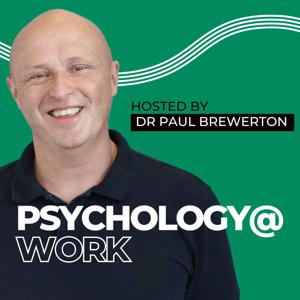
Deep dive into strengths-based psychologist and Strengthscope founder, Dr Paul Brewerton's mind for insights on human behaviour in the world of work, helping you get the most from work and from life, every day. A series of bi-weekly podcasts to help you transform your understanding of individuals and how to help them reach their best performance.
Follow Dr Paul Brewerton on LinkedIn: https://www.linkedin.com/in/paul-brewerton-0719461/
Follow Strengthscope 👇
Learn more about Strengthscope: https://www.strengthscope.com/

1,085 Listeners

3,054 Listeners

835 Listeners