
Sign up to save your podcasts
Or



Daily strength users enjoy higher levels of well-being, lower stress levels, higher levels of motivation, are more effective at problem-solving, have improved relationships at work, higher self-confidence, see greater career success and enjoy higher levels of job satisfaction.
For the research findings which back up all of that, check the references at the end of this blog. What we also know is that if you seek to learn and develop in areas of strength, where energy and motivation already exist, you’re also more likely to see quick and strong results.
Today’s podcast is about directing your learning towards areas of strength – why and how.
There’s negativity all around us and sometimes that can make things feel stuck, like we can’t move forward. It’s relatively easy to get caught up in those negative feelings so our focus can become even more negative and we see even more of the negative when actually nothing much has really changed.
Get this on the Strenghtscope blog
Today’s podcast is all about becoming aware of your mindset and making conscious choices about shifting it when you’re ready to do so. That is, learning how to move from the path of limitation to the path of possibility.
The path of possibility is there for you, and strengths can give you a gateway to get there.
Stress affects us more than we might think. The American Institute of Stress recently reported that over 80% of workers feel stressed at work at some time, so understanding what stress is is important.
Stress occurs when the demands of a situation exceed your perceived ability to deal with them. The more that we perceive we can control, the less stressed we feel.
Today’s podcast is about managing stress and change and controlling the controllables, so that you can stay on top of stress and stay at your best.
We’ve all been there – when you feel you’re in a situation where you just don’t have the strength to get the best outcome. You might be facing change without having a Flexibility strength. Or you might need to work with others but you don’t have Collaboration as a strength.
Or you may be needing to think about the future, without the benefit of a Strategic mindedness strength.
What can you do in these situations? You might second guess yourself, you might feel anxious that you don’t have what it takes, you might even find yourself engaging in negative self-talk, beating yourself up for not having the right stuff.
So what can you do when you find yourself in a place where you feel like a fish out of water, lacking confidence, uncertain and in uncharted territory?
Today’s podcast is about what to do when you just don’t feel that you have the strength. Here are 3 tips (options) that will help you face these situations.
So I’ve been working with wholly or partially dispersed or virtual teams for around 15 years, across a number of industries and today, I’d like to talk about what I’ve learned from working with these teams to help them ensure that they get the very best from themselves and from others in the team when working at distance.
This podcast is best consumed in combination with my others on Making homeworking work for you (Season 6, Episode 12) and Getting the most from remote management (Season 7, Episode 1), so check those out too. Whether you’re a team leader, or a team member, in a virtual team, or even in a co-located team to be honest, this podcast is for you.
Transcript here: Getting the best from virtual teamworking
Now, the challenges with virtual teamworking are several and can include time zone differences, communication challenges, people not feeling connected or involved, fewer non-verbal cues than in co-located environments. Here’s what the science says about virtual teamworking…
So with all that, and so so much more, in mind, I bring you my tips for getting the best from virtual team working.
More and more people are managing some or all of their team remotely these days – partly because technology allows and in some cases, because circumstances dictate.
Whatever the reason for you managing others remotely, or even you being managed remotely, I’d like to share some tips with you on today’s podcast as to how to get the very best from yourself and your team if you’re in that place.
Transcript - Getting the most from remote management
First up, there’s nothing virtual or remote about virtual or remote management, at least not in the literal sense. Like I mean it shouldn’t feel either virtual or remote to your team – instead the aim is to make it feel close and real. Management at a distance needs an even greater awareness of human psychology and your team’s needs than co-located management. And that’s particularly the case in challenging or stressful times when there’s uncertainty about, so my tips relate firstly to good practice management, whether you’re co-located or working separately from your team, and secondly to those things that you need to be particularly aware of when managing from a distance. So here’s my tips for good practice remote management. There’s a few here, so let’s get going
Working from home is on the increase thanks mainly to improvements in communication and work technology, and for some people it’s more of a necessity because of their location or home circumstances.
Personally, I work from home 2 days a week so that I can do the school run twice a week and I’ve had periods of my working life where I’ve been full time working from home and also part-time homeworking, so I kind of know the territory both with kids in my life and without kids.
Today’s podcast is about how you can make homeworking work for you, whatever your individual work preferences and style may be.
Transcription: Womankind podversation with Alicia Luther-Jones
Today we have an exciting podversation with Alicia Luther-Jones, Philanthropy Manager at Womankind, one of Strengthscope’s charity partners.
We talk about Womankind’s vision and purpose, because more people need to know about the amazing work these guys do.
The energy lifeline - plotting your year ahead
As we come to financial year end for many organisations, it may well be worth taking a moment to stop and reflect on how the last year at work has been for and how you can get more out of the year ahead.
To do that, I want to introduce you today to the energy lifeline – a handy tool that can be used in all sorts of ways…looking at your whole career, your relationships, your family and home life, all sorts really, with the same basic approach.
Today though, we’ll be using the energy lifeline to reflect on the year just gone at work so that you can identify when you were at your most energised and least energised, what the underlying reasons might have been for this and how you make that work for you in planning for the year ahead.
So you can plan your year to get the best from yourself and your life without the year running away with itself and you being merely a passenger.
So what is the greatest leadership risk of all? It’s not the stuff that leaders do badly or don’t do at all, despite what you might think.
It’s not having a lack of skills in certain areas, although of course that can be a problem all of its own.
No, the greatest leadership risk of them all is the dreaded strength in overdrive.
Today I want to talk about this leadership risk in more detail – how to recognise strengths in overdrive and what to do about it once that overdrive behaviour has been spotted.
From the publisher's feed
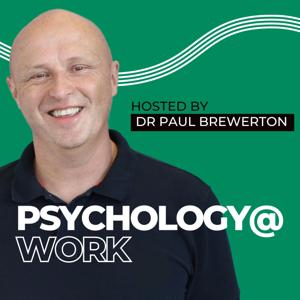
Deep dive into strengths-based psychologist and Strengthscope founder, Dr Paul Brewerton's mind for insights on human behaviour in the world of work, helping you get the most from work and from life, every day. A series of bi-weekly podcasts to help you transform your understanding of individuals and how to help them reach their best performance.
Follow Dr Paul Brewerton on LinkedIn: https://www.linkedin.com/in/paul-brewerton-0719461/
Follow Strengthscope 👇
Learn more about Strengthscope: https://www.strengthscope.com/

1,085 Listeners

3,054 Listeners

835 Listeners