
Sign up to save your podcasts
Or



Energise your employee experience
Employers are starting to wake up to the fact that it’s them who need to start flexing to the needs and expectations of their employees rather than the other way around.
And in my view, these changes are accelerating, won’t be reversed and any employer that doesn’t shift its thinking will fail to attract and keep good people, ultimately leading to untimely death.
In todays podcast I am going look through a strengths lens – well there’s no greater relevance for strengths than in the context of the employee experience.
How to change the habits of a lifetime
Changing habits comes up a lot on people’s to do lists – when we want to keep our NY resolutions, lose weight, get fit, stop smoking, eat healthily and so on and so on. With the stuff I talk about on these podcasts, it’s usually the case that we’re wanting to change habituated behaviour by adopting new thinking or new behavioural patterns and using our brain’s innate ability to create more efficient neural networks.
But some of our habituated patterns of thinking and behaviour go soooo far back to our early lives that they may well underpin many of our behaviours in later life, wait for it, without us even knowing!
I’m going to be talking today about one way of looking at these drivers of our behaviour, in the context of a psychotherapeutic system called Transactional Analysis.
Why? Because I want to talk about whether what our parents gave us as ways of thinking and behaving from the very beginning of our lives are still working for us now.
And if not, what we can do about it.
Today's podcast is about how adding strengths together can actually lead to a multiplication of strengths (I know right, mad maths), which can make those strengths either super-strong, or which may lead to them getting totally out of control.
How to create super-strengths and not strength monsters
My podcasts focus on the intersect between life and work and strengths and Oh My Actual God (other deities are available), today’s podcast really does cover all three.
Like literally, in the form of a diagram - Ikigai.
Live Longer With Ikigai
Today’s podcast is all about the intersection between work and strengths and how to do this best, particularly when it comes to leadership development.
Make your leadership 360 degree feedback program work
Employee engagement is a workplace approach designed to ensure that employees are committed to their organisation’s goals and values, motivated to contribute to organisational success, and are able at the same time to enhance their own sense of wellbeing.
Engaging employees is seen as a bit of a ‘holy grail’ when it comes to managing people and looking after their well-being.
So how exactly do people professionals – from departments like Human Resources, Learning and Development and Organisation Development - create the conditions to engage employees in their work?
That’s the topic of today’s podcast. To keep it simple, I’m going to focus on four key elements for engaging employees in the workplace.
So as we head in to the new year, there’s a good chance that you’ll be thinking about your goals for the year ahead.
So the question I’m posing this week, and giving you some tips for, is how best to structure your goal-setting for the start of the year (or quite frankly for any time) to give you the best possible chance of success. And, as usual, my tips are backed by science.
This week I am delighted to be joined for a podversation by Louise Blanchett, a wonderful lady with approximately 200% more energy than me. I know right? And Louise is going to tell her story of strengths through her career so far – how she’s used the approach in her corporate career, for her own personal development and outside of work too.
Being present at Chrismas
I know you know that Christmas can be stressful. Forget that, Christmas is stressful. In fact, hold on, has someone actually designed-in stress to Christmas as a way of making more money from us?
Or is that a conspiracy theory too far?
Ok, so assuming no one's actually deliberately manipulating our stress levels against our will at Christmas, we’re probably more in control of the Christmassy goings-on than we think.
Present-buying, late-night shopping, organising family events, friend get-togethers, work socials, Christmas dinner organising, cooking, hosting, present-giving, family tensions, overindulging.
All these things can be seen as standard stresses that we associate with Christmas but they’re also kind of restricted to just Christmas itself – like nothing else is quite like it for creating that nervous anxiety.
So in today’s podcast, I want to talk about staying present at Christmas and keeping focused on the important things, so you don’t get washed away in a sea of unsatisfying busyness only to wake up on Boxing Day needing a serious holiday and wondering what the last few weeks have all been for.
From the publisher's feed
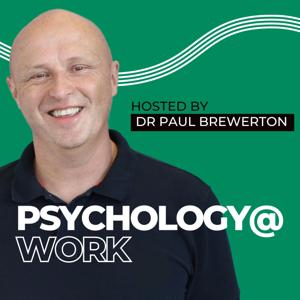
Deep dive into strengths-based psychologist and Strengthscope founder, Dr Paul Brewerton's mind for insights on human behaviour in the world of work, helping you get the most from work and from life, every day. A series of bi-weekly podcasts to help you transform your understanding of individuals and how to help them reach their best performance.
Follow Dr Paul Brewerton on LinkedIn: https://www.linkedin.com/in/paul-brewerton-0719461/
Follow Strengthscope 👇
Learn more about Strengthscope: https://www.strengthscope.com/

1,085 Listeners

3,054 Listeners

835 Listeners