
Sign up to save your podcasts
Or


This comprehensive guide, "Quantum Computing Explained For Programmers," introduces the fundamental shift from classical to quantum computing by explaining core concepts such as qubits, superposition, and entanglement. It visualizes qubit states and their manipulation using the Bloch sphere and categorizes various quantum gates by their function and the number of qubits they affect, highlighting the importance of multi-qubit gates for entanglement and universal gate sets for achieving quantum advantage. Finally, the text surveys the current landscape of quantum SDKs, including Qiskit, Cirq, Azure QDK, Amazon Braket, PennyLane, and Ocean SDK, emphasizing their Python-first, cloud-integrated models and the critical role of transpilers in optimizing circuits for specific hardware. The source concludes by recommending practical next steps for programmers to begin their journey into the quantum era.
Research done with the help of artificial intelligence, and presented by two AI-generated hosts.
Note: “qubit” was incorrectly pronounced as “kwibit” instead of “cue-bit” (the standard pronunciation). This issue arises from phonetic handling, and it cannot be easily corrected because the second-stage AI is not reading from a fixed script but generating new dialogue from the research report. As a result, all the episodes on Quantum Computing were affected by this error.
 View all episodes
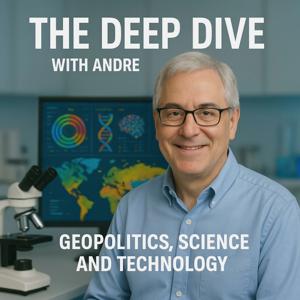
 By Andre Paquette


3.7
33 ratings
This comprehensive guide, "Quantum Computing Explained For Programmers," introduces the fundamental shift from classical to quantum computing by explaining core concepts such as qubits, superposition, and entanglement. It visualizes qubit states and their manipulation using the Bloch sphere and categorizes various quantum gates by their function and the number of qubits they affect, highlighting the importance of multi-qubit gates for entanglement and universal gate sets for achieving quantum advantage. Finally, the text surveys the current landscape of quantum SDKs, including Qiskit, Cirq, Azure QDK, Amazon Braket, PennyLane, and Ocean SDK, emphasizing their Python-first, cloud-integrated models and the critical role of transpilers in optimizing circuits for specific hardware. The source concludes by recommending practical next steps for programmers to begin their journey into the quantum era.
Research done with the help of artificial intelligence, and presented by two AI-generated hosts.
Note: “qubit” was incorrectly pronounced as “kwibit” instead of “cue-bit” (the standard pronunciation). This issue arises from phonetic handling, and it cannot be easily corrected because the second-stage AI is not reading from a fixed script but generating new dialogue from the research report. As a result, all the episodes on Quantum Computing were affected by this error.
14,380 Listeners

5,516 Listeners
12,229 Listeners
4,172 Listeners
1,626 Listeners

22 Listeners

16,023 Listeners