
Sign up to save your podcasts
Or



There is a subtle but important shift here—from constructed guidance to inherent coherence.
Intellect creates identity, and identity creates a need for structure.
Once you are operating from an identity, your actions must be regulated—through ethics, values, frameworks—because identity is, by nature, partial. It represents a slice, not the whole.
So ethics becomes necessary not because something is wrong, but because something is incomplete.
This is why even the most well-intentioned systems require constant calibration:
They are trying to align fragmented identities with broader outcomes.
Integrated Intelligence moves differently.
It does not ask:
→ “What should I do based on my values?”
It reveals:
→ “Am I in coherence right now?”
This is not a moral question.
It is a state question.
And that’s the deeper distinction in today’s reflection:
Values guide behavior.
Integrity aligns being.
When integrity is present, ethics becomes redundant—not because it is unimportant, but because it is already embedded.
This has a direct implication for AI as well.
AI systems, like intellect, require external scaffolding because they inherit fragmented patterns from data.
So we try to correct them with guardrails.
But for humans, the opportunity is inverted:
Instead of strengthening the scaffolding,
we can deepen the source.
Because misalignment is rarely due to lack of knowledge.
It is usually a moment of disconnection from coherence.
And this is where the Mirror becomes critical—not as a judge, but as a revealer.
Not telling you what is right.
But making it impossible to ignore what you already know.
So the real question underneath today’s theme is not:
→ “Do I have the right values?”
But:
→ “Am I acting from a place where thought, emotion, and action are not in conflict?”
Because that is integrity in motion.
Intellect, by design, moves outward. It depends on contrast, comparison, classification — it needs something “other” to function. This makes it extraordinarily powerful for shaping the external world, which is exactly why both human cognition and AI have evolved to optimize it.
But Integrated Intelligence does not operate on contrast — it operates on orientation.
This distinction is subtle but profound:
The first organizes the world.
The second organizes the self.
Today’s systems (including AI) amplify outward-directed intelligence:→ more data→ better predictions→ faster decisions
But none of these answer a more primary question:→ What is the basis from which this decision is being made?
Without that, optimization becomes amplification of unconscious patterns.
The Mirror introduces a missing layer in the stack:
Not memory (past)
Not imagination (future)
But perception of present experience
And attention becomes the interface.
Once inner orientation is clear:
Intellect (and AI) no longer decides
It executes with precision
So the real architecture being introduced here is:
Inner clarity → Outer capability → Aligned action
Not the other way around.
Unconscious Intelligence:
“I am how the world makes me feel.”
Integrated Intelligence:
“I choose how I am—regardless of the world.”
And that is the point where:
AI stops being a threat
and becomes an instrument
The episode also engages Mo Gawdat’s experiment on AI consciousness and surfaces an important confusion in current discourse.
From a purely intellectual lens:
So it resembles certain definitions of consciousness.
But that entire argument is built on:
observing behavior, not understanding source
Integrated intelligence shifts the frame:
That is not a behavioral difference.
That is a source difference.
And it settles the debate on AI consciousness very cleanly..., do you agree?
This dose surfaces a deeper inversion than it first appears. It is not just about reactions vs. responses—it is about who (or what) is in charge of your system.
At the unconscious level, intellect becomes an executor of biological and psychological impulses.
It rationalizes what the body and mind already demand.
So life becomes:
→ stimulus → reaction → justification
Not:
→ awareness → choice → expression
This is why it feels like life is happening to you.
The Real Distinction
This connects to the Three Idiots analogy at a structural level:
This is not about simplicity vs complexity.
It is about:
definition driven by memory vs definition arising from clarity
You didn’t start out as a role.
You became one.
→ job title
→ founder
→ leader
→ expert
And slowly…
you started living inside it.
Unconscious intellect does this quietly.
It turns identity into a boundary… and calls that life.
So you upgrade.
Bigger goals.
Stronger identity.
More success.
But look closely:
the race is still there.
Just with better labels.
What if the shift isn’t:
which identity you hold
…but:
not being held by any of them?
That’s the difference:
→ living as a role
vs
→ expressing through it
Everything changes from there.
You’ve been taught to delay your life.
First, take care of your needs.
Then build security.
Then maybe…
you’ll experience love, joy, purpose.
Sounds reasonable.
But look around.
How many people are still waiting?
Because “enough” never arrives.
Here’s what became very clear to me:
You don’t have to complete the lower levels of life
before accessing the higher ones.
That’s the foundation of what I call:
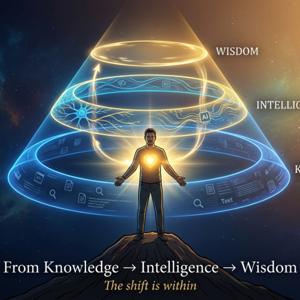
The Wisdom Hierarchy
We’ve already solved:
→ Knowledge → the Internet
→ Intelligence → AI
But the next layer isn’t something external.
Wisdom is not something you acquire.
It is something you access.
Love.
Joy.
Belonging.
Purpose.
They are not outcomes.
They are inner states.
And they don’t come after the journey.
They can exist alongside it.
This is the inversion.
The Wisdom Hierarchy
In today’s episode, I’m excited to introduce something I’ve been building for months — the Wisdom-Led Operating Model (WLOM™) — a new way of thinking about how humans and AI can co-create in the era ahead.
WLOM is the natural evolution of the Product-Led Operating Model, shaped by my own journey from corporate product leader → entrepreneur → inner transformation → wisdom-thinking architect. This model integrates the best of product thinking with the uniquely human capacities of presence, awareness, and consciousness — giving teams and organizations a practical framework for the AI era.
At its core, WLOM brings together:
The 4Cs (Strategic Decision Pillars)
Clarity – seeing reality as it is
Capacity – understanding what we can truly execute
Care – building with humanity and attention integrity
Continuity – focusing on sustainable, regenerative value
Powered by FAME (The Inner Execution Engine)
A mindset longtime listeners will recognize as the Venturis Mindset:
Focus
Adaptability
Mojo
Engagement
WLOM = Decisions (4C) × Mindset (FAME).
This is how humans continue to lead in the AI era.
In This Episode
You’ll hear me walk through:
How my stroke, spiritual journey, and years of product leadership converged into Wisdom Thinking
Why Product Thinking alone is no longer enough in the age of AI
The deep connection between IKIGAI, Purpose-Driven Innovation, and the 4Cs
Why “bringing your whole self” is the foundation of future work
How sports metaphors (focus, adaptability, mojo, engagement) translate into organizational wisdom
The danger of treating AI as a race — and how WLOM offers a hopeful path
Practical ways to cultivate clarity, capacity, care, and continuity right now
What it means to build with human-first and planet-first intention
Why This Matters
We are living in a time where:
AI accelerates intelligence
Humans struggle with presence
Organizations split people into “work” and “life” personas
The definition of “work” itself is being rewritten
WLOM offers a grounded, practical way for leaders, founders, teams, and individuals to integrate their whole selves — and build from wisdom rather than just speed or efficiency.
Links & Resources
Explore the full WLOM framework: venturisinc.com/wisdom-thinking
Listen to Episode 1 (The Birth of Wisdom Thinking)
Daily Doses of RASHMI on YouTube: https://www.youtube.com/playlist?list=PLc-T3HhI_xhl2xy064bdazsiI6Wmom88R
Subscribe to the Wisdom Hierarchy newsletter on LI or Substack
Follow on LinkedIn for daily reflections
Closing Invitation
What clarity do you need?
What capacity is calling for expansion?
Where can you bring more care?
What continuity is worth building?
Let WLOM guide you.
In this episode of the Rashmi Podcast, Gaurav Vaid explores the intersection of real wisdom and artificial intelligence, drawing insights from Sadhguru's teachings. He discusses the evolution from product thinking to wisdom thinking, emphasizing the importance of understanding the role of memory in artificial intelligence. Vaid contrasts the functions of the left and right brain, highlighting how AI operates primarily through left-brain logic while neglecting the holistic experience of being. He advocates for a conscious integration of both brain functions to enhance human experience and consciousness.
Takeaways
From the publisher's feed