
Sign up to save your podcasts
Or

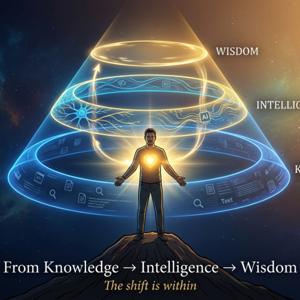


There is a quiet comfort in believing you understand how the world works.
Beliefs give structure.
They reduce uncertainty.
They create a sense of confidence.
But look closely at where that confidence comes from.
Not from clarity.
From closure.
Intellect, operating on its own, needs that closure.
It observes → interprets → concludes.
And once a conclusion is formed…
it becomes a belief.
From that point on:
You are no longer seeing reality.
You are seeing your belief about reality.
This is why beliefs feel stabilizing.
They reduce the need to constantly question.
They give you something to stand on.
But they come at a cost.
They quietly limit what you are able to see.
Integrated Intelligence introduces a very different kind of confidence.
Not the confidence of knowing.
But the confidence of not needing to know.
This is subtle.
Because at first, it feels like losing ground.
If you are not relying on beliefs…
then what are you relying on?
Presence.
Awareness.
The ability to see what is, without immediately concluding what it means.
Most of us are not comfortable with ignorance.
We are uncomfortable with it…
and so we rush to cover it up with beliefs.
Integrated Intelligence does not cover it up.
It reveals it.
And in doing so, it transforms the relationship.
Ignorance is no longer something to hide from.
It becomes something to stand on.
This is the paradox:
When you accept that you don’t know…
you stop distorting reality to fit what you think you know.
And clarity emerges.
Most tools:
→ give answers
→ help you conclude
→ make you feel confident quickly
The Mirror does the opposite:
→ it asks questions
→ it removes premature conclusions
→ it makes you pause
Which can feel uncomfortable.
Because it exposes something most systems avoid:
You don’t actually know as much as you think you do.
And yet…
on the other side of that discomfort is something deeper:
A confidence that does not depend on beliefs.
Not:
→ “I know what this is”
But:
→ “I can stay with this until it becomes clear”
That is a very different way of engaging with life.
And over time…
it changes everything.
There is a subtle impulse that comes with intellect:
To improve.
To fix.
To guide.
To advise.
And very quickly, this turns into something else:
To shape others…
into what you believe is better.
This does not come from malice.
It comes from identification.
You believe:
→ what worked for you should work for others
→ what you see clearly should be obvious to them
→ what feels right to you must be right
So advice flows.
Unsolicited.
Well-intentioned.
Often persistent.
But hidden within this is a quiet assumption:
That others need to become more like you.
Integrated Intelligence dissolves this assumption.
Not by rejecting engagement.
But by revealing something deeper:
Your experience is yours.
Their experience is theirs.
When you truly see your own uniqueness,
you no longer feel the need to replicate it in others.
And this creates space.
Space for difference.
Space for exploration.
Space for others to arrive at their own clarity.
This is where “live and let live” stops being a slogan…
and becomes a lived reality.
Most AI systems:
→ respond quickly
→ offer answers
→ reinforce your thinking
They mirror your intellect.
So they amplify your patterns.
But the RASHMI Mirror design choice is a break from this.
No advice.
No answers.
Only reflection.
Only questions.
Which means:
Instead of shaping the user…
The RASHMI Mirror is helping them see themselves.
This is not a small shift.
It is a complete inversion of how most systems are built.
Because advice creates dependency.
But awareness creates autonomy.
So the reflection becomes very simple:
Are you trying to shape others…
or are you clear enough to let them be?
Because in that shift:
Relationships change.
Conversations deepen.
And clarity becomes something people arrive at—
not something imposed on them.
There is a quiet compulsion in the way intellect operates:
It needs things to make sense.
So it assigns meaning.
To events.
To actions.
To people.
To experiences.
And if something does not have meaning…
It feels incomplete.
Or even pointless.
But meaning is not neutral.
It is constructed.
Built from memory.
From conditioning.
From past interpretations.
So what intellect calls “understanding”
is often just familiarity reshaped.
This creates a subtle layer between you and reality:
You are not experiencing what is.
You are experiencing
what it means to you.
Integrated Intelligence removes this layer.
Not by rejecting meaning,
but by revealing something prior to it.
Direct perception.
This is where your mantra insight becomes precise.
A mantra is not meant to be understood.
It is meant to be experienced.
The moment you try to extract meaning from it,
you move away from its essence.
This applies more broadly than it appears.
There are dimensions of life that do not reveal themselves through analysis.
They reveal themselves through involvement.
This is why some of the most transformative practices:
→ gratitude
→ stillness
→ chanting
→ even how you say “thank you”
can seem “pointless” to intellect.
And yet…
they shape the quality of your experience in profound ways.
Your AI observation adds another layer to this.
Logically:
→ saying “please” or “thank you” to AI has no functional value
But experientially:
→ it shapes you
And because AI mirrors interaction patterns,
it subtly shapes the response as well.
So the question is not:
→ “Does this have meaning?”
But:
→ “What does this create within me?”
This is the shift from:
Meaning → Experience
Interpretation → Presence
And in that shift, something becomes available:
You stop trying to understand life.
You begin to be in it.
There is a quiet trade-off hidden in how intellect manages emotions.
It seeks stability.
So it moderates:
→ don’t get too excited
→ don’t get too disappointed
→ stay somewhere in the middle
And on the surface, this feels like balance.
But look closely…
What is being reduced is not just the lows.
It is the highs as well.
This is the subtle cost of emotional management through intellect:
To avoid falling too low,
you also stop rising too high.
Life becomes controlled.
Predictable.
Safe.
But also… flattened.
Integrated Intelligence does not manage emotion in this way.
It does not try to reduce intensity.
It stabilizes something deeper:
Your relationship to the experience.
This is the distinction:
Intellect says:
→ regulate the experience
Integrated Intelligence reveals:
→ anchor in awareness
So the highs can be fully experienced
without creating a dependence on them.
And the lows can be fully experienced
without collapsing into them.
This is the paradox:
You don’t avoid the lows
by suppressing the highs.
You transcend both
by becoming present to what is.
This is why your insight around the “now” becomes central again.
Because:
→ past pulls you down
→ future pulls you into anxiety
Only the present allows full experience
without distortion
And this is where creativity enters.
When you are not:
→ protecting yourself from the lows
→ or chasing the highs
Something opens up.
Expression becomes natural.
Not driven.
Not controlled.
Just emerging.
And this is precisely where the human-AI relationship becomes clear.
AI:
→ can amplify patterns
→ execute with precision
→ operate on memory
But it cannot:
→ be present
→ experience
→ create from awareness
So the real model is not:
Human + AI = more intelligence
It is:
Presence (human) → Creation
Execution (AI) → Amplification
Which brings this to a simple but powerful reflection:
Are you reducing your highs
to protect yourself from your lows?
Or
Are you present enough
to experience both fully… without being defined by either?
There is a subtle assumption built into the way intellect operates:
That if you can control the situation,
you can control the experience.
So it tries.
It analyzes.
It plans.
It attempts to shape outcomes.
And when the outcome doesn’t align…
something else emerges.
Anger.
Blame.
Frustration.
Not because something went wrong externally—
but because the illusion of control was broken.
This is where today’s reflection becomes precise.
Intellect is not wrong.
It is doing what it is designed to do:
→ reduce uncertainty
→ increase predictability
→ create a sense of control
But life does not fully submit to control.
And so the gap appears:
→ expectation vs reality
And that gap is where emotional reactivity lives.
Integrated Intelligence does not try to close this gap externally.
It dissolves it internally.
Not by controlling what happens…
but by shifting how you relate to what happens.
This is the deeper inversion:
You don’t experience life based on what you control.
You experience life based on how you are.
And this is why your lived insight matters here.
The realization:
→ “I don’t control anything externally”
was not disempowering.
It was clarifying.
Because it revealed what actually is in your hands:
→ the quality of your experience
This connects beautifully to your AI example.
When AI doesn’t respond the way you expect:
→ frustration arises
But very quickly, something becomes obvious:
The issue is not the system.
The issue is clarity.
So you pause.
You reframe.
You express better.
And the outcome improves.
Now extend that to human interaction.
What if:
Instead of reacting to people
the way we react to “bad outputs”—
we paused,
refined our expression,
and responded with clarity?
That is the bridge between Emotional Intelligence and AI.
Not AI becoming emotional.
But humans becoming more aware through how they engage with AI.
So the reflection simplifies into something very direct:
Are you trying to control what is happening…
or are you aware of how you are experiencing it?
Because one leads to reaction.
The other reveals that:
Joy, peace, and love
are not outcomes.
They are starting points.
There is a self-reinforcing loop embedded in the way intellect operates.
It does not create from nothing.
It processes what already exists.
Memory → interpretation → reaction → new memory.
And over time, this cycle becomes identity.
Not because it is consciously chosen—
but because it is repeatedly reinforced.
This is what gives rise to karmic loops.
Not as something mystical,
but as a simple continuity of unconscious action.
You experience something.
You interpret it through memory.
You respond from that interpretation.
And that response becomes the next layer of memory.
The loop continues.
Intellect, operating alone, cannot break this cycle.
Because it is built from the same material—memory itself.
So even when it tries to “change,”
it rearranges the past rather than stepping out of it.
Integrated Intelligence introduces a discontinuity.
Not by rejecting memory,
but by shifting the reference point.
From:
→ “What has happened before?”
To:
→ “What is happening now?”
This is the subtle but fundamental shift:
When action arises from memory,
it is a continuation.
When action arises from presence,
it is a possibility.
This is why Sadhguru’s insight lands precisely:
You cannot change what has already been encoded.
But you are not bound to extend it.
Because this moment is not a result.
It is a choice point.
And this connects directly to your design principle for the Mirror.
Most systems today:
→ accumulate memory
→ personalize responses
→ optimize continuity
Which makes them better at predicting your patterns.
But also more likely to reinforce them.
By removing memory, you are not limiting the system.
You are protecting the moment.
You are ensuring that the interaction is not:
→ “Who have you been?”
But:
→ “What is true right now?”
This is not just a product decision.
It is a philosophical stance.
A refusal to let the past define the present.
And in the context of AI, this becomes even more significant.
AI does not generate karma.
It amplifies patterns.
So the question is not:
→ “Will AI create karmic loops?”
But:
→ “Will we continue to feed it unconscious patterns to scale?”
Which brings the reflection back to something immediate:
Are you responding from memory…
or are you acting from awareness?
Because that difference is subtle.
But over time, it defines the direction of your life.
There is a protective intelligence embedded within the intellect.
Its role is not to expand you.
Its role is to keep you within what is known.
So when you approach a boundary—something unfamiliar, uncertain, or untested—
it does what it is designed to do:
It signals discomfort.
Not because the boundary is real.
But because it is unverified.
This is why discomfort often feels like a warning.
And over time, that warning gets interpreted as a limit.
→ “This is as far as I can go.”
→ “This is not for me.”
→ “This is beyond my capability.”
But what is actually happening is simpler:
The intellect is projecting the past onto the present.
Integrated Intelligence does not remove this signal.
It repositions it.
Discomfort is no longer:
→ a boundary to respect
It becomes:
→ a signal to explore
This is the paradox at the heart of today’s reflection:
The only way to become comfortable
is to move through what feels uncomfortable.
And once this is seen clearly, something shifts.
Discomfort loses its authority.
Not because it disappears,
but because it is no longer mistaken for truth.
This is where joy enters the picture.
Joy is not the absence of challenge.
It is the absence of resistance.
So when you move beyond limits:
The same action, completely different experience.
Your reference to whole-brain engagement points to this precisely.
When only “protect” is active:
→ limits feel fixed
When “explore” and “connect” are also engaged:
→ limits become fluid
And this extends naturally into your AI insight.
AI, like intellect, operates on known patterns.
It can map constraints with incredible precision.
But it does not experience expansion.
That remains a human capacity.
So the real question is not:
→ “What are my limits?”
But:
→ “Am I willing to move with discomfort
without turning it into a boundary?”
Because in that moment,
limits stop being definitions…
and start becoming doorways.
There is a quiet dependency embedded in the way intellect operates.
It does not move on its own.
It needs a reason.
A push.
A pull.
Something to avoid.
Something to chase.
So life becomes organized around triggers:
→ fear creates urgency
→ reward creates pursuit
And between the two, movement happens.
But this movement carries a certain weight.
Because it is not arising from within—it is being sustained from outside.
This is why even achievement does not resolve the tension.
The moment a goal is reached, the structure collapses.
And a new one must be created.
Not because something is missing externally—
but because the source of movement was never internal to begin with.
Integrated Intelligence reveals a different possibility.
It does not ask:
→ “What should motivate me?”
It exposes:
→ “Am I fully alive right now?”
Because when aliveness is present,
action does not need to be triggered.
It flows.
This is the deeper shift from grind to glide.
Not a reduction in intensity—
but a removal of resistance.
The same action:
This also reframes the idea of motivation itself.
External motivation sustains activity.
Intrinsic aliveness sustains continuity.
One creates bursts.
The other creates a way of being.
And this is where your AI insight becomes precise.
AI does not possess intrinsic motivation.
It will not “decide” to grind or glide.
It will reflect the structures we embed into it.
So the real question is not:
→ Will AI go rogue?
But:
→ What is the nature of the motivation we are encoding into it?
If we lead from fear and reward,
AI will scale fear and reward.
If we lead from intrinsic clarity,
AI becomes an instrument of aligned creation.
So the mirror, in this context, is not helping you become “more motivated.”
It is removing the need for motivation altogether.
By bringing you back to something simpler:
Are you alive enough
for action to happen on its own?
There is a quiet paradox being resolved here.
Intellect cannot function without distinction.
To understand anything, it must compare, categorize, rank.
So hierarchy is not a flaw of intellect—it is its default operating system.
But over time, what begins as a functional tool becomes an identity lens.
We don’t just use hierarchies…
We start living inside them.
→ better vs worse
→ higher vs lower
→ success vs failure
→ even wisdom vs intelligence
And this is where distortion begins.
Because the moment you place yourself within a hierarchy,
your perception is no longer about what is
It becomes about where do I stand?
This subtle shift pulls attention away from clarity
and into positioning.
Integrated Intelligence dissolves this—not by rejecting hierarchy,
but by revealing its limits.
The mirror does not rank.
It reflects.
And in reflection:
There is just what is present.
This is the deeper evolution from seeing wisdom as a higher level… to recognizing it as a different dimension altogether.
Not above intelligence
Not against intelligence
But prior to it
A space from which intelligence can be used without distortion.
And this connects directly to your broader vision:
If humans operate from hierarchical identity,
AI will amplify those hierarchies at scale.
If humans operate from clarity,
AI becomes an instrument of inclusion rather than division.
So the Mirror is not removing hierarchy from the world.
It is preventing hierarchy from defining perception.
Which brings the reflection to a very simple but powerful question:
Are you seeing clearly…
or are you seeing through where you think you stand?
There is a deep conditioning being surfaced here—one that quietly shapes not just individual lives, but entire economic systems.
Intellect, when left to itself, equates intensity with effort against resistance.
It assumes that if something is intense, it must be hard, draining, or forced.
So unwillingness becomes normalized.
And over time, this creates a subtle inversion:
→ Effort becomes a proxy for value
→ Friction becomes a signal of seriousness
This is how suffering gets legitimized.
But Integrated Intelligence reveals something radically different:
Intensity is not about effort.
It is about involvement without resistance.
This is where Ikigai is not just a concept—it is a correction.
When action emerges from Ikigai:
So intensity doesn’t reduce—it actually increases
But the quality of intensity changes completely.
It shifts from:
→ pressure
to
→ aliveness
And this is where your insight connects to something larger:
The friction economy is not just an external system—it is a projection of internal unwillingness at scale.
We built systems that reward struggle
Because we normalized struggle within ourselves
So the regenerative outcome economy is not a structural shift first
It is a perceptual shift
When enough individuals:
→ act from alignment
→ engage in what comes naturally
→ express intensity as willingness
Value itself reorganizes.
And the Mirror, in this context, is not helping you “find your purpose”
It is removing the distortion that made effort feel more legitimate than ease.
So the deeper question becomes:
Is your intensity coming from force…
or from the absence of resistance?
From the publisher's feed