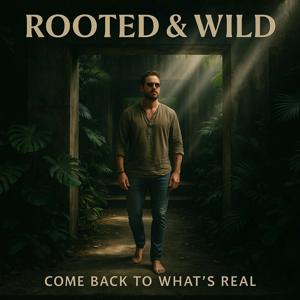
What happens to us when there is no longer enough space to simply be?
In this episode of Rooted & Wild, I’m joined once again by Amy Rogg, creator and facilitator of Underbelly: The Art of Slowing Down®, for a deeper exploration of something many of us experience but may struggle to name: compression.
Compression can show up physically as tension, bracing, shallow breathing, constriction, or the feeling that we need to make ourselves smaller. It can happen mentally when our attention becomes crowded by information, expectations, decisions, and constant stimulation. And culturally, it can emerge from systems built around urgency, productivity, consumption, speed, and the expectation that there should always be more.
Amy’s work with Underbelly was created specifically in response to what she describes as the loss of slowness and spaciousness in dominant culture. Through rest, embodied movement, music, stillness, relational exploration, and nervous-system co-regulation, her practice invites people away from incessant stimulation and toward a slower, more receptive relationship with themselves and one another.
But spaciousness isn't necessarily about having an empty calendar or escaping to somewhere quiet.
It's about what happens inside us when there is enough room to feel.
Amy and I explore the body's continual movement between expansion and contraction and what can happen when contraction becomes our default way of living. We talk about the subtle ways we brace against life, override sensation, rush toward answers, fill silence, consume stimulation, and lose contact with the quieter intelligence of the body.
We also move beyond the individual.
If our bodies are compressed, what happens to our relationships? Our creativity? Our ability to listen? Our capacity to tolerate complexity? And what happens when entire cultures become organized around speed?
Underbelly intentionally centers qualities that our accelerated culture can leave little room for: rest, boredom, emotional digestion, subtlety, listening, parasympathetic capacity, communion, complexity, and attuned relationship.
Perhaps healing isn't always about adding another practice, solution, or piece of information.
Sometimes healing begins when we create enough space for what is already inside us to finally unfold.
In this episode, we explore:
• What Amy means by compression and spaciousness
• How compression can manifest in the physical body
• Expansion and contraction as natural bodily experiences
• Tension, bracing, holding, and constriction
• Why modern life can leave us feeling internally crowded
• Speed, urgency, productivity, and incessant stimulation
• The nervous system's relationship with space
• Why slowing down can reveal sensations we've stopped noticing
• Rest and boredom as meaningful human experiences
• Emotional digestion and allowing feelings time to move
• Why we rush toward answers, certainty, and solutions
• The difference between fixing ourselves and listening to ourselves
• Creating space for complexity and contradiction
• How compression affects relationships and connection
• Individual regulation and co-regulation
• Returning agency to the body
• Movement, stillness, breath, and embodied awareness
• How culture shapes the way our bodies experience the world
• Reclaiming slowness without abandoning modern life
• Creating more spaciousness in ordinary moments
About Amy Rogg
Amy Rogg is the creator, steward, and facilitator of Underbelly: The Art of Slowing Down®, a non-verbal somatic journeying practice incorporating rest, embodied movement, music, stillness, and relational exploration.
Her work responds to the loss of slowness and spaciousness in modern culture by creating environments where people can explore nervous-system regulation, emotional digestion, listening, subtlety, relationship, and embodied awareness without being pushed toward a predetermined outcome.
Amy has a B.A. in television and film production, studied acting and improvisation in Los Angeles, has taught yoga as an E-RYT 500 and meditation for more than a decade, is a certified herbalist, and has engaged in and facilitated somatic and relational movement practices since 2012.
Connect with Amy Rogg:
Website: AmyRogg.com
Practice: Underbelly: The Art of Slowing Down®
Rooted & Wild provides general information for educational and informational purposes only. The views and opinions expressed by guest speakers are their own and do not necessarily reflect those of Henry Hawk. The content shared on this podcast is not intended to replace individualized medical, psychological, or therapeutic advice, nor should it be used to diagnose or treat any health condition. Listeners are encouraged to consult with qualified healthcare professionals regarding any medical or mental health concerns.