
Sign up to save your podcasts
Or

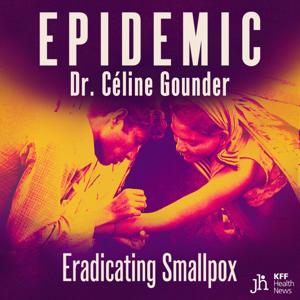

In 1975, smallpox eradication workers in the capital of Bangladesh, Dhaka, rushed to a village in the south of the country called Kuralia. They were abuzz and the journey was urgent because they thought they just might be going to document the very last case of variola major, a deadly strain of the virus.
When they arrived, they met a toddler, Rahima Banu.
She did have smallpox, and five years later, in 1980, when the World Health Organization declared smallpox eradicated, Banu became a symbol of one of the greatest accomplishments in public health.
That’s the lasting public legacy of Rahima Banu, the girl.
Episode 8, the series finale of “Eradicating Smallpox,” is the story of Rahima Banu, the woman — and her life after smallpox.
To meet with her, podcast host Céline Gounder traveled to Digholdi, Bangladesh, where Banu, her husband, their three daughters, and a son share a one-room bamboo-and-corrugated-metal home with a mud floor. Their finances are precarious. The family cannot afford good health care or to send their daughter to college.
The public has largely forgotten Banu, while in her personal life, she faced prejudice from the local community because she had smallpox. Those negative attitudes followed her for decades after the virus was eradicated.
“I feel ashamed of my scars. People also felt disgusted,” Banu said, crying as she spoke through an interpreter.
Despite the hardship she’s faced, she is proud of her role in history, and that her children never had to live with the virus.
“It did not happen to anyone, and it will not happen,” she said.
Voices From the Episode:
Find a transcript of this episode here.
“Epidemic” is a co-production of KFF Health News and Just Human Productions.
To hear other KFF Health News podcasts, click here.
Subscribe to "Epidemic” on Apple Podcasts, Spotify, Google Podcasts, Pocket Casts, or wherever you listen to podcasts.
Hosted by Simplecast, an AdsWizz company. See pcm.adswizz.com for information about our collection and use of personal data for advertising.
 View all episodes
 By KFF Health News and JUST HUMAN PRODUCTIONS

4.6
10051,005 ratings
In 1975, smallpox eradication workers in the capital of Bangladesh, Dhaka, rushed to a village in the south of the country called Kuralia. They were abuzz and the journey was urgent because they thought they just might be going to document the very last case of variola major, a deadly strain of the virus.
When they arrived, they met a toddler, Rahima Banu.
She did have smallpox, and five years later, in 1980, when the World Health Organization declared smallpox eradicated, Banu became a symbol of one of the greatest accomplishments in public health.
That’s the lasting public legacy of Rahima Banu, the girl.
Episode 8, the series finale of “Eradicating Smallpox,” is the story of Rahima Banu, the woman — and her life after smallpox.
To meet with her, podcast host Céline Gounder traveled to Digholdi, Bangladesh, where Banu, her husband, their three daughters, and a son share a one-room bamboo-and-corrugated-metal home with a mud floor. Their finances are precarious. The family cannot afford good health care or to send their daughter to college.
The public has largely forgotten Banu, while in her personal life, she faced prejudice from the local community because she had smallpox. Those negative attitudes followed her for decades after the virus was eradicated.
“I feel ashamed of my scars. People also felt disgusted,” Banu said, crying as she spoke through an interpreter.
Despite the hardship she’s faced, she is proud of her role in history, and that her children never had to live with the virus.
“It did not happen to anyone, and it will not happen,” she said.
Voices From the Episode:
Find a transcript of this episode here.
“Epidemic” is a co-production of KFF Health News and Just Human Productions.
To hear other KFF Health News podcasts, click here.
Subscribe to "Epidemic” on Apple Podcasts, Spotify, Google Podcasts, Pocket Casts, or wherever you listen to podcasts.
Hosted by Simplecast, an AdsWizz company. See pcm.adswizz.com for information about our collection and use of personal data for advertising.

43,898 Listeners

43,528 Listeners
2,055 Listeners

340 Listeners

87,529 Listeners

111,948 Listeners

496 Listeners

16,975 Listeners

9,370 Listeners

4,480 Listeners

386 Listeners

3,353 Listeners

8,203 Listeners

31,752 Listeners

7,020 Listeners