
Sign up to save your podcasts
Or

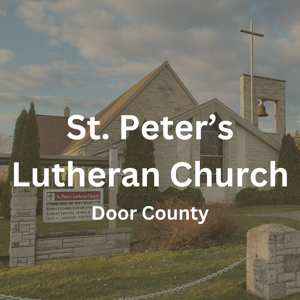


Title: Hope for the Life to Come | Text: 1 Corinthians 15:51–57 | Liturgical Date: Easter 2025 | Calendar Date: April 20, 2025 | Location: Saint Peter’s Lutheran Church in Door County | Preacher: Rev. Dr. Christopher D. Jackson
Saint Peter’s Lutheran Church in Door County
316 W Main St, Forestville, WI 54213
(920) 856-6420
Saint Peter’s Lutheran Church in Door County serves Sturgeon Bay and other locations in Northeast Wisconsin.
TRANSCRIPT
The following transcript was generated with the assistance of AI.
In the name of the Father, the Son, and the Holy Spirit. Amen. Alleluia. Christ has risen. He has risen indeed. Alleluia. Christ has risen and sin is tread down under His feet. Christ has risen and death has been put to death by His own death and resurrection. Christ has risen and the lying, accusing tongue of Satan has been cut off. Christ has risen, and the gates of hell have slammed shut. Christ has risen and the doors of heaven have been opened to all believers. Christ has risen and the harvest has already begun. Christ has risen and the new world has risen as well.
There once was a family of ducks, and the family of ducks went down to the duck church to hear a sermon from the duck minister. The duck minister told the ducks about how the Lord had blessed them so much. The Lord had blessed them like the mammals, just as the mammals have legs that they can move around on the ground and in the woods. The Lord had blessed the ducks in that way as well, but the Lord had done something even better for the ducks. The mammals couldn’t swim around in the lake, but the Lord had granted the ducks these buoyant feathers and webbed feet. They can move around on the ground but also in the water like the fish. But the Lord had blessed the ducks even more than He had the mammals and the fish. He had granted them also wings. They could move around on the ground like the mammals and in the lake like the fish, but they could also soar through the skies. All the duck family thought that was such a marvelous sermon. They talked about what a wonderful sermon the duck minister had preached to them that day as they waddled all the way back home.
Aren’t we like those ducks sometimes? The Lord has granted us eagles’ wings so that we can leave the mire and grime of sin behind, and yet we still waddle in it. The Lord has granted us freedom from sin by the death and resurrection of Christ. By His death, our sins are atoned for, our righteousness fulfilled, and by His resurrection, He has granted us new life, which is a life of sonship to Him instead of slavery to sin, a life of freedom from sin. Yet guilt over our transgressions so often still weighs down our hearts. Shame causes us to, instead of fleeing to God for mercy and to lift up prayers and praises and supplications to Him, flee from His gaze. Even worse, by the Spirit of life, the Lord has given us the power to resist sin, but instead of resisting it, we allow it to have a foothold in our life. Maybe even worse, instead of allowing it to have a foothold, we actively invite it in.
I’m here to tell you, brothers and sisters in Christ, through the resurrection of Christ, the Lord has granted you freedom from sin. No longer must you have guilt. No longer must you have shame, but instead, you can flee to God, seeking His grace and mercy, lifting up prayers and praises and supplications. The Lord has indeed granted you the Spirit of life. Therefore, I encourage you to keep in step with the Spirit, leaving sin behind, pressing on to the paths of righteousness. Christ, the Good Shepherd, leads you in, and that is the blessing that the Lord has given us in this life.
But if our hopes are for this life only, then we are of all men most to be pitied. I tell you, the Lord has blessed us by means of His resurrection beyond this life, but also for the life to come. I have an uncle by the name of Wes Jackson. He’s pretty well known in some circles. His life’s work has been to try to get different agricultural systems, revolutionary agricultural systems, for the Great Plains. He’s been featured in magazines like Smithsonian, National Geographic, all that stuff. But he has his detractors. His detractors say, you know, you haven’t actually accomplished your goal yet, and you’re an old man. His answer to this, I think he got this from church—he was raised in church—is that if your goals are only so big that they can be accomplished in your life, then they’re not big enough.
He’s talking about a secular project and his secular goals, but by this, he puts to shame so many Christians who hope in Christ for this life only. There are many Christians, or those who claim the name of Christ, who consider Christ a good teacher, and yet they do not look to Him for salvation and eternal life. There are other Christians who consider Him something of a genie in the bottle. Ask Him in the right way, and He’ll give you whatever you want in this life. That is too small of a perspective on Jesus Christ. Christ indeed came to bless us in this world, in this life. But His blessings are so much greater than this, for by His resurrection, He has granted us eternal life. By means of His rising from the dead, He has inaugurated a new creation, a new world, a world with untold blessings that far surpass anything we could comprehend in this age. Christ has opened that new life to us, that new world to us, by means of the forgiveness of sins, which we receive by faith.
Speaking of faith, this morning, I would like to talk specifically to the skeptic and the doubter among us. Easter Sunday is one of those Sundays where, even if you do not believe, even if you consider the things of the faith to be foolishness, even if you think that people could only believe in the resurrection 2000 years ago because they were naive and foolish, this word is for you. This word is also for the doubter, the person who wants to believe but finds it hard to believe, or perhaps has a fledgling faith but still finds many questions welling up in heart and mind concerning the resurrection of the Lord Jesus Christ.
People in the time of Christ were just as realistic about the finality of death. That’s why Peter was skeptical when he heard the reports of the women that the tomb was empty. A man like Peter was probably far more realistic about the finality of death in this world than any of us. A man like Peter had probably buried multiple aged relatives in a time of high infant mortality. Peter, in all likelihood, had laid to rest one or maybe even several of his own children. A man like Peter knew that the dead in this world do not rise. That’s where the skeptic and the doubter have something right. The dead in this world do not rise, but the skeptic is still wrong about the fact that Christ had arisen.
Peter, this skeptic, became convinced of the resurrection of the Lord, so much so that he was willing to die a martyr’s death for that testimony. Peter’s not known as the greatest skeptic or doubter in the Bible. The greatest skeptic, the greatest doubter we encounter is St. Thomas. What did Thomas do after he became convinced of the resurrection? He was so convinced that he traveled thousands upon thousands of miles to what you could more or less call a different continent altogether. He traveled all the way to India, was so convinced of the resurrection that he, with his own hands, built a church there in India, and he too was put to death for this testimony, run through with a spear.
That was the faith of so many of the other apostles. The only apostle of the twelve who did not die a martyr’s death for the sake of this testimony was John, even though he suffered for the sake of his testimony. You can get a man to die for all kinds of reasons. A man will gladly die for the sake of his country, and many have. A man will die for the sake of his family, and many have. But to get a man to die for the sake of a lie, for the sake of a conspiracy, that just doesn’t happen. For eleven to die for such a thing, forget about it. Even unbelieving, skeptical scholars who do not believe the truth of the resurrection still believe that the disciples, the apostles, firmly believed that Christ had risen. It is reasonable to believe there is an empty grave in Jerusalem, and it is on the basis of this that we firmly and confidently believe that Alleluia, Christ has risen. He has risen indeed. Alleluia.
I said a few minutes ago that the skeptic and the doubter have something right, that in this world, the dead do not rise. This is why the Scriptures are clear that Christ is the firstfruits of the new creation. This world is consumed by death and will end in death and destruction and chaos. From day to day, we go from bad to worse. If our hopes of eternal life are just for a continuation of life in this world, life as we know it, as St. Paul says, we would be most pitied. That would not be salvation at all. That sounds more like hell to me. But Christ is the firstfruits of the new creation, a creation which defies our understanding, which goes far beyond anything we can comprehend. So incomprehensible is it that Isaiah didn’t meticulously define it like you might a science issue. He used pictures that confound our understanding: lions and wolves eating grass and hay like the oxen, wolves and lambs dwelling together. That’s not a world like anything we know, and praise be to God for that. It is a world of untold joy, a world of untold order, a world of untold light.
That light has already dawned with the resurrection of Christ. It is that light which now shines in our hearts, but will shine upon our eyes when it is brought to its fullness and consummation in His return. We are confident in that because Christ keeps His promises. He promised that in three days He would arise, and indeed He did. Alleluia. Christ has risen. He has risen indeed. Alleluia. Therefore, we are glad and confident and hopeful in the world that the Lord will bring about in His return, when He comes in power and might and glory to draw us to His right hand to live and dwell with Him in blessedness and righteousness forever.
In the name of the Father, the Son, and the Holy Spirit. Amen. Please rise for the Nicene Creed.
The post Sermon: Hope for the Life to Come [Easter 2025] first appeared on Saint Peter's Lutheran Church.
Title: On Repentance
Text: Luke 13:1-9
Liturgical Date: Lent 3
Calendar Date: March 23, 2025
Location: Saint Peter’s Lutheran Church in Door County
Saint Peter’s Lutheran Church in Door County serves Sturgeon Bay and other locations around Northeast Wisconsin.
The following transcript was generated with the assistance of AI and does not reflect the sermon as preached 100 percent:
TRANSCRIPT
In the name of the Father, and of the Son, and of the Holy Spirit. Amen. Today, in our sermon, we’re taking up the theme of repentance—that God loves to forgive our sins when we repent. Today, we are exploring this theme under four headings. First, we’re going to be talking about what repentance is. Second, we’ll discuss the fact that the reason why this world continues to turn day by day is for the sake of repentance, so that sinners would repent of their sins and trust in Christ. Then, we’re going to talk about how whatever evil we behold in this world is there—that we experience it—to remind us to repent. And finally, we’ll see that nobody is too far gone to repent. So let’s get into it.
What is this word “repentance” that we use a lot in church? It’s one of those words we probably use so much that we don’t really think about it, and we don’t really remember what it means. So let’s talk about that a little bit. Repentance has two parts. Those two parts are contrition on the one hand and trust on the other. Now, what is contrition? It’s one of these fancy church words that we use. Basically, that means that we’re sorry for our sins. If we examine our lives according to the law of God and take an honest look at ourselves—as we honestly look at God’s expectations for us—we’ll see that there is ample opportunity to sorrow over our sins.
God demands purity of us. God demands purity of us in our actions, honoring the Lord with what we do and serving the neighbor as well. God demands purity not only of our actions but of our words, our lips. God wants us to speak prayers, for example, and not curse. God wants us to speak the truth instead of lies. God wants us to honor Him not only with our actions and our words but also with our minds. He wants us to accept the truth and to understand what is right and what is wrong. And finally, above all, God wants us to honor Him and our neighbor with our hearts.
Here, I believe, we have the two bookends—the two hardest commandments. The first commandment is, “You shall have no other gods before me.” With that commandment, God encourages us to love, fear, and trust Him above all things. And on the other bookend of the commandments, there’s the commandment, “Thou shalt not covet your neighbor’s house or the various relationships that your neighbor has.” That is also a commandment of the heart. Not only are we supposed to be externally righteous to our neighbor, but also internally. Those are the hardest commandments because externally we may look good, but internally it could be a very different matter—and it is a very different matter.
I’m convinced that if each one of us could see into each other’s hearts, we would not be able to look each other in the eye. We’d all go around like this, in utter complete shame, if people could look into our hearts. The plain fact of the matter is that all of us commit idolatry in our hearts whenever we put something in our hearts where only God ought to be. Every single one of us sins against our neighbor in our hearts. Who of us can say that we’ve never been bitter, that we’ve never been unforgiving, that we’ve never borne a grudge, that we’ve never been jealous? The whole list could go on about the nature of our hearts. When we understand the depth of our sin—both in what we do and say, but also what we think and the motions of our hearts—it ought to lead us to sorrow over our sin. That’s what contrition is.
But that’s not where repentance ends. There’s contrition on the one hand, and then there is trust on the other hand. Trust in what? Well, it’s the law which leads us to contrition, and it’s the gospel which causes trust to well up in us. The gospel is that message of free forgiveness, life, and salvation won for us by King Jesus on the cross. It’s the message that we no longer have reason for shame because, while our hearts have been defiled, the heart of Christ has been pure towards us. Therefore, the righteousness of Christ is our righteousness. We can look God, as it were, in the eye—not as condemned sinners, but rather as redeemed sons and daughters. That’s the message of the gospel, and the wondrous message it is. Therefore, we shouldn’t shy away from repentance but rather gladly repent, gladly acknowledge our sin, and gladly receive the forgiveness that God so abundantly offers. Because if we confess our sins, God is faithful and just—He will forgive our sins and cleanse us from all unrighteousness. God delights when the sinner repents.
And therefore, it is for this reason that this world continues to turn as it does. It’s the reason why the sun rises each day. Today, we heard in our gospel lesson these words from Christ: A man had a fig tree planted in his vineyard, and he came seeking fruit on it and found none. He said to the vinedresser, “Look, for three years now I’ve come seeking fruit on this fig tree, and I find none. Cut it down. Why should it use up the ground?” And he answered him, “Sir, let it alone this year also, and I’ll dig around it and put on manure. Then, if it bears fruit next year, well and good; but if not, you can cut it down.”
What is that parable about? That parable is about the reason why, to our understanding, Christ is tarrying in His return—why Judgment Day has not yet happened. Now, we pray that Christ returns. We pray for Judgment Day, and you actually might not realize how often you pray for it. In that common meal prayer, “Come, Lord Jesus,” that I know a lot of us pray—do you know where that phrase comes from? It comes from the last chapter of Revelation, where the Lord is instructing us to pray, “Jesus, come and bring Judgment Day.” That’s what you’re praying. Yes, you’re praying, “Jesus, be present at our table at this meal that you have set before us.” But also, you may not exactly realize this, but maybe from time to time you can think about this—you’re also praying, “Jesus, come and set before me the great messianic feast that you have promised, the feast of fine wine well refined and meat full of marrow.” Jesus, do that.
Sometimes we pray that prayer in a very mindful way. For example, maybe we are in a time of suffering or a time when we experience the evil of this world—which we’re going to get to here in a minute—and we see all the darkness, the chaos, and the fallenness of this world. We may say to ourselves, “Jesus, come, Lord Jesus.” You’re praying for Judgment Day. But why does Christ tarry? According to my understanding, He isn’t tarrying, mind you—doesn’t Scripture say, “For God, a day is like a thousand years, and a thousand years is like a day”? But this parable gives us the answer. Jesus is tarrying for the sake of repentance, that sinners might turn to Him in faith and hope and trust.
I love this metaphor that is used there. It may not be exactly what Christ had in mind, but I think it’s applicable—I think it’s valid. What does this gardener do? First of all, he digs around the roots of the tree. Now, I don’t know if plants feel pain or not—they haven’t told me. But I imagine if they could feel pain, that would not particularly feel good, to have someone digging around your roots. Isn’t that exactly what happens with the law? The Lord digs around our roots. Yes, that can be painful. By this means, we are enabled to receive the life-giving nutrient of the gospel. That’s precisely what God intends to do as well—yes, to dig around our roots and the roots of all the sinners of this world with the law, so in turn we might receive that life-giving nutrient of a message of free forgiveness and salvation, which certainly brings forth the fruits of repentance. God desires the repentance of the sinner so much that He allows this fallen world to continue to turn, so that the evil might repent and receive salvation.
But this puts us in a very difficult circumstance, right? In some ways, we continue on in this evil world, and we behold all kinds of evil things. I used to think—by the way, as I kind of mature in life, I now see the wisdom in things that I used to think were foolish. Let me tell you, I go and visit a lot of seniors—it’s part of what I do, right? Almost inevitably, as I’m visiting seniors, I’ll start talking about the news and all the terrible things happening on the news. They’ll say, “You know, I think God’s sending us a message. People need to turn to Him. That’s what’s happening.” I used to think, “Oh, that’s just kind of lowbrow thinking—that’s kind of foolishness and silliness.” But no, I think that’s exactly right.
Whenever there’s chaos, darkness, destruction in this world, it’s a little window into the ultimate chaos, destruction, darkness, damnation of hell. Yes, whenever we encounter that—whether that’s on the nightly news, or when we open up a newspaper, or when we’re doom-scrolling on our app of choice or whatever it is—when we encounter evil, darkness, destruction in this world, this ought to warn us. This is precisely what Christ was saying once again in our gospel lesson. People come to Him and say, “Jesus, Pilate just did something terrible. There were these Galileans—maybe you even knew them; you’re a Galilean, after all. There were some Galileans, and Pontius Pilate shed their blood even as they were offering sacrifices.” Mind you, Christ knew that He would be offering Himself, and this Galilean—His blood would be poured out as well in the midst of that sacrifice.
But Jesus goes on and says, “Well, you see what happened there? And also the people of—well, guess what? Even worse things are going to happen unless you repent.” Brothers and sisters in Christ, the darkness that we experience in this world ought to motivate us to embrace the light of the world to come. The evil that we see in this world ought to move us to embrace the purity of the heavenly kingdom, and so on it goes. We ought to repent because repentance is essentially saying, “Lord, the evil, the darkness of this world—even while I reflect that in my own heart—I want nothing to do with it. So cleanse me of it. Purify me of it. Forgive me of it, so that I might belong to the world to come, which your Son is bringing when He returns in power and might and glory.”
And finally, here’s the last encouragement: There’s nobody that is too far gone to receive the grace and mercy of God in Christ. If we took a look at ourselves honestly, we might be tempted to think, “There’s no way God could show mercy on me. There’s no way salvation could be mine. I am too far gone.” There were some in the time of Ezekiel who felt the same way, who would express the same things when they realized just how bad the iniquity of Israel was. They said, “Truly, our transgressions and our sins are upon us, and we rot away because of them. How then can we live?” In other words, the people of Israel were saying, “We are too far gone to be redeemed by God.” And kind of the upshot with that is, “Why not just continue in the evil ways that we have been?”
God commands His prophet Ezekiel to say this: “As I live,” declares the Lord, “I have no pleasure in the death of the wicked, but that the wicked turn from his way and live. Turn back, turn back from your evil ways—for why will you die, O house of Israel?” It may be the case for you, or it may be the case for someone you know, but there’s a feeling there—a sense that there’s no way that you could be a child of God, no way that heaven could be yours, no way that you could be acceptable to God. But I am here to tell you that the merits of Christ are so overabundant, the forgiveness that He won for you is so cleansing, that your sins stand no chance before the cleansing flood of His blood on His cross. There was no mere man who died, but the Son of God in man—man in God. Your sins are nothing compared to the righteousness of Christ.
God desires for you to repent because God desires you to live. So gladly, day by day, contemplate your life according to the law of God. But even more, day by day, gladly remember the salvation won for you by Christ Jesus. By this, know and be certain of eternal life. In the name of the Father, and of the Son, and of the Holy Spirit. Amen.
The post Sermon: On Repentance first appeared on Saint Peter's Lutheran Church.
Title: Jesus, Prophet Above Prophets
Text: Luke 9:28-36
Liturgical Date: Transfiguration C
Calendar Date: March 2, 2025
Location: Saint Peter’s Lutheran Church in Door County
Preacher: Rev. Dr. Christopher D. Jackson
Saint Peter’s Lutheran Church in Door County serves Baileys Harbor and other communities around Northeast Wisconsin.
Today, we heard these words from God: “This is my Son, my Chosen One. Listen to him.” In this sermon, we will explore the theme that Jesus is the prophet above all prophets and that, because of this, we ought to listen to him. Unfortunately, it is all too easy to allow the voices of others to cloud our minds and hearts.
This truth is reinforced for me almost every time we discuss the resurrection in our youth catechism classes. When we begin talking about the resurrection, a couple of eager students often get excited to tell me they know all about it. They explain that when we die, our souls go into other people’s bodies and are born again. I have to correct them: “That’s not what we teach. That’s not the doctrine of the resurrection; it’s the doctrine of reincarnation, which is not a Christian teaching at all. It’s a belief from Eastern religions, not part of our faith.” It’s so easy to let the words of false prophets cloud our minds and hearts, and that’s what this sermon is about today—listening to Jesus.
Peter made a similar error on the Mount of Transfiguration, though his mistake was less severe than the one I just described. He didn’t give honor to false prophets, but he failed to recognize who the ultimate prophet truly was. His error offers us instruction, especially since we sometimes commit the greater sin of not recognizing the true and ultimate prophet.
What exactly was Peter’s error? In his sleepy stupor, Peter said, “Master, it is good that we are here. Let us make three tents—one for you, one for Moses, and one for Elijah.” He was reacting to the fact that Moses and Elijah had begun to depart, and he didn’t want them to leave. He thought it was good that they were there, and as someone skilled with his hands, he believed it was fitting for him to build tents for Moses, Elijah, and Jesus to keep them from departing. Peter’s mistake was thinking there would be a loss if Moses and Elijah left. He failed to recognize that the fullness of what God had to offer was present in Jesus alone.
Our error is often much worse than Peter’s. Instead of giving equal honor to true prophets like Moses and Elijah, we too often lend our ears to those who are plainly false. For example, I mentioned the confusion in my catechism class, where unchristian teachings like reincarnation cloud our minds and hearts. But it doesn’t have to be people who exalt themselves as religious figures. How many of us let what we see on social media influence our perspectives on right and wrong, good and bad? We allow those voices to hold greater sway over our minds and hearts than the voice of God in Christ Jesus. Perhaps it’s not social media for you—maybe it’s what you see on television, hear on the radio, or absorb from podcasts. Many people believe the words of Christ are outdated, backward, or even embarrassing. They say, “What Christ taught was then, and this is now.” In countless ways, we allow false prophets to have equal, if not greater, influence over us than Christ Jesus.
God offers a corrective, both to Peter and to us, through the Transfiguration. This corrective comes in multiple forms. First, it appears in the testimony of Moses and Elijah themselves. As the text tells us in verses 30 and 31, “Moses and Elijah, who appeared in glory, spoke of Jesus’s departure, which he was about to accomplish at Jerusalem.” On the Mount of Transfiguration, Moses and Elijah discussed Jesus, showing us that the entire Old Testament bears testimony to him—not only through Moses but also through later prophets like Elijah.
God also offers a corrective through his own words. A cloud envelops the scene, and a voice declares, “This is my Son.” Moses and Elijah were great men, indeed servants of God. Through Moses, God led the Hebrews out of Egyptian slavery, but this was only a foreshadowing, a preparation for an even greater deliverance—an exodus accomplished in Christ Jesus. Moses was a great writing prophet who recorded the first five books of the Bible, the Torah, as the Word of God. But Jesus is the Word of God, not a mere servant but God’s own Son. Elijah, an incredible wonder-working prophet, performed mighty miracles through the Lord’s power. Yet Jesus is the miracle of miracles, rising from the dead. As the Son of God, he bears all of God’s wisdom, knowledge, power, and authority. He surpasses even these good prophets, Moses and Elijah, and far outstrips the false prophets whose words so often tickle our ears.
God then adds, “This is my Chosen One,” revealing that the one prophesied throughout Scripture has arrived in Christ Jesus. He is the one foretold in Genesis 3, the son of Eve who would crush the head of Satan even as his heel was struck. He is the prophet promised in Deuteronomy 18, exceeding even Moses. He is the one prophesied in Isaiah, wounded for our transgressions and crushed for our iniquities. This Chosen One is here in Jesus. Therefore, we ought to listen to him. To remove any doubt about whom the Lord is speaking, the cloud lifts, and only Jesus remains.
What does this mean for us? First, brothers and sisters in Christ, we should heed the Father’s command to listen to Jesus. Even I, as someone paid to study the Bible, can reflect on my own life and realize how much time I spend listening to the radio, podcasts, or scrolling social media—sometimes more than I spend studying God’s Word. Are these things inherently evil? No, not by any means. They can be used for evil purposes, but in themselves, they are not wicked. Still, I can relate to the need to spend more time in God’s Word and be more attentive to Scripture.
There are many ways to do this, but let me offer a few practical suggestions. For many of us, especially the younger ones, the first thing we do in the morning is pick up our phones to check notifications. I see how foolish this can be—including for myself—because half the time, those notifications are from so-called friends who want to argue, disagree, or call us out. How much wiser it would be to open the Word of God instead of turning on the morning news with its doom and gloom or scrolling through notifications. Or consider this: as we drive down the road, instead of turning on the radio or a podcast, we could play God’s Word over our speakers. These are just two ideas among countless possibilities. The point is that Jesus will have greater sway over our hearts and minds if we are attentive to his Word. As we enter Lent, this is an especially fitting time to prioritize this practice—which is why we add midweek services to give you more opportunities to hear God’s Word.
Listening to God’s Word builds trust, and this is how we honor Christ as the prophet above all prophets. Christ offers something no other prophet—not even Moses or Elijah—could accomplish: freedom from sin, death, and the devil. Moses and Elijah discussed Jesus’s “departure,” alluding to how Moses helped the Israelites depart from slavery. But Christ has delivered us from a far greater slavery—one that no one else could, would, or has overcome.
Christ has defeated death and delivered us from its power. He did this through the forgiveness of our sins. Though Christ had no sin, he shared in the consequences of sin through his death on the cross. As St. Paul writes, “The wages of sin is death.” This is only natural: when we reject the way of life God gave us in the Ten Commandments, we reject the Life-Giver himself. We contribute to chaos, destruction, and death. When we die—whether in this world or eternally—we receive the just deserts of our choices in sin. Yet Christ, though sinless, shared in that death on the cross. By doing so, he defeated sin through the ultimate act of loving obedience to the Father and the ultimate act of loving sacrifice for us. He fulfilled the law to its greatest extent, and we get to share in that victory. Where there is now no sin, there is also no more death. Christ has led the way into life through his holy resurrection. On the third day, he rose again from the dead, proving he is the prophet above all prophets.
Every false prophet lies in the grave—Muhammad, Joseph Smith, Buddha—but Christ Jesus has risen. Even Moses, a true prophet of God, died and was buried because of his sin. But Christ our Lord has risen from the dead. Though we won’t say this for another 40 days after Wednesday, let’s proclaim it now: Alleluia, Christ is risen! He is risen indeed. Alleluia! Christ is the firstfruits of the resurrection, the firstfruits of the world to come. He has led the way out of the valley of the shadow of death and into the still waters and green pastures of eternal life. That is our destiny as well, through his power and might.
Christ has also cut off the lying tongue of the devil. As we trust in him for salvation, the forgiveness of our sins, and everlasting life, we rely on his Word and instruction. When the devil seeks to deceive us—calling bad good and good bad, evil right and right evil—Christ conforms our minds to his truth, which is the truth. Even when the devil tries to drive us to despair, convincing us we could never be God’s children, Jesus, the Son of God by nature, assures us that we are God’s sons and daughters by adoption.
Brothers and sisters in Christ, let us listen to him who is the prophet above all prophets, the Son of God. By listening to him, our hearts and minds are formed to his will. In the name of the Father, and of the Son, and of the Holy Spirit. Amen.
The post Sermon: Jesus, Prophet Above Prophets first appeared on Saint Peter's Lutheran Church.
Title: Sermon: God Blesses Us by His Name. We Bless the Name of God
Text: Psalm 103:1
Liturgical Date: Epiphany 7C
Calendar Date: February 23, 2025
Location: Saint Peter’s Lutheran Church in Door County
Preacher: Rev. Dr. Christopher D. Jackson
In the name of the Father, and of the Son, and of the Holy Spirit. Amen. “Bless the Lord, O my soul, and all that is within me. Bless His holy name. Bless the Lord, O my soul, for getting out all His benefits.” Today, we’re going to explore the theme that God blesses us with His name, and therefore, we, in turn, bless His name.
What’s in a name? Quite a bit! You can say some of the last names in the community, and already, pictures are going to pop up in your mind. Just think about some of the common names in the area: Clark, Dahms, Uecker, Schley, Jeanquart, Mueller. Right away, I am sure and certain that just by saying these names, you already have a little bit of a picture of someone. Maybe you imagine what they look like—how tall or short they are, or what kind of build they have. You might already have a sense of the kind of jobs they do or the hobbies they enjoy. You might even know something about their temperament. You just kind of know because of that last name. Now, not everybody who shares the same last name is exactly the same, but you get a sense.
Brothers and sisters in Christ, we have received God’s name. And even as we have received God’s name, so also we reflect who God is. We bless Him on that account. That is precisely what our sermon is about today. We are marking the rite of confirmation, and what is the rite of confirmation? It is many things, but one of the things it is an affirmation of what the Lord grants us in holy baptism.
We have all been baptized—those of us who have been baptized in the name of the Father, and of the Son, and of the Holy Spirit. By this means, we have been blessed by God’s name. In what way? Christ our Lord tells us in the institution: “Go ye therefore and make disciples of all nations, baptizing them in the name of the Father and of the Son and of the Holy Spirit.” What does it mean to be a disciple? To be a disciple means to be a follower of Jesus. But what does that mean? Usually, when we think about being a follower of Jesus, we think about following Jesus in moral terms, and it is nothing less than following Jesus morally. He Himself indicates this when He goes on to say, “Baptizing them in the name of the Father, the Son, and the Holy Spirit, and teaching them to obey every command that I have given you.”
But it is something far more than following Jesus morally. Baptism is nothing less than a miracle, I believe—a miracle that, while not perceptible to the eye, is perceptible to the heart. What miracle is this? St. Paul explains it in Romans chapter six: “Do you not know that all of us who have been baptized into Christ Jesus were baptized into His death? We are buried therefore with Him by baptism into death, in order that, just as Christ was raised from the dead by the glory of the Father, we too might walk in newness of life.” What St. Paul is telling us in the book of Romans is this: in baptism, we follow Jesus into His cross, into His death, into His grave. And the promise is that, even while we follow Him into His grave—into, as it says in Psalm 23, the valley of the shadow of death—yet, because we do so, we therefore follow with Him into the green pastures and the still waters of eternal life.
We emerge out of that valley into heavenly bliss and the resurrection of the dead. That is the promise given to us in holy baptism. By means of that triune name with the water—in the name of the Father, Son, and Holy Spirit—even as Christ has died and risen, so also we die with Him by baptism, and so also we will rise. Baptism is how the work of the cross of Christ is applied to us. On the cross 2,000 years ago, Christ died for the redemption of us from our sin, and in holy baptism, we have a washing of redemption and the forgiveness of sins. As St. Paul tells us, “The wages of sin is death.” Therefore, where there is now no sin, there is also now no death. “Where, O death, is thy victory? Where, O death, is thy sting?” Death comes from sin. Through our baptism, sin is washed away, and we therefore have eternal life.
God blessed us with His name thereby, and therefore, in turn, we bless His.
How do we as Christians bless His name? We bless His name first of all when we use His name as He desires. In the Second Commandment, God says, “Thou shalt not misuse the name of the Lord thy God.” What does this mean? We know from the Small Catechism that we should not curse, swear, lie, deceive, or practice satanic arts by His name. With this comes the positive exhortation: What are we to do with God’s name instead? Pray, praise, and give thanks. We bless God’s name when we use that name to lift up prayers and supplications to Him, and God delights in hearing our prayer. We bless His name when we praise God, when we extol Him for His wondrous attributes and lift up His wondrous actions for us. We do this to all who will hear, and to Him as well. We bless God’s name when we lift up thanksgivings to Him, thanking Him for all of His worldly benefits—our house, home, clothing, shoes, all these blessings the Lord has given us. And we thank Him not only for these earthly blessings but also, and especially, for the heavenly blessings: the forgiveness of sins, eternal life, and salvation.
We bless God’s name when we lead a life befitting of a Christian. In the introduction, I said you probably have some understanding of the temperament of an individual just by virtue of that individual’s last name. So also let it be the case that we have a way of life and conduct befitting of the name of Christian. As we heard in our Gospel lesson, God is generous to all; therefore, let us be generous as well. God is merciful, gladly forgiving sins; therefore, let us be merciful as well—not holding bitterness or grudges, but gladly forgiving, giving even as we have been forgiven. By this, the name of God and the name of Christ is glorified when we lead lives of love as God has commanded us to do.
Finally, we bless God’s name when we confess our faith—when we confess our faith in God the Father, who has made all things and given us every earthly blessing; when we confess our faith in Jesus Christ, His Son, who has redeemed us from every sin; and when we confess our faith in the Holy Spirit, who grants us faith in these things so that we receive the benefits of Christ’s work on the cross, which is eternal life. That’s a powerful thing to say: “I believe.” When you say, “I believe,” you’re saying, “Yes, I assent with the mind.” But even more, you’re saying, “I trust in the heart.” I trust in the Father. I trust in the Son. I trust in the Holy Spirit. And when you say, “I believe,” the gates of hell shake. When you say, “I believe,” the gates of heaven open. When you say, “I believe,” God the Holy Spirit uses this as a hammer to crush the dull crust off your neighbor’s hearts, so they, hearing the words of God upon your lips, may also believe and be built up in the faith.
I grew up at the very tail end of established Christianity in the United States of America. I remember the ‘80s, when church was just full as a matter of course, and on special services, you had to fill the aisles with folding chairs and things like that. On the one hand, that was great, but on the other hand, it also meant there were an awful lot of people who were there simply because they felt they had to be. You could hear it in the way they confessed the creed. I remember being in third grade, and the creed would come up, and people would say, “I believe in… maker of heaven and earth.” It was so listless, it was uninspired. I remember a lot of the men in the congregation just wouldn’t say anything at all. Brothers and sisters in Christ, let this not be our confession. Rather, every time we confess the creed, let us say it with strength, say it with power, say it with confidence: “I believe!” And by this, we bless the name of Father, Son, and Holy Spirit, who has so wondrously blessed us by means of His name.
In the name of the Father, and of the Son, and of the Holy Spirit. Amen.
The post Sermon: God Blesses Us by His Name. We Bless the Name of God first appeared on Saint Peter's Lutheran Church.
Title: Seeking God’s Favor Rather than Man’s Favor
Text: Luke 6:17-26
Liturgical Date: Epiphany 6C
Calendar Date: February 16, 2025
Location: Saint Peter’s Lutheran Church in Door County
Preacher: Rev. Dr. Christopher D. Jackson
Saint Peter’s Lutheran Church in Door County serves Fish Creek and other communities throughout Northeast Wisconsin.
In the Name of the Father, and of the Son, and of the Holy Spirit. Amen.
Today, we are reflecting on seeking the favor of God rather than the favor of man. We do so based on these words of Christ our Lord:
Blessed are you when people hate you, when they exclude you and insult you, and reject your name as evil because of the Son of Man. Rejoice in that day and leap for joy, because great is your reward in heaven, for that is how their ancestors treated the prophets.
The young people today have a term—perhaps not a flattering one—that they use for a certain kind of individual: the “pick me.” A “pick me” is someone who lacks solid convictions, attitudes, or values of their own and instead conforms to the prevailing mood around them, seeking to be liked. Brothers and sisters in Christ, I am afraid that too often, we as Christians fall into the trap of being “pick me” Christians—seeking the approval of the world and, in doing so, risking our very souls.
There is a tension in Scripture regarding this. On one hand, Jesus says, Blessed are you when people revile you and insult you, and Woe to you when all people speak well of you, for that is how their ancestors treated the false prophets. This tells us that if we follow God and live as identifiable Christians, rejection by the world is inevitable.
Yet, there is another truth in Scripture. In Acts 2, the early church was thought well of by those around them. Paul, when outlining the qualities of a pastor, states that he must be thought well of by outsiders. So which is it? Are we to be rejected, or to be respected? The answer is not either-or, but a matter of priority.
If we prioritize seeking the favor of man, we are chasing a fool’s errand. First, because it is a path that leads to spiritual destruction. Cursed is the man who trusts in man and makes flesh his strength, whose heart turns away from the Lord. Seeking human approval above all else will turn our hearts away from God. To put it bluntly: Damned is the man who trusts in man and makes flesh his strength. Why? Because humanity is confused—unable to distinguish right from wrong, truth from falsehood.
Consider how the world elevates behaviors and values contrary to God’s will. Drunkenness, substance abuse, and all kinds of immorality are celebrated. If we conform to the world’s values, our hearts will harden against God. We will resist the Holy Spirit to the point that we may even reject His mercy. That is why currying favor with the world is not only dangerous but ultimately deadly—both spiritually and eternally.
Not only this, but human approval is fleeting. The opinions and values that are celebrated today may be condemned tomorrow. Those who once praised you may later reject you. Why then would we place our trust in the shifting opinions of men?
But seeking the favor of God is entirely different. It is different, first and foremost, because we do not earn God’s favor through our works or efforts. Rather, we receive it through the work of Christ Jesus. He was completely rejected—by Jew and Gentile, by the powerful and the lowly, by men and women alike. The cross of Christ is the ultimate symbol of rejection by the world. Yet, through that rejection, He suffered for our sakes so that we would be acceptable to God. He bore our sins so that we might be forgiven, redeemed, and made righteous.
Through faith in Christ, God transforms our hearts. Hearts that once were cold toward Him and others now beat with love. He pours His love into us, and His law begins to guide that love.
Consider the second table of the Law:
When we live in accordance with God’s law out of love, this naturally leads to the favor of others. This is why the early Christians in Acts 2 were thought well of. It is why Paul insisted that pastors could be respected by outsiders—not because they sought human approval as an end in itself, but because they lived lives of integrity and love.
So, what does this mean for us?
First, stand firm in your identity as a Christian. Gladly bear the name of Christ, hold to the truths of Scripture without compromise, and live according to God’s will—even if it means being rejected by some. Christ was rejected, and so will His followers be.
Second, as you live out your Christian faith, do so with an attitude of love and service. Do not hold opinions or live differently simply for the sake of being contrary. Instead, seek to serve others, just as Christ has served you.
Third, remain connected to the source of life and strength. Blessed is the man who trusts in the Lord, whose trust is the Lord. He is like a tree planted by water, that sends out its roots by the stream. That water is the mercy of God in Christ. Each night, examine your life according to God’s Word. Where you have fallen short, confess your sins, for God is faithful and just to forgive you. It is His grace that empowers you to stand firm, to bear fruit, and to love others.
May the Lord bless and strengthen us in His mercy, that we may live lives of love and faithfulness.
In the name of the Father, and of the Son, and of the Holy Spirit. Amen.
The post Sermon: Seeking God’s Favor Rather Than Man’s Favor first appeared on Saint Peter's Lutheran Church.
Title: Following Christ
Text: Luke 5:1-11
Liturgical Date: Epiphany 5C
Calendar Date: February 9, 2025
Location: Saint Peter’s Lutheran Church
Preacher: Rev. Dr. Christopher D. Jackson
Saint Peter’s Lutheran Church in Door County serves Sturgeon Bay and other communities in Northeast Wisconsin.
The following transcript was produced with the assistance of AI and does not reflect 100 percent the sermon as it was preached.
In the name of the Father, and of the Son, and of the Holy Spirit. Amen.
“When they had brought their boats to land, they left everything and followed him.”
On the basis of these words, we’re going to talk about following Christ and how our following Him—just as it was for the original disciples—is on account of the Lord’s provision for us.
When we think about Peter, James, and John, these disciples whom Jesus called to follow Him at the Lake of Gennesaret, we might be amazed at all they gave up for the sake of Christ. And indeed, they did give up quite a bit. Scripture tells us, “they left everything and followed him.”
But what is that everything that they left behind?
Let’s start by talking about Peter. What did he leave behind? Peter seems to be at a stage in life where he is well regarded. He appears to be at the head of a large fishing operation. He’s not just a small-time fisherman, but someone who, through a lifetime of hard work, has accumulated a good deal of possessions. He owns a boat, for example, which signifies material wealth. Not only does he have a boat, but we also know he has a household. He is the head—the patriarch—of a household in Capernaum. He has a wife, children, and others under his care.
Peter seems to be well regarded in his community. People know about his household, and his home appears to be large enough to welcome sizable groups of people. He’s a man who, as we might say, pulled himself up by his bootstraps. And yet, all of this—his business, his home, his social standing—he left behind for the sake of Christ.
But he wasn’t alone. James and John also left everything behind.
Their circumstances were a little different from Peter’s. James and John seemed to be younger men. They also had some measure of wealth, but for a slightly different reason. From what we can tell, they came from a well-known, possibly aristocratic family. How do we know this?
During the Passion of our Lord, James and John were welcomed into the courts of the high priest. Why? Because they were known. They were recognized. They were the sons of Zebedee. And Zebedee, their father, seems to have been a well-known figure—not only in Galilee but even in Jerusalem.
And yet, this too they left behind. They left behind their fishing business, their source of income. They left behind the social standing, the recognition that came with their family name. And where did this lead them? Eventually, it led to the loss of their very lives. Peter and James were both martyred for Christ.
John, the only apostle who died a natural death, still died far from home. He lived out his last years in Asia Minor—modern-day Turkey—hundreds, even thousands of miles away from his homeland, from the place where he was known and respected. This, too, he left behind for the call of Christ.
The call of Christ upon these men cost them a great deal in worldly terms. And our jaws might drop at that. But the fact of the matter is this: they turned aside from these worldly forms of wealth not because of who they were, not because they had an uncommon strength of character. Notice, they admitted their faults and failings. Peter himself said, “Depart from me, for I am a sinful man, O Lord.”
It wasn’t on account of their own power, their own abilities, or their own iron will that they were able to make these sacrifices. It was on account of the provision of Christ. And it is on account of that provision that we, too, can follow Him.
Now, we may not be called to give up our lives or our livelihoods for the sake of Christ in the way that they were. And yet, all of us are called to follow Him. And that following will lead to some form of worldly sacrifice, one way or another.
Let’s talk about it.
These disciples were willing and able to follow Christ because Christ had provided for them in three ways.
The first way that they were able to follow behind Christ as His disciples was that Christ had provided for them through His teaching.
Now, when we read this Gospel lesson, in all likelihood, the thing that sticks in our minds is the incredible miracle—the miraculous catch of fish. This massive catch is so great, so abundant, that it threatens to break their nets and sink their boats. It is an incredible miracle, no doubt—an important miracle that we will talk about in a moment.
But notice what Jesus was doing before that miracle.
“Getting into one of the boats, which was Simon’s, He asked him to put out a little from the land. And He sat down and taught the people from the boat.”
Before the miracle, before the great catch of fish, Jesus taught the people. Jesus provided for the disciples by teaching them. And Jesus provides for us by teaching us as well. And we need that teaching. We desperately need that teaching.
St. Paul indicates as much in our Epistle lesson for today. Paul was dealing with all kinds of problems in the Corinthian church. One of the problems he faced was that many people claimed to have some sort of spiritual power, but they exercised that power in a way that glorified themselves. They acted in ways that often contradicted the Scriptures. Their so-called power didn’t edify the congregation because it had no Christian content.
And so what does Paul say?
“Will I pray in my spirit? Yes. Will I sing with my spirit? Yes. But I will also pray with my mind. I will sing with my mind. I will bless you with teaching by my mind.”
This tells us something important: our minds must be formed by God. And that formation doesn’t come through some vague, undefined spiritual revelation. No, our minds are conformed to the will of God by means of His teaching—by the Word of God.
And we need that teaching because, apart from it, our minds are deluded by sin.
That might sound harsh, but it’s the truth. Sin makes you crazy. It makes you think that up is down, left is right, backwards is forwards, right is wrong, and wrong is right.
I saw this play out in a striking way when I was in college. You may have heard me use this example before, but I think it’s a powerful one.
I was in an ethics class, and the professor posed a question. He said:
*”Let’s say you’ve been verbally promised a promotion at your corporate job. Because of the pay raise that’s coming, you go out and buy a new house—one you couldn’t normally afford without that promotion. You also enroll your daughter in her dream college, an expensive school out east. The money isn’t rolling in yet, but you know it will soon.
Then, your boss calls you in and says, ‘You know Joe, your subordinate? There may be circumstances in which we need to let him go. But in order to do that, we need cause. Here’s what I want you to do: write up a bad performance evaluation. We know Joe is doing just fine. But just in case we need to fire him, we need this on record. And if you don’t? Well, your faithfulness and loyalty to this company may be in question. And that promotion? We may have to reconsider.’
Now, would you write that bad evaluation?”*
It was a class of about 30 people. Only three of us refused.
That didn’t surprise me. I assumed people were saying, “I know I shouldn’t do it, but I also know I’m weak.” That, I could understand. But that’s not what people said.
When asked why they would write the bad evaluation, to the last person, they all said: “Because it’s the right thing to do.”
They said, “Look, your family is depending on you. Your company is depending on you. If you don’t write that bad evaluation, you’d be letting your company down, and you’d be letting your family down. It’s the right thing to do.”
It was as if the Eighth Commandment—“Thou shalt not bear false witness against thy neighbor”—didn’t even register as a moral guide.
That is what sin does.
It utterly deludes our minds. It makes us think that wrong is right and right is wrong. And that is why we need God’s teaching to show us His ways.
In this example, what does God’s Word say?
“Thou shalt not bear false witness against thy neighbor.”
No conditions. No exceptions. No asterisks. No “unless it threatens your promotion.”
“Thou shalt.”
We need that teaching. We need other teachings as well so that we may follow in God’s ways. And Jesus amply provides this through the Holy Scriptures and the preaching of His Word.
My prayer, brothers and sisters in Christ, is that we would be people of the Word—so that we might follow in the ways of Christ.
Now, as we follow in the ways of Christ, we may indeed suffer some form of worldly loss. We may not be called to give up our lives as Peter and James were, but to follow Christ will mean making sacrifices that others may not be willing to make.
Let me give you a tangible example.
Many of you know that I like to tinker with construction, auto repair, and that kind of thing. I’ve always enjoyed using my hands. But I’ve also noticed something—it would be so easy to cheat a customer in construction.
So much of what is done gets buried behind drywall and other finishing work. I’ve seen people in the industry cut corners to make a little extra money, knowing the customer will never see it.
And yet, as Christians, that is something we cannot do.
Why? Because we lay aside worldly gain for the sake of following the commands of Christ.
“Thou shalt not steal.”
As Christians, our lives will look different. They must look different.
We just heard, for example, how the majority of people who do not know Christ see no problem with bearing false witness against their neighbor. So it shouldn’t surprise us that our way of life stands out.
And perhaps, as the years go by, as we become known as Christians, that distinction costs us something.
Maybe we get passed over for a job. Maybe we lose an opportunity for a promotion, an internship, or a degree.
Let us gladly accept that cost.
And why?
Because Jesus gives us the answer here—in that great catch of fish.
This is the second way that Christ provided for His disciples and, therefore, made them willing to leave all and follow Him.
By providing them with this miraculous catch, Jesus was demonstrating that He is the Lord of all creation. All things are in His hands.
I imagine Peter may have been afraid to follow Christ.
“Who’s going to take care of my family?”
“Who will provide for my household?”
“Who’s going to lead this fishing fleet?”
And yet, in this abundant catch of fish, Christ was showing Peter:
“I am the Giver of every good gift. I will provide for you.”
And, brothers and sisters in Christ, we can trust that as we follow Him, He will provide for us as well.
Yes, it may mean some form of worldly sacrifice. But we trust that the Lord is our Provider.
This is not the only way Christ provided.
When Peter saw this incredible miracle—the great ingathering of fish—he perceived something deeper.
He saw the glory, the power, the holiness of God resting in Christ.
And what was his reaction?
He was overwhelmed.
He knew he was a sinner.
And so he threw himself at Jesus’ feet and said,
“Depart from me, for I am a sinful man, O Lord!”
Likewise, Isaiah—when he was drawn up into the heavenly courtroom and saw the glory of God—was filled with fear.
“Woe is me, for I am lost! For I am a man of unclean lips, and I dwell in the midst of a people of unclean lips! For my eyes have seen the King, the Lord of hosts!”
Like Isaiah, like Peter, we may find ourselves thinking:
“There is no way I can follow Christ. I am too much of a sinner.”
“I sin too often. My sins are too great.”
“My heart is too hard. My faith is too weak. My trust is too small.”
And when our sin presses in on us, we may feel paralyzed—unable to follow Christ.
We may think:
“I have sinned—why not sin more?”
“I have sinned—so I am not worthy to pray.”
“I have sinned—so I don’t belong in church.”
But once again, Christ provides.
Jesus says to Simon:
“Do not be afraid. From now on, you will be catching men.”
Notice—He doesn’t say, “Peter, you’re not really that bad.”
He doesn’t say, “Peter, you’re mistaken about your sinfulness.”
No, He simply says, “Do not be afraid.”
And why?
For the same reason that Isaiah was not destroyed in the presence of the Lord.
What happened to Isaiah?
One of the seraphim flew to him, carrying a burning coal taken from the altar. He touched Isaiah’s lips and said:
“Behold, this has touched your lips. Your guilt is taken away, and your sin is atoned for.”
The reason Isaiah could be commissioned—though he was a man of unclean lips—to call God’s people to repentance…
The reason Simon Peter—a sinful man—could be called to be a fisher of men…
Is the same reason you can follow Christ.
Because of the abundant provision of mercy and grace won for you by Jesus on the cross.
Your sin—atoned for.
Your guilt—erased.
By the work of Christ.
By the power of Christ.
By the righteousness of Christ.
So that you may be known as God’s people—not by your works, not by your strength, not by your abilities…
But by His work, His power, His ability as the Son of God, your Redeemer.
And so, my prayer for you, brothers and sisters in Christ, is this:
That you would gladly follow Christ.
Follow Him by knowing and studying His Word.
Follow Him, trusting in His ability to provide for you all that you need.
Follow Him, receiving His greatest provision—His sacrifice for your sins, making you His holy people.
In the name of the Father, and of the Son, and of the Holy Spirit. Amen.
The post Sermon: Following Christ first appeared on Saint Peter's Lutheran Church.
Text: Luke 4:16–30
Liturgical Date: Epiphany 3 C
Calendar Date: January 26, 2025
Location: Saint Peter’s Lutheran Church, Forestville, WI
Preacher: Rev. Dr. Christopher D. Jackson
Saint Peter’s Lutheran Church serves Ephraim and other areas of Door County, Wisconsin.
THE FOLLOWING TRANSCRIPT WAS PRODUCED VIA AI. IT DOES NOT MATCH THE PREACHED AUDIO WORD FOR WORD.
In the name of the Father, and of the Son, and of the Holy Spirit. Amen.
Today, we are going to reflect on our Gospel lesson as we discuss the importance of preaching and its proper place in the Christian church.
Before I begin, I owe you a bit of an apology. Earlier this week, I had a cold. Now, I feel 100 percent healthy everywhere in my body, and I don’t believe I’m contagious. However, my voice hasn’t quite caught up with the rest of me. My usual booming, powerful voice is weaker today, so I apologize for that.
I know you all love and beg for those long Pastor Chris sermons—but today won’t be one of them! However, I must warn you: there will be no refunds on the offering.
My apologies for that.
Preaching is a central part of the Christian life and faith. To remind ourselves of this, I’d like us to recite together where we are taught about preaching in the Ten Commandments.
If you open your hymnals to page 321, you will find the entire Small Catechism printed there. Let’s recite together the Third Commandment and its explanation:
Remember the Sabbath Day by keeping it holy.
What does this mean?
We should fear and love God so that we do not despise preaching and His Word, but hold it sacred and gladly hear and learn it.
That is the core of today’s sermon.
We must first understand what preaching is and why it matters, so that we may, as God desires, gladly hear and learn it.
Preaching has always been central to God’s people. We see this throughout Scripture, including in today’s readings.
When the Lord returned the captives from Babylon back to Jerusalem, one of the first things they did was to retrieve the Book of the Law from the rubble of the temple. Then, they gathered together as one people to hear it read.
This is one of my favorite moments in the Old Testament. It paints a beautiful picture of people who treasure God’s Word—a moment where Scripture was read in its original language.
However, because centuries had passed and many had lost the context of the language, the priests and Levites explained the Word in a way the people could understand—in other words, they preached.
The people were moved to tears—not only because they realized how they had failed to keep God’s Word, but also because the priests reminded them that this was a day of rejoicing.
In today’s Gospel reading, we see the beginning of Christ’s preaching ministry in Nazareth. Throughout His time on earth, Jesus gave primacy to preaching. He went out preaching and performing miracles.
Often, we think: Wouldn’t it be amazing to have seen Jesus perform miracles? But in reality, Jesus placed greater emphasis on preaching than on miracles.
Remember when the crowds gathered around Him like sheep without a shepherd? His first response was not to perform miracles—though He eventually did—but to preach to them.
This was how He exercised His role as Shepherd—by teaching, guiding, and feeding His people with the Word of God.
Not only do we have the example of Christ, but also the example and encouragement of the apostles—Paul, Peter, and others—who were great preachers themselves.
They also taught about the importance of preaching. We know that salvation is by grace through faith—but how is faith received?
Paul tells us:
Faith comes through hearing.
Thus, preaching remains a central part of the Christian life and the life of the Church.
This leads us to an important question:
What ought preaching to be about? What should it look like?
First, preaching must be based on and help us understand the Scriptures. This is a consistent principle in today’s readings:
Likewise, all Christian preaching must be faithful to Scripture. It should help us learn it, mark it, and inwardly digest it.
Preaching should never go beyond what Scripture teaches, nor should it preach anything less than what Scripture teaches.
Scripture presents two main messages, which good Christian preaching will always proclaim:
We must first acknowledge our captivity to sin before we can receive Christ’s liberation.
Jesus came to proclaim liberty—but how can we be set free if we don’t realize we are bound?
This is why good Christian preaching must confront us with the truth of our sin.
This brings us to our final point:
All preaching must be centered in Christ.
Every sermon should:
Christ must be the focus.
I have two prayers for you this morning.
Right now, authentic Christian preaching is in a dire state in the United States. Many sermons do not even mention the name of Jesus.
Pray for pastors to remain faithful to the Scriptures and bold in proclaiming Christ.
Pray for me and for St. Peter’s—that this pulpit will always proclaim:
I firmly believe that if the Lord does not return first, St. Peter’s Lutheran Church has centuries of ministry ahead.
May it always remain a house of the Word, a place where Christ is proclaimed, and a beacon of truth in a world that desperately needs the Gospel.
In the Name of the Father, and of the Son, and of the Holy Spirit. Amen.
The post Sermon: The Proper Place of Preaching first appeared on Saint Peter's Lutheran Church.
Saint Peter’s Lutheran Church serves Baileys Harbor and other communities throughout Northeast Wisconsin.
Title: Bridging the Gap [Marriage]
Text: Isaiah 62:1–5
Liturgical Date: Epiphany 2 C
Calendar Date: January 19, 2025
Location: Saint Peter’s Lutheran Church in Door County
Preacher: Rev. Dr. Christopher D. Jackson
THE FOLLOWING TRANSCRIPT WAS EDITED VIA AI TO MAKE IT MORE READABLE. IT DOES NOT MATCH THE PREACHED VERSION 100 PERCENT.
In the Name of the Father, Son, and Holy Spirit
In the name of the Father, and of the Son, and of the Holy Spirit. Amen.
Today, we take up the theme “Bridging the Divide” and reflect on how marriage serves as a privileged institution in Scripture. Marriage is described as a bridge spanning the widest gap in humanity—the gap between man and woman.
Because of this unique role, Scripture uses marriage as a metaphor for the bridge between us and God. Finally, we will explore three ways this truth shapes how we live as Christians.
To illustrate the gap between man and woman, let me share one of my favorite poems. Now, before you roll your eyes—yes, a poem! But don’t worry; it’s a funny one by Ogden Nash, written in the mid-20th century. Though many highbrow poets dismissed Nash as “silly,” his work often carries profound truths, and this poem, “I Do, I Will, I Have,” is no exception.
Here’s how it goes:
How wise I am to have instructed the butler,
To instruct the first footman,
To instruct the second footman,
To instruct the doorman,
To order my carriage.
I’m about to volunteer a definition of marriage.
Just as I know there are two Hagans, Walter and Copen,
I know that marriage is a legal and religious alliance
Entered into by a man who can’t sleep with the window shut
And a woman who can’t sleep with the window open.
Moreover, just as I am unsure of the difference
Between flora and fauna and flotsam and jetsam,
I am quite sure that marriage is the alliance of two people—
One of whom never remembers birthdays,
And the other never forgets them.
He refuses to believe there is a leak in the water pipe,
And she is convinced she’s about to asphyxiate or drown.
She says, “Quick! Get up and move my hairbrushes off the windowsill. It’s raining in.”
He replies, “Oh, they’re alright—it’s only raining straight down.”
That’s why marriage is so much more interesting than divorce:
It’s the only known example of the happy meeting of
The immovable object and the irresistible force.
So, I hope husbands and wives will continue to debate
And combat over everything debatable and compatible,
Because a little incompatibility is the spice of life—
Particularly if he has income and she is pattable.
Yes, it’s a silly poem, but behind its humor lies a profound truth. Marriage is, indeed, a bridge spanning the widest divide in humanity. This divide isn’t between Democrats and Republicans, rich and poor, or even Packers and Bears fans. The biggest divide in humanity is between male and female.
Now, I understand we live in a time when this idea may not be popular. Many would argue that the differences between men and women are insignificant. But the truth is that males and females are fundamentally different in profound ways.
For instance, our brains are structured differently. A brain scan of a male and a female typically reveals clear distinctions—differences in which neurons fire and how they fire. We also have different strengths and abilities. Generally, men are larger and physically stronger, while women are blessed with the unique and beautiful ability to carry and nurture children. These differences extend even to the cellular level. Every cell in my body, down to its chromosomes, differs from the cells in a woman’s body.
Because of these God-given differences, men and women experience the world in distinct ways. We perceive things differently, which can naturally lead to conflicts and disagreements—whether it’s one person insisting the rain is coming straight down while the other insists it’s blowing in through the window.
These differences also have societal implications. Sociologists have found that gender can be a significant predictor of where people stand on various social, political, and religious issues, especially among younger generations. Here’s an interesting example: among Generation Z—those we call Zoomers—young men are attending church in greater numbers than young women, a trend that’s unique in American history.
Despite the differences and potential for conflict, marriage serves as a bridge across this divide. It brings reconciliation between people who, in many ways, are at odds with one another. This union brings blessings—not just to the couple, who provide lifelong help and support to each other, but also to society as a whole. When the Lord blesses a marriage with children, they become a gift, not only to the family but to the broader community.
Marriage is the foundation of civil society. It’s within the structure of marriage that children are brought forth and nurtured, providing stability and continuity for the community. Because of its foundational role, Scripture exalts marriage and gives it a privileged place.
In Genesis, we see that marriage is the first human institution established by God. Before there were cities, tribes, nations, or kings, there was marriage.
In our Old Testament reading today, the prophet Isaiah uses the imagery of marriage to describe God’s salvation and His delight in His people. Isaiah speaks of how God rejoices over His people as a bridegroom rejoices over his bride. It’s a powerful metaphor that highlights the deep love and commitment God has for His people.
In the New Testament, Christ Himself honored marriage by performing His first miracle at a wedding feast in Cana, blessing the union of the bride and groom. Later, in the epistles, St. Paul uses marriage as a metaphor for the relationship between Christ and His Church. He speaks of the love, sacrifice, and unity that characterize this divine relationship and encourages Christians to reflect those qualities in their own lives.
So, what does this mean for our lives as Christians? First, it means embracing the bridge that God has built between us and Himself through Christ. Just as marriage bridges the divide between men and women, God has bridged the infinite gap between Himself and humanity. In Christ, the eternal and spiritual God took on mortal, physical flesh. The incarnation is the ultimate act of reconciliation, where God became one of us to bring us into communion with Him.
In His incarnation, Jesus shared in every human weakness—except sin. He experienced hunger, thirst, weariness, and even grief, so He could truly understand and represent us. But the bridge God built through Christ didn’t stop there. He also bridged the gap through redemption. Though He was sinless, Jesus bore the consequences of our sin, including alienation from the Father. On the cross, He cried out, “My God, My God, why have You forsaken Me?” In that moment, He took our unrighteousness upon Himself so that we might share in His righteousness and unity with the Father.
Another way we honor marriage is by valuing its fruits, especially children. This connects us to the theme of Sanctity of Life Sunday, which we observe today. In Psalm 128, we hear these beautiful words:
Blessed is everyone who fears the Lord, who walks in His ways!
Your wife will be like a fruitful vine within your house; your children will be like olive shoots around your table.
Behold, thus shall the man be blessed who fears the Lord.
My prayer for us as Christians is that we embrace this view of children. May we see them not as burdens or conditional assets but as the natural fruit of marriage and gifts from God to be cherished.
Finally, marriage provides us with a model for reconciliation in all relationships. If God can reconcile Himself to us through Christ, and if man and woman can be reconciled in marriage, then no human relationship is beyond the possibility of healing and restoration. This truth encourages us to lead lives of love, service, and unity with those around us.
Within the Church, let us also look at our fellow believers as those whom God has called us to love and serve. Above all, let us share the good news of Christ’s reconciling love, proclaiming the unity we have with God and with one another through Him.
In the name of the Father, and of the Son, and of the Holy Spirit. Amen.
Let me know if you’d like any additional edits or headings!
The post Sermon: Bridging the Divide [Marriage] first appeared on Saint Peter's Lutheran Church.
Saint Peter’s Lutheran Church in Door County serves Fish Creek and surrounding areas.
Text: Jude 20-25
Liturgical Date: Last Sunday of Church Year (B)
Calendar Date: November 24, 2024
Location: Saint Peter’s Lutheran Church in Door County
Preacher: Rev. Dr. Christopher D. Jackson
Transcript
The following transcript was produced with the assistance of AI. It has been altered for readability. It does not match the sermon as was preached 1:1
In the name of the Father and of the Son and of the Holy Spirit. Amen.
Today in the Epistle, Jude, we heard these words: “To the only God, our Savior, through Jesus Christ, our Lord, be glory, majesty, dominion, and authority, before all time and now and forevermore.” In these words, we find so many descriptions of Jesus as King. To be “Lord” is another way of saying “King.” To have glory, majesty, dominion, and authority—these are all qualities that kings possess. That is our theme for today, a common theme we reflect on during the last Sunday of the church year, which is today.
You might say that we are in the New Year’s Eve of the church year this morning. On this day, we often talk about Jesus as King. Today, we’ll explore the Lordship of Christ, the kingship of Christ, under three headings:
You might think, “Pastor Chris, this image of kingship doesn’t really connect with us as Americans.” After all, a few hundred years ago, we rebelled against King George and declared our independence! Yet, it seems we can’t quite escape the allure of royalty. Consider the royal wedding in 2018 between Prince Harry and Meghan Markle. Despite the time difference, millions of Americans tuned in to watch. The ceremony aired at 7:00 a.m. Eastern Time, which was 4:00 a.m. in California!
Let me ask you: how many people do you think watched the royal wedding? Here are your options: 3 million, 10 million, 30 million, or 100 million. Raise your hand for each guess. [Pause for responses.]
The answer? 30 million. That’s roughly one in every eight Americans setting their alarms early on a Saturday morning to watch the royal wedding. Clearly, we are still fascinated by royalty. This reminds us that the image of Christ as King can resonate with us, too. Just as people eagerly anticipated the pageantry of that royal wedding, my hope is that we, as Christians, will eagerly await the revealing of the glory of Christ.
As Christians, we await this because we trust in Him. To trust in Christ is to be part of His Kingdom of Grace. In John 18, an alternate reading for today, Jesus says:
“My kingdom is not of this world. If my kingdom were of this world, my servants would have been fighting, that I might not be delivered over to the Jews. But my kingdom is not from the world.”
Pilate responds, “So you are a king?” Jesus answers, “You say that I am a king. For this purpose I was born and for this purpose I have come into the world—to bear witness to the truth. Everyone who is of the truth listens to my voice.”
What is this truth? It is the Gospel: “For God so loved the world that He gave His only begotten Son, that whoever believes in Him should not perish but have eternal life.”
The truth Christ came to proclaim is that through His righteous life, His atoning death, and His glorious resurrection, sinners are redeemed. We have all failed to keep God’s law, but Christ succeeded. He lived in perfect obedience to the Father and in perfect love for His neighbors. Above all, He demonstrated this on the cross, where He bore the punishment for our sins.
For all who trust in this truth, who place their faith in Christ, there is forgiveness, salvation, and inclusion in His Kingdom of Grace. This kingdom is perceived in the heart, even though it is not seen with the eye. We cannot see faith, forgiveness, or grace, but we know them in our hearts. We know the comfort of freedom from guilt, the joy of freedom from shame, and the hope of everlasting life.
This invisible kingdom is not only personal but also shared with believers around the world. Together, we form what theologians call the “Invisible Church,” united in Christ. Though invisible to us, this Kingdom of Grace is fully known to God.
Christ also has a Kingdom of Power. In Matthew 28, the Great Commission declares:
“All authority in heaven and on earth has been given to me. Go therefore and make disciples of all nations, baptizing them in the name of the Father and of the Son and of the Holy Spirit, teaching them to observe all that I have commanded you. And behold, I am with you always, to the end of the age.”
Jesus possesses all authority in heaven and on earth. Nothing lies outside His power. As Christians, we acknowledge this, even though it is not always visible to the eye. For example, we recognize God’s provision in our lives, especially during times of thanksgiving.
This week, many of us will sit down to enjoy a Thanksgiving feast. When I see a beautifully roasted turkey on the table, I give thanks to God. The world, however, might scoff at this, saying, “That turkey didn’t come from God! Someone raised it, shipped it, bought it, and cooked it.” Yet, as Christians, we see Christ working behind all these things, providing for us through His Kingdom of Power.
God’s power extends not only to blessings but also to trials. Romans 8:28 reminds us: “For those who love God, all things work together for good, for those who are called according to His purpose.” Even in tribulations, distress, or persecution, God is at work for our ultimate good.
Sometimes we glimpse how God uses our trials for good. For example, as a middle school student, I suffered from terrible insomnia. Yet, those sleepless nights drew me to Scripture and the Small Catechism, deepening my faith in ways I could not have imagined. What seemed like a burden became a blessing, shaping me for the ministry I have today.
Christ’s Kingdom of Power is at work in all things, whether we see it or not.
Finally, we come to Christ’s Kingdom of Glory. This is the kingdom that we eagerly await, as described in our Gospel lesson:
“Then they will see the Son of Man coming in clouds with great power and glory. And He will send out the angels and gather His elect from the four winds, from the ends of the earth to the ends of heaven.”
Even now, Christ reigns in glory in heaven. The angels and saints there see clearly what we, in His Kingdom of Grace, perceive only by faith: Christ’s reign over all things. They see how His power is at work in the world, orchestrating all things for the good of those who love Him.
The time is coming, however, when this heavenly glory will be fully revealed on earth. Just as Christ ascended into heaven, He will return in power and might. On that day, the angels will gather God’s elect from every corner of the earth. What we now trust in by faith—Christ’s righteousness, power, and glory—will be visible to all.
Philippians 2 declares: “At the name of Jesus every knee should bow, in heaven and on earth and under the earth, and every tongue confess that Jesus Christ is Lord, to the glory of God the Father.” At His return, all creation will acknowledge His lordship.
For believers, this will be a day of joy. Our faith will be vindicated, and our transformation will be complete. We will see Christ face to face, and we will be like Him, reflecting His glory. This is the hope we cling to as we live in His Kingdom of Grace and experience His Kingdom of Power.
So, brothers and sisters in Christ, let us not lose heart. Let us trust in the grace of Christ, who has redeemed us by His life, death, and resurrection. Let us find comfort in His power, which works all things—even our struggles and sorrows—for our good. And let us eagerly anticipate His return in glory, when His reign will be fully revealed and His promises fully realized.
As we wait, we live in the confidence of Christ’s words: “I am with you always, to the end of the age.” Whether in times of joy or trial, He walks with us, bearing all authority in heaven and on earth.
And so, we give thanks for His Kingdom of Grace, where we find forgiveness and salvation. We give thanks for His Kingdom of Power, where He sustains and governs all things for our good. And we look forward with great expectation to His Kingdom of Glory, when He will return to make all things new.
In the name of the Father and of the Son and of the Holy Spirit. Amen.
The post Sermon: Christ the King first appeared on Saint Peter's Lutheran Church.
St. Peter’s Lutheran Church in Door County serves Sturgeon Bay and surrounding areas.
Address: 316 W. Main Street, Forestville, WI 54213
Phone: 920-856-6420
Text: Mark 13:1–13
Liturgical Date: Pentecost 26, Proper 28 B
Calendar Date: November 17, 2024
Location: Saint Peter’s Lutheran Church in Door County
Preacher: Rev. Dr. Christopher D. Jackson
The following transcript was generated through the assistance of AI to make it more easily readable as written text. It does not match 1:1 the sermon as preached.
In the name of the Father, and of the Son, and of the Holy Spirit. Amen.
Christ our Lord said, “The one who endures to the end will be saved.” St. Augustine, reflecting on the many passages in Scripture about the end of the world, once noted that we should not become so consumed with the world’s final day that we forget our own final day in this world.
Yes, there will be a last day for the world, but each of us also has a last day. Whether it comes with Christ’s glorious return or the day of our death, we are all called to endure to the end. That is our theme today: Christian endurance.
We will explore how to gain endurance in the faith so we can stand firm in Christ until the end of our earthly lives, whether that end comes at our death or the return of our Lord.
I recall what seemed to be the last day for a beloved member of our sister congregation, St. John’s in Rankin—someone many of you may have known, Laverne Medkey. Laverne lived on a farm just south of Forestville but was more connected to the Rankin congregation. To this day, she is the oldest member I’ve ever served, living to the age of 102. I do have another member who may reach that milestone—he’s doing quite well at 99—but so far, Laverne holds the record.
When Laverne was about 100 and a half, I received a call from her family: “Pastor, Laverne is dying. Please come and minister to her.” I went to see her at Algoma Long-Term Care, where I had brought her communion many times before. When I arrived, it looked as though her time was near.
I ministered to her in the usual way: performing the commendation of the dying, reading Scripture, praying with her, and singing a hymn. But she seemed completely unresponsive, oblivious to everything around her. She appeared unconscious. Still, I ministered to her as I always do.
A week and a half later, I received another call: “Pastor, Laverne woke up—and she wants to see you!” So I returned to her room. As I walked in, I exclaimed, “Laverne, you’re alive!” She responded, “Yes, Pastor, I’m alive.”
Her family added, “She has a question for you.” It turned out that one of the first things she had asked upon waking was: “What was the hymn the pastor sang to me?”
This is something to keep in mind when you are with your loved ones nearing their end. They may seem unaware, as though they cannot hear you, but more often than not, they do know you’re there.
I told Laverne the hymn was “O Sacred Head, Now Wounded.” Without missing a beat, this 100-year-old woman belted out the words at the top of her lungs:
“O Sacred Head, now wounded, with grief and shame weighed down…”
The faith that had been nurtured in Laverne throughout her life—the hymns, the Scriptures, the Word of God—was so deeply embedded in her that even when her body grew frail, her faith remained strong. Her legs no longer carried her to church. Her eyes were blind, unable to read devotionals. Her hearing was so diminished I had to raise my voice significantly when I visited. Yet the fire of faith burned brightly in her heart.
This is what Christian endurance is all about: that the faith be so firmly rooted in our hearts and minds that, on the last day—whether it is our death or Christ’s return—we may stand strong and inherit eternal life.
How do we achieve this kind of endurance? First, through right doctrine—a solid understanding of Christian teaching and convictions.
We live in a time where doctrine is often dismissed or overlooked. Many claim that what matters isn’t what you know but how you feel. Yet Scripture warns us that our hearts are flighty and unreliable. As Isaiah reminds us, “The word of the Lord endures forever.” This enduring word is our foundation.
The importance of doctrine is clear in today’s readings. Christ himself warned the disciples about false teachers:
“See that no one leads you astray. Many will come in my name, saying, ‘I am he,’ and they will lead many astray.”
How do we guard ourselves against being led astray? Through well-formed convictions rooted in sound doctrine.
The writer of Hebrews echoes this when quoting the Old Testament:
“This is the covenant I will make with them after those days, declares the Lord: I will put my laws on their hearts and write them on their minds.”
The work of the Holy Spirit is to move God’s Word from something external—words on a page or spoken aloud—to something internal, written on our hearts and minds. This is what Jesus meant when he told his disciples not to worry about what they would say when brought before councils:
“The Holy Spirit will teach you what to say in that hour.”
Jesus wasn’t suggesting that the Holy Spirit would magically beam the right words into their minds. Rather, he was giving them confidence that the Word they already knew—the Word they had been trained in—would be brought to their lips when needed. The Holy Spirit works through what is already implanted in us.
This is why, for instance, I insist on memory work in catechism class. Time and time again, I’ve had senior members tell me they’re thankful their pastors made them memorize Scripture, the catechism, and hymns. Sure, they may have grumbled about it as kids, but as they’ve grown older, they’ve realized how valuable it is.
I suspect this is how Laverne knew “O Sacred Head, Now Wounded” by heart. She likely learned it in school or during her confirmation instruction. Memorizing Scripture and hymns ensures that God’s Word becomes part of us—not just something external we access occasionally, but something we carry within us always.
This is also why we worship the way we do. Our worship is repetitive and doctrinally rich for a reason. The hymns we sing and the liturgy we follow aren’t merely about stirring emotions; they are designed to embed God’s Word in our hearts. As St. Paul says, “Let the word of Christ dwell in you richly, teaching and admonishing one another in all wisdom, singing psalms, hymns, and spiritual songs.”
For example, let’s try something together. I’ll start singing, and when you remember the words, join in:
“Create in me a clean heart, O God,
And renew a right spirit within me.
Cast me not away from Thy presence,
And take not Thy Holy Spirit from me…”
You just sang a portion of Psalm 51. Even if your memory faltered for a word or two, you could rely on the voices of those around you to carry you along. This brings us to our second point: we gain Christian endurance through the mutual encouragement of the Church.
The writer of Hebrews exhorts us:
“Let us hold fast the confession of our hope without wavering, for he who promised is faithful. And let us consider how to stir up one another to love and good works, not neglecting to meet together, as is the habit of some, but encouraging one another, and all the more as you see the Day drawing near.”
Your brothers and sisters in Christ need to be strengthened in their faith, and that is a significant reason why we gather as the Church. Yes, coming to church is about being served—we’ll talk about that shortly—but it’s also about serving one another.
When you say the Creed, for instance, your fellow Christians hear those timeless words of faith from your lips. Those words resound in their ears, reinforcing their convictions and building them up in the faith. Similarly, when you sing psalms, hymns, and spiritual songs, you help embed God’s Word not only in your own heart but also in the hearts of those around you.
Psalm 51, which we sang earlier, is a perfect example. You likely learned it because others sang it with you, teaching you as you participated in worship. This communal act of faith—this shared confession and song—builds us up as a Church, uniting us in the truth of God’s Word.
Your presence, your voice, your time, your talents, and your treasures all contribute to the ministry of the Church. When you give, you support Sunday school teachers who instruct our little ones. You enable pastors like me to preach, teach, and minister. Through your contributions, you empower countless acts of service that strengthen the body of Christ.
And here is the beauty of God’s economy: as you serve, you are also served. Your fellow Christians build you up in the faith through the Word, through teaching, and through their own acts of service. In this mutual ministry, we gain endurance as we press on together in the faith.
Finally, brothers and sisters in Christ, we gain Christian endurance when we focus on the things that endure—the eternal gifts of God—rather than the temporary things of this world.
So often, we get this backward. Many Christians, consciously or not, seek only practical tips for improving this earthly life. One of the saddest moments in my ministry happened early on, nearly 18 years ago, in my first parish in Lexington, Kentucky. A Lutheran elder—an elder of the Church, mind you—once came to me after a sermon and said, “Pastor Chris, I’m tired of hearing about forgiveness and heaven and eternal life. I just want you to teach me how to be a better businessman.”
How fleeting is a career? Forty years? Maybe fifty? And then what?
The disciples, too, struggled with this perspective. As they left the temple, they marveled at its grandeur: “Look, Teacher, what wonderful stones and what wonderful buildings!” The temple was awe-inspiring, with its oldest sections dating back centuries and newer portions constructed with massive, seemingly indestructible stones.
Yet Jesus warned them: “Do you see these great buildings? There will not be left here one stone upon another that will not be thrown down.”
And so it was. Within 40 years, the temple lay in ruins, destroyed by the Romans. Even something as seemingly permanent as the temple had an expiration date. The same is true of everything in this life—careers, wealth, even our very lives.
But the grace of God? That endures forever.
The merit of Christ, won for us on the cross, has no expiration date. His sacrifice covers even the greatest of our sins, and his grace far surpasses anything this world can offer. As the Scriptures promise, the blessings of eternal life are immeasurable. In the new Jerusalem, gold is so plentiful it will pave the streets!
When we set our hearts on these eternal things, we gain the endurance to persevere in faith. This eternal perspective strengthens us as we serve one another in the Church, as we are served by the Word, and as we hold fast to sound doctrine.
That, dear friends, is my ultimate goal for you—not only that you live as Christians but that you die as Christians. May the Lord grant us all a blessed end, through the power of his Word and our mutual ministry in Christ.
In the name of the Father, and of the Son, and of the Holy Spirit. Amen.
The post Sermon: Christian Endurance first appeared on Saint Peter's Lutheran Church.
From the publisher's feed